
Short answer: A marketing funnel is the path from someone first noticing your business to paying you and coming back. For a local business, count seven stages: seen, visited, contacted, answered, booked, paid and came back. Divide each stage by the one before it, and the biggest drop against your own past months is where to work first.
What a marketing funnel is, and why the usual three stages fall short
A marketing funnel is the path from someone first noticing your business to paying you and coming back. It narrows at every step because some people drop out, and the shape of that narrowing tells you where to spend your effort.
Most guides split it into three parts: top of funnel (awareness), middle (consideration) and bottom (the sale). Others use four or more. The labels matter less than one problem they share for a local service business: they stop at the lead. A plumber, a spa or a private school doesn't make money when the form arrives. It makes money when someone answers, quotes, books, does the work and gets paid.
The U.S. Small Business Administration's marketing and sales guide makes the same point from the other side. It asks owners to explain each step a customer takes once they decide to buy, and notes that the influence operations has on marketing and sales is often overlooked. A sales funnel for a small business has to include those operational steps, or it hides the leaks that cost the most. Our guide to lead generation for small businesses covers the top of the funnel, so this post spends its time on counting the whole thing.
Marketing funnel or sales funnel: one path, two names
In bigger companies the marketing funnel belongs to the marketing team (getting noticed, getting the inquiry) and the sales funnel belongs to the sales team (turning the inquiry into a customer). In a small business the same two or three people usually do both, so splitting them only creates a gap where nobody owns the handoff. Track it as one path from first glance to paid invoice, and give every stage a name everyone in the business uses the same way.
Seven marketing funnel stages you can count
Try a simple table: one row per stage, the number you count for it, and where that number already lives. It's our suggestion, not an industry standard. The point is that every stage gets a real count from a real source, including the ones after the lead.
| Stage | What to count | Where the number lives |
|---|---|---|
| Seen | Times your business showed up in search, maps or ads | Business Profile performance, Search Console, ad accounts |
| Visited | Visits to your website or profile clicks | GA4, Google Business Profile |
| Contacted | Calls, forms, bookings and messages | Call tracking, GA4 key events, your inbox |
| Answered | Contacts that reached a person or got a reply | Phone system log, shared inbox |
| Booked | Estimates, consultations or appointments set | Calendar, booking tool or CRM |
| Paid | Jobs done and paid for | Invoicing or accounting software |
| Came back | Repeat jobs, referrals and reviews | CRM, Google reviews, your lead log |
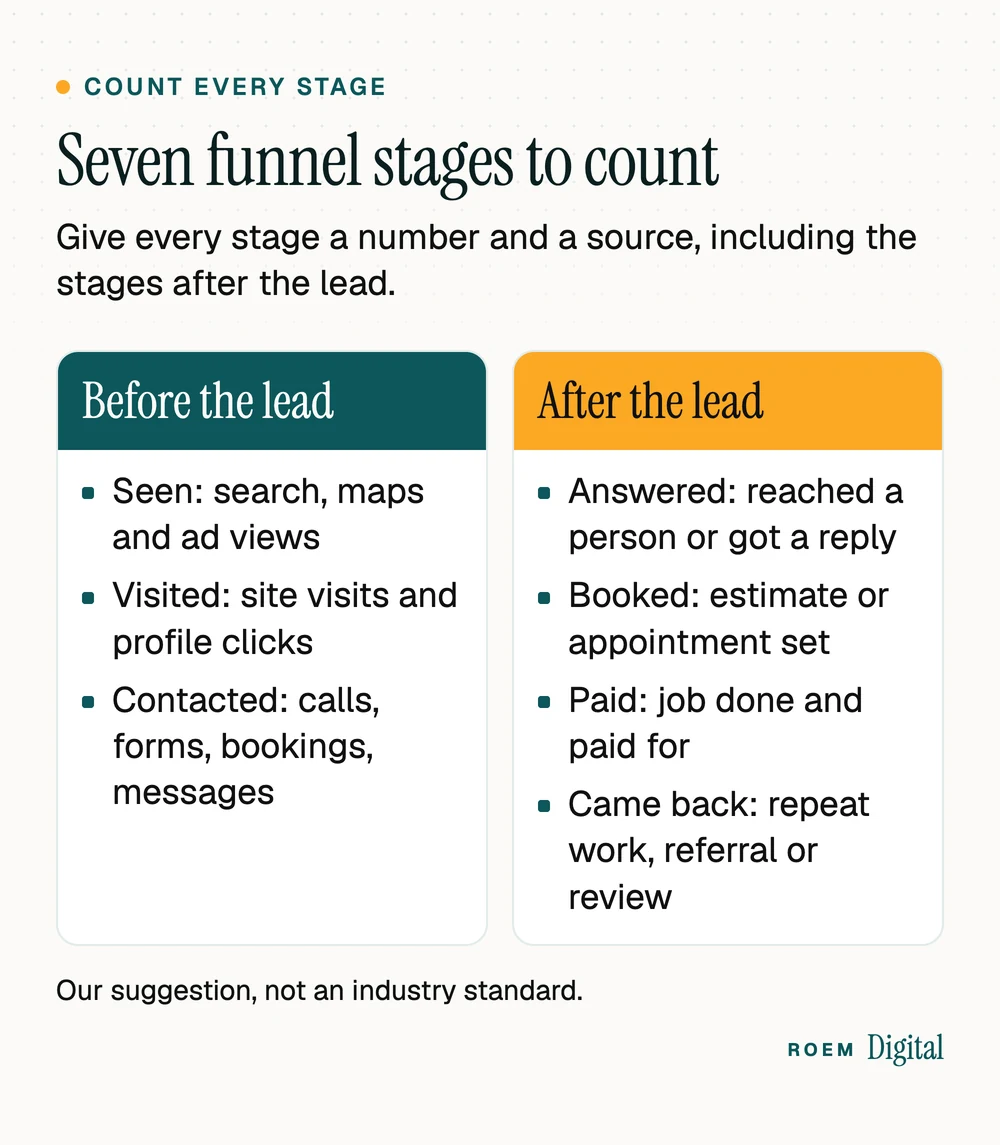
You won't have every number on day one, and that's fine. A blank row is a finding in itself: it tells you which part of the business nobody is watching. Read each source for what it really counts, too. Google's help page says profile views count people who viewed your Business Profile on Search and Maps, not every appearance of your business on Google, and its calls figure counts taps on the call button, not answered calls. Our guide to the five numbers every marketing report should show covers how to report the ones that matter most each month.
How to find the leak: divide each stage by the one before it
Once the counts are in, divide each stage by the stage above it. That gives you a stage rate, and the stage rates tell you more than any total. Here's a made-up month for a home service business, with round numbers chosen only to show the method:
| Stage | Count | Out of the stage before |
|---|---|---|
| Seen | 3,000 | Starting point |
| Visited | 300 | 300 of 3,000 |
| Contacted | 45 | 45 of 300 |
| Answered | 30 | 30 of 45 |
| Booked | 18 | 18 of 30 |
| Paid | 16 | 16 of 18 |
| Came back | 4 | 4 of 16 |
In this example, 15 of 45 people who reached out never reached a person. More ads would push more people into the same hole. The cheapest fix is the phone, not the marketing.
Compare each stage rate with your own past months, not with someone else's averages. A rate that drops against last quarter, or against the same season last year, is a leak. A rate that's simply lower than a number you read online may be normal for your service. Our post on website conversion rate applies the same own-baseline approach to the visited-to-contacted step.
Four counting rules that keep the marketing funnel honest
- Count people, not events. One customer who calls three times is one contact. Ten form submissions from a spam bot are zero.
- Follow each lead, not just each month. A call in March often becomes a job paid in April. Keep a simple lead log (date, source, outcome, value) so a paid job traces back to the month and source it came from.
- Separate new from returning customers. Repeat customers skip the top stages, so mixing them in makes the early stages look better than they are.
- Write down what changed. A new phone system, a price change or a website launch explains a jump better than any chart. Note it beside the month.
Where small business funnels leak after the lead, and why reports miss it
Here's our contrarian view: for many local businesses, the most expensive leaks sit below the contact stage, where ad platforms and website analytics stop looking. The marketing worked. The business didn't follow through.
- Contacted to answered. Missed calls, voicemail boxes that are full, forms that land in an inbox nobody checks. Our guide to speed to lead shows how to route every inquiry to a person fast.
- Answered to booked. Callers who can't get a time, quotes that take a week, no follow-up when someone says they'll think about it. An online booking system closes part of this gap.
- Booked to paid. No-shows and last-minute cancellations. Reminder texts help, as long as they follow the consent rules in our guide to appointment reminder texts.
- Paid to came back. No thank-you, no review request, no reason to return. Our guide to getting more Google reviews covers the ask, and SMS marketing for small businesses covers bringing customers back by text.
You can count the answered stage without new software. For one week, check the missed call log on every business phone each evening and note how many missed callers never got a call back. Do the same for forms: write down when each one arrived and when someone replied. A week of honest tallies usually settles whether the leak is marketing or follow-through.

Measuring the online stages in GA4 and Google Ads
The first three stages can be measured automatically. GA4's funnel exploration lets you define up to 10 steps and see how many users complete each one. It offers open funnels, where users can enter at any step, and closed funnels, where they must start at step one. A "show elapsed time" toggle reports the average time between steps for people who complete them, which shows where customers take longest to move on. Google also notes that users are only counted in the steps they complete in the order you set, and a user can enter the funnel only once in the date range, so keep the steps few and in the order customers really take them.
Those steps only work if the contact events exist. Our guide to tracking calls and form fills in GA4 covers that setup, and UTM parameters keep email, social and print links from landing in the wrong channel.
Google Ads can now carry the funnel past the lead. Its page on qualified and converted leads describes a lead funnel report that shows conversion volumes from interactions to leads, qualified leads and converted leads, using outcomes you import from your CRM or lead system. That's the booked and paid rows of the table above, fed back into the ad account. Our post on return on ad spend covers how to put a value on those outcomes.
Fix one stage at a time: what to try first at each point in the funnel
Work on the stage with the worst drop against your own history, and change one thing at a time so you can tell what helped. A starting point for each stage:
| Leaking stage | First thing to try | Where to read more |
|---|---|---|
| Seen | Complete your Google Business Profile and add a page for each service | Local SEO audit |
| Visited | Fix page titles, descriptions and pages that don't match what people search | SEO audit checklist |
| Contacted | Put the phone button and one main action in the first screen | Landing pages for ads |
| Answered | Route calls and forms to a person, with a backup | Speed to lead |
| Booked | Offer times online and follow up on open quotes | Online booking |
| Paid | Confirm and remind before every appointment | Reminder texts |
| Came back | Ask for a review and give a reason to return | Email marketing |
If you'd rather pick from a list of ideas sorted by stage, our small business marketing ideas post groups them the same way, and our one-page marketing plan turns the fix you choose into a 90-day plan.
Getting outside help to map and measure your funnel
If you'd rather not set up the counts alone, look for help that leaves the tracking and every account in your business's name, so the counts keep coming after the engagement ends. We're a small senior team based in Davenport, Florida, working with businesses across Central Florida and nationwide, and every plan starts with the free audit. Read more about our consulting and strategy service, which includes KPI and analytics setup and monthly strategy reviews.
“Both Robert and Emily were extremely helpful and easy to work with. We had multiple strategy calls regarding a client's new business website direction, all were a breeze.”
Frequently asked questions
What are the stages of a marketing funnel?
Most guides use three: awareness, consideration and the sale. For a local service business, seven countable stages work better: seen, visited, contacted, answered, booked, paid and came back. The last four happen after the lead arrives, which is where many businesses lose customers without noticing it in their marketing reports.
What is the difference between a marketing funnel and a sales funnel?
People use the terms loosely. The marketing funnel usually covers getting noticed and getting the inquiry, and the sales funnel covers turning that inquiry into a paying customer. For a small business with one team doing both, it helps to track them as one path, so a leak in either part shows up.
How do I build a marketing funnel for a small business?
List every step a customer takes from first noticing you to paying and coming back. Next to each step, write the number you can count and where it lives, such as GA4, call tracking, your calendar or invoices. Fill in a month of counts, then divide each stage by the one before it.
How do you measure a marketing funnel?
Count each stage for the same period, then divide each count by the stage above it to get a stage rate. Use GA4's funnel exploration for website steps, call tracking for calls, and your booking tool and invoices for the stages after the lead. Compare stage rates with your own past months.
What is a good conversion rate for each funnel stage?
There isn't a universal one, because services, prices and buying cycles differ. The useful comparison is your own history: the same stage last quarter or the same season last year. A stage rate that falls against your own baseline is a leak worth fixing, whatever an industry average says.
Do local service businesses need a marketing funnel?
They already have one, whether or not it's written down. Every customer gets seen, calls or writes, gets an answer, books, pays and maybe returns. Writing the stages down and counting them shows where customers drop out, which is usually cheaper to fix than buying more traffic.