
Short answer: ROAS, or return on ad spend, is the revenue your ads produced divided by what those ads cost. A good ROAS is any number above your break-even point, which is 1 divided by your margin. If customers call instead of checking out, put a dollar value on each qualified call before you trust the ratio.
What is ROAS, and how do you calculate it?
ROAS, short for return on ad spend, is the revenue your ads brought in divided by what you paid for those ads. Spend $1,000 on ads that produce $4,000 in sales and your return is 4.
Google Ads sets Target ROAS bids as a percentage. Its help page on Target ROAS bidding walks through a shoe store that wants $5 in sales for each $1 of ad spend: $5 divided by $1, times 100%, gives a 500% target. Other tools write that as 5:1 or 5x. They all mean the same thing, so check the format before you compare two reports.
| Format | Example | Where you'll see it |
|---|---|---|
| Ratio | 4:1 | Articles and agency reports |
| Multiple | 4 or 4x | Spreadsheets, and Google's Conv. value / cost column |
| Percentage | 400% | Bid targets in Google Ads, which multiply the ratio by 100 |
Two parts of the formula trip people up. The revenue side only counts sales your tracking connected to the ads, so anything it misses (a phone call nobody tracked, a customer who came back a week later) is invisible. The cost side usually means media spend only. Management fees, creative and landing pages sit outside the ratio unless you add them, the same reason our guide to the five numbers every marketing report should show reports cost per lead both media-only and all-in.
What is a good ROAS? Any number above your break-even line
Search for a good return on ad spend and you'll find confident averages. They come from other businesses with other margins, and none of them knows what a job costs you. A return of 3 can be a healthy profit for one business and a slow loss for another. The only rule that holds for everyone is the break-even line: the point where ads pay for themselves and nothing more.
The U.S. Small Business Administration's break-even calculator defines the break-even point as the point where total cost and total revenue are equal, and contribution margin as the sale price minus the variable cost per unit, divided by the sale price. Apply the same idea to ads. Each dollar of sales leaves you only its margin to pay for the ad that won it, so break-even return on ad spend is 1 divided by your margin.
If 40 cents of every sales dollar is left after materials and labor, you need $2.50 in sales for every $1 of ads just to stand still, because 1 divided by 0.40 is 2.5. Anything above 2.5 is profit. Anything below it loses money, even though the report says the ads returned more than they cost.
| Margin left after direct costs | Break-even ROAS | Sales needed per $1 of ads |
|---|---|---|
| 80% | 1.25 | $1.25 |
| 60% | 1.67 | $1.67 |
| 40% | 2.5 | $2.50 |
| 25% | 4 | $4.00 |
| 15% | 6.67 | $6.67 |
Set your target above break-even, not at it
A target is break-even plus the profit you want the ads to leave behind. Subtract the share of each sales dollar you want to keep from your margin, then divide 1 by what's left. With a 40% margin and a goal of keeping 15 cents of every sales dollar, 0.40 minus 0.15 leaves 0.25, and 1 divided by 0.25 gives a target of 4. That's where a 400% target in Google Ads should come from: your own books.
If the math says you need a return your ads have never reached, the fix is usually margin, price or close rate, not a bigger budget. Our guide to how much a small business should spend on Google Ads runs the same logic backward to an affordable cost per lead.
Three questions before you trust a ROAS number
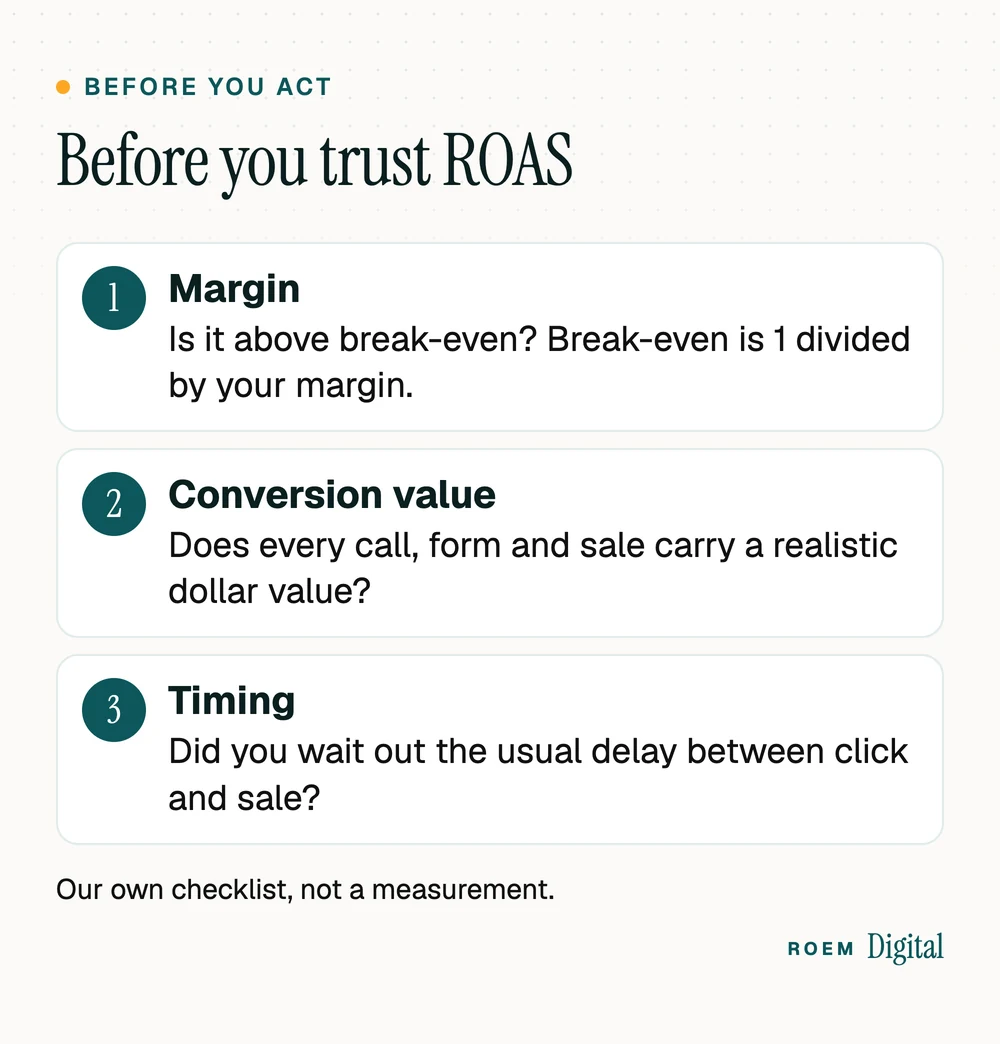
A ratio can be calculated correctly and still mislead you. Run every return figure through three questions before you act on it. They're our own checklist, built on the break-even formula and on how Google Ads says it measures returns.
- Is the number above your break-even line, worked out from your real margin? A ratio with no break-even beside it is a score with no par.
- Does every conversion carry a dollar value that matches reality? Google's guide to conversion values says that if you offer different services at different price points, you should use different values for each conversion, and that without the extra code the default value you enter is used for every conversion.
- Did enough time pass for the sales to land? Google's Target ROAS page advises that the time frame you evaluate should exclude the most recent conversion delay period, because a sale that starts with a click can finish days later.
Most bad calls about ads fail one of these questions. A campaign gets cut for a ratio that was fine for its margin, kept for one inflated by a default value, or judged on a week whose sales hadn't arrived yet. When the value side looks thin, check the page as well as the ad: our guide to website conversion rate shows how to find your baseline.
Return on ad spend when customers call instead of checking out
Online stores get the revenue side almost for free, because the checkout reports each order's value. A plumber or a dental office doesn't. The ad produces a call, the call produces an estimate or a visit, and the money arrives days or weeks later. Google's page about offline conversion imports describes that path: an ad that starts a customer toward a sale finished at your office or over the phone, measured by importing what happened afterward.
Step one: put a working value on each qualified call
Until you can import real sales, give each tracked call or form a value from your own records: average job revenue multiplied by the share of qualified calls that become jobs. If your average job brings in $1,200 and one in four qualified calls books, each qualified call is worth about $300 in revenue. Those are made-up round numbers to show the method. Use revenue here, not profit, because the break-even comparison already handles profit.
Count only calls that could become customers. A wrong number or a sales pitch shouldn't carry $300. Our guide to call tracking for small businesses covers tying each call to the ad that produced it, and our walkthrough of Google Ads conversion tracking covers the setup inside the ad account.

Step two: send the real outcome back to the ad account
A flat value is a stand-in. The better version reports which leads actually became customers. Google Ads uses two goal types for this, according to its page on qualified and converted leads: a qualified lead was further qualified in your CRM or lead system, and a converted lead completed a step you choose, such as a closed sale, typically outside Google Ads. On its offline conversion imports page, Google recommends that businesses new to importing start with enhanced conversions for leads, which it describes as an upgraded offline conversion import.
You don't need expensive software to start. A lead log with the date, source, outcome and job value, kept up every week, is enough to calculate your return by hand and to see which campaigns bring jobs rather than just calls.
ROAS vs ROI, cost per lead and CPA: which number answers which question
Return on ad spend is one ratio among several, and each answers a different question. Mixing them up is how a campaign with a healthy-looking return ends up losing money.
| Metric | How to calculate it | The question it answers |
|---|---|---|
| Return on ad spend | Revenue from ads divided by ad spend | How much revenue did each ad dollar bring in? |
| ROI | Profit from ads after all costs, divided by all costs | Did the whole effort make money once every cost is counted? |
| Cost per lead | Ad spend divided by leads | What does it cost to make the phone ring? |
| Cost per acquisition (CPA) | Ad spend divided by new customers | What does it cost to win a customer? |
| Conversion rate | Conversions divided by visits or clicks | Is the page turning visitors into leads? |
Here's how a strong ratio hides a loss. A campaign returning $3 in sales for every $1 of ads, at a 25% margin, leaves 75 cents of margin per ad dollar. It loses a quarter on every dollar before anyone pays for management or creative.
Use return on ad spend to compare campaigns and set bid targets. Use ROI to decide whether to keep advertising at all, because it's the only one of these that subtracts fees, creative and the cost of doing the work. Cost per lead is the early warning that something broke, and CPA tells you what a customer costs. For a lead business, our guide to lead generation for small businesses shows how paid leads fit beside the ones you own and earn.
Where return on ad spend misleads: brand searches, past visitors and thin data
Some campaigns post high returns because they reach people who were going to buy anyway, or because there's too little data to mean anything. Watch for these before you move budget:
- Searches for your business name. People typing your name already chose you. A brand campaign can protect that click, but its return says little about winning new customers, so report it apart from everything else.
- Past visitors. Ads shown to people who already visited your site often look efficient for the same reason. Our post on retargeting ads covers how to judge them fairly.
- Repeat customers. A first job that barely breaks even can still pay if customers come back. If you count lifetime value, say so in the report and keep a first-sale version beside it.
- Thin data. Google requires at least 15 conversions in the past 30 days before a Search campaign can use Target ROAS bidding, and a handful of sales can swing the ratio wildly in either direction.
- Targets set too high. Google's own guidance warns that a target that's too high may limit how much traffic your ads get. Raise a target in steps and watch volume as well as the ratio.
If you want the bigger picture of where ad money should go first, our marketing budget guide for small businesses splits spending into layers before any campaign gets judged on its own.
Measure return on ad spend before the first dollar is spent
We're a small senior team based in Davenport, Florida, running Google Ads and social ads for businesses across Central Florida and nationwide. Before any ad money is spent, we set up tracking for calls, forms and bookings, because a return figure built on missing calls is a guess. You own the ad accounts and the analytics, so the numbers stay with your business no matter who runs the ads.
A break-even line agreed at the start saves an argument about a ratio six months in. Read more about our paid media and lead generation service, or check who owns your website and ad accounts before you change anything.
Frequently asked questions
How do you calculate ROAS?
Divide the revenue your ads produced by what you spent on those ads. If $2,000 of ads brought in $8,000 in sales, your return on ad spend is 4, which tools also write as 4:1 or 400%. Count only sales your tracking ties to the ads, and use the same date range for both numbers.
What is a good ROAS for a small business?
Any return above your own break-even point. Divide 1 by your margin to find it: a business keeping 40 cents of each sales dollar breaks even at 2.5, while one keeping 20 cents needs 5. Averages from other businesses ignore your costs, so set your target from your own books instead.
What is break-even ROAS?
Break-even return on ad spend is the ratio at which the margin on ad-driven sales covers exactly what the ads cost. Calculate it as 1 divided by your margin after direct costs. Below it, your ads lose money even when they bring in more revenue than they cost.
Is ROAS the same as ROI?
No. Return on ad spend divides revenue by ad spend only. ROI subtracts every cost, including the work itself, management fees and creative, then compares the profit with what you invested. A campaign can return 3 on ad spend and still lose money if your margin is 25%.
How do you measure ROAS if customers call instead of buying online?
Give each qualified call a working value, such as your average job revenue multiplied by the share of calls that book. Then replace that estimate with real outcomes by importing closed sales into Google Ads as converted leads, so the ratio reflects jobs won rather than phones ringing.
Why does Google Ads set ROAS targets as a percentage?
Google Ads sets bid targets as a percentage, so a goal of $5 in sales for each $1 of spend becomes a 500% target. Its Conv. value / cost column shows the same figure as a plain ratio, and Google's help page says to multiply that ratio by 100 to get the percentage.