
Short answer: No single percentage fits every business: the SBA's own blog says there's no hard and fast answer to how much to spend on marketing. Build your small business marketing budget from what a customer is worth, how many more you can serve and what it costs to win one.
How much should a small business spend on marketing? No single percentage
There's no rule that fits every business, and a post on the SBA's own blog says so. How to Get the Most From Your Marketing Budget, written for the SBA's blog by Rieva Lesonsky of GrowBiz Media on July 9, 2019, says there's no hard and fast answer to how much your marketing budget should be. It notes that many businesses use a percentage of revenues as a guide, that a startup can use projected revenues, and that the percentages people spend vary widely.
So when you see one percentage presented as the answer, read it as somebody else's average, not your budget. A better marketing budget for small business owners comes from three numbers you already have: what a new customer is worth to you, how many more customers you can handle, and what it costs to win one. The rest of this guide turns those into a monthly figure, then shows how to split and adjust it. For the full planning process around the budget, see our one-page marketing plan.
Why a percent-of-revenue rule misleads a small business
A percentage of revenue is easy to calculate and easy to defend. It also ignores almost everything that decides whether marketing pays:
- Your margin. The same revenue can leave very different profit behind, and profit is what pays for marketing.
- Your capacity. If you're booked out for weeks, more leads mean more people waiting, not more revenue.
- Your stage. That SBA blog post says you'll need to budget more when you're just starting out, while you build awareness and attract customers.
- How customers find you. A business that lives on referrals and one that lives on search need different budgets, even at the same revenue.
There's a timing trap too. A budget pegged to revenue shrinks when sales slow, which is exactly when that post warns that cutting marketing can push sales down further. If you want a benchmark anyway, it suggests asking your industry trade association or reading trade publications. Use what you find as a sense check against your own numbers, not as the number. The marketing reports that matter here are covered in the five numbers every marketing report should show.
Build the budget from three numbers you already have
This is the part of your budget that buys new customers. Work it out on paper:
- What one new customer is worth to you, in gross profit, not revenue: the money left after labor and materials on a typical first job. If customers come back, decide whether to count only the first job or a cautious estimate of repeat work.
- How many more customers you can serve each month without hiring or letting quality slip. This caps the budget more often than owners expect.
- The most you'll pay to win one customer. Pick a figure well below what a customer is worth, so marketing leaves profit behind.
- Multiply the customers you want by that cost per customer. That's your monthly budget for winning new customers.
- Check it against what you can afford for a few months without results, because most channels need time before you can judge them.

If paid search is where that money goes, our guide to how much a small business should spend on Google Ads walks through the same math with worked figures, including how to turn cost per lead into a test budget. If you don't yet know your cost per customer, that's normal. Your first budget is an educated guess, and tracking is what turns it into a real number.
If you don't know your numbers yet
A brand-new business has no cost per customer and no history, so the three-number method needs a starting assumption. Use your best estimate of profit per job, the SBA blog post's suggestion to work from projected revenues if you lean on a percentage, and a test you can afford to lose. Then run it like a test:
- Fund the foundation first: a website that works on phones, tracking, and a complete Google Business Profile.
- Pick one engine channel, the one closest to people already looking for what you sell.
- Set an end date and a decision rule before you spend, such as keeping the channel if it wins customers below your target cost by the end date.
After two or three months you'll have real figures, and your small business marketing budget can be rebuilt from them instead of from a guess.
Split the marketing budget into three layers: foundation, engine, tests
Owners often treat the budget as one pot, then judge everything in it the same way. We find it clearer to split it into three layers. This is our editorial framework, not an industry standard, but it stops the most common mistake: cutting the foundation because it doesn't produce leads on its own.
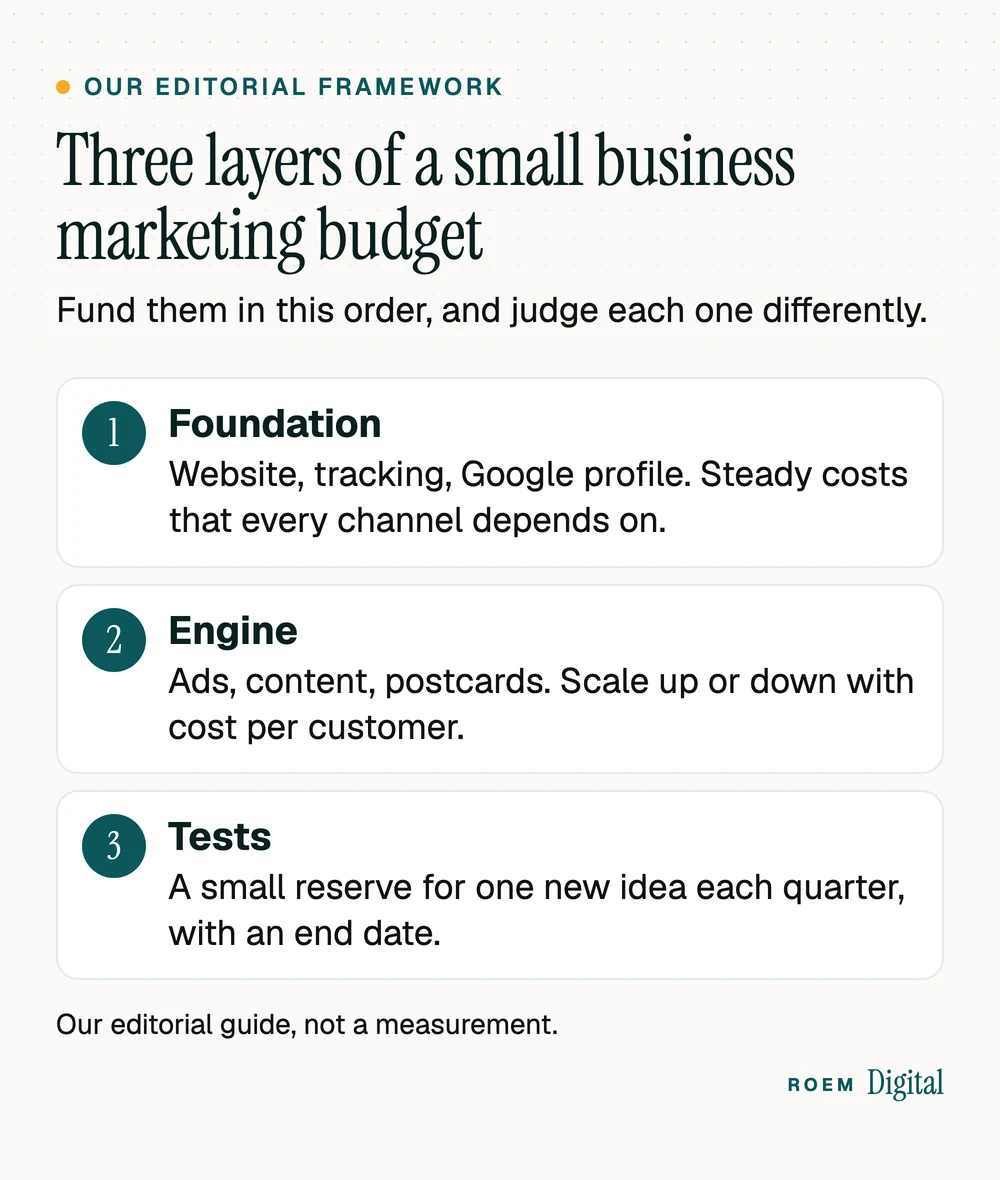
| Layer | What's in it | How to judge it |
|---|---|---|
| Foundation | Website and hosting, domain and email, call and form tracking, your Google Business Profile, a way to ask for reviews | Does it work every day? Fast pages, forms that arrive, calls that get counted |
| Engine | Ad spend, ad management, content and SEO, social media, postcards | Cost per customer against your target, month by month |
| Tests | One new channel or idea at a time, with a set end date | Did it beat the engine's cost per customer by the end date? |
Some foundation pieces cost nothing but time. Google's Business Profile overview says creating a Business Profile and listing your business on Google is free. A website that loads slowly or drops form emails, on the other hand, quietly wastes every dollar in the engine above it. Our guide to small business website costs explains what drives that line.
What goes in a small business marketing budget, line by line
Write every line down, including the ones that don't arrive as a bill. The total is often larger than owners think, and the surprise usually comes from the last row.
| Line item | What to know |
|---|---|
| Website, hosting, domain and email | Steady costs. Check who owns each account before you pay for another year. |
| Tracking | Call tracking and analytics setup. Without it, nothing else in the budget can be judged. |
| Ad spend | Paid to the platform. Google Ads says you won't pay more than 30.4 times your average daily budget in a month for most campaigns. |
| Management and creative | What you pay a person or agency to run ads, write content or design. Count it separately from ad spend. |
| Software | Email, booking, scheduling and review tools. Easy to forget because each one is small. |
| Print, events and sponsorships | Postcards, signs, booths. Give each a way to count responses, such as its own phone number, link or code. |
| Your time and your staff's time | Hours spent posting, replying and filming are a real cost, even when nobody sends an invoice. |
The ad spend row is the one that moves. Google's help page About average daily budgets explains that spend can vary by day, with a daily limit of two times your average daily budget for most campaigns, and gives the monthly formula: divide your monthly amount by 30.4 to get the daily budget. Before you renew anything, confirm your business owns the accounts you're paying for, using our guide to who owns your website and ad accounts.
When to raise, hold or cut your marketing budget
Once you've tracked a few months, the budget stops being a guess. Review it monthly. The SBA's marketing plan guide recommends comparing your marketing and sales costs to the revenue they generate, so you can see whether you're getting a positive return, and cost per customer is the clearest way to run that comparison.
| Layer | What the numbers show | Do this |
|---|---|---|
| Foundation | Forms not arriving, calls not counted, pages slow on phones | Fix it before you change anything in the engine |
| Engine | Cost per customer under target, with room for more work | Raise it in steps and recheck next month |
| Engine | Cost per customer well over target after a fair test | Cut that line and keep the foundation |
| Tests | The end date has arrived | Keep it only if it beat the engine's cost per customer, otherwise end it |
| Whole budget | Sales slowing across the board | Check tracking and the foundation before cutting the engine |
For a single Google Ads campaign, our Google Ads budget guide covers when to raise or hold. Across the whole budget, cut what doesn't work, not everything at once. The same SBA blog post makes the point from the other side: when sales slow, it might be the right time to increase marketing, particularly in a slow economy when other businesses are cutting back. Our list of small business marketing ideas includes plenty that cost time instead of cash if you need to hold spend steady.
Budget for your seasons, not twelve equal months
Your marketing budget rarely needs to be flat. If demand rises in spring or before the holidays, move engine money into the weeks just before the rush, when people start searching, and trim it when you're booked solid. Central Florida owners can line those weeks up with tourism peaks and school breaks using our guide to Central Florida's busy and slow seasons. Keep the foundation steady all year, because it's what your customers find whenever they look.
How we help set a marketing budget, without a price list
We don't publish prices, because a budget depends on the numbers above, not on a menu. Every plan with us starts with the free audit, and the quote comes after. Our small senior team tracks calls, forms and bookings before any ad spend starts, and your business owns its domain, website, ad accounts and analytics, so you can see what each line of the budget brings in and the history stays with you.
If you'd like a senior second opinion on your numbers, our marketing consulting covers marketing strategy, KPI and analytics setup, and monthly reviews.
Frequently asked questions
What percentage of revenue should a small business spend on marketing?
No single percentage fits every business. A 2019 post on the SBA's blog says there's no hard and fast answer, notes that many businesses use a percentage of revenues as a guide, and says the range is wide. Build the figure from what a customer is worth, your capacity and your cost per customer instead.
How much should a new small business spend on marketing?
Usually more, relative to sales, than an established one. A 2019 post on the SBA's blog says new businesses need to budget more while they build awareness and attract customers, and suggests using projected revenues if you work from a percentage. Keep the first months small enough to test, and track every call and form from day one.
Should I cut my marketing budget when sales slow down?
Not across the board. Check your tracking and your website first, then cut the specific lines whose cost per customer is well over target. A 2019 post on the SBA's blog warns that cutting marketing when sales drop can push sales down further, and says a slowdown may be the right time to increase marketing.
What should a small business marketing budget include?
Website, hosting, domain and email, call and form tracking, ad spend, management and creative fees, software such as email and booking tools, print and events, and the time you and your staff spend on marketing. Listing every line, including unbilled time, shows what each customer really costs.
Is a Google Business Profile part of the marketing budget?
It belongs in the foundation layer, but it costs time rather than money. Google says creating a Business Profile and listing your business on Google is free. Budget the hours to complete it, post on it and reply to reviews, because those hours are what make it work.
How do I know if my marketing budget is working?
Compare what each channel costs with the customers and revenue it brings in, every month. That needs call and form tracking plus a simple log of which leads became customers. If cost per customer stays under your target and you have room for more work, the budget is working.