
Short answer: The small business marketing ideas that work are the ones aimed at your biggest leak: not being found, not being chosen, missing the call, or never hearing from a customer again. Start with free fixes on Google and your website, ask every customer for a review, answer fast, and track what each idea brings in.
Which small business marketing ideas work? The ones aimed at your leak
Most lists of small business marketing ideas hand you 30 tactics in no particular order. The order is the part that matters. Every customer passes through four stages: they find you, they choose you over the business listed next to you, they reach you, and later they remember you. A business losing people at one stage won't fix it with ideas aimed at another.
More ads won't help if the phone goes to voicemail. A better Instagram feed won't help if nobody can find you on Google Maps. So we sort ideas by the leak they fix, and we call it the leak order: fix the stage where most people drop out first, then move to the next. It's our editorial framework, not a law of marketing, but it keeps a small budget out of the wrong stage.
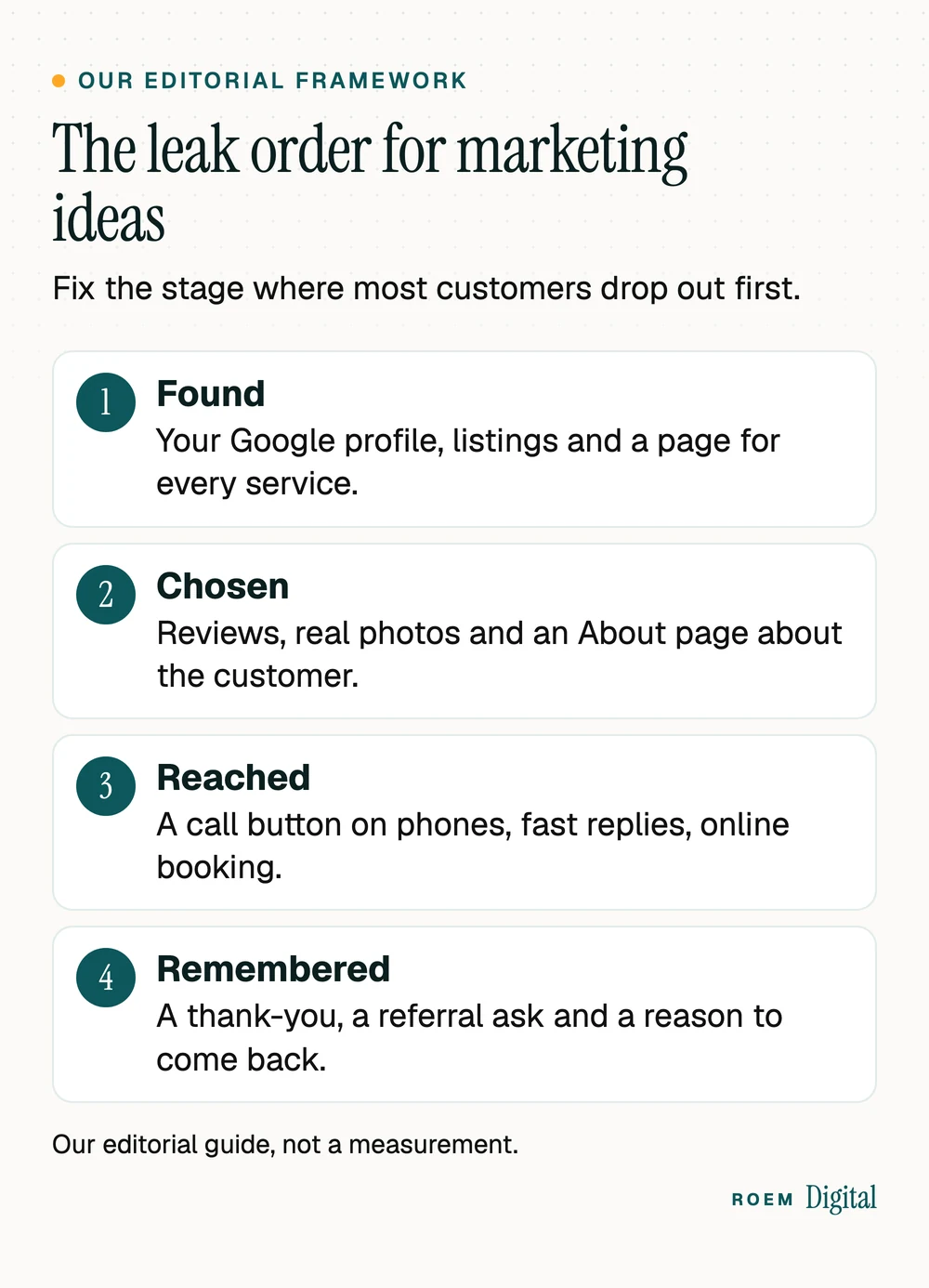
Most ideas below link to a deeper guide, so you can go from idea to how-to in one click. Most cost time rather than cash, which makes them good cheap marketing ideas for a business watching every dollar. If you'd rather start from a written plan, read how to write a marketing plan for a small business alongside this list.
Find your leak in two minutes before you pick an idea
Before you pick from any list of marketing ideas for small business owners, look back at the last month and match what you see to the table. If you can't tell where any customer came from, your first idea is tracking, because everything else is a guess until you have it.
| What you notice | Where the leak is | Start with |
|---|---|---|
| Few calls and few website visits, even in your busy season | Found | Your Google Business Profile and a page for each service |
| Plenty of profile views and visits, but few calls or forms | Chosen | Reviews, real photos and a clearer About page |
| People say they called or wrote and never heard back | Reached | Faster replies and a phone someone answers |
| New customers come once, then never return or refer anyone | Remembered | A thank-you, a review ask and a reason to come back |
| You can't say where any customer came from | Unknown | Call and form tracking before anything else |
Our guide to the five numbers every marketing report should show explains how to count leads by source, so this table stops being a hunch the second time you use it.
Get found: free marketing ideas for Google and your website
Google's guide to improving your local ranking says local results are mainly based on relevance, distance and how well known a business is, which it calls prominence, and that prominence draws on information like how many websites link to you and how many reviews you have. You can't move closer to every customer. You can work on the rest this week:
- Finish your Google Business Profile. Categories, services, service area, hours, photos and a plain description. Our Google Business Profile checklist walks through every field.
- Post on the profile every week or two: a finished job, an offer, an event. Our guide to Google Business Profile posts has ideas when you run dry.
- Fix your listings everywhere else. Your name, phone and website should match on the few directories that matter, as our guide to business listings and citations explains.
- Give every service its own page, written the way customers search for it. If you work at customers' homes instead of a storefront, read local SEO for service-area businesses.
- Answer the questions you hear on the phone on your website, one plain answer per question. It's the same groundwork that showing up in AI search depends on.
“Moving to a new city and rebuilding your business isn’t an easy task, so we turned to Robert to help with our business website, run our social media and help get our Google biz profile back up and running! He was extremely thorough and even came on a job site to take photos for our website. What he built in a short amount of time is amazing. We would absolutely NOT have been able to do any of this without him. We would highly recommend for any website building and project management!!”
Get chosen: proof that costs time, not money
Once someone finds you, they compare you with the two or three results beside you. These ideas give them a reason to pick you:
- Ask every customer for a Google review, the same way each time, with a link you send once the job is done. Every customer, not only the ones you expect to be happy: Google's policy on fake engagement says merchants may not selectively solicit positive reviews, or offer incentives such as discounts in exchange for a review. The same policy says you shouldn't require or pressure customers to write a review while they're on your premises, so send the link and let them write it later. Our guide to getting more Google reviews has wording you can copy.
- Reply to every review, good and bad. Google's ranking guide notes that replying shows you value the feedback, and a calm reply to a one-star review is read by future customers comparing you with the business next door. See how to respond to negative reviews.
- Swap stock photos for real ones: your team, your vehicles, your finished work. Real photos are one of the 12 things every service business website needs.
- Rewrite your About page around the customer: who you help, where, and why you. Our roundup of About page examples shows what that looks like on real sites.
- Put your proof next to the button: licenses, insurance, the areas you serve and a review or two, where people decide whether to call.
Get the call: make reaching you the easy part
This is the cheapest stage to fix and the most expensive to ignore, because every idea above sends people here. If a customer can't reach you in a tap or two, the work you did to get found is wasted.
- Put a call button at the top of every page on phones, plus one clear next step such as a free estimate or a booking.
- Answer fast. A lead who waits until tomorrow may already have called someone else. Our guide to speed to lead covers how to reply quickly without living on your phone.
- Let people book online if your work runs on appointments. Start with our guide to online booking for small businesses.
- Send reminders so booked appointments actually happen. Our appointment reminder text templates are ready to adapt.
- Shorten your forms to what you need for a callback, then measure the change with our guide to website conversion rate.

Be remembered: ideas that bring customers back and send friends
Past customers already trust you, which makes them the cheapest marketing you have. It's easy to stop asking them for anything once the invoice is paid.
- Keep a customer list with names, emails and what each person bought, and send a short email only when you have something useful to say: a seasonal reminder, a new service, an opening in the schedule. Each of those emails is a commercial message, so the FTC's CAN-SPAM compliance guide says it needs a clear way to opt out and your valid physical postal address.
- Ask for referrals out loud. A thank-you text after the job that says you'd be grateful for an introduction to anyone who needs the same work costs nothing.
- Set reminders for repeat work. If customers need you every spring or every six months, put that reminder on your calendar, not theirs.
- Post what you actually do on the one social platform your customers use. Our guide to what to post as a local service business has post ideas, and our explainer on the Instagram algorithm covers what Instagram says about ranking.
Local marketing ideas tied to your street and your calendar
Local marketing ideas work best when they tie you to a real street, a real date or a real neighbor. A few worth putting on the calendar now:
- Small Business Saturday on November 28, 2026. A service business can use the day too, with a booking window or an open house. See our Small Business Saturday ideas.
- A postcard to the streets you already serve. The Postal Service's Every Door Direct Mail delivers to every address on the mail routes you pick, addressed to "Postal Customer", so you don't need a mailing list. The retail version requires at least 200 pieces and allows up to 5,000 a day per ZIP Code.
- Nextdoor, where neighbors ask each other for recommendations. Our guide to Nextdoor for business helps you decide whether it's worth your time.
- A partner business next door. A painter and a flooring installer, a spa and a bridal shop: share a referral card, a joint offer or an event. Our event marketing ideas cover how to fill one.
- Spanish, if your customers search in it. A Spanish page or Google post meets those customers in their language. Start with our guide to building a bilingual website.
- Your slow season. In Central Florida, tourism and school calendars move demand for many businesses, so plan your pushes for the quiet weeks with our guide to Central Florida's busy and slow seasons.
Run three ideas for 30 days, then keep what you can measure
Twenty small business marketing ideas at once is how marketing turns into busywork. Pick three: one aimed at the stage where you leak most, one quick win, and one you can keep doing every week. Give each a start date, a person responsible and one number to watch.
| Idea | Costs you mostly | Number to watch |
|---|---|---|
| Google Business Profile and posts | Time | Calls and website clicks from the profile |
| Review requests and replies | Time | New reviews per month |
| Faster replies and online booking | Time, sometimes software | Leads answered the same day, bookings |
| Postcards to your service area | Printing and postage | Calls and visits from the card's own link or code |
| A small paid ad test | Ad spend | Cost per lead, then cost per customer |
After 30 days, keep what moved its number and drop what didn't. Write the winners into a marketing budget so they survive your busy season. When an idea is ready for real money, our guide to how much to spend on Google Ads shows how to size a first test from your own numbers.
We're a small senior team based in Davenport, Florida, and we track calls, forms and bookings before any ad spend starts, so you can see what each idea brings in. When owners want a second opinion on which three ideas to run first, that's what our marketing consulting is for.
Frequently asked questions
What is the cheapest way to market a small business?
Start with what costs only time: finish your Google Business Profile, ask every customer for a review, reply to reviews, put a call button at the top of your site on phones and answer leads quickly. These fix the most common leaks before you spend anything on ads or printing.
What marketing works best for a local service business?
Usually your Google Business Profile, reviews and a website with a page for each service, because that is where local customers compare options. Then make it easy to call or book. Paid ads come later, once you can track which calls and forms each channel brings in.
How many marketing ideas should a small business try at once?
Three is plenty for most owners: one aimed at your biggest leak, one quick win and one habit you can keep every week. Give each a start date, a person responsible and one number to watch, then keep what moved after 30 days.
Can I give customers a discount for leaving a Google review?
No. Google's fake engagement policy says merchants may not offer incentives such as payment, discounts or free services in exchange for a review, and may not selectively ask only happy customers. Ask every customer the same way once the job is done, and send the link so nobody feels pressured on the spot.
How do I know if a marketing idea worked?
Pick one number before you start, such as calls, form fills, bookings or new reviews, and write down where it stands today. Track calls and forms by source so you can see where each lead came from. After 30 days, compare against your starting point and the same weeks last year.
Should a small business start with social media or Google?
For most local service businesses, Google comes first, because people searching for a service are closer to calling than people scrolling a feed. Social media still matters as proof that you are active and real. Post on the one platform your customers use rather than spreading thin.