
Short answer: To respond to a negative review, read it twice, check your records, then reply once, briefly and calmly, for the next customer who reads it. Keep private details out and offer a direct line. Report the review only if it breaks Google's rules, and never pay, pressure or threaten anyone to take it down.
How to respond to negative reviews: the short answer
Here's how to respond to negative reviews in one paragraph: wait until you're calm, check what actually happened, then post one short, polite public reply that acknowledges the problem, keeps private details out and gives the reviewer a direct way to reach you. After that, fix whatever caused it.
That matches Google's own advice. Its tips for review replies ask owners to protect privacy and avoid personal attacks, be honest about limitations, apologize when appropriate, personalize the reply and respond promptly. It also says a mix of positive and negative feedback often feels more trustworthy, so one bad review isn't the disaster it feels like at 10 p.m.
Our guide to getting more Google reviews covers asking for reviews and a basic reply outline. This post covers the harder part: deciding what kind of review you're dealing with, what to say, and what you must never do.
Read, route, reply, repair: four steps for a one-star review
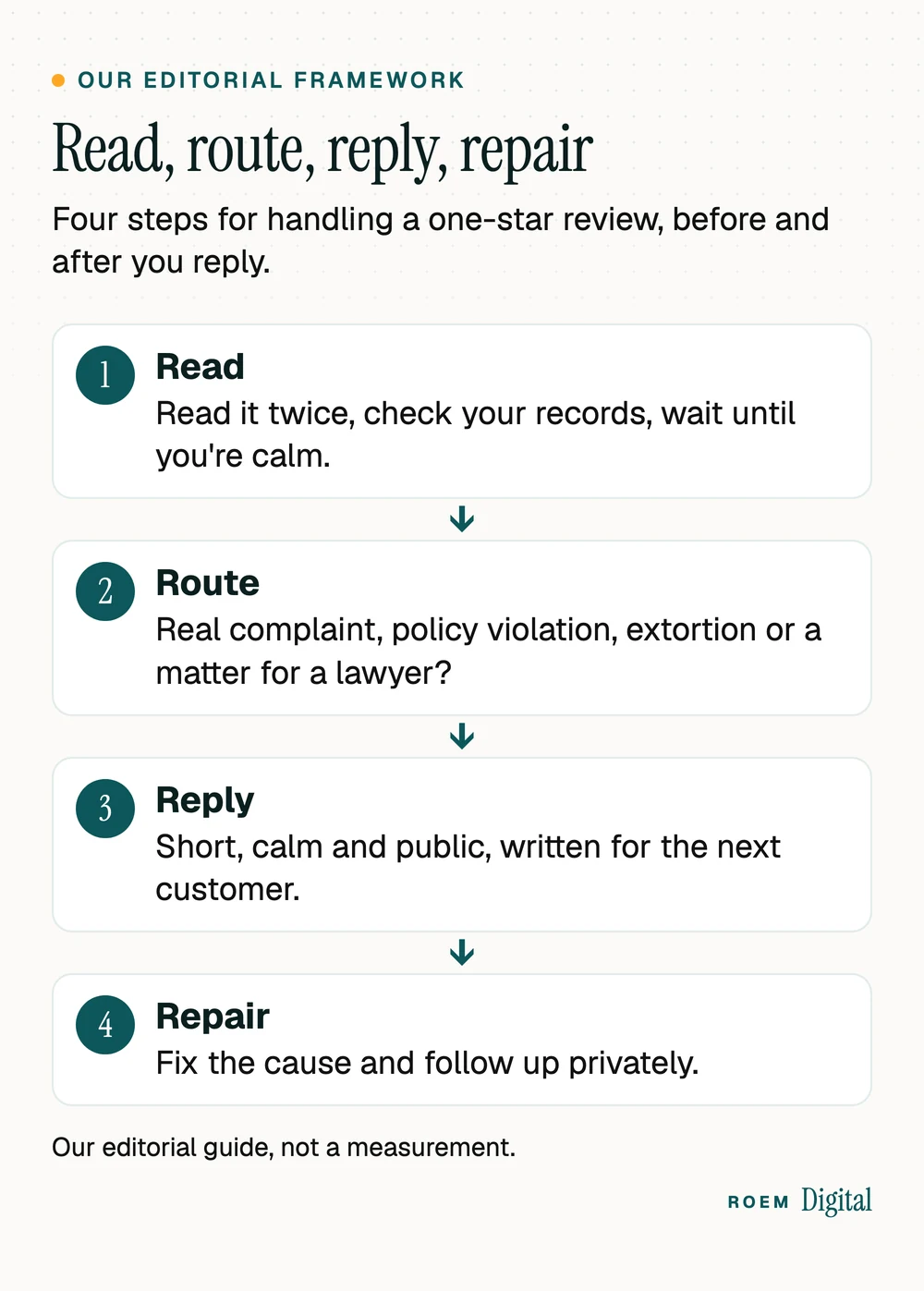
Most advice on how to respond to negative reviews jumps straight to the reply. The reply is step three. We use a four-step sequence, our editorial framework, because the right move depends on what kind of review it is:
- Read. Read it twice. Pull up the job, the invoice, the call log or the booking. Write down what's true, what's wrong and what you can't tell. Don't reply angry.
- Route. Decide which of four things it is: a real complaint (reply), a review that breaks Google's policies (report it, and still reply calmly if it stays up), an extortion attempt (report it to Google and don't pay), or something serious enough for a lawyer (talk to one before you post anything).
- Reply. One short public answer, written for the next customer reading, not to win the argument.
- Repair. Fix the cause, then follow up privately. The FTC's questions and answers on its consumer review rule confirms the rule doesn't stop a business from contacting customers who post negative reviews to resolve the issue.
Repair is the step that can change the review itself. Google notes that a reviewer is notified when you reply and can still change the review afterward. And if the same complaint keeps showing up, the problem lives in how the business runs, not in the review section. That's the kind of fix our consulting and strategy work looks at.
Negative review response examples you can adapt
Use these as starting points, not copy and paste. Change the details so each one sounds like you and fits what happened. Google's tips suggest skipping identical replies in favor of specific, helpful ones.
| Situation | Example reply |
|---|---|
| You arrived late or missed the window | Hi Sam, you're right that we arrived well after the window we gave you, and I'm sorry. We've changed how we confirm arrival times. I'd like to make it right, so please call me directly at the office. [Your name], owner |
| The price surprised them | Thanks for the feedback, Jordan. I can see the final total still caught you off guard, and I'd like to walk you through it and hear what would have made the quote clearer. Please call or email me directly. [Your name] |
| The work didn't hold up | Lee, I'm sorry the trim isn't holding up. That's not the standard we hold ourselves to. Please call the office so we can come back and look at it. [Your name] |
| You can't find them in your records | We take every review seriously, and we can't find a visit or job under this name. If we've missed something, please contact us directly so we can look into it. [Your name] |
| Partly true, partly not | Thanks, Alex. You're right that we were slow to return your first call, and we've fixed that. Some details here don't match our records, so I'd rather sort them out with you directly. Please call me. [Your name] |
| A health, legal or other confidential practice | Thank you for sharing this. We don't discuss any individual's care or matter in public, but we take every concern seriously. Please call our office manager so we can talk. [Practice name] |
Keep yours about that length. Google's tips say that if a reply is too long, people might stop reading before they get to the main point. If the review is written in Spanish, answer in Spanish so the reviewer and the next reader can follow. Serving customers in English and Spanish under one plan is what our bilingual marketing is built for.
Notice what none of them do: argue the facts, promise a refund in exchange for an edit, or mention a discount. Google's reply tips ask owners to be conversational, not promotional. Reviews on Facebook and other platforms deserve the same care, and replying to comments and reviews is part of the community management in our social media management.
How to reply to a bad Google review without making it worse
Responding to bad reviews is public writing: the reviewer is notified, and every future customer can read it. A calm reply can take the sting out of a one-star review. A bad reply can turn it into the thing people remember. These are the lines not to cross, each backed by Google or the FTC:
- Don't share private information. Google's tips say never share a reviewer's private information. Leave out anything from your records: their address, their invoice, their history with you.
- Don't offer anything to change or remove a review. Google says incentives such as free or discounted goods or services in exchange for posting, changing or removing reviews are strictly prohibited. The FTC adds that offering incentives to take down negative reviews could be an unfair practice under the FTC Act.
- Don't threaten or accuse. The FTC says you can respond publicly, but its rule prohibits a false accusation about the reviewer made knowingly or with reckless disregard for the truth, and physical threats or intimidation to get a review changed. Legal action is only on the table with a legitimate basis, never as an unfounded or groundless legal threat.
- Don't try to ban reviews by contract. The FTC's guide to the Consumer Review Fairness Act explains that the law protects people's ability to share honest opinions about a business, including through limits on contract terms that impose a penalty or fee on someone who gives a review.
- Don't drown it in fake praise. Fake positive reviews break Google's policies and invite restrictions on your profile.

Two practical details. Google reviews owner replies before they post: its help page on managing reviews says replies usually take up to 10 minutes to review, but sometimes up to 30 days. And if you draft replies with an AI tool, read and edit every one before it goes up. Our guide to AI for small business marketing covers where those tools help and where they don't.
When a review breaks Google's rules: report it, then appeal once
Google removes reviews that violate its policies, not reviews that are simply negative. Its page on reporting reviews says not to report a review just because you disagree with it, and that Google doesn't get involved in conflicts between businesses and customers. Its Maps content policy does prohibit fake engagement and reviews based on a conflict of interest, such as current or former employment or competitors.
- Open your Business Profile and select Read reviews.
- Next to the review, select Report and choose the reason, such as Spam.
- Check the status in Google's Reviews Management Tool. Google says evaluation typically takes several days.
- If the result is no policy violation and you disagree, submit the one-time appeal from the same tool.
Extortion is different. Google's page on negative review extortion scams describes a sudden burst of 1-star and 2-star reviews followed by a demand for money, goods or services to remove them. Its advice: don't engage or pay, gather evidence immediately, and use its merchant extortion report form. If a review problem turns into a restriction on the whole profile, our guide to a suspended Google Business Profile explains what to do next.
Medical, legal and other confidential businesses: say less
Some businesses can't tell their side of the story in public, even when the review is wrong. Health care providers have patient privacy duties under HIPAA, and lawyers have confidentiality duties under their bar's rules. In both cases, even confirming that the reviewer is a patient or client can reveal more than you mean to.
For Florida lawyers, The Florida Bar has addressed this directly. Its News reported in October 2020 that Proposed Advisory Opinion 20-1, which the Bar's 2021 notice calls Florida Ethics Opinion 20-1, concluded a response to a former client's online criticism has to be general, such as saying the lawyer disagrees with the comments, and can't reveal confidential information without the client's consent, even information in the public record. A later proposed opinion on reviews from non-clients, 21-1, notes that advisory ethics opinions are not binding. It says a lawyer may state, if true, that the poster isn't a client, but when the post comes from someone connected to a real matter, such as opposing counsel or a client's relative, even a general disclaimer can reveal the lawyer's involvement.
The safe pattern for any confidential practice is the last example in the table above: no confirmation, no details, an offer to talk. If you run a practice like this, see how we approach marketing for law firms and med spas.
When to talk to a lawyer or compliance officer instead of replying
This is general marketing information, not legal advice. Most negative reviews need a calm reply and nothing more. Get professional advice before you post when:
- The review accuses you or a staff member of a crime, fraud or a safety failure.
- You believe the review is false and damaging, and you're considering legal action. Talk to an attorney first, since the FTC rule bars unfounded legal threats.
- Someone demands money or services to remove reviews. Report it to Google, keep the evidence, and consider law enforcement.
- You're a health care provider and the reply would touch on anyone's care. Ask your compliance officer or a health care attorney.
- You're a lawyer. Check the Rules Regulating The Florida Bar, or call The Florida Bar's ethics hotline, before you respond.
It also helps to make sure you control the profile itself, so you can reply, report and appeal without waiting on anyone. Our Google Business Profile checklist starts with ownership for that reason.
How ROEM helps with reviews and your Google profile
Reviews are part of the Google Business Profile work inside our SEO and content service. We're a small senior team based in Davenport, Florida, working with businesses across Central Florida and nationwide. When you're deciding how to respond to negative reviews on your own profile, a second opinion helps, but we'd rather help you build a steady, honest flow of new reviews, as described in our guide to getting more Google reviews, than chase any single bad one. You keep ownership of your profile and every account.
Frequently asked questions
Should I respond to every negative review?
Reply to real negative reviews, once and calmly, because future customers read your answers. If a review breaks Google's policies, such as spam or a conflict of interest, report it as well. If a reply would expose private information, keep it to a short, general invitation to contact you directly.
How quickly should I reply to a bad Google review?
Google's tips say a prompt response shows you value feedback, but speed shouldn't beat accuracy. Check your records and wait until you're calm, then reply. Google reviews owner replies before they post, usually within about 10 minutes, though it can take up to 30 days.
Can I get a negative Google review removed?
Only if it violates Google's policies, for example spam, fake engagement, a conflict of interest or offensive content. Report it from your Business Profile, track the result in the Reviews Management Tool, and use the one-time appeal if you disagree. Google won't remove a review just because it's negative.
Can I offer a refund if a customer removes their review?
No. Google says offering incentives such as free or discounted goods or services in exchange for changing or removing a review is strictly prohibited. The FTC says such incentives could be an unfair practice. You can still contact the customer to fix the problem, with no strings attached to the review.
What should I do if someone demands money to remove fake reviews?
Don't engage or pay. Google calls this an extortion scam and asks owners to gather evidence right away, including screenshots of the demands with dates and contact details, and to report it through its merchant extortion report form. Paying doesn't guarantee the reviews come down and can invite more attempts.
Can a doctor or lawyer reply to a negative review?
Yes, carefully. Health care providers have patient privacy duties and lawyers have confidentiality rules, so the reply shouldn't confirm the reviewer was a patient or client or mention any details. A short, general reply offering to talk privately is safest. Check with a compliance officer or your bar first.