
Short answer: AI for small business marketing works best as a fast assistant on drafts: post ideas, email outlines, ad variations and summaries of customer questions. A person should check every fact, price and claim before anything goes out, and some jobs never go to AI, such as inventing reviews or testimonials.
What AI is actually good at in small business marketing
AI for small business marketing means using generative AI tools, such as chat assistants, to draft, sort and summarize marketing work faster, while a person decides what gets published. Used that way, it speeds up first drafts without changing who's responsible for the message.
Many owners start with ChatGPT for marketing, and the same habits apply to any assistant. The jobs where AI helps most are the repetitive ones you already understand well enough to judge:
- First drafts of social captions and Google Business Profile posts, which you then rewrite in your own voice. Our guide to social media for a local service business covers what to post in the first place.
- Outlines for emails, newsletters and blog posts, so you start from a structure instead of a blank page.
- Variations of ad headlines and descriptions for the ad platform to test.
- Summaries of your own reviews and the questions customers ask most, sorted into themes you can answer on your website.
- Rewrites of one long piece into shorter ones: a blog post into three posts and an email, for example.
- Plain-English checks on a page you wrote, asking where a customer might get confused.
Notice what's missing from that list: deciding who you serve, what you offer, what you charge and what you promise. Those stay with you.
AI also doesn't know your town. It can't tell which neighborhoods you actually serve, which jobs you turn down or what your customers asked last week. The more of that you feed it, the less generic the draft, and the less time you spend fixing it.
Where AI goes wrong: confident mistakes, a generic voice and private data
AI tools write fluently, and fluency reads as accuracy. It isn't. The federal government's Generative AI Profile from NIST, published in July 2024, lists confabulation among the risks unique to or made worse by generative AI: confidently stated but false content that can mislead the people reading it. In marketing, that looks like a made-up statistic, a service you don't offer, a wrong license detail or a promise you never approved.
The same NIST profile lists data privacy as a risk too, including leakage of personal information. The practical rule for an owner: don't paste customer names, health details or private records into a public AI tool unless you've checked its data settings and your agreement covers it.
The third problem is sameness. Ask a general tool for a post about your service and you get the post every competitor gets. Google doesn't object to AI as such: its guidance on AI-generated content says appropriate use of AI or automation is not against its guidelines, while content generated mainly to manipulate rankings is against its spam policies. The risk for a small business is publishing pages that sound like nobody in particular. We cover that in our post on using AI without publishing slop.
The AI task map: green, yellow and red jobs
Here's the sorting rule we suggest, labeled plainly as our editorial judgment, not a study. Before you hand any marketing job to AI, give it a color. Green jobs are low risk: AI drafts, you edit. Yellow jobs carry facts or customer contact: AI can help, but a person checks every claim. Red jobs stay with people: AI never writes them, and private data never goes into a public tool.
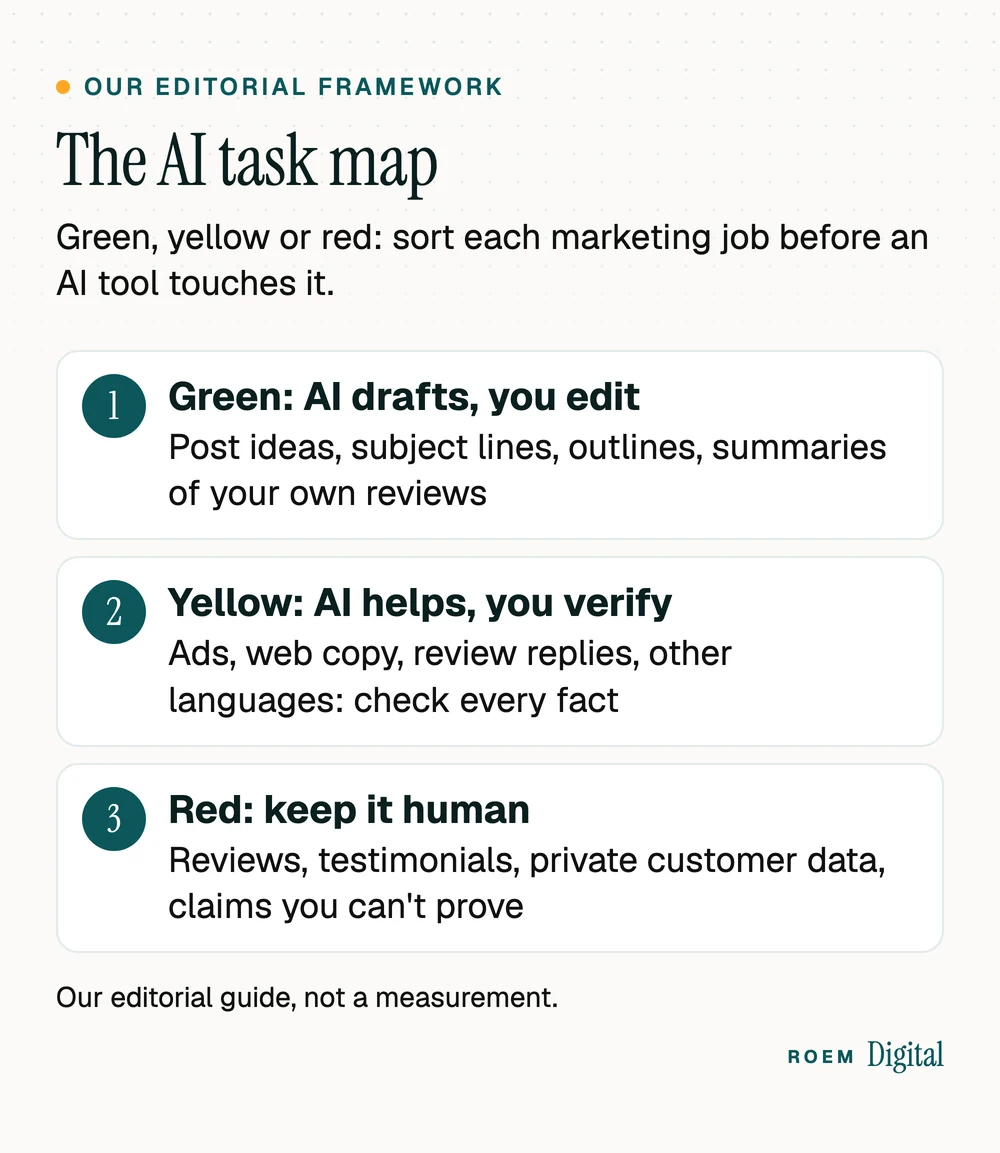
| Marketing job | Lane | Why |
|---|---|---|
| Post ideas, captions and email subject lines | Green | Low risk and easy to edit. You choose what fits and rewrite it in your voice. |
| Summaries of your public reviews and common questions | Green | The input is your own material, and the output is a list for you to act on. |
| Ad headlines and descriptions | Yellow | Every claim in an ad has to be true and provable before it runs. |
| Blog posts and service page copy | Yellow | Drafts can state wrong facts confidently. Check every fact, price and promise. |
| Replies to reviews | Yellow | Drafting help is fine. A person sends it and keeps customer details private. |
| Spanish or other language versions | Yellow | Have someone fluent review it before it goes live. |
| Reviews, testimonials and customer stories | Red | Never generate them. The FTC's rule bans fake reviews and testimonials, such as AI-generated fake reviews. |
| Results, rankings or savings you can't document | Red | The FTC expects proof before an ad runs, not after. |
| Private customer data | Red | Keep it out of public tools unless your agreement covers it. |
Our free AI Marketing Playbook goes further, with copy-ready prompts and a pre-publish check you can run on every draft.
How to use ChatGPT for marketing: a five-step routine
The tool matters less than the routine around it. This one works with any assistant and keeps you in charge:
- Pick one repeated job. Weekly Google Business Profile posts or monthly newsletters are good first candidates. One job done well beats ten done halfway.
- Give it your facts first. Paste your services, service area, hours and a few paragraphs you wrote yourself, so it has your real details and your voice to copy.
- Ask for options, not a final. Three short versions give you something to choose from and make generic phrasing easier to spot.
- Edit for truth and voice. Check every number, price, date and promise against your own records, then read it aloud. Cut anything you wouldn't say to a customer face to face.
- Measure whether it worked. Track calls, forms and bookings, not likes. Our guide to the marketing report numbers that matter shows which ones to watch.
A starter prompt you can adapt
You're helping a small [type of business] in [town] write a Google Business Profile post. Here are our services, our hours and two paragraphs in our own voice: [paste]. Write three versions under 80 words each about [this week's topic]. Use only the facts I gave you. Don't invent prices, statistics, awards or customer quotes. End each version with one clear next step.
The last two instructions do the most work. They won't stop every mistake, so step four still applies, but they cut down the made-up details you'd otherwise have to catch.

If you're thinking about advertising inside AI tools rather than using them to write, that's a separate decision. Our post on ChatGPT ads covers what a local business should know.
What the FTC says about AI-written reviews and marketing claims
Two federal requirements matter most when you use AI for small business marketing. The first is about reviews. On August 14, 2024, the Federal Trade Commission announced a final rule banning fake reviews and testimonials. It covers reviews and testimonials that misrepresent that they're by someone who doesn't exist, such as AI-generated fake reviews, prohibits businesses from creating or selling them, and lets the agency seek civil penalties against knowing violators.
The FTC's questions and answers on the rule add that a business could be liable if it wrote or created fake reviews, and that insiders such as employees who post reviews should clearly disclose their relationship to the business. The honest route is asking real customers, which our guide to getting more Google reviews walks through.
The second is the long-standing truth-in-advertising standard. The FTC's advertising guide for small business says advertising must be truthful and non-deceptive, that advertisers must have evidence to back up their claims, and that the proof has to exist before the ad runs. An AI tool that writes "rated the best in town" or "results in one visit" hasn't checked any of that. You have to.
AI is fine for drafting a reply to a review, as long as a person reads it before it's posted. Our post on how to respond to negative reviews covers what to say and what to leave out. This is general marketing information, not legal advice.
When to talk to a professional before you publish
Most AI-assisted marketing needs nothing more than a careful owner. A few situations deserve a second opinion before anything goes live:
- Health, legal or financial claims. Licensed professions have their own advertising rules on top of the FTC's. Ask an attorney who knows your field, or your licensing board.
- Testimonials, endorsements and influencer posts. Disclosure rules apply, and an attorney can tell you what yours need.
- Customer data in AI tools. If you handle health, student or payment information, check with your compliance lead or attorney before any of it touches an AI tool.
- Strategy. AI writes faster than it thinks. If you're unsure what to say, to whom and where, a senior marketer can settle that before AI writes a word. That's the work behind our marketing consulting.
Where AI fits in a real marketing plan
AI for small business marketing speeds up production. It doesn't replace the plan. You still need to know who your best customers are, which services earn the most, which channels bring them in and how you'll measure it. Our guide to building a marketing plan for a small business covers that groundwork, and AI can help you draft each piece once the decisions are made.
Being found by AI is a different job from using it. When people ask an AI assistant for a recommendation, it leans on clear pages, your Google profile and your reviews. Our guide to showing up in AI search explains how that works.
We're a small senior team based in Davenport, Florida, working with businesses across Central Florida and nationwide by video. Our consulting and strategy service is for owners who want a sharper plan before they spend, and every plan starts with a free audit of your website, Google listing, ads and tracking from the outside, with no logins needed.
Frequently asked questions
How can a small business use AI for marketing?
Start with repeated drafting jobs: social captions, Google Business Profile posts, email outlines, ad variations and summaries of customer questions. Give the tool your real facts and a sample of your writing, ask for options, then edit every draft for accuracy and voice. Keep strategy, pricing and promises in human hands.
Is it okay to use ChatGPT to write marketing content?
Yes, as a drafting assistant. Google says appropriate use of AI isn't against its guidelines. The risks are wrong facts stated confidently, a generic voice that sounds like every competitor, and private data pasted into a public tool. Check every fact and rewrite in your own words before publishing.
Can I use AI to write customer reviews or testimonials?
No. The FTC's rule on fake reviews and testimonials, announced in August 2024, covers reviews by people who don't exist, such as AI-generated fake reviews, and prohibits businesses from creating or selling them. Ask real customers for reviews instead, and never put words in their mouths.
What marketing tasks should I never give to AI?
Never use AI to invent reviews, testimonials or customer stories, to make claims about results you can't document, or to process private customer data in a public tool. Also keep the big decisions human: who you serve, what you offer, what you charge and what you promise.
Do I have to disclose that I used AI in my marketing?
No single answer covers every case. Check the current rules of each platform you post or advertise on, and remember that the FTC expects employees and other insiders who review you to disclose the connection. What applies everywhere is that the content must be true. For your own situation, ask an attorney.
What are the best AI marketing tools for a small business?
The best tool is the one that fits the job you repeat most. A general chat assistant covers most drafting, and many tools you already use, such as email and social schedulers, have AI built in. Pick one job, use one tool for a month, and judge it by calls and bookings.