
Short answer: ChatGPT ads are paid placements in ChatGPT, bought through OpenAI's Ads Manager, which launched as a self-serve beta in May 2026. Google also shows ads inside AI Mode, using existing Search campaigns. For most local businesses, the first move is clean tracking and a clear website, not a new ad budget.
ChatGPT ads in 2026: what happened, and when
ChatGPT ads are paid placements that appear in ChatGPT, kept separate from its answers and labeled as ads. Businesses buy them through OpenAI's Ads Manager, choosing what to pay for, where the ads run and which website actions to measure.
OpenAI built the program in steps through 2026. Every date below comes from OpenAI's own announcements.
| Date | What OpenAI announced |
|---|---|
| January 16, 2026 | Plans to start testing ads in the U.S. for the Free and Go tiers, with principles including answer independence, conversation privacy, and choice and control. |
| February 9, 2026 | Began testing ads in the U.S. for logged-in adults on the Free and Go plans. |
| May 5, 2026 | A beta self-serve Ads Manager for companies of all sizes, plus cost-per-click bidding and expanded measurement tools. OpenAI said it was gradually opening Ads Manager to more businesses. |
| October 21, 2026 | Expansion to 26 more countries, 89 in total, as over 100,000 advertisers had run campaigns. OpenAI says advertisers from local businesses to global brands can now reach people in ChatGPT, and ads appear only on the Free and Go plans. |
OpenAI's February post on testing ads in ChatGPT sets the ground rules: ads are clearly labeled as sponsored, kept visually separate from the answer, and don't influence the answers ChatGPT gives. If you're weighing ChatGPT ads for small business use, that independence matters most: paying for an ad doesn't buy a mention in the answer. During its test, OpenAI also said ads weren't eligible to appear near sensitive or regulated topics like health, mental health or politics, according to its January announcement, so a health practice should check current rules before planning a campaign. For being cited in AI answers without paying, see our guide to AI search optimization.
How advertising on ChatGPT works for a business
OpenAI's developer documentation on bidding and budgets, written for its Ads API, and its companion pages lay out the moving parts. These are the ones a local business needs to understand before spending anything:
| Setting | What OpenAI's docs say | What it means for you |
|---|---|---|
| Campaign goal and billing | Impressions bill per 1,000 impressions, clicks bill per valid click, and conversion campaigns bill per valid click, not per conversion | You can pay only for clicks, but a conversion goal still charges for the click |
| Location | Location targeting covers countries, regions or markets, and its example market is a whole metro area. With none set, a campaign can target all available locations | Pick the market that holds your service area, and expect to reach some people outside it |
| Platforms | The ChatGPT iOS app, the Android app and the web, including mobile web | Most of your audience may be on a phone, so the landing page has to work there |
| Measurement | A Measurement Pixel on your site records conversions that can be attributed to ads in ChatGPT | Without it on your forms and booking pages, you can't tell whether the spend produced leads |
One detail matters for service businesses. The standard conversion events include a lead form or contact request and a booked meeting, demo or consultation, but there's no standard event for a phone call. Anything outside the list needs a custom event, and OpenAI's docs say a custom event can't be the optimization goal for a conversion campaign. If most of your customers call you, measuring results takes more setup than measuring a form.
Budgets work much like other ad platforms. The same docs describe daily or lifetime campaign budgets, a fixed bid you set yourself, or Maximize Results strategies where OpenAI adjusts bids to seek more clicks or conversions from your budget. In OpenAI's Ads API, new campaigns are created paused, so setup can be finished before anything spends.
Ads are reviewed before they run, and the troubleshooting docs list in review, approved and rejected as outcomes. Leave time for review before a seasonal push. Our Paid Media & Lead Gen service covers Google Ads and social ads, with calls, forms and bookings tracked before ad spend starts, which is the groundwork any new platform needs.
Google AI Mode ads: your Search campaigns may already be there
Google's side needs no new account. Its help page on ads in AI-powered experiences in Google Search says existing Search, Shopping and Performance Max campaigns are automatically eligible to serve ads within AI Overviews and AI Mode, labeled Sponsored. You can't target AI Mode alone or opt out of it separately from Search, but negative keywords and brand exclusions still apply.

- Match types matter more. Exact and phrase match keywords are eligible only when the search shows direct commercial intent. Broad match, AI Max for Search and Performance Max can also match the AI response to a longer, exploratory question, which makes a current negative keyword list more important.
- Billing doesn't change. Google says ads in AI Mode use the same auction and cost-per-click or conversion-based bidding as standard Search ads, with no extra charge to take part.
- Your website feeds the context. Some ads show with AI explainers that Google writes from the search, the AI response and public sources including your website. You can't edit them, so keep your site accurate and current.
- Reporting is blended. Results from AI Overviews and AI Mode are included in your normal campaign and search terms reports, in aggregate.
Google first said it was starting to test ads in AI Mode on May 21, 2025, in a Google Marketing Live post. On October 28, 2026, Google announced on its blog that it's scaling ads in AI Mode to ten more countries and launching multiturn ads in the U.S., so ads can appear in follow-up questions too. Google also says queries in AI Mode are, on average, three times longer than traditional searches. Its help page lists the United States among the countries where ads appear within AI Overviews and AI Mode, in English.
For a local business already running Google Ads, three checks cover most of it. Read the search terms report for longer, question-style searches and decide which ones you want. Make sure each service page answers the questions people ask before they hire you, since Google says clear, up-to-date website content helps it surface accurate context in AI explainers. And confirm your conversion tracking works, because the help page recommends Smart Bidding backed by accurate conversion measurement for these placements.
ChatGPT ads vs Google AI Mode ads, side by side
The two programs solve the same problem in different ways. Google folds AI Mode into the Search campaigns you may already run, while OpenAI's program is a separate platform with its own account, pixel and budget.
| Question | ChatGPT ads | Google AI Mode ads |
|---|---|---|
| How you get in | A separate OpenAI Ads Manager account | Existing Search, Shopping and Performance Max campaigns are automatically eligible |
| How you pay | Per 1,000 impressions or per valid click | The same cost-per-click or conversion-based bidding as Search |
| Can you opt out | It's its own platform, so you choose whether to run it | Not separately from Search |
| Location | Countries, regions or metro-area markets | Your normal Google Ads location settings |
| Phone calls | No standard call event, so calls need a custom event | Your existing Google Ads call tracking |
| Where results show | Reporting inside OpenAI's Ads Manager | Blended into your standard campaign reports |
For a business already running Google Ads, the AI Mode change is mostly about match types, negative keywords and the accuracy of your site. Our guide to Google Ads Quality Score covers the landing page side, which matters wherever the ad shows.
Ready, test, wait: a rule for AI ads at a local business
New ad platforms reward the businesses that can measure them. We use a simple rule, our editorial framework rather than a study, to decide whether a local business should spend on advertising on ChatGPT, or lean into AI Mode, yet.
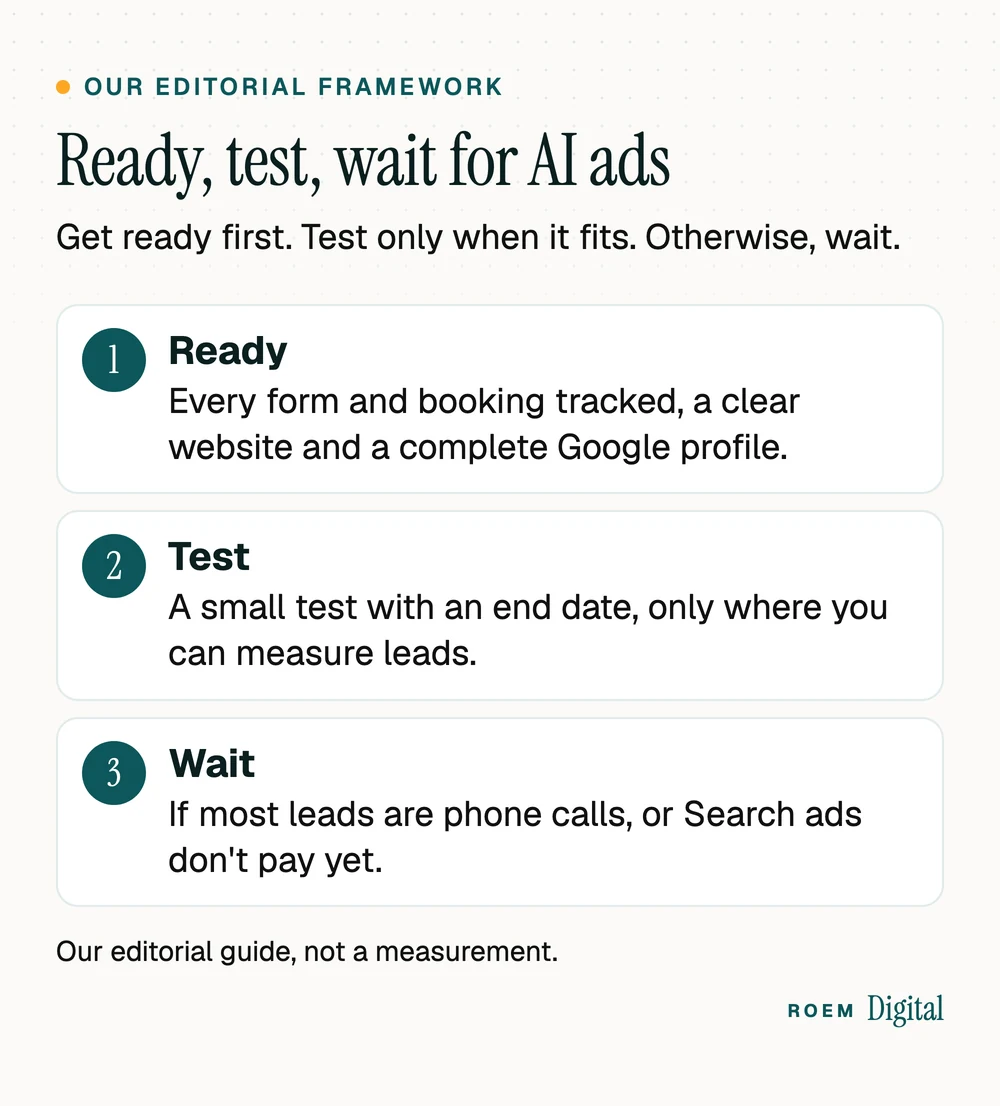
- Ready. Every form and booking is tracked, your website says clearly what you do and where, and your Google Business Profile is complete. Our guide to tracking calls and form fills in GA4 covers the first part.
- Test. If you sell something people research in conversation before buying, and your leads come through forms or bookings you can measure, run a small test with a fixed budget and an end date. Set the location to the smallest market that covers your service area, put the Measurement Pixel on your form and booking pages, and compare cost per lead and booked jobs with your Google Ads at the end.
- Wait. If most of your leads are phone calls, if you can't measure conversions yet, or if your Google Search campaigns don't pay for themselves, hold off. Fix those first.
What not to do with AI ads in 2026
- Don't move budget away from what already works. Test new placements with new money and a deadline.
- Don't pay anyone who says an ad can buy a mention in ChatGPT's or Google's answers. OpenAI describes answer independence, and Google says paid advertising does not influence its organic AI responses.
- Don't open up match types without guardrails. Broad match reaches more AI Mode searches, so keep your negative keyword list current and read the search terms report weekly.
- Don't run OpenAI's ads without the Measurement Pixel on the pages where leads happen. Clicks alone won't tell you whether the test worked.
- Don't leave your website stale. Google can draw on your site for the AI explainers beside your ads, and you can't edit those.
- Health practices: don't add any ad pixel to booking or intake pages until your compliance advisor approves it. Our guide to marketing for therapists explains why. This is general marketing information, not legal advice.
Most of this is the same discipline as any new channel: measure first, spend second. If you're also using AI to write ads and posts, our guide to AI for small business marketing covers where it helps and where it needs a human check.
How we approach a new ad platform
We're a small senior team based in Davenport, Florida, working with businesses across Central Florida and nationwide. Our Paid Media & Lead Gen service starts from your numbers: what a customer is worth and what you can spend to win one. Calls, forms and bookings are tracked before ad spend starts, spend goes up only as campaigns prove they pay off, and you own the ad accounts and analytics.
That's the same test we'd put any AI placement through, on OpenAI or on Google. A new placement earns more budget when it books customers at a cost you're happy with, not because it's new.
Frequently asked questions
Can small businesses advertise on ChatGPT?
Yes, though access is still opening up. OpenAI announced a beta self-serve Ads Manager for companies of all sizes on May 5, 2026, and said it was gradually opening it to more businesses. By October 21, 2026, it said over 100,000 advertisers had run campaigns. Check Ads Manager for your location before you plan a campaign.
How do you pay for ChatGPT ads?
OpenAI's developer documentation lists three campaign goals. Impressions bill per 1,000 impressions, clicks bill per valid click, and conversion campaigns optimize toward a tracked action while still billing per valid click rather than per conversion. You set a daily or lifetime budget for each campaign.
Do I need a new campaign for ads in Google AI Mode?
No. Google says existing Search, Shopping and Performance Max campaigns are automatically eligible to serve ads within AI Overviews and AI Mode. Exact and phrase match keywords only qualify for searches with direct commercial intent, while broad match, AI Max and Performance Max can also match longer, exploratory questions.
Can I opt out of ads in Google AI Mode?
Not separately. Google's help page says you can't target ads only to AI Overviews or AI Mode, or opt out of them separately from Search. You can still use negative keywords and brand exclusions to control when your ads show, and results appear in your normal campaign reports.
Will running ads get my business mentioned in ChatGPT's answers?
No. OpenAI describes answer independence as one of its ground rules for ads, and Google says paid advertising doesn't influence its organic AI responses. Being cited in AI answers depends on your website, your Google Business Profile and what others say about you, which is a separate job from buying ads.
Should a local service business try ChatGPT ads now?
Only once your forms and bookings are tracked and your Google Ads already pay for themselves. ChatGPT ads have no standard phone call event, so call-driven businesses need a custom setup to measure them. If you test, use a fixed budget and an end date, and compare cost per lead with Google.