
Short answer: Google Ads Quality Score is a 1 to 10 rating for each search keyword that compares your expected click rate, ad relevance and landing page experience with other advertisers. Google calls it a diagnostic tool, not an input in the ad auction, so use it to find what to fix rather than chasing a 10.
What Google Ads Quality Score is, and what it isn't
Quality Score is a 1 to 10 rating Google Ads shows for each search keyword. It estimates how relevant and useful your ad and landing page are to people searching that keyword, compared with other advertisers.
Google's own Quality Score help page is blunter than most guides about it. It calls Quality Score a diagnostic tool, says it is not a key performance indicator and should not be optimized or aggregated with the rest of your data, and states that it is not an input in the ad auction.
That doesn't make quality unimportant. The ad quality the score summarizes does feed the auction. Google's Ad Rank definition lists the quality of your ads and landing page among the factors that decide whether your ad shows and where. Its page on ad quality adds that higher quality ads typically cost less per click, and that with low quality ads your actual cost per click may sit close to your maximum bid even when competition is low.
The help page also says some factors related to ad quality might not be captured by the score, including the device used in the search, the searcher's location, the time of day and your assets. The number is a summary, not the full picture.
So treat the Google Ads Quality Score like a dashboard warning light. The light isn't the problem, the thing it points to is. That's how we read it when we manage Google Ads for small businesses.
The three quality score components, in plain English
Google calculates your Google Ads Quality Score from three components. Each gets a status of Above average, Average or Below average, based on a comparison with other advertisers whose ads showed for the exact same search over the last 90 days.
| Component | Google's definition | What usually moves it |
|---|---|---|
| Expected clickthrough rate | The likelihood that your ad will be clicked when shown | Ad text that names the service, the area and a clear next step |
| Ad relevance | How closely your ad matches the intent behind a user's search | Tight ad groups, one service per group, with ads written for that service |
| Landing page experience | How relevant and useful your landing page is to people who click your ad | A page about that exact service that loads fast and works on a phone |
The middle column is Google's wording. The right column is our read of what usually moves each one in a local service account. For the landing page side, our guide to Google Ads landing pages explains why the homepage is rarely the right destination.
Diagnose, don't chase: the Quality Score triage
Most advice about how to improve quality score treats the number as the goal. Google's help center doesn't: its own guide calls the score a general indicator of which areas to focus on, "rather than a score to be optimized." Google's advertiser article does say a better score can help your budget go further, and both hold once you read "improve the score" as improving the ad and page quality behind it. So we use a four-step triage instead. It's our editorial framework, built on Google's own guidance to use the score as a diagnostic.
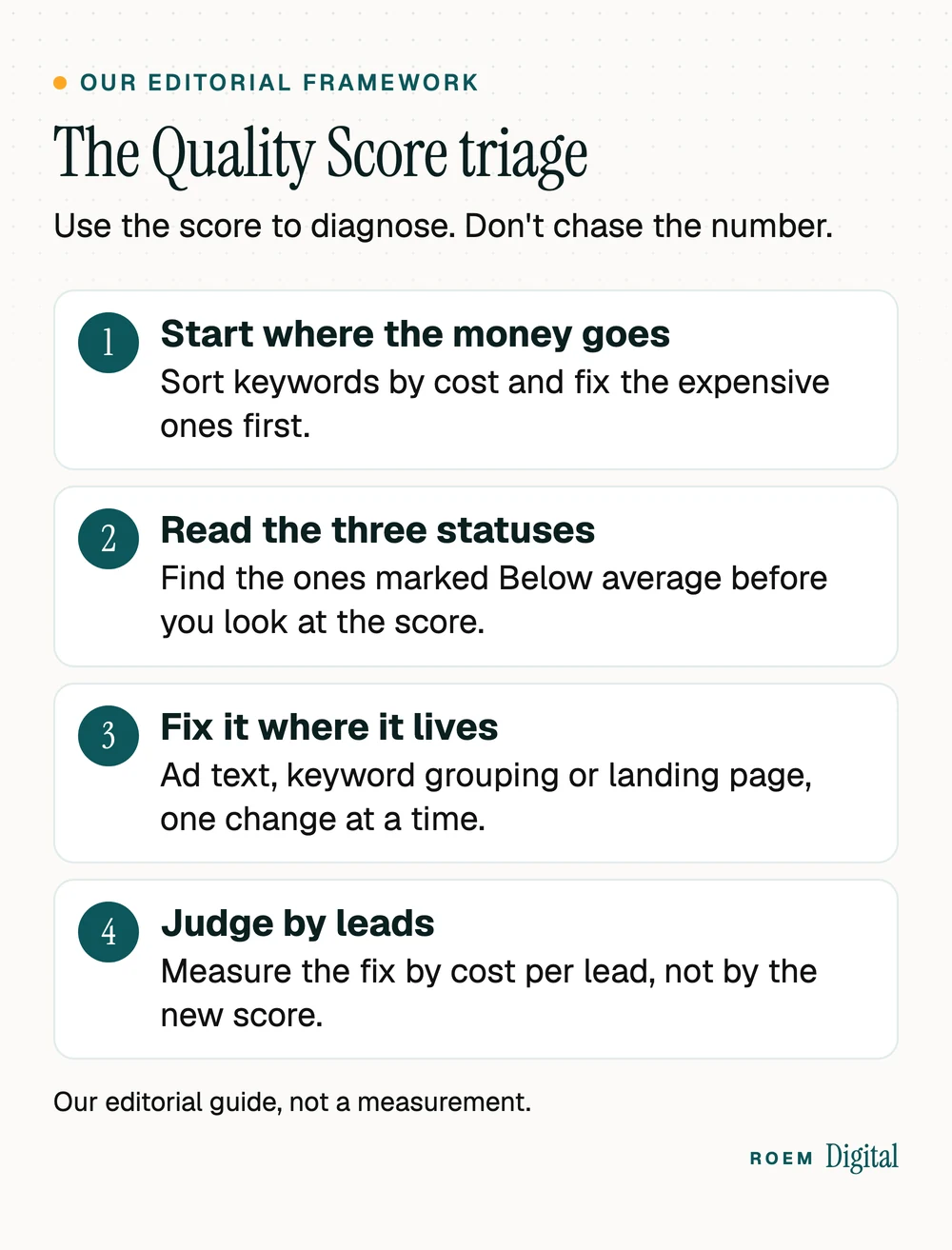
- Start where the money goes. Sort your keywords by cost. A low score on a keyword that spends almost nothing can wait. Before you fix anything, cut the searches you never wanted with negative keywords.
- Read the three statuses. Add the Quality Score, Exp. CTR, Ad Relevance and Landing Page Exp. columns in the Keywords view. Google says Average or Below average may point to an opportunity, so start with Below average, then look at Average.
- Fix it where it lives. Ad relevance points to keyword grouping and ad text. Expected CTR points to the ad itself. Landing page experience points to the page. Change one thing at a time so you can tell what worked.
- Judge by leads. Give the change time to gather impressions, then compare cost per lead before and after. If leads got cheaper, the fix worked, whatever the number says. To see whether the score moved too, add the historical columns, such as Quality Score (hist.), and segment the table by day.
How to improve ad relevance: one service per ad group
Ad relevance drops when one ad has to cover too many different searches. Google's guide to using Quality Score suggests matching your ad text more directly to search terms, splitting ad groups that hold many different keywords, and grouping keywords into themes based on your products or services.
For a local service business that usually means one ad group per service. A plumber might run water heater repair, drain cleaning and leak detection as three groups, each with ads that name that service and a landing page about it. A single group mixing all three forces one ad to speak to every search, and it fits none of them well.
Google also notes that moving an ad group with the same ads and keywords to another campaign or account doesn't change its ad quality. Reshuffling campaigns won't help. Rewriting the ads and regrouping the keywords can. Point each group at the page for that service, as our landing page guide describes.
How to improve expected CTR: write the ad the searcher wanted
Expected clickthrough rate is Google's estimate of how likely people are to click your ad. Google's suggestions for a weak status include making your offer more compelling, making sure the ad's details match the intent of your keywords, highlighting a unique benefit, testing calls to action such as Get a Quote, and being more specific.
- Name the service and the area in the first headline, in the words people search with.
- Say what happens next: a free estimate, a same-day callback or online booking, but only if it's true.
- Give a reason to pick you that a competitor can't copy, such as years in business, a warranty or a specialty.
- Cut generic lines like "quality service" that every ad on the page already says.
Google adds a useful warning: a more specific ad can get fewer clicks but more conversions. That's often a good trade for a small budget, because you stop paying for clicks from people who wanted something else. Assets count as well: the Ad Rank definition includes the expected impact of assets and other ad formats, so add sitelinks to your main service pages and a call asset with your tracked number. And if the ad promises a fast reply, answer fast, as our guide to speed to lead covers.
How to improve landing page experience on a phone
Landing page experience measures how relevant and useful your page is to the people who click. Google's suggestions: give people what they're looking for, keep the message consistent from ad to page, make the site work well on phones and improve loading speed. It also suggests using conversion rate as a proxy for landing page experience, while noting that conversion rate doesn't affect the status itself.

For speed, Google's Core Web Vitals guide on web.dev gives a general benchmark for a good page experience (it isn't a Google Ads metric): Largest Contentful Paint within 2.5 seconds, Interaction to Next Paint of 200 milliseconds or less, and Cumulative Layout Shift of 0.1 or less. One more Google note saves a lot of wasted rewriting: the exact words of a search don't need to appear on your landing page. Deliver what the searcher wanted instead.
Before you judge the status, test the page the way a customer meets it:
- Open the ad's final URL on your own phone, on mobile data rather than office Wi-Fi.
- Check that the service from the ad is named at the top, without scrolling.
- Tap the call button and confirm it dials the right number.
- Submit the form and confirm the lead reaches someone who will answer it.
If plenty of people click but few call, the page is the problem whatever its status says. Our guide to website conversion rate shows how to find where visitors drop off.
Quality score myths that waste a small budget
These myths cost money because they send budget after the number instead of the customer, and a small budget has less room for that, as our guide to Google Ads budgets explains. Every answer below comes from Google's own help pages.
| Myth | What Google says |
|---|---|
| A higher bid raises your Quality Score | Your bid may affect Ad Rank, but it doesn't affect the assessment of your ad quality. |
| Switching match types fixes a low score | Quality Score is based on historical impressions for exact searches of your keyword, so changing match types won't change it. |
| Moving ad groups to a new campaign resets the score | Moving an ad group with the same ads and keywords to another campaign or account doesn't affect ad quality. |
| More conversions raise your ad quality | Reported conversions don't affect ad quality. |
| Every keyword needs a 7 or higher | Google doesn't set a target. It says Quality Score isn't a key performance indicator and shouldn't be optimized. |
| A dash in the column means something is broken | It means there aren't enough searches that exactly match the keyword to score it yet. |
You're more likely to see the dash in a small local account, because fewer searches exactly match each keyword. Google's fix is to find higher-volume keywords in Keyword Planner or broaden match types so the keyword enters more auctions, not to rewrite the ads.
How we use Quality Score when we run Google Ads
We're a small senior team based in Davenport, Florida. Robert handles builds, ads, tracking and optimization, and Emily handles strategy, design and content, so the ads and the landing pages they point to come from the same two people. Our Paid Media & Lead Gen service covers Google Ads, ad creative and landing pages, with calls, forms and bookings tracked before ad spend starts.
That tracking is what makes Google Ads Quality Score useful. The score tells you where to look, and cost per lead tells you whether the fix paid off. You own the ad account and the analytics, so the history stays with your business.
Frequently asked questions
What is a good Quality Score in Google Ads?
Google doesn't name a target. It describes Quality Score as a diagnostic tool, not a key performance indicator, and says it shouldn't be optimized or aggregated. Treat any component marked Below average as the first thing to fix, then any marked Average, and judge the result by your cost per lead rather than by the 1 to 10 number.
Does Quality Score affect cost per click?
The score itself isn't an input in the auction, but the ad quality it summarizes is. Google says higher quality ads typically cost less per click, and that with low quality ads your actual cost per click may sit close to your maximum bid even when competition for the search is low.
How long does it take for Quality Score to change?
There's no fixed timeline. Google compares each component with other advertisers whose ads showed for the exact same search over the last 90 days, so changes appear as new impressions come in. Keywords with few searches can take longer, and some show a dash until there's enough exact-match data.
Why does my keyword show a dash instead of a Quality Score?
Google shows a dash when there aren't enough searches that exactly match your keyword to calculate a score. That's more likely in small local accounts. Google suggests finding higher-volume keywords with Keyword Planner, or broadening match types so the keyword takes part in more auctions and gathers enough data.
Can a landing page change improve Quality Score?
It can move the landing page experience component, which measures how relevant and useful your page is to people who click your ad. Google's suggestions include giving people what they searched for, keeping the message consistent with the ad, making the page work well on phones and improving load speed.
Should I pause keywords with a low Quality Score?
Not automatically. Check what each keyword costs and whether it brings leads first. A low-scoring keyword that books jobs at a good cost is worth fixing, not pausing. One that spends without leads may need pausing, or a closer look at whether it matches a service you actually sell.