
Short answer: Speed to lead is the time between a customer reaching out and your first real reply. Research published in Harvard Business Review found firms that tried to reach leads within an hour were nearly seven times as likely to qualify them as firms that tried even an hour later. For most small businesses, the fix is routing, not hustle.
Speed to lead: how fast is fast enough
Speed to lead is the time between a customer asking for help (a form, a call, a message or a booking request) and your first real reply. A faster reply gets more real conversations with buyers, and the research behind that is older and more specific than most posts admit. It matters most when demand jumps overnight, which is what our post on the IKEA monkey plush sellout is about.
The study most people quote ran in Harvard Business Review in March 2011. The authors audited 2,241 U.S. companies by sending each a web-generated test lead. 37% responded within an hour, 23% never responded at all, and among companies that answered within 30 days, the average response time was 42 hours.
In a separate study of 1.25 million leads, the same authors found that firms that tried to contact a lead within an hour of receiving it were nearly seven times as likely to qualify it (have a meaningful conversation with a key decision maker) as firms that tried even an hour later. Compared with firms that waited 24 hours or longer, the gap was more than 60 times.
You'll see bigger, more precise numbers online, often about the first five minutes. We couldn't trace most of them to a study we could open, so we don't repeat them. The practical bar for a local business is plain: a real reply inside the first hour, every time, including the leads that arrive while you're on a job. If you pay for those leads through Google Ads or social ads, every slow reply wastes money you already spent to win that lead. And if the problem is too few leads rather than slow replies, start with our guide to lead generation for small business.
Slow follow-up is usually a routing problem, not an effort problem
Few owners ignore leads on purpose. Leads go cold because they land somewhere nobody is looking. The HBR authors pointed to a similar habit among the companies they studied: pulling new leads from their systems once a day instead of continuously. A small business does the same thing with an inbox, a voicemail box or an ad account.
| Where the lead arrives | Where it gets stuck | The fix |
|---|---|---|
| Website form | An email to an old address, or a shared inbox nobody checks on weekends | Send every form to an address that alerts a phone someone carries, and test it monthly |
| Phone call | A full voicemail box, or a busy line while you're on another call | Forward to a second phone when busy, and return missed calls before starting new work |
| Google Ads lead form | Inside the ad account. Google's help page says you can only download leads from the last 30 days | Connect the form to your email or CRM so each lead arrives as it comes in |
| Local Services Ads message | An email or text from Google that's easy to miss on a busy day | Pick text alerts to the phone you actually carry |
| Facebook or Instagram lead form | In Meta's ad tools, waiting for someone to look | Connect it to your inbox or CRM before the ad runs |
| Booking request | App notifications switched off on the owner's phone | Turn notifications on for one named person, with a backup |
None of this needs new software first. It needs someone to submit a test lead through every door and watch where it lands. Our guide to tracking calls and form fills in GA4 covers the measuring side, so you can see which channel each lead came from.
The first-hour relay: four handoffs every lead must survive
We think of speed to lead as a relay with four handoffs. A lead can be dropped at any one of them, and each needs a named person. This is our editorial framework, built on the HBR finding that the first hour matters most.
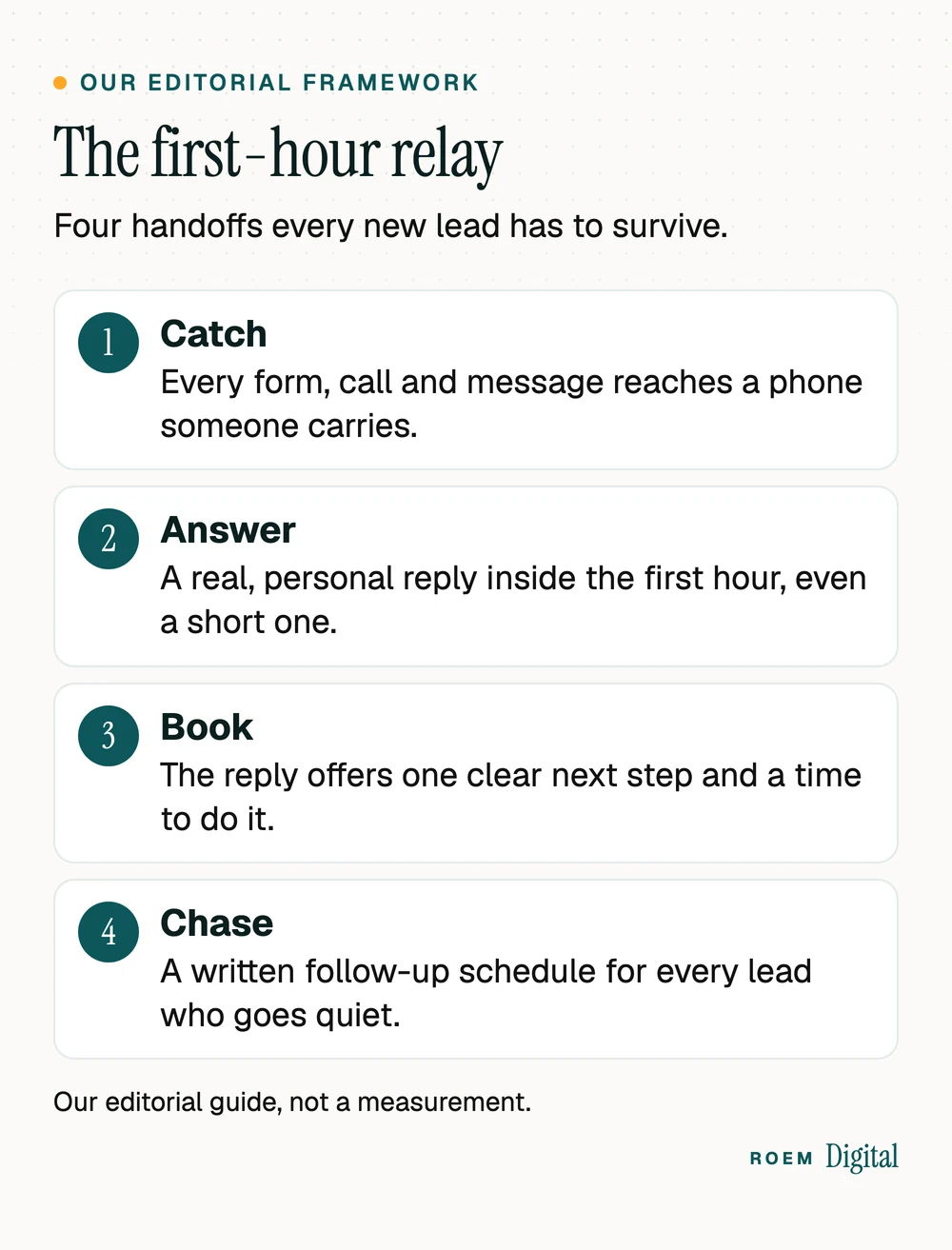
- Catch. Every form, call, message and booking request reaches a phone someone carries. If calls are a big share of your leads, call tracking shows which ones rang out with nobody picking up.
- Answer. A real, personal reply inside the hour. A short holding message counts if it names the person, their request and when you'll call.
- Book. The reply's job is a booked next step: a call, a visit or an estimate at a specific time. Offer two times rather than asking when they're free.
- Chase. Leads who go quiet get a written follow-up schedule, not a single voicemail. The schedule below is a starting point.
Write the name of the person responsible for each handoff. In a two-person business it might be the same name four times, and that's fine as long as everyone knows it, including who covers on days off.
What to say in the first reply when you're on a job
The first reply has one job: show that a person saw the request and offer the next step. It doesn't need a price or a pitch. Here are sample replies to adapt, each short enough to send between jobs.

- When you call: "Hi Maria, this is Dan from the plumbing company. You asked about a leaking water heater a few minutes ago. Is now a good time for two quick questions?"
- When you can't call yet: "Hi Maria, Dan here. Got your request about the water heater. I'm on a job until 3. Can I call you at 3:30, or would tomorrow at 9 work better?"
- When they asked by email: answer the question they asked in the first line, then offer two times to talk or a link to book.
- After hours: a short reply first thing in the morning beats a perfect one at noon. If you take online bookings, include the link (how to add booking to your website).
Use the customer's name and repeat their request in your own words. A reply that could have gone to anyone reads like an autoresponder, and people treat it like one.
How to follow up with leads who don't answer
Plenty of good leads miss your first call. They're at work, driving or putting kids to bed. A follow-up schedule decides how many of them you win back, and it keeps you from giving up after one voicemail.
| When | What to do |
|---|---|
| Within the first hour | Call. If there's no answer, leave a short voicemail and send one message with a specific time you'll try again. |
| Later the same day | Call once more at a different time of day, during daytime hours. |
| Day 2 | Send a short message that answers the question they asked, with two times you can talk. |
| Day 4 or 5 | One more call, mentioning something specific from their request. |
| Around day 10 | A polite close-the-loop note asking whether to keep the request open or close it. |
| After that | Only seasonal check-ins, and only if they agreed to hear from you. |
Stop as soon as someone asks you to, and log every attempt in one place so two people don't chase the same lead. Text only people who gave you their number and asked to be contacted. Texting has its own consent rules, which our appointment reminder text guide walks through. This is general marketing information, not legal advice.
Google Local Services Ads reward fast replies
If you run Local Services Ads, speed to lead affects more than your close rate. Google's ad rankings help page lists your responsiveness to customer inquiries and requests among the factors in how likely your ad is to produce a lead, and says missed calls may negatively affect it. The same page names average response time as part of profile quality.
Google's guide to managing leads recommends responding to leads as soon as they come in, and says a consistently fast response time could improve your ad's ranking. Once you have two or more message leads in the last 90 days, an estimated message response time may appear on your ad, ranging from "a few minutes" to "one day".
So the reply time your customers feel is also the reply time Google may show the next customer. Our comparison of Local Services Ads and Google search ads covers eligibility, bad leads and how to split a budget between the two.
Measure your lead response time once a week
Lead response time is the gap between when a lead arrives and when someone first replies. Measure it for each channel, because a fast phone line can hide a slow inbox.
- Once a month, send yourself a test lead through every door: the website form, a call during and after hours, and any ad lead forms. It's the same test-lead method the HBR researchers used, on a small scale.
- Pull last week's leads and write two times next to each one: when it arrived and when someone first replied.
- Count missed calls that never got a callback. Your phone system or call tracking shows them.
- Count how many leads became a booked call, visit or estimate.
- Fix the slowest door first, then test it again.
If your marketing report shows leads but nobody can say how fast they were answered, the report is missing half the story. It's one of the first gaps we look for in a free marketing audit.
How we track every lead before ads run
We're a small senior team based in Davenport, Florida, working with businesses across Central Florida and nationwide. Our Paid Media & Lead Gen service includes lead follow-up automation alongside Google Ads, social ads, ad creative and landing pages. Calls, forms and bookings are tracked before ad spend starts, and you own your ad accounts and analytics.
That order matters for speed to lead. When tracking shows where each lead came in and when, the slow doors become obvious, and you can fix the slowest one before paying for more clicks.
Frequently asked questions
What is a good speed to lead for a small business?
Aim for a real reply within the first hour, every time. Research published in Harvard Business Review in 2011 found firms that tried to reach a lead within an hour were nearly seven times as likely to qualify it (have a meaningful conversation with a key decision maker) as firms that tried even an hour later.
How do you calculate lead response time?
Take the time a lead arrived, from the form email, call log or ad platform, and compare it with the time someone first replied. Track it for each channel, because a fast phone line can hide a slow inbox, and count the leads that never got a reply at all.
How many times should you follow up with a lead?
There's no magic number. A reasonable pattern is several attempts over about ten days, mixing calls with a text or email, then a polite note asking whether to close the request. Stop as soon as someone asks you to, and only message people who asked to hear from you.
What should I do with leads that come in after hours?
Make sure they reach a phone someone checks, send a short personal reply as early as you can, and offer a specific time to talk. Online booking lets after-hours visitors pick a slot themselves. If you run ads, consider showing them only when someone can answer the phone.
Does response time affect Google Local Services Ads?
Yes, according to Google. Its help center lists responsiveness to customer inquiries as a factor in how likely your ad is to produce a lead, says missed calls may hurt it, and may show your estimated message response time on the ad once you have two or more message leads in 90 days.
Do I need special software to improve speed to lead?
Usually not at first. Most slow replies come from leads landing in the wrong place: an unread inbox, an ad account or a full voicemail box. Route every door to a phone someone carries and test it monthly. Software helps once there are more leads than one or two people can answer.