
Short answer: The IKEA monkey is Punch, a baby macaque at Ichikawa City Zoo in Japan whose orangutan plush from IKEA sold out after his videos went viral in February 2026. The lesson for a small business: have your stock messages, Google hours, phone script and one calm post ready before demand arrives overnight.
The IKEA monkey story: Punch, his orangutan and a sellout
The IKEA monkey is Punch, known in Japan as Panchi-kun, a young Japanese macaque at Ichikawa City Zoo in Chiba Prefecture. He was born in July 2025 and, as the zoo wrote on X, "was rescued from being abandoned and raised through hand-rearing," NBC News reported. His zookeepers gave him an orangutan stuffed toy as a substitute for his mother, and videos of him carrying it everywhere went viral in February 2026.
Fans rallied around the hashtags #GanbarePanchi and #HangInTherePunch. The Japan Times reported on February 24 that some of the most widely shared videos had passed 40 million views across platforms in February alone.
The toy is IKEA's Djungelskog orangutan. In February, The Japan Times reported that IKEA told The New York Times that "since Punch became viral, sales of the toy have spiked in Japan, the U.S. and South Korea." On March 3, CNN reported that it was priced at $19.99 and, when CNN checked IKEA's website, sold out at all but five of the chain's 54 US stores, with resale listings appearing at marked-up prices.
The happiest part of the story is Punch himself. By early March, CNN reported, videos showed him being groomed by and playing with other monkeys as he gradually fit in with his troop, and leaving his toy behind for longer stretches. A little monkey learned to be a monkey, and a lot of people learned what an orangutan plush is called. Unlike the brands in our newsjacking guide, IKEA didn't have to borrow anyone's moment: it was already in the picture.
Two businesses went viral at once, and both kept their heads
It's easy to tell the IKEA monkey story from the global retailer's side. The more useful example for a local business is the small city zoo that suddenly had the world at its gate. Here's what each one did, based on the reporting above:
| What happened | IKEA | Ichikawa City Zoo |
|---|---|---|
| Demand | The orangutan toy sold out in many stores and resale listings appeared | CNN reported roughly 9,600 visitors over one weekend and about 47,000 in February, more than double the year before |
| First response | A statement that it was working to get the toy back in stock as soon as possible | Limits on front-row viewing time, a ban on selfie sticks, a stronger barrier and requests for quiet |
| Tone | IKEA USA posted two plush orangutans hugging: "Sometimes, family is who we find along the way" | Statements on X explaining Punch's behavior and asking fans to support him rather than feel sorry for him |
| Giving back | IKEA Japan's president was donating replacement toys, the city's mayor posted, and IKEA's Malaysia page tied a portion of each sale to orangutan conservation | Regular updates on Punch's progress with his troop |
Notice what the zoo put first: the animal. CNN reported that the viewing limit and the selfie stick ban were there to limit stress on Punch and the other macaques. That's the lesson most viral moments teach a small business too. The attention is lovely, but your job is to protect what made people care in the first place, whether that's your product quality, your staff or your regulars. Running steady, kind social media for a local business is what makes that calm voice possible when the spike comes.
When something you sell goes viral, demand hits five places at once
You don't need a famous macaque for this to happen to you, but the IKEA monkey shows the pattern. A viral product rarely arrives through one door. In the first day or two, the same wave of curious people tends to show up everywhere you exist online and off:
- Your website, where product pages get hit far harder than usual. If the site slows down or breaks, you lose the sale and the goodwill. Our guide on whether a slow website is costing you calls explains how to test it before it matters.
- Google, where people search your name, check your hours and read your reviews before they drive over.
- Your phone and inbox, with the same three questions over and over: do you have it, when will you get more, can you hold one.
- Your social comments and messages, where fans, resellers and the occasional troll all arrive at once.
- Your store and your staff, who absorb lines, repeat questions and the frustration of people who drove out for nothing.
None of these is hard on its own. The trouble is that they all happen in the same two days, usually on a day you didn't plan for. Preparation is the only real fix, and most of it costs nothing.
What not to do in the rush
- Don't raise prices overnight. Customers screenshot everything, and a price jump during a feel-good moment becomes the story.
- Don't promise a restock date you can't confirm. "Soon, and we'll post it first" beats a date you miss.
- Don't argue with resellers or critics in public. Answer once, politely, and get back to the people who want to buy from you.
- Don't turn someone else's story into your ad. If the viral moment belongs to a person, a pet or an animal, keep their image out of your promotions unless you have permission.
The overnight demand kit: what to set up before anything goes viral
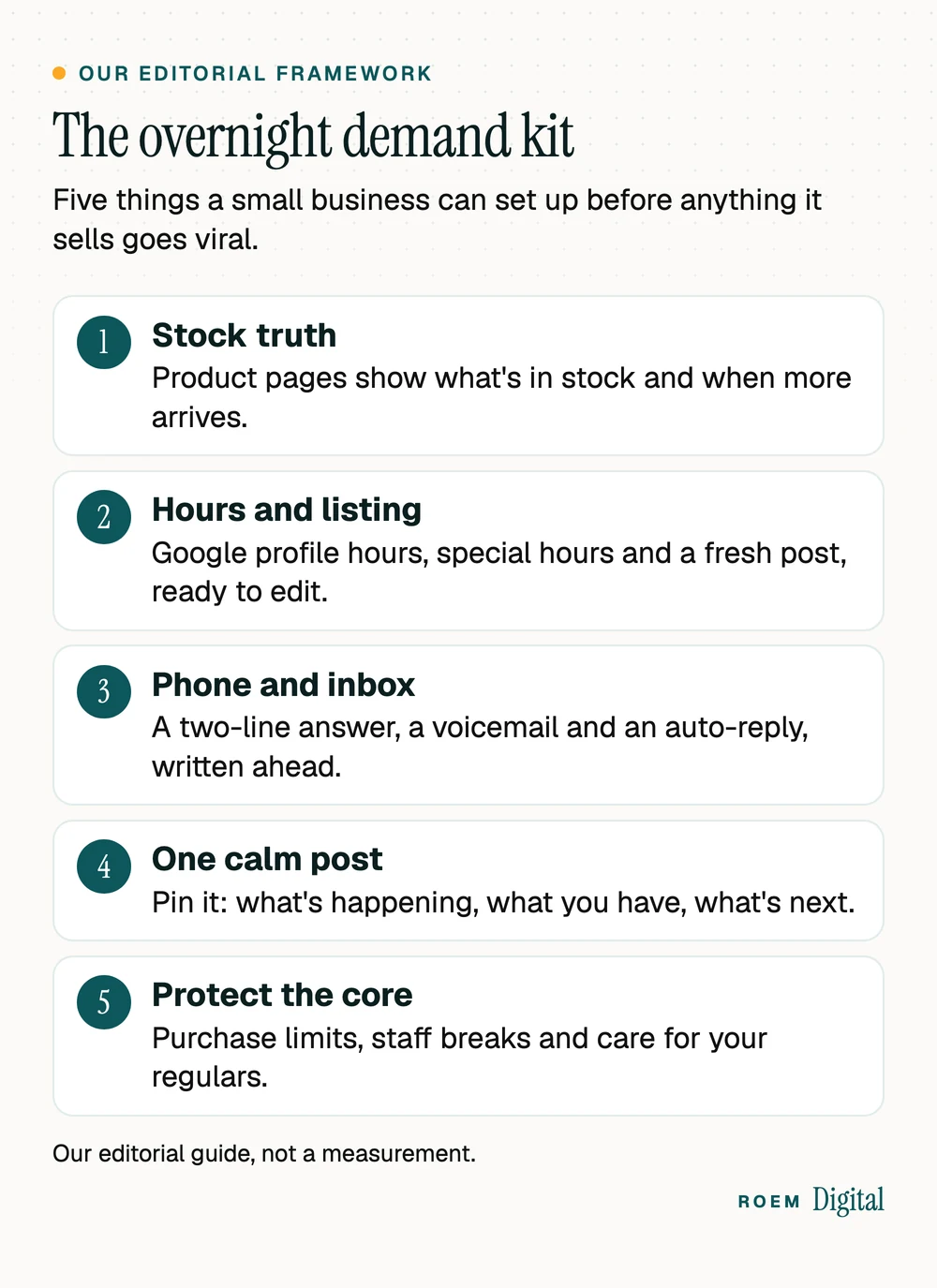
We call this the overnight demand kit. It's our editorial framework, not IKEA's or the zoo's procedure, built for a small business that can't hire a crisis team on a Saturday morning:
- Stock truth. Every product page says plainly what's in stock, and a sold-out item keeps its page with a note about when more is coming.
- Hours and listing. You can edit your Google Business Profile hours, special hours and posts from your phone today, not after a password reset.
- Phone and inbox. A two-line answer, a voicemail greeting and an email auto-reply are written and saved, ready to switch on.
- One calm post. A short template you can pin: what's happening, what you have, what's next and where to check for updates.
- Protect the core. You've decided in advance about purchase limits, holds, staff breaks and how your regular customers get served first.
Item two is the easiest to overlook, because the person who set up the Google profile or the website years ago may no longer be around. Our guide to who owns your website and marketing accounts shows how to check every login before you need it.
Your website and Google listing: tell the truth about stock and hours
When a viral product sells out, as the IKEA monkey's orangutan did, the instinct is to hide it. Google's own guidance says the opposite. Asked whether to remove out-of-stock products from Search, Google's Search Central guide to pausing an online business answers: "It's better to still allow that page, and mark it out of stock. That way people can still understand what's going on, even if they can't purchase the item."
The same guide suggests a banner or popup on every page that mentions "any known and unusual delays, shipping times, pick-up or delivery options," and updating your structured data so it reflects current availability. For a small online store, that means three changes you can make in an afternoon:
- Keep the product page live, marked sold out, with a line about when you expect more and a way to get notified.
- Add a site-wide banner that answers the top question before anyone has to call.
- Point people to what you do have, such as similar items, gift cards or preorders, if you can honor them.
Then fix your Google listing. Google's help page on special hours explains that "when your hours of operation change for a brief period of time, like for a special event, you can set special hours so that your regular hours don't change." If you open early or stay late for the rush, set special hours so nobody drives over to a locked door. A short Google Business Profile post about stock is the next place people will look, and our Google Business Profile checklist covers the rest of the listing.
The phone, the inbox and the comments: a calm script beats a clever one
When the same question arrives a hundred times, write the answer once and use it everywhere. Keep it short and honest, and never promise a date you can't keep.
| The question | A calm answer |
|---|---|
| "Do you have it?" | "We're sold out right now. We expect more soon and post updates on our page first." |
| "Can you hold one for me?" | "We can't hold items while demand is this high, so everyone gets the same fair chance." |
| "Why is it so expensive online?" | "Those listings aren't ours. Our price hasn't changed, and we only sell through our own site and store." |
| An angry comment about the sellout | "We're sorry you missed out. We're restocking as fast as we can and will post the moment it's back." |
Answer fast, because a curious buyer cools quickly. Our post on speed to lead explains why the first reply matters so much. If a comment thread turns into an argument, step out of it rather than winning it, as our guide to rage bait explains.

How ROEM helps small businesses get ready for attention
We're a small, senior team based in Davenport, Florida, working with businesses across Central Florida and nationwide. We build custom websites and online stores, including Little Milo's Closet, and our brand, web and e-commerce work starts with pages that tell customers the truth about what you sell. Our social media management covers the strategy, the content calendar, the creative, the posting and the day-to-day community management, so the calm post and the replies don't all land on you.
You own the domain, the website and every account. Nobody can promise a viral day, but you can be ready for one.
Frequently asked questions
What is the IKEA monkey?
The IKEA monkey is Punch, a young Japanese macaque at Ichikawa City Zoo in Japan. Zookeepers hand-raised him after he was abandoned and gave him an orangutan stuffed toy from IKEA as a substitute for his mother. Videos of him carrying the toy went viral in February 2026, and the plush sold out in many stores.
What is the orangutan toy Punch the monkey carries?
It is IKEA's Djungelskog orangutan soft toy. CNN reported it was priced at $19.99 in the US and sold out at most US stores after Punch's videos spread. IKEA said it was working to restock it, and NBC News reported that IKEA Japan's president was donating replacement toys for Punch.
How is Punch the monkey doing now?
By early March 2026, CNN reported that videos showed Punch being groomed by and playing with other monkeys as he gradually fit in with his troop. He was also leaving his stuffed toy behind for longer and more frequent stretches, which zoo fans took as a sign of growing independence.
What should a small business do when a product goes viral?
Tell the truth about stock on your website, keep sold-out product pages live with a restock note, update your Google hours and post a short update. Write one answer for the most common questions and use it on the phone, by email and in comments. Decide on purchase limits and holds before the rush.
Should I remove a sold-out product from my website?
Usually not. Google's own guidance on pausing an online business says it is better to keep the page live and mark it out of stock, so people can still understand what is going on even if they cannot buy. Add when you expect more and a way to get notified.
How do I update my Google Business Profile hours for a busy day?
Use special hours. Google explains that when your hours change for a brief period, like a special event, you can set special hours so your regular hours stay the same. Open your Business Profile, edit hours, add the date under special hours and enter the opening and closing times.