
Short answer: Newsjacking means joining a big news moment while people are talking about it, with a post or offer that ties your business to it. For a small business it works when the link is real, the timing is fast and the post gives fans something, without using a famous name, photo or logo in a way that implies endorsement.
What newsjacking is, and how it differs from trendjacking
Newsjacking is joining a big news story while it's still the thing everyone is talking about, with a post, an offer or a comment that connects it to your business. Done well, it borrows attention without borrowing anyone's name. Done badly, it reads as a brand shouting "me too" at a party it wasn't invited to.
Marketers use three related terms, and the difference matters mostly for timing:
| Term | What it means | A small-business version |
|---|---|---|
| Newsjacking | Reacting to a dated news event, usually within hours or a day | A bakery posts a "something blue" cupcake special the morning after a famous wedding |
| Trendjacking | Joining a meme, sound or format that runs for weeks | A salon uses a trending video format to show a real before and after |
| Real time marketing | The umbrella: any marketing that responds to what's happening now | A pool company posts a heat-wave safety reminder the day the forecast breaks a record |
None of this needs a big budget. It needs someone who can decide quickly and a feed that already sounds like a real business. If yours doesn't yet, start with what a local service business should post, then come back here.
A celebrity engagement and a July 2026 wedding: how brands joined in
In July 2026 a celebrity wedding drew crowds and headlines, and businesses had been joining the story since the couple's engagement the year before. Taylor Swift and Travis Kelce were married on Friday, July 3, 2026, at Madison Square Garden in New York City, CBS News reported, with around 1,000 guests according to law enforcement sources familiar with the security planning. A jumbotron outside the arena lit up with "JUST&T MARRIED!" and the Empire State Building announced on social media that it had lit up in "something blue" in celebration.
The engagement in August 2025 was the warm-up, and NPR's report on how brands cheered the engagement is a field guide to both sides of newsjacking. Companies from the Cheesecake Factory, Whataburger and Pillsbury to Southwest Airlines, Scrub Daddy and Invisalign posted self-referential photoshops and captions. Olipop offered fans an extra 13% off any subscription order, referencing Swift's favorite number, and DoorDash offered 13% off all orders through that Thursday.
The standouts had a real connection. A week before the engagement, Panera heard Swift talk about her sourdough habit on Kelce's podcast, and within 16 hours it had launched special-edition merch and a "loaf story" meal, NPR reported. When the engagement news came, Panera was ready with "she said yeast!" Starbucks, already in the middle of its pumpkin spice launch, simply posted: "are we supposed to keep talking about PSL like nothing happened???"
Not everyone was charmed. Marcus Collins, a professor at the University of Michigan's Ross School of Business, told NPR that brands jumping into every cultural moment risk "jumping on things to be opportunistic, not to contribute anything." His sharper warning: people may stop rolling their eyes and simply tune out, and "that might actually be worse for brands." ROEM has no connection to the couple or to any brand named here, and nothing on this page suggests one. A small business that joins a moment like this should be able to say the same. For the rules around big events specifically, read our guide to ambush marketing.
Contribute or skip it: most brand posts on big moments fall flat
Our contrarian view, and it's editorial judgment rather than research: for most small businesses, the right newsjacking post is a useful one, not a joke, and the right number of posts on most big moments is zero. A celebrity wedding has nothing to do with an HVAC company. A florist, a bakery, a bridal shop or a venue? Different story. Sometimes the moment finds you instead, and our post on what Punch the monkey taught small businesses about overnight demand covers being ready for it.
Collins drew the line in the same NPR piece: the Starbucks post was "a contribution to the discourse," while too many brands pile into moments that "have nothing to do with them." A contribution gives fans something: a deal they can use, a laugh that fits your voice, a fact that helps. A grab only gives you something.
- Contribution: a bridal boutique posts how to style "something blue" in a Florida summer wedding, with photos from its own racks.
- Contribution: a venue shares its own blue uplighting from a real couple's reception, with their permission.
- Grab: a tire shop photoshops its logo onto the couple's engagement photo.
- Grab: any post that turns the moment into an argument, which our piece on rage bait explains is a losing trade for a local business.
Skipping is a strategy too. Your regulars won't notice that you didn't post about a wedding. They will notice a feed that goes quiet for a month, so steady posting about your real work still matters more than any single moment.
The RSVP check: four tests before you join a big moment
Before anyone on your team posts about the news, run it through what we call the RSVP check. It's our editorial framework, built for small businesses without a legal department. Every answer has to be yes:
- R, Relevant: does the moment touch what you sell or who you serve? A wedding fits a florist. A championship parade fits a sports bar. A storm never fits a sales pitch.
- S, Soon: can you post while people still care? Panera moved within 16 hours. If your post needs three rounds of approval, the moment will be gone.
- V, Value: does the post give fans something, such as a deal, a laugh in your own voice or a useful fact? If it only gives you something, skip it.
- P, Plays fair: no famous names in ads or on products, no photos, logos or lyrics you don't own, and nothing that suggests the people in the news use or like your business.
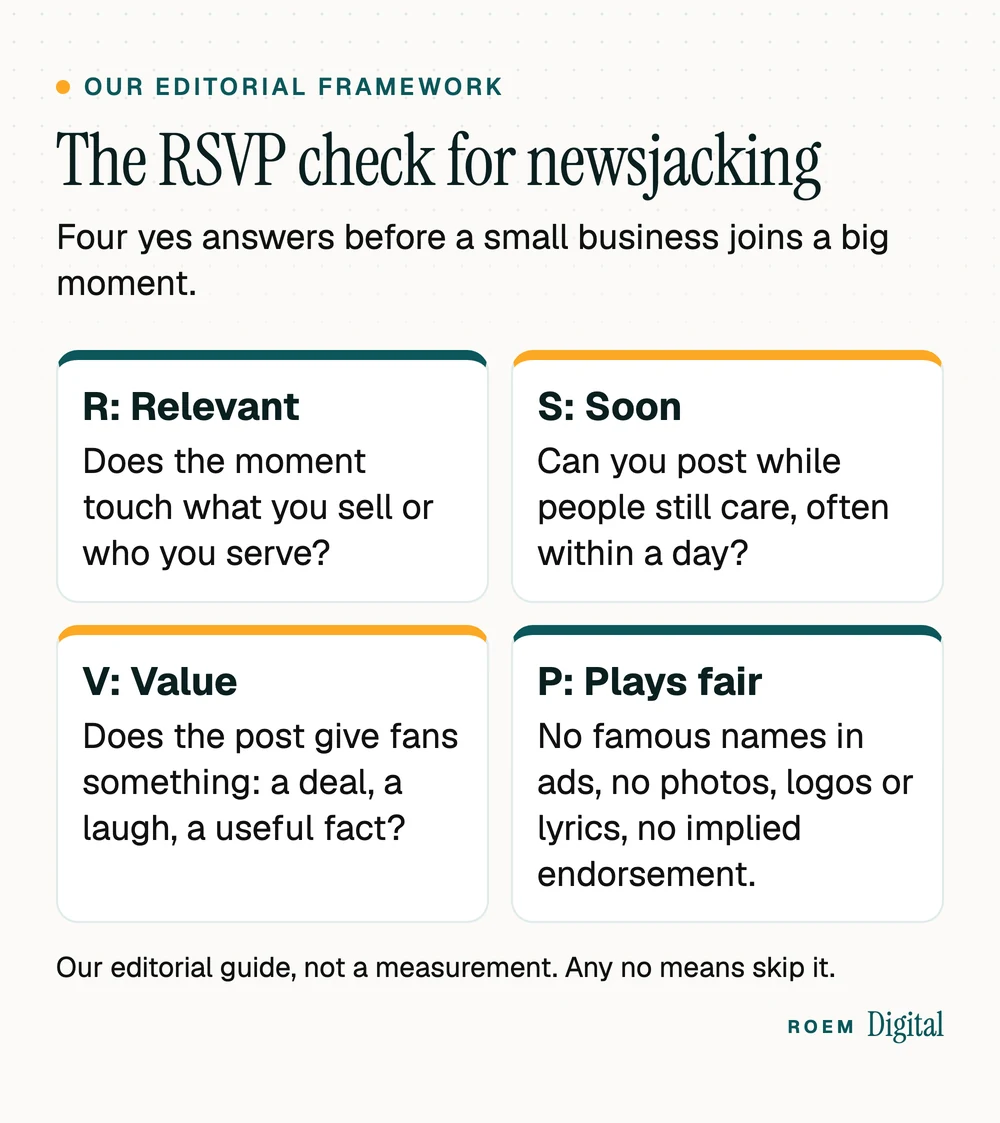
The check is fast on purpose. A good newsjacking decision should take minutes, not meetings, and a content calendar that already has room for the unexpected makes the yes easier.
Don't borrow a famous name: endorsement and trademark risk
The fastest way to turn a fun post into a problem is to make it look like the people in the news vouch for you. The FTC's Endorsement Guides FAQ explains that "an endorsement is an advertising message that consumers are likely to believe reflects the opinions or beliefs of someone other than the sponsoring advertiser." The same page notes that the Guides themselves don't have the force of law, but that practices inconsistent with them may result in law enforcement actions alleging Section 5 violations.
A celebrity who has never heard of your bakery can't be endorsing it, so don't word an ad as if they do. Florida law goes further: Fla. Stat. 540.08 bars using a real person's name, photograph or likeness for a commercial or advertising purpose without their consent. The same caution applies to event names, team names and logos, which owners often protect as trademarks. This is general marketing information, not legal advice. If a campaign leans on someone else's name, image or mark, talk to a trademark or advertising attorney before it runs.
| Riskier | Safer |
|---|---|
| A famous name in an ad headline or on a product label | A general nod in an organic post: "Wedding fever is in the news this week" |
| The couple's photo, or a screenshot of their post | A photo of your own product, team or space |
| Song lyrics in your caption | Your own words, or an old tradition like "something blue" |
| "Their favorite cupcakes, now on sale" | "Something blue cupcakes, this weekend only" |
| Event logos or official names on a sign or in a paid ad | Plain descriptions such as "the big game," covered in our ambush marketing guide |
Paid ads deserve extra care. An organic post on your own page is a passing remark. An ad is a sales message, and ad platforms apply their own advertising policies on top of the law. If you run ads, our paid media and lead generation service explains how we approach them.
When to call an attorney before you post
- A famous person's name, photo or voice appears in an ad, a boost or on a product.
- You plan to use an event name, team name or logo anywhere you sell.
- A brand or agent contacts you about a post you made.
- You want to run the same idea as a paid campaign.
Ask a trademark or advertising attorney before the campaign runs, not after a complaint arrives.
Plan your next newsjack before the news breaks
Surprise news can't be scheduled, but most of the moments a local business can join are on the calendar months ahead. Build a short list now and you'll have posts ready instead of scrambling:
- List the dated moments that fit you. For the next few months that includes Small Business Saturday on November 28, 2026, GivingTuesday on December 1, 2026, and Super Bowl LXI in February 2027.
- Add your local calendar. School breaks, festivals, home games and seasonal swings matter more to most local businesses than national news. Our guide to Central Florida's busy and slow seasons shows how to map them.
- Write a never list. Tragedies, disasters, politics and news stories involving children stay off your feed, no matter how much attention they get.
- Decide who can say yes. One person, with the RSVP check, and a rule that a second person reads the post before it goes out.
- Keep a ready kit. Brand colors, a few photos of your team and products, and two or three caption styles that sound like you.
- Point people somewhere useful. Make sure the link in your profile goes to a page that can take a booking, an order or a call.

Then measure it like any other post: calls, messages, orders and bookings in the days after, not just likes. Our guide to the numbers every marketing report should show explains what to count.
How ROEM helps local businesses join the moment
We're a small, senior team based in Davenport, Florida, working with businesses across Central Florida and nationwide. Our social media management covers the strategy, the content calendar, the creative, the posting and the day-to-day community management, so the moments that fit your business are planned, and the ones that don't are easy to skip.
You keep ownership of every profile and every photo. We'd rather help you post one smart, timely idea that brings in bookings than ten jokes that bring in nothing.
Frequently asked questions
What is newsjacking in marketing?
Newsjacking is joining a big news story while people are still talking about it, with a post, offer or comment that ties it to your business. It works best when the connection is real, the timing is fast and the post gives fans something useful or fun instead of only promoting the brand.
What is the difference between newsjacking and trendjacking?
Newsjacking reacts to a dated news event, usually within hours or a day, such as a celebrity wedding or a championship. Trendjacking joins a meme, sound or video format that can run for weeks. Both fall under real time marketing, which covers any marketing that responds to what is happening right now.
Can a small business mention a celebrity in a social media post?
A passing, factual mention in an organic post is different from using a famous name to sell. Avoid celebrity names in ads or on products, never use their photos, and never suggest they use or like your business. This is general information, not legal advice, so ask an attorney before a campaign that leans on a name.
What are some good newsjacking examples?
In August 2025, NPR reported that Panera launched special-edition merch and a themed meal within 16 hours of hearing the singer talk about sourdough on a podcast, and Starbucks greeted her engagement with a playful one-liner during its own seasonal launch. Both had a real connection or a natural voice, which is what made them work.
Is newsjacking risky for a business?
It can be. The common mistakes are posting about tragedies or politics, forcing a connection that isn't there, being too slow, and implying a famous person endorses you. A quick check for relevance, timing, value and fair play before posting avoids most of them, and skipping a moment is always an option.
How fast do you need to post when newsjacking?
For breaking news, often within a day, while people are still searching and sharing. That is why the decision should sit with one person who can approve quickly. For dated moments like Small Business Saturday or GivingTuesday, plan and write the posts weeks ahead so speed is never the problem.