
Short answer: The best Giving Tuesday ideas for churches and private schools fund one specific, visible need and give people four ways to take part: give money, bring goods, serve or share. Giving Tuesday falls on December 1, 2026, which leaves about two weeks to set a goal, build one giving page and plan the thank-yous.
Giving Tuesday ideas that work for churches and private schools
Giving Tuesday is on Tuesday, December 1, 2026, according to the GivingTuesday FAQ. The Giving Tuesday ideas that work for a church or a small private school have three things in common: one named need, a goal people can picture, and more than one way to help. Counting from November 16, that's 15 days.
Anyone can take part. The same FAQ lists schools and religious organizations among the partners that built the movement, says there's no registration, and notes it's free to participate (your donation platform's usual fees still apply). Pick one or two of these ideas rather than all of them:
- Fund one named need: the youth group's van repair, new library books, or a month of food pantry shelves.
- Run a matching challenge. A board member, a family or a group of members offers to match gifts up to a set amount.
- Hold a goods drive for a local school or shelter. GivingTuesday's page for churches and places of worship lists food and clothing drives and adopting families for the holidays.
- Raise money for a neighbor. The same page describes a church that fundraised for a school across town.
- Let students lead. GivingTuesday's Educator Resource Hub has lesson plans for ages 5 to 18.
- Ask alumni and grandparents, not only current families, to support a specific classroom or scholarship need.
- Host a serve morning on the Saturday before, then report what got done on Tuesday.
For the bigger picture of how we help ministries and schools online, see our pages for churches and private schools.
The four-ask plan: give, bring, serve and share
Most Giving Tuesday campaigns ask for one thing: money. GivingTuesday's own numbers show the day is wider than that. Its 2025 results estimate that 38.1 million people in the US took part and $4.0 billion was donated. Of those participants, 19.1 million made financial contributions, 13.5 million gave goods, 11.1 million volunteered and 20.9 million spoke out about causes.
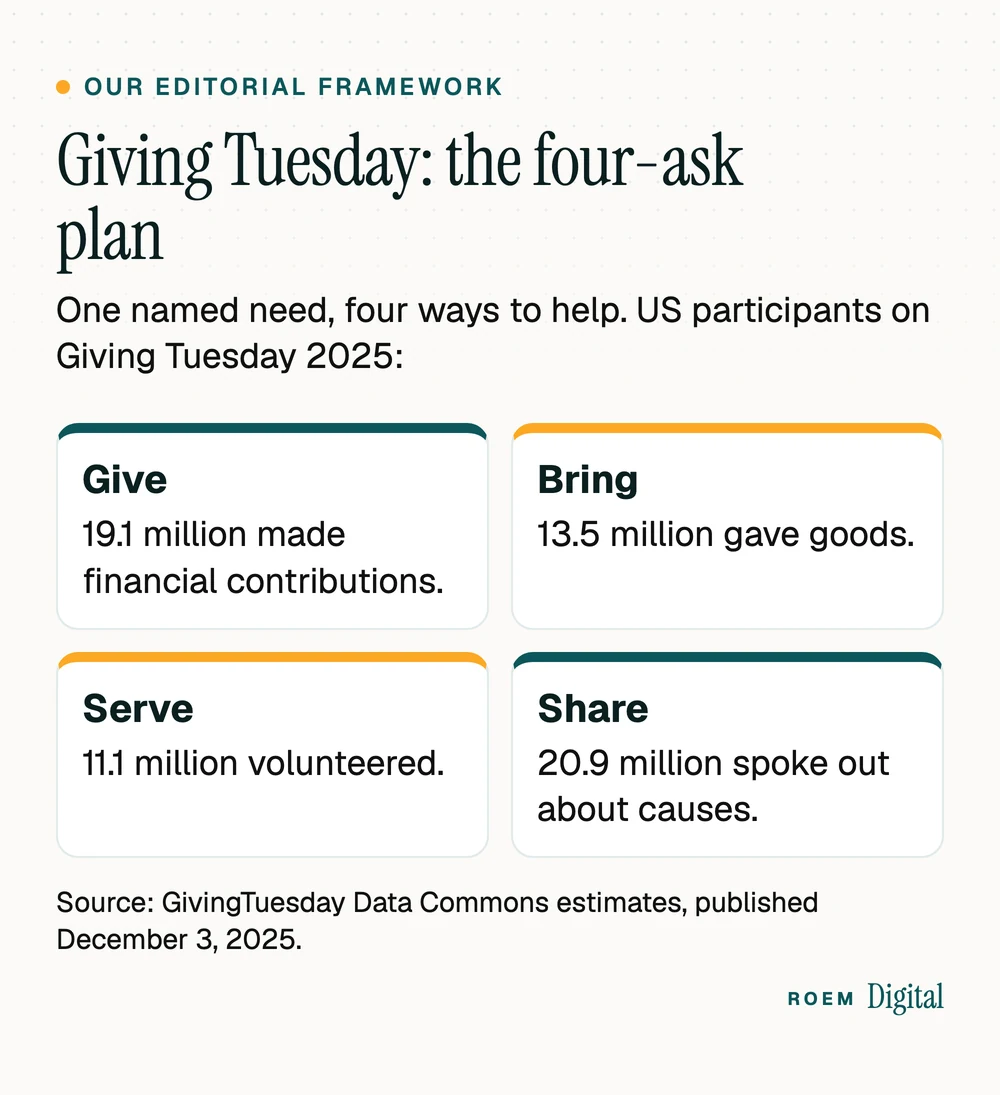
We call our framework the four-ask plan. It's editorial judgment built on those categories: name one need, then offer one ask of each kind, so the college student, the retiree on a fixed income and the family that already gives can all say yes to something.
- Give: a gift toward the named need, with a goal and a progress update during the day.
- Bring: a short, specific list of goods, a drop-off window and a place.
- Serve: two or three volunteer slots with a start time, an end time and a leader's name.
- Share: a ready-made post and photo people can repost, plus a link that tells you which share brought a gift. Our social media service builds this kind of kit.
Sample wording for each ask
- Give: "Help us stock the food pantry for December. Our goal is [amount] by midnight on December 1."
- Bring: "Drop off canned vegetables or new children's socks at the front office by Friday."
- Serve: "We need eight volunteers on Saturday morning to sort and pack donations. Sign up here."
- Share: "Repost this photo with one sentence about why our church matters to you."
A 15-day Giving Tuesday campaign plan, starting November 16
Fifteen days is enough for a focused campaign if you decide quickly. Here's a calendar that works around Thanksgiving on November 26:
- November 16 to 17: choose the one need, set the goal, and confirm who approves the wording, the photos and any match.
- November 18 to 20: build the giving page, connect the Give button to the giving platform you already use, and test it on a phone.
- November 21 to 24: write three emails (announcement, day-of reminder, thank-you) and four social posts. Record a 60-second video from your pastor or head of school, and send the school announcement in the last newsletter before the Thanksgiving break.
- November 25 to 29: announce it at weekend services on November 28 and 29, with the serve and bring details.
- December 1: send the morning email, post progress at lunch and in the evening, and thank people by name where they've agreed to it.
- December 2 to 8: send receipts and a results update with a photo of the need being met.
Tag each email and social link so you can see which one brought gifts. Our guide to UTM parameters shows how to build them in a few minutes.
Build one Giving Tuesday page that works on a phone
Every email, post and announcement should point to one page on your own website, not a different link each time. That page carries the campaign, and the Give button on it hands people to your giving platform for the payment itself.
- The need in one sentence, with a real photo of the place or the people it helps (with permission).
- The goal and a progress line you update during the day.
- A Give button near the top, linked to your existing giving platform, plus the bring, serve and share asks below it.
- A plain answer to "where does my money go?" and who to contact with questions.
- Tracking: count Give button clicks and volunteer signups as key events, as our guide to tracking forms in GA4 explains.
Open the page on your own phone before you announce it, tap every button and complete a small test gift if your platform allows it. If your site makes that hard, our website and branding service builds church and school sites with campaign pages your staff can update.
Naming the campaign. GivingTuesday's FAQ says GivingTuesday is not trademarked and invites organizations to redesign its logo, and its logos page provides the files. USPTO records also show a live registration for GIVING TUESDAY (Registration 6291409, on the Supplemental Register) held by a separate nonprofit for charitable fundraising. Use the name to describe the day, keep your church or school name as the brand on the page, and ask a trademark attorney before putting the name on shirts or other merchandise. This is general information, not legal advice.
Keep the page live after December 1. Change the headline to the result, add a photo of the need being met, and invite first-time givers to one next step, such as a volunteer slot or a newsletter. A first gift can be the start of a relationship, and that page is where the second step begins.
Giving Tuesday for a church versus a private school
The four asks work for both, but the audience and the calendar differ. Use this as a starting point:
| Question | Church | Private school |
|---|---|---|
| Who you ask | Members, regular attenders and the wider community | Current families, alumni, grandparents, staff and the board |
| A need people can picture | Food pantry shelves, a missions trip, a youth event | Library books, a classroom project, a scholarship fund |
| Where you announce it | Weekend services, the live stream and email | The family newsletter, a school assembly and pickup-line flyers |
| Who leads the share ask | Ministry leaders and small groups | Students, with family consent for any photos |
| Photo permission | Ask adults before you post them | Written consent from each child's family |
Churches can use Giving Tuesday as an easy first step for newer attenders, which ties into our guide to church growth strategies. For schools, a student-led project gives families and grandparents a way to take part beyond writing a check.
Receipts and thank-you gifts: what the IRS says
Giving Tuesday thank-yous often include a mug, a shirt or a dinner ticket, and the IRS has rules for gifts that come with something in return. This is general information, not legal advice or tax advice, and each point below quotes the IRS rather than interpreting it.
- Gifts of $250 or more. The IRS page on written acknowledgments lists what the acknowledgment must contain, including the organization's name, the amount of a cash contribution, and a statement that no goods or services were provided, if that's the case.
- Gifts that come with something in return. The IRS page on quid pro quo contributions describes a payment made partly as a contribution and partly for goods or services, and says a disclosure statement must be provided when the donor's payment is more than $75. The same page lists exceptions, including goods or services of insubstantial value, so ask your CPA how your thank-you items count.
- Religious benefits. The written acknowledgment page also mentions a statement that any goods or services provided consisted entirely of intangible religious benefits, if that was the case.
Most giving platforms can send automatic receipts. Make sure your church or school, not a volunteer or a vendor, owns that account and its donor list. Our guide to who owns your marketing accounts explains how to check.
When to talk to a CPA before you promise donors anything
Your marketing team can build the page and write the emails. Questions about what a donor can deduct belong with a CPA or tax professional who knows churches or schools. Call one before Giving Tuesday if any of these apply:
- You plan to give thank-you items, event tickets or meals in return for gifts.
- Someone wants to give stock, a vehicle, property or another non-cash gift.
- Gifts will be restricted to a scholarship fund, a specific student or a specific family.
- A business wants to sponsor the campaign or match gifts in exchange for recognition.
- Your wording says anything about deductions, such as "fully tax-deductible."
Ask the CPA to review your receipt template and your campaign page's giving language in one pass. Once it's approved, reuse it for your year-end appeal, which our consulting service can help you plan.
How ROEM helps churches and schools before December 1
We're a small senior team based in Davenport, Florida, working with churches and private schools across Central Florida and nationwide by video. We built the websites for Solid Rock Community Church and Still We Rise Excellence Academy, a Christ-centered Montessori school in Kissimmee. For campaigns like this, we build the page, link the Give button to the giving platform you already use, and track clicks and signups from the first announcement. You own the website and every account.
“ROEM is a first class all systems partner. Their expertise extends from organizational infrastructure, communications, and digital marketing, to web design, graphic design, IT support, and so much more. Still We Rise Excellence Academy is better because of ROEM!”
Read more about what we do for private schools and churches.
Frequently asked questions
When is Giving Tuesday 2026?
Giving Tuesday 2026 is on Tuesday, December 1, 2026, according to GivingTuesday's own FAQ. That's five days after Thanksgiving, so churches and schools can announce it at weekend services or in the last school newsletter before the break, then send the main appeal that Tuesday morning.
Can churches participate in Giving Tuesday?
Yes. GivingTuesday's FAQ lists religious organizations and schools among the partners that built the movement and says there's no registration. Its page for churches and places of worship suggests ideas like rallying a congregation to fill a community need, food or clothing drives and adopting families for the holidays.
What are good Giving Tuesday ideas for schools?
Fund one specific need families can picture, such as library books or a classroom project, and let students lead a goods drive or a share campaign. Ask alumni and grandparents, not only current families. GivingTuesday's Educator Resource Hub offers lesson plans for ages 5 to 18 if teachers want to build it into class.
How do you promote a Giving Tuesday campaign?
Point every message to one page on your website. Announce it at services or in the newsletter the weekend before, send an email the morning of December 1, post progress updates during the day, and thank people afterward. Tag each email and social link so you can see which ones brought gifts.
Do we have to give donors a receipt for Giving Tuesday gifts?
The IRS lists what a written acknowledgment must contain for a contribution of $250 or more, and requires a disclosure statement when a donor's payment of more than $75 is partly for goods or services, with exceptions such as items of insubstantial value. This is general information, not tax advice, so ask a CPA to review your receipts.
Can we use the Giving Tuesday name and logo?
GivingTuesday's own FAQ says GivingTuesday is not trademarked, invites organizations to redesign its logo and provides logo files. USPTO records also show a live GIVING TUESDAY registration on the Supplemental Register held by a separate nonprofit. Use the name to describe the day, keep your own name as the brand, and ask a trademark attorney about merchandise.