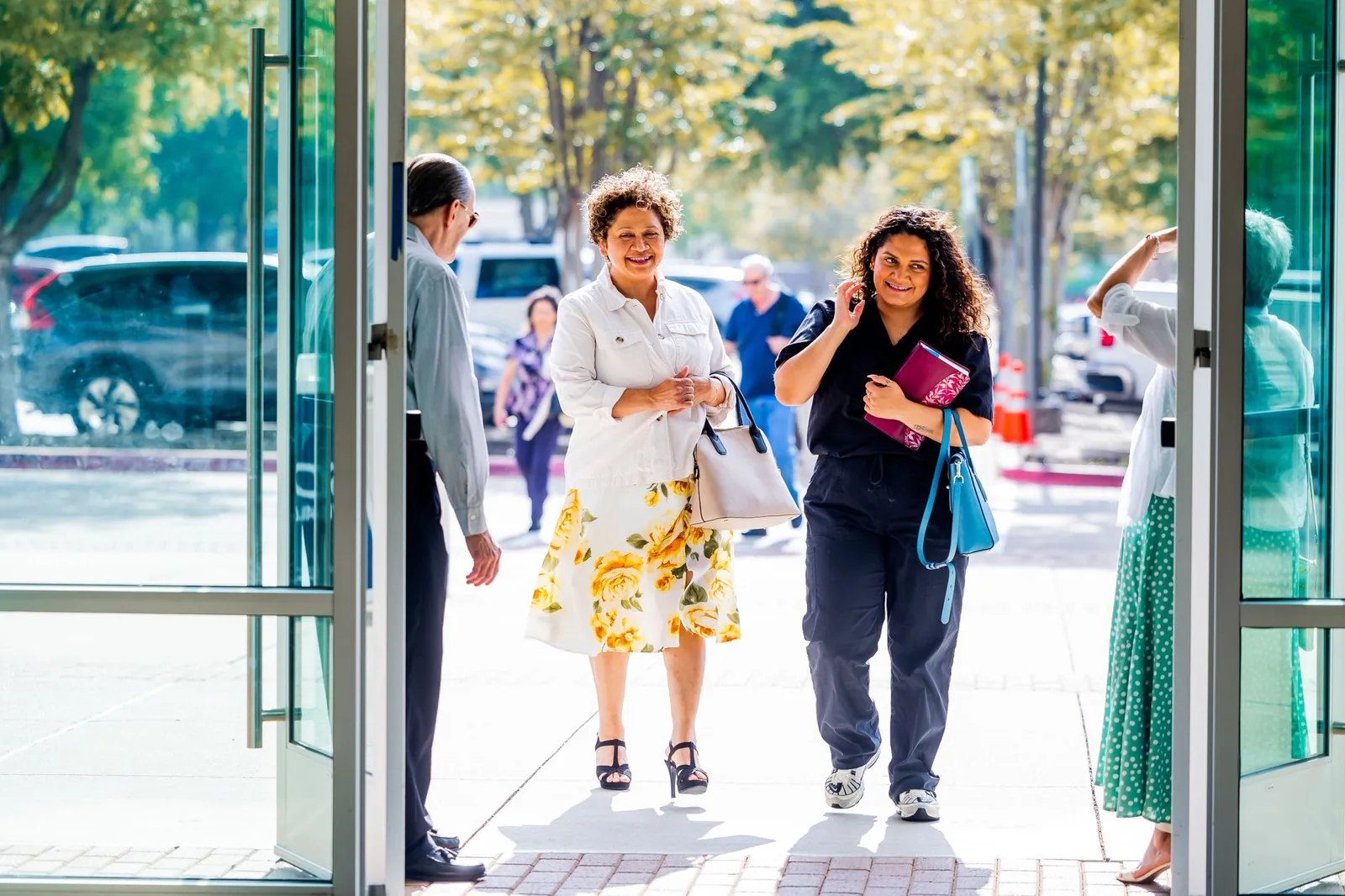
Short answer: The church growth strategies that work best help members invite friends, then make every next step easy: an accurate Google listing, a website that answers first-visit questions, and one simple way to get connected after Sunday. Research from Pew and Lifeway shows people choose a church by visiting and talking to members.
Church growth strategies that work start with an invitation
The church growth strategies that hold up help your members invite people, then make the rest of the path easy: an accurate Google listing, a website that answers first-visit questions before anyone asks, and one clear next step after Sunday. Growth is two numbers, not one. More people have to arrive than quietly drift away.
This guide covers the outward-facing side of growth: how people find you, decide to visit and stay connected. Preaching, theology and leadership belong to your pastors. For what we build for ministries, see our church website and marketing page. Here's the short list, with the reasons below:
- Equip members to invite. Give them a link worth sending: a plan-your-visit page, an event page or a sermon.
- Fix your Google Business Profile. Correct name, address, category and photos, with service times in the right place.
- Answer first-visit questions on your website: service times, parking, kids, what to wear and how long it runs.
- Put your preaching online so a curious person can hear a sermon before they come.
- Host events neighbors actually want, and give each one its own shareable page.
- Offer one easy next step after a first visit: a class, a group or a serve team.
- Follow up within days, from a real person, with no pressure.
- Count arrivals and departures, so you know which door needs work.
What research says about how people choose a church
Two large surveys explain why invitations and websites work together. Pew Research Center's 2016 study Choosing a New Church or House of Worship found that about half of U.S. adults have looked for a new congregation at some point, most commonly because they moved. Of those who looked, 83% said the quality of preaching played an important role, nearly as many said feeling welcomed by clergy and lay leaders mattered, and seven in ten named location.
The same study found that 85% of people who looked attended a service at a church they were considering, and seven in ten talked with members, friends or colleagues about the decision. Online searching was far more common among younger adults: 59% of adults under 30 said they used online searches when looking for a new congregation, compared with 12% of those 65 and older.
Lifeway Research's 2016 survey of 2,000 unchurched Americans adds the invitation side. Half (51%) said a personal invitation from a friend or family member would be effective in getting them to visit a church, while a Facebook ad scored 18%. Interest ran higher for community events than for worship: 62% would attend a church meeting about neighborhood safety, and 35% would attend a worship service if invited.
| Finding | What it means online |
|---|---|
| Moving is the most common reason people look for a church (Pew) | Newcomers search by location, so your Google Business Profile and address have to be right. |
| Preaching quality matters most (Pew) | A sermon library lets someone hear your pastor before they visit. |
| Feeling welcomed matters nearly as much (Pew) | A plan-your-visit page and photos of real greeters show the welcome in advance. |
| Most people attend a service and talk it over with members or friends before deciding (Pew) | The website supports the visit. It can't replace it. |
| A personal invitation outperforms ads (Lifeway) | Give members pages they're glad to send to a friend. |
Both studies date from 2016, so treat the exact figures as a snapshot. The pattern is what matters for church growth: people decide in person, and your online presence either makes that first visit feel easy or quietly talks them out of it.
The invitation chain: a church growth framework you can check in an afternoon
We call it the invitation chain. It's our editorial framework, built on the research above: growth moves from person to person in five links, and the chain is only as strong as its weakest link. Many churches put their energy into the first link, asking members to invite, and never check whether the next links hold.
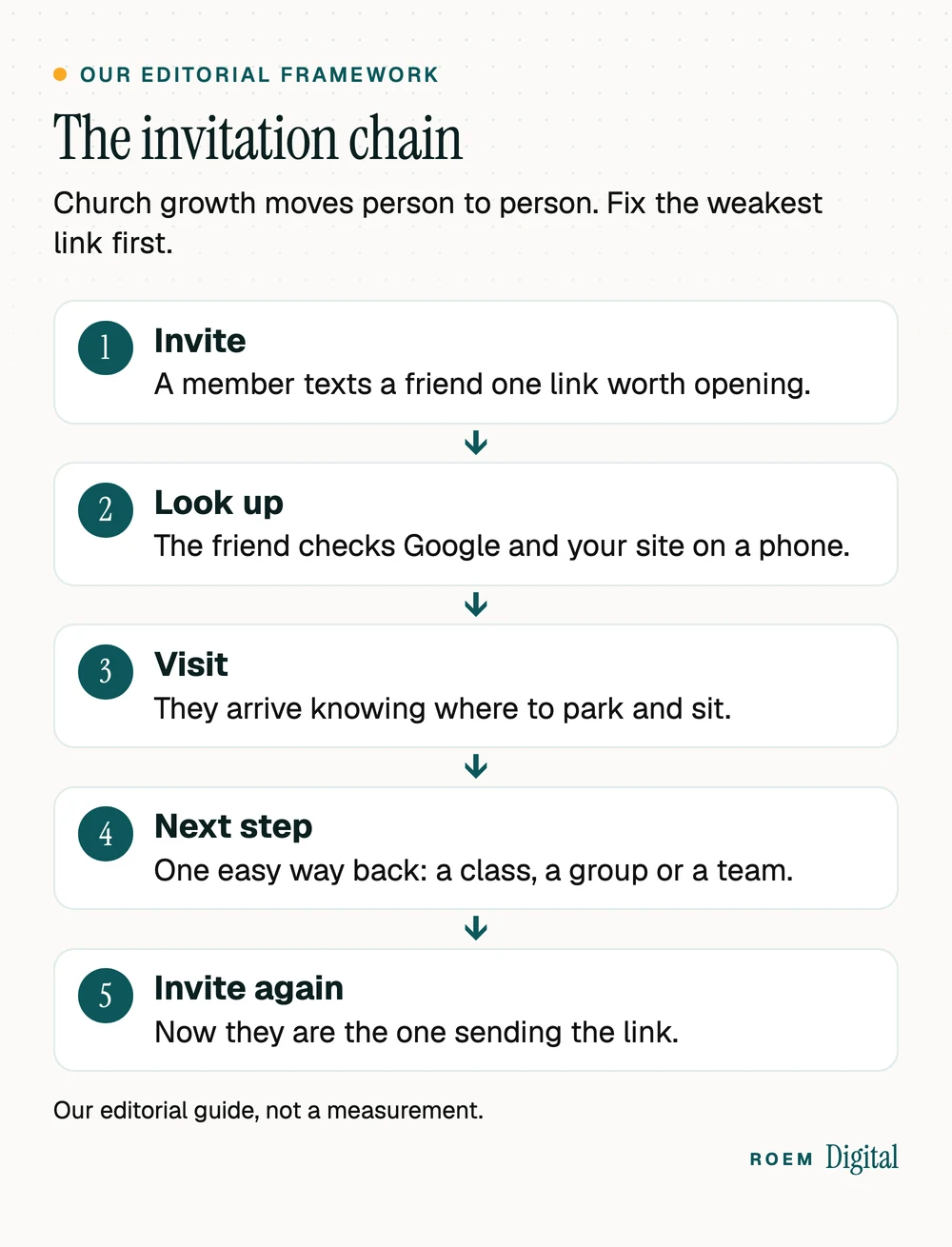
Check each link the way a guest would experience it:
- Invite. Can a member text a friend one link that answers "what is this, and when?" A plan-your-visit or event page works. A homepage slideshow doesn't.
- Look up. Search your church's name on a phone. Do the address, service times, photos and reviews look current?
- Visit. Does the website tell a first-timer where to park, where kids go and how long the service runs?
- Next step. After one visit, is there one obvious, low-pressure way to get connected: a class, a group or a serve team?
- Invite again. Does the person who stayed have something to share, like an upcoming event or a new sermon series?
The chain also explains why we treat ads as a supporting tool for churches rather than the engine. In Lifeway's survey, unchurched adults rated a Facebook ad far below a friend's invitation. If you do run ads, our paid media service page explains how we set up call and form tracking before ad spend starts.
Get the second link right: your Google listing
When a friend says "come Sunday," the next move is usually a search for your church's name, or for churches nearby if they've just moved. Your Google Business Profile often answers before your website does, so treat it as your sign by the road.
- Name, address and category exactly as they appear on your building. Extra keywords in the name break Google's rules.
- Service times in the right place. Google's guidelines for representing your business say businesses with varied hours, naming worship services as an example, shouldn't provide hours. Put service times on your website and in posts on your profile instead.
- Real photos of the entrance, parking, kids' area and your people, shared with their permission.
- Reviews you answer. Ask members to describe their experience honestly, and reply to every review with grace. Our guide to getting more Google reviews covers how to ask within Google's rules.
For the full setup, work through our Google Business Profile checklist. If your church has moved or merged campuses, correct old directory listings too, because an outdated address in a directory sends a newcomer to the wrong building.
Let your church website do the visit before the visit
Pew found that most people attend a service and talk with members or friends before choosing a church. Your website's job is to make that first attendance feel predictable. A first-time guest wants a handful of answers: when, where, what happens with the kids, what to wear and how long it lasts. Put them on one plan-your-visit page and link to it from every page.

We built the site for Solid Rock Community Church in Kissimmee in English and Spanish, with plan-your-visit, sermons and live stream, events, ministries, a food pantry and the Growth Track course members take online (more in our portfolio). A few habits make a site like that work for growth:
- A sermon library by series and date. Preaching was the top factor in Pew's study, so let people hear it on a Tuesday night.
- Key pages in the languages your neighbors speak. Our guide to building a bilingual website covers the setup.
- Plain answers an AI assistant can quote, such as a short "what to expect" section in everyday language.
- Fast pages that read well on a phone, with the address one tap away from directions.
Planning a rebuild? Our website and branding service explains how a custom build works, from the first audit to launch.
Close the back door: next steps that help people stay
A church grows only when more people arrive than drift away, and the back door gets less attention because nobody announces they're leaving. Online tools can't replace a pastor's phone call. They can make the next step easier to take.
- Put the membership class or growth track online so people can start when they're ready. Solid Rock's Growth Track is a course members take online.
- List every group and serve team on one page, with who leads it, when it meets and a short signup that reaches that leader directly.
- Link the live stream clearly for members who travel, work Sundays or are home sick, so one missed week doesn't turn into a habit.
- Make giving one tap away and explain what it supports. Our GivingTuesday ideas for churches and schools cover a timely campaign: GivingTuesday is December 1, 2026.
Events sit on both sides of the door. In Lifeway's survey, unchurched adults showed more interest in a church meeting about neighborhood safety (62%) or a community service event (51%) than in a worship service. A food pantry day, a back-to-school drive or a concert gives members something easy to invite a neighbor to. Our event marketing ideas cover how to promote one step by step.

Follow up within a few days with a short, personal note and one invitation, not five. Whoever sends it, the message should come from a real name and make it easy to say no.
How to tell which church growth strategies are working
You don't need a dashboard full of charts. Track a handful of numbers each month and compare them with the same month last year, and compare Easter with last Easter, because seasons like Easter, summer and Christmas can shift attendance.
| Number | Where it comes from | Which link it tests |
|---|---|---|
| First-time guests | Connection cards or a guest form | Invite and visit |
| Plan-your-visit form submissions | Your website analytics, counted as a key event | Look up |
| Calls and direction requests | Your Google Business Profile performance view | Look up |
| Second visits within a month | Your guest follow-up list | Next step |
| Class, group and serve signups | Signup forms routed to ministry leaders | Next step and invite again |
If the plan-your-visit form isn't counted yet, our guide to tracking calls and form fills in GA4 shows how. When one number stalls, go back to the invitation chain and fix that link before adding a new program.
How ROEM helps churches strengthen their front door online
We're a small senior team based in Davenport, Florida, working with churches across Central Florida and nationwide by video. We build custom church websites, hand-built rather than templated, set up Google Business Profiles to Google's guidelines, and track plan-your-visit forms and calls before any ad spend starts. Your church owns the domain, the website and every account.
We built the Solid Rock Community Church site and its Youth Revival 2026 event site, so we know how small ministry teams actually work. Our church marketing page covers sermons, events, giving and online courses in more detail.
Frequently asked questions
What are the most effective church growth strategies?
Start with what research shows people respond to: a personal invitation, a warm welcome and preaching they can connect with. Then make each step easy online, with an accurate Google listing, a plan-your-visit page, sermons on your website and one simple next step after a first visit, such as a class or small group.
How can a small church grow without a big budget?
Focus on free steps first. Claim and complete your Google Business Profile, put service times and a plan-your-visit page on your website, share sermons online and give members easy links to send friends. In Lifeway Research's 2016 survey, unchurched adults showed more interest in community events than in a worship service.
Should a church list service times as business hours on Google?
No. Google's guidelines for representing your business say businesses with varied hours, naming worship services as an example, shouldn't provide hours. Put your service times on your website and share them in posts on your Business Profile, including holiday and special service changes, so newcomers can find the current schedule.
How do people choose a new church?
In Pew Research Center's 2016 study, people who looked for a new congregation most often cited the quality of preaching, feeling welcomed by leaders, the style of worship and location. Most attended a service and talked with members, friends or colleagues before deciding, and younger adults were far more likely to look for information online.
What should a church website include for first-time guests?
Service times and the address up front, a plan-your-visit page that covers parking, kids, dress and service length, real photos of your people, a sermon library, upcoming events, ministries, a way to give and a simple way to ask a question. It should load quickly and read well on a phone.
How do you keep new visitors coming back to church?
Make the second step small and clear. Follow up within a few days with a personal note, invite guests to one easy next step like a newcomer lunch, class or group, and keep that information on your website so they can act when ready. Clear live stream links help members stay connected through busy weeks.
How do you measure church growth?
Track first-time guests, plan-your-visit form submissions, calls and direction requests from your Google listing, second visits within a month, and signups for classes, groups and serve teams. Compare each month with the same month last year, and Easter with last Easter, so seasonal swings don't mislead you.