Short answer: Ambush marketing is when a business ties itself to a big event, like the World Cup or the Super Bowl, without being a sponsor. Event organizers protect their names, logos and slogans, so a local business should celebrate the moment with generic words and its own imagery, never the event's marks.
What ambush marketing is, in FIFA's own words
Ambush marketing is a business linking itself to a major event it doesn't sponsor, to borrow the event's attention for free. FIFA's brand protection page defines it as marketing that tries to take advantage of an event's interest and profile "by creating a commercial association and/or seeking promotional exposure without the authorisation of the event organiser."
FIFA lists the usual forms: advertising or promotions that use tournament names, giving away or raffling off tickets, creative campaigns that hint at the event through imagery or wording, and a promotional presence in or around stadiums. The common thread, in FIFA's words, is that these activities "primarily seek free advertising."
Most local businesses that run into trouble aren't trying to ambush anyone. They put an event name on a flyer or a social post because everyone is talking about it. This article explains what the rules looked like for the 2026 World Cup and what to know before Super Bowl LXI in February 2027. It's general information, not legal advice. If big moments are part of your social calendar, our social media management service plans posts around them.
The 2026 World Cup: what FIFA's trademark guidelines told businesses
The 2026 FIFA World Cup was scheduled as the first with 48 teams and 104 matches, across Canada, Mexico and the United States from June to July 2026, according to FIFA's intellectual property guidelines for the tournament. The guidelines' World Cup trademark list covers FIFA's word marks, including "FIFA World Cup 26," "World Cup," "Copa Mundial" and "Mundial," and the guidelines say only FIFA's rights holders may use the official marks for commercial purposes.
The guidelines then give examples. Here's how they applied to the things a local business might have done:
| If a business wanted to | FIFA's guidelines said |
|---|---|
| Decorate with flags and soccer balls | Generic football or country-related decorations are generally accepted. Official marks as decorations are not, unless authorized. |
| Mention the tournament in an ad | Using official marks in commercial advertisements is likely to create an unauthorized association and should be avoided. |
| Use the event's hashtags on business posts | Company profiles using official marks in hashtags for commercial benefit create a commercial association, which is restricted to FIFA and its rights holders. |
| Share FIFA's official posts | Fans may share without commercial benefit. Sharing for commercial purposes is an exclusive right of rights holders. |
| Run a countdown to kickoff | Any commercially branded countdown tool creates an unauthorized association. |
| Give away match tickets | Not permitted unless authorized by FIFA or run with a rights holder, and tickets from unauthorized promotions are canceled. |
| Sell themed merchandise | Generic football terms, country names and flags don't infringe. Official marks on merchandise are reserved for rights holders. |
| Name a business or website after the event | Official marks in a business name or domain name aren't permitted without FIFA's authorization. |
Near the stadiums, FIFA also uses Clean Zones, set by local laws, that restrict unauthorized commercial activity on and before matchdays. Its brand protection page describes a "business as usual" principle: businesses regularly operating inside a Clean Zone may continue their usual core operations, as long as they aren't specifically targeting the event for promotional benefit. For a related look at reacting to big news fast, see our post on newsjacking.
Can you say Super Bowl in an ad? Why brands say "the big game"
The NFL has held the "Super Bowl" trademark since 1969, according to U.S. Patent and Trademark Office records cited by Fox Business in January 2020. It reported that brands mention "the big game" in their advertising because they can't name the Super Bowl without paying the NFL. The same report noted that news outlets reporting on the game can call it what it is, and that criticism, education and parody can fall under what's legally called fair use.
A trademark doesn't make a word off limits everywhere. The USPTO's own explanation of trademarks says owning a mark doesn't give rights to a word or phrase in general, only to how it's used with specific goods or services. In our reading, that's part of why a news story or a fan's post is treated differently from a business ad. Whether a particular ad crosses the line is a question for a trademark attorney.
Super Bowl LXI is in February 2027. If you're planning game-day promotions, plan the wording now, alongside the rest of your seasonal calendar. Our guide to Central Florida's busy and slow seasons helps with the local side. Our post on Super Bowl commercials from 2026 covers what local businesses can borrow from the big ads without the big budget.
Borrow the moment, not the mark: safer words for game-day promos
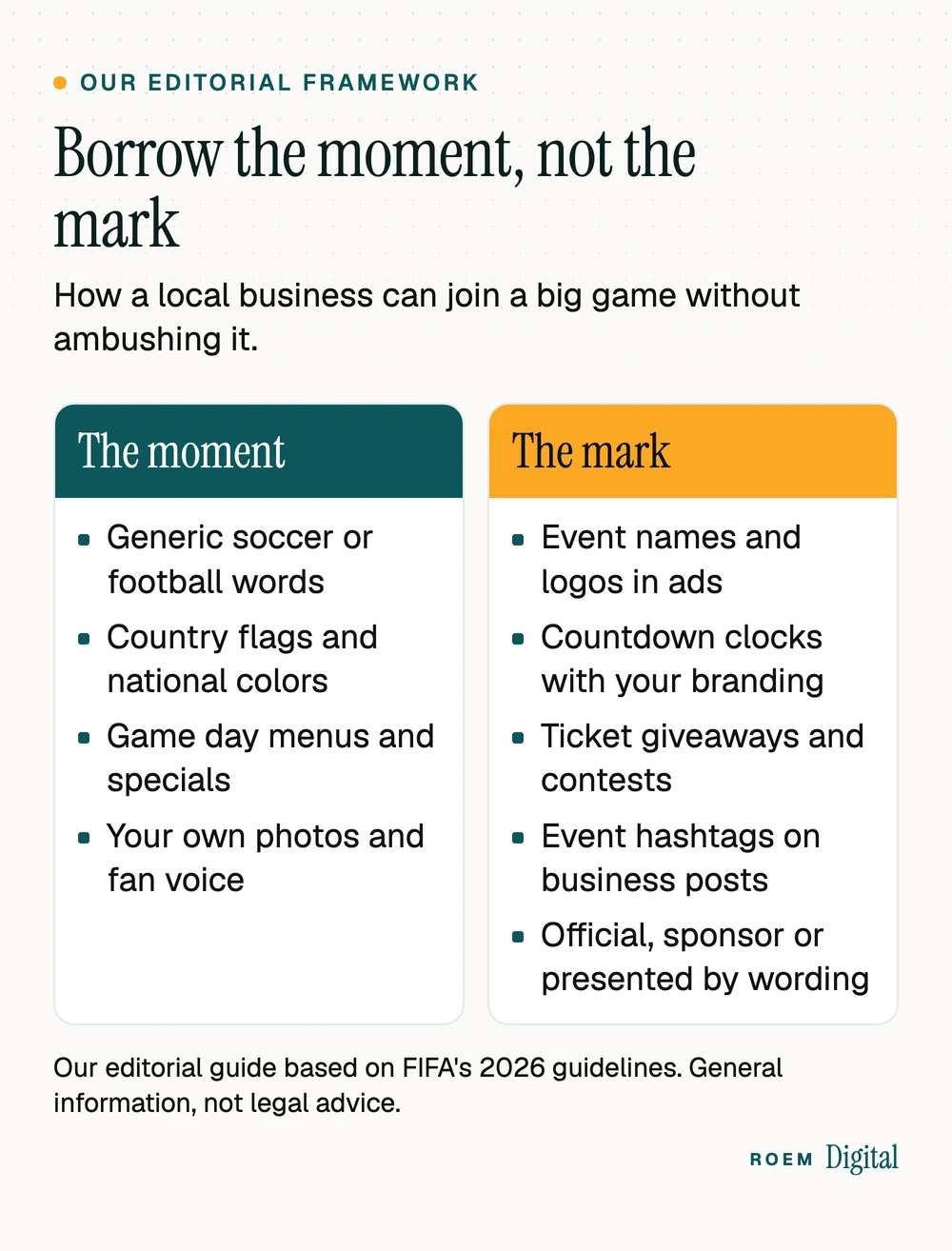
Our editorial rule for any big event is borrow the moment, not the mark. The moment (a summer of soccer, a Sunday of football, a city full of fans) belongs to everyone. The marks (names, logos, slogans, trophies, mascots) belong to the organizer. Ambush marketing problems start when a business reaches for the second to get the first.
| Instead of | Try |
|---|---|
| "World Cup watch party" | "Soccer watch party" or "Cheer for your team here" |
| "Super Bowl Sunday special" | "Game day special" or "Big Sunday wings" |
| "Official World Cup menu" | "Soccer summer menu" with country-themed dishes |
| Event logo on a flyer | Your logo, a generic ball and your brand colors |
| "Countdown to kickoff" graphic with your brand | A plain post about when your doors open on game day |
| Event hashtags on your posts | Your own hashtag, your city and generic sport tags |
| Ticket giveaway | A giveaway of something you sell |
The same rule carries into paid ads and email. Write the offer around your product and the day, and let the timing do the work. If you're deciding where to spend on a short local promotion, our comparison of Meta ads vs Google ads for local businesses explains which channel fits which goal.
A game-day promo plan that avoids ambush marketing
Big games come with a date you know weeks ahead, which makes them easy to plan for. Here's a simple run-up that keeps the focus on your business:
- Pick the offer. Choose something you already sell and decide what makes it a game-day special: a bundle, extended hours, a family-size order.
- Write the words once. Draft the flyer, posts and email using the safer wording above, then have a second person check every piece for event names, logos, slogans and hashtags.
- Update your Google listing. Add special hours if you're opening early or staying late, and a post about the special. Our Google Business Profile checklist covers hours and holiday hours, and our post on Google Business Profile posts covers what to post.
- Schedule the social posts. Write them in a fan's voice and decide who answers comments and messages on the day.
- Count what happened. Compare orders, calls or covers with a normal Sunday so you know whether the next big game is worth the effort. Our guide to the numbers a marketing report should show helps you keep it simple.
None of this needs the event's name. Customers know which Sunday it is.
When to talk to a trademark attorney
This article is general information, not legal advice, and trademark rules vary by country and by event. FIFA's own guidelines suggest seeking independent legal advice to avoid promotional activities that infringe its rights. Talk to a trademark attorney before you:
- Use an event's name, logo, slogan or mascot in any ad, menu, sign or post.
- Name a product, business, domain or social handle after an event.
- Sell merchandise that references an event, a team or a player.
- Partner with an official sponsor and want to mention the event together.
- Receive a cease-and-desist letter or a takedown notice.
If you're naming something new, the USPTO's guide to likelihood of confusion explains why marks don't have to be identical to be confusingly similar. On the marketing side, our social media management service builds a posting calendar around the moments your customers care about, using your own brand.
Frequently asked questions
What is ambush marketing?
Ambush marketing is when a business ties itself to a major event it doesn't sponsor to borrow the event's attention. FIFA defines it as marketing that tries to take advantage of an event's interest by creating a commercial association or seeking promotional exposure without the organizer's authorization, often through event names, ticket giveaways or hints.
Can a business use World Cup in its advertising?
FIFA's guidelines for the 2026 tournament listed World Cup among its word marks and said using official marks in commercial advertisements is likely to create an unauthorized association and should be avoided. Generic football terms, country names and flags were described as acceptable. Ask a trademark attorney before naming any event in an ad.
Can you say Super Bowl in an ad?
The NFL has held the Super Bowl trademark since 1969, and Fox Business reported in 2020 that brands say the big game because they can't name the Super Bowl in advertising without paying the NFL. News reporting is different. If you want to name the game in a promotion, talk to a trademark attorney first.
Is it ambush marketing to host a watch party?
It depends on how you run it. FIFA's guidelines said authorized public viewing events needed a license and had their own regulations, and other public displays of matches should avoid official marks and sponsor-style references. Call it a soccer or game day watch party, and ask a trademark attorney before promoting one.
Can a small business use event hashtags on social media?
FIFA's 2026 guidelines said fans using official marks in hashtags without commercial benefit was generally accepted, but company profiles doing so for commercial benefit created an association reserved for FIFA and its rights holders. A business account is safer with its own hashtag, its city and generic sport tags.
What happens if a business gets caught ambush marketing?
FIFA says it prefers education and direct contact to end an infringing situation, but in serious cases it may take legal action and claim compensation. A sports marketing consultant told Fox Business the NFL's lawyers would likely start with a cease-and-desist letter. If you receive one, talk to a trademark attorney before replying.
How to join big-event buzz on social media without ambushing it
Social media is where most accidental ambush marketing happens, because it's fast and the event hashtag is right there. A few habits keep you on the right side of event trademark rules:
Sports aren't the only events with protected names, so check before you borrow any event's title. Our post on Small Business Saturday ideas covers that day's naming rules. For everyday posting ideas between big moments, see our guide on what a local service business should post.