
Short answer: Rage bait is content built to make people angry so they react, comment and share, and Oxford named it its 2025 Word of the Year. For a local business it backfires: the reach comes from strangers, Meta demotes posts that beg for engagement, and angry outsiders can land in your Google reviews.
What rage bait means, and why Oxford made it its 2025 Word of the Year
Rage bait is content made to annoy you on purpose, so you react, comment or share it. Oxford University Press named rage bait its Word of the Year on December 1, 2025, and defines it as online content "deliberately designed to elicit anger or outrage by being frustrating, provocative, or offensive, typically posted in order to increase traffic to or engagement with a particular web page or social media content."
Oxford's experts chose it from a shortlist with aura farming and biohack, after three days of voting in which more than 30,000 people had their say. They report that usage of the term tripled in the previous 12 months. The phrase first appeared on Usenet in 2002, describing a driver's reaction to being flashed by another driver who wanted to pass.
It's a close cousin of clickbait. Clickbait teases your curiosity to get a click. This goes after your temper to get a reaction. Casper Grathwohl, President of Oxford Languages, described the shift as the internet moving from curiosity in exchange for clicks to "hijacking and influencing our emotions, and how we respond."
The formats are familiar: the deliberately wrong recipe, the "unpopular opinion" written to start a fight, the video of a job done badly so experts pile into the comments. For an account paid by views, that can add up. For a plumber, a spa or a private school, it's a trap. The rest of this guide explains why, and what to post instead. If you want the basics first, start with what a local service business should post.
Rage bait, engagement bait and a real call to action are different things
The rules Meta publishes on this are written around engagement bait, and outrage posts often lean on it. Meta's content distribution guideline on engagement bait covers posts that "explicitly request engagement (such as votes, shares, comments, tags, likes, or other reactions)" for purposes other than a specific call to action. The reason it gives is plain: "Feedback shows people dislike spammy posts on Facebook that ask them to interact." The same guideline says it does not cover posts that ask people to engage to show they do or do not support an issue, so an outrage post about a cause may not be demoted at all. Don't count on the algorithm to protect your reputation.
This isn't new. In a December 2017 newsroom post, Facebook said it would begin "demoting individual posts from people and Pages that use engagement bait" and would add "stricter demotions for Pages that systematically and repeatedly use engagement bait to artificially gain reach." Later updates to that post extended the demotion to comments that contain engagement bait and to videos with engagement bait in the audio.
The same post spells out what's safe. Posts that ask people for help, advice or recommendations, such as circulating a missing child report, raising money for a cause or asking for travel tips, "will not be adversely impacted." The current guideline lists similar exceptions: finding missing people or property, raising money and sharing a petition.
| Post type | What it sounds like | How Meta's rules apply |
|---|---|---|
| Rage bait | A deliberately wrong claim or a jab at a group, posted so people correct you or fight | Judged by what it asks for. If it begs for likes, shares, comments or tags, the engagement bait guideline can cover it, unless it asks people to show support for an issue. |
| Engagement bait | "Comment YES if you agree," "Tag a friend who does this," "Share this with someone who needs it" | Posts that explicitly request engagement without a specific call to action are demoted, a policy Facebook announced in December 2017. |
| A real call to action | "Help us find this lost dog," "We're raising money for the food pantry," "Book Saturday's class here" | Help, advice and recommendation requests are named as safe. A booking link asks for a booking, not a reaction. |
Meta's page on reducing the distribution of problematic content explains the mechanism. Content that doesn't break the Community Standards but might still be problematic can have its distribution reduced, and the page names "clickbait and engagement bait" as low-quality content. In plain terms, the post stays up and fewer people see it. If you need reach beyond your followers, paid ads do that job more predictably, as our comparison of Facebook and Instagram ads vs Google Ads explains.
Why rage bait backfires for a local business
Our contrarian take, and it's editorial judgment rather than a study: for a local business, reach from strangers is a cost, not a win. A viral argument fills your comments with people who will never live in your service area, never book and never refer anyone. The people who might hire you see the argument too, and they see you in the middle of it.
Local service businesses sell trust. A customer is about to let you into their home, onto their skin or into their child's school day. Your feed's job is to answer quieter questions: are you still open, is your work good, do you seem like decent people? An outrage post answers the last one badly.
Likes are not the number that pays you
A post with thousands of angry comments and no calls did nothing for the business. Count calls, form fills, bookings and messages from real prospects instead. Our guide to the five numbers every marketing report should show explains why those beat reactions.
Outrage can spill into your Google reviews
When a post blows up, some angry viewers go looking for your Google Business Profile. Google's rules are on your side here. Its Maps policy on prohibited and restricted content says to post only content based on your experience at a location, and "we don't allow content which contains general, political, or social commentary or personal rants." Google's posting restrictions page adds that posting may be turned off for a place for a short period "to help protect the place or area from a spike in irrelevant or offensive content," for example during a real-world event.
That's a safety net, not a plan. Flagged reviews take time to review, and a page of one-star rants is what new customers see in the meantime. Years of patiently earned Google reviews are worth far more than one week of attention.
The Counter Test: four questions before you post anything spicy
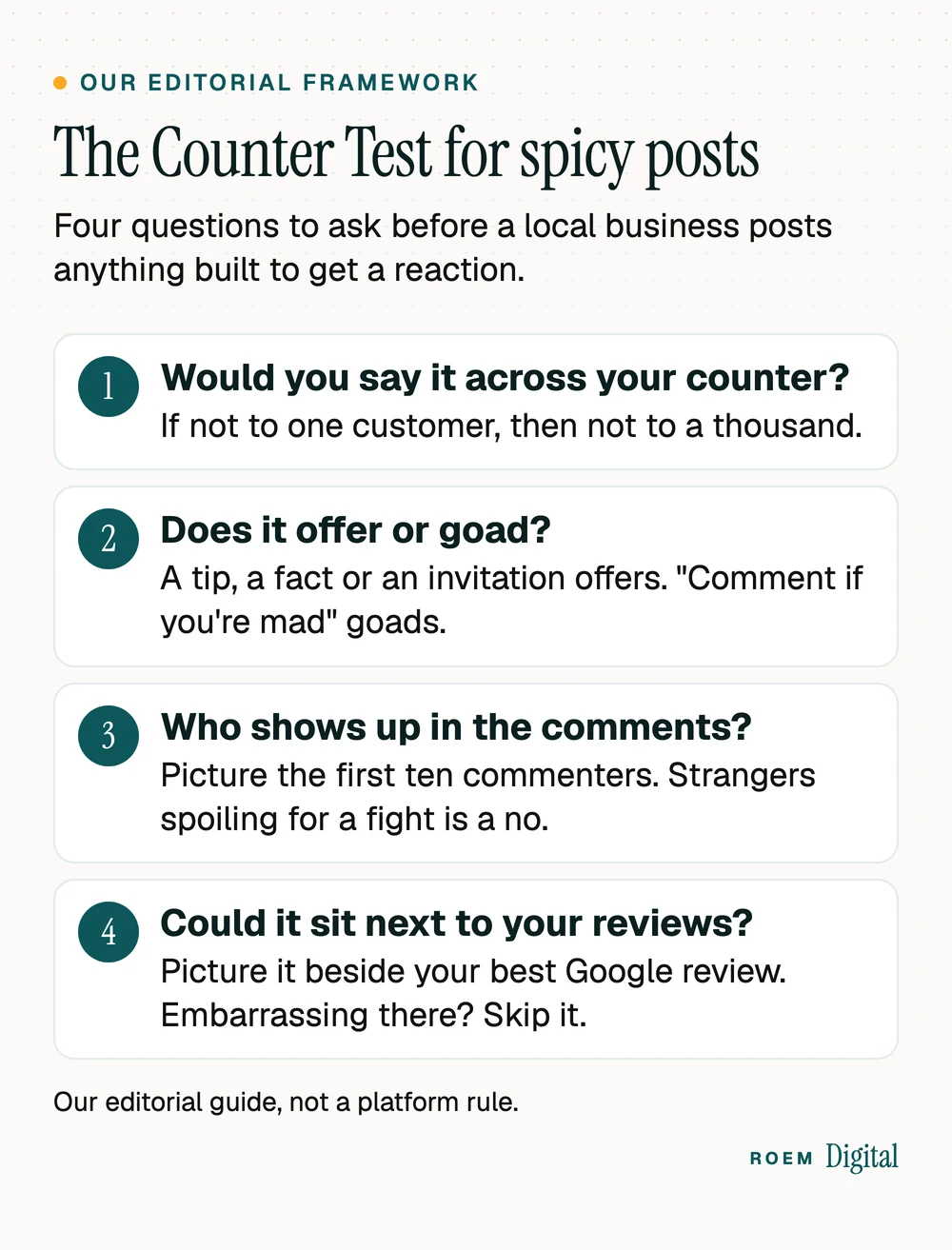
Strong opinions are fine. A painter who refuses to paint over mold, or a groomer who explains why they won't shave a double coat, is sharing expertise customers can use. The line is whether a post is built to inform or built to provoke. We use a four-question check we call the Counter Test. It's our editorial framework, not a platform rule:
- Would you say it across your counter? If you wouldn't say it to one customer standing in front of you, don't post it to a thousand of them.
- Does it offer something or goad someone? A tip, a fact or an invitation offers. "Wrong answers only" and "comment if you're mad" goad.
- Who will show up in the comments? Picture the first ten commenters. If they're strangers spoiling for a fight, the post is working for them, not for you.
- Could it sit next to your reviews? Imagine a screenshot of the post on your Google profile, beside your best five-star review. If it would embarrass you there, skip it.
The test works for news and trends too. Joining a big cultural moment can be fun and good for business with a light touch, and our guide to newsjacking for small businesses shows how to join one without borrowing anyone's name or picking a fight. Slang works the same way: our guide to the 6-7 meme covers when a school or local brand should use Gen Alpha jokes and when to skip them.
What to do when someone rage-baits your business
Sometimes the outrage comes to you: a video mocking your prices, a neighborhood group post about a misunderstanding, a stranger quote-posting your ad. The instinct is to fight back in public. Don't.
- Don't feed it. Every reply, quote or angry comment from you is more engagement for the post you dislike.
- Reply once, calmly, where your customers will see it. One short, factual message on your own page beats ten replies in someone else's thread.
- Take real complaints offline. If a genuine customer is upset, invite them to call or message, and fix it there.
- Report what breaks the rules. Use the platform's reporting tools for harassment, and flag Google reviews that aren't based on a real experience.
- Write down what happened. Dated screenshots help if you need to report posts or reviews later.
- Keep posting normally. A steady feed of real work tells new visitors the business is fine.
If the reviews have already landed, our guide to responding to negative reviews covers what to say and when to stay quiet. Meanwhile, make sure the rest of your Google listing (hours, photos, services) is accurate and current.

How ROEM keeps a local feed busy without the bait
We're a small, senior team based in Davenport, Florida, working with businesses across Central Florida and nationwide. Our social media management starts with strategy and a content calendar built from your real work, then covers the creative, the posting and the day-to-day community management, with reports on what lands. We would rather your post earn five comments from people nearby than five hundred from strangers looking for a fight.
You keep ownership of every profile and every photo. Replies and messages are part of community management, so a post that catches fire, for good reasons or bad, doesn't land on you alone.
“Moving to a new city and rebuilding your business isn’t an easy task, so we turned to Robert to help with our business website, run our social media and help get our Google biz profile back up and running! He was extremely thorough and even came on a job site to take photos for our website. What he built in a short amount of time is amazing. We would absolutely NOT have been able to do any of this without him. We would highly recommend for any website building and project management!!”
Frequently asked questions
What does rage bait mean?
Rage bait is online content designed to make people angry so they react, comment or share it. Oxford University Press named it the Oxford Word of the Year 2025 and defines it as content deliberately designed to elicit anger or outrage, typically to increase traffic or engagement. It targets your temper the way clickbait targets your curiosity.
Is rage bait against Facebook's rules?
Meta's published guidance targets engagement bait: posts that explicitly ask for likes, shares, comments, tags or votes without a specific call to action. Facebook has demoted those posts since December 2017, with stricter demotions for Pages that do it repeatedly. Content that breaks no rule can still have its distribution reduced, so fewer people see it.
What is the difference between rage bait and clickbait?
Clickbait teases curiosity to earn a click, like a headline that hides the answer. Rage bait provokes anger to earn a reaction, like a deliberately wrong claim people rush to correct. Oxford calls clickbait a close parallel, with rage bait focused more specifically on evoking anger, discord and polarization.
Does rage bait work for small businesses?
It can raise views, but views from strangers rarely turn into local customers. A local business sells trust, and a post built to provoke shows prospects an argument with you in the middle of it. Angry viewers can also leave off-topic Google reviews. In our view, steady, useful posts bring more calls than one viral fight.
Can a viral post lead to fake Google reviews?
It can. Angry viewers sometimes find a business on Google Maps and post reviews without ever visiting. Google's policy asks for content based on real experiences and bans general, political or social commentary and personal rants. Flag those reviews, and know that Google may briefly turn off posting for a place during a spike of off-topic content.
How do I get more comments without engagement bait?
Ask real questions you will answer, share tips from your trade, show real jobs and reply to every comment within a business day. Skip lines like comment YES, tag a friend or share if you agree. A few comments from people who have the problem you solve are worth more than a pile of angry reactions.
How to get comments without engagement bait
Comments still matter. You just want them from the right people, for the right reason. The swap is simple: ask a real question you'll actually answer, or give people a reason to reply that helps them.
Then do the part bait never does: reply. Answer questions within a business day, thank people by name, and move anything about price or a complaint to a message or a call. The same habits work for Google Business Profile posts: useful, specific and about your actual business.
Short video helps here. A clip of you answering the question customers ask most often on the phone invites comments from people who actually have that problem. For what Instagram itself has said about ranking, see our notes on the Instagram algorithm in 2026.