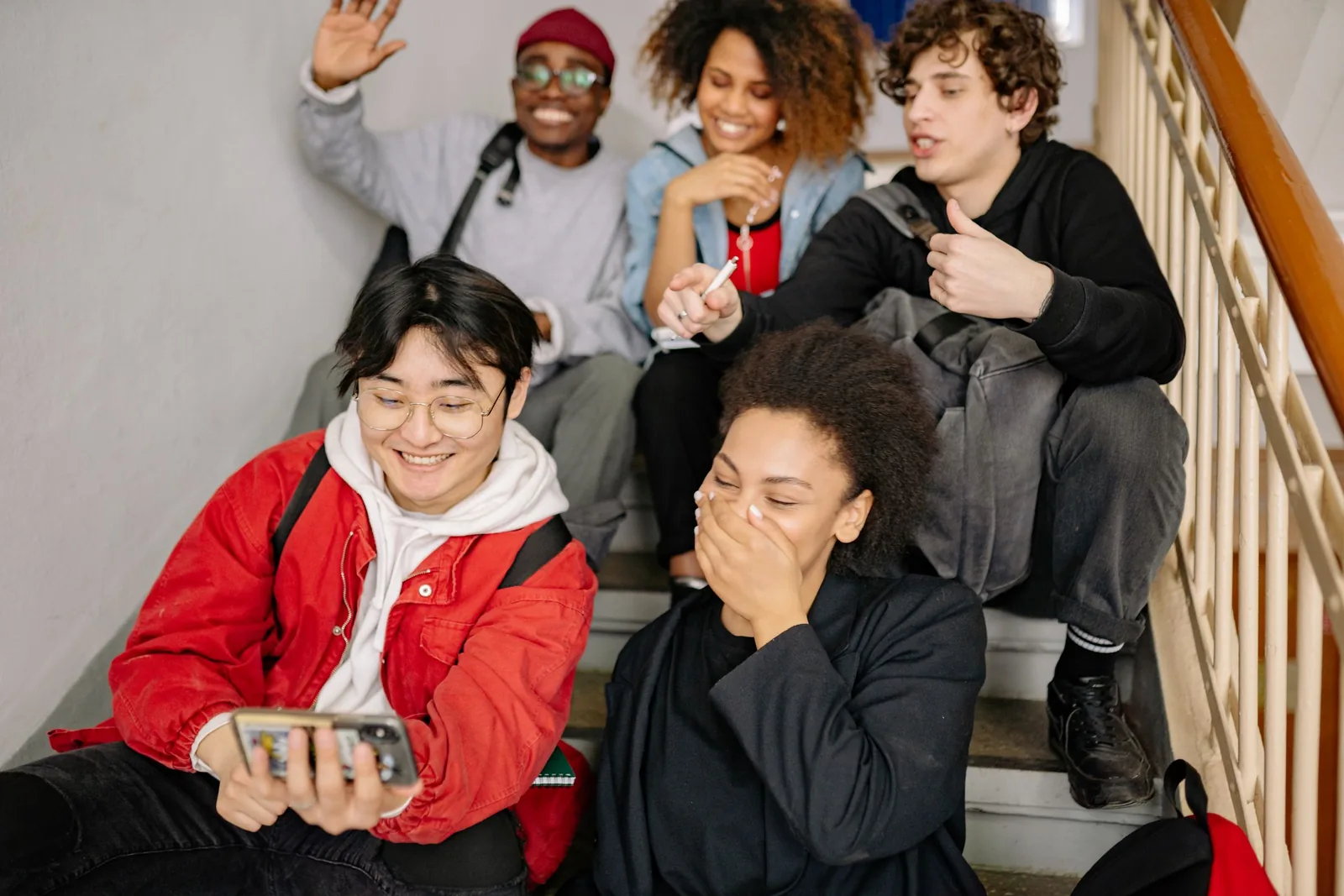
Short answer: The 6-7 meme is "67," said "six-seven," a phrase kids use, often with a palms-up hand gesture, that means almost nothing on purpose. Dictionary.com named it its 2025 Word of the Year. Schools, youth groups and local brands should mostly let kids own it: use it rarely, in a student's voice, and never at a child's expense.
What the 6-7 meme means: officially, nothing
The 6-7 meme is "67," pronounced "six-seven," a slang phrase kids say, often with a hand gesture, that has no fixed meaning. Some use it to mean "so-so." Others use it as an answer to just about any question. Dictionary.com, which named 67 its 2025 Word of the Year in October 2025, put it best: "Perhaps the most defining feature of 67 is that it's impossible to define."
The gesture matters as much as the word. Dictionary.com describes it as both palms facing up and moving alternately up and down. It also offers one firm rule: you may see it written as 67, 6 7, 6-7 or six-seven, but "the most important thing is to never pronounce it as 'sixty-seven.'"
Its rise was fast. Dictionary.com says searches for 67 "increased more than sixfold" from June 2025, while most other two-digit numbers showed no meaningful trend. NPR's report on why 67 has no definition traces it to "Doot Doot (6 7)," a song by the Philadelphia rapper Skrilla released in December 2024, then to viral basketball videos, including clips of LaMelo Ball, the Charlotte Hornets point guard who stands 6 feet, 7 inches tall. From there it spread to other sports and, before long, to schools across the country.
If you run social media for a school, a church or a business with young customers, you've probably already been asked whether you should join in. Short answer: rarely, carefully and in someone else's voice. The rest of this guide explains why, and how. For the basics of a steady feed, see our social media management service or our guide to what a local service business should post.
Why kids love it: belonging, not meaning
Adults find the 6-7 meme baffling because they're looking for the meaning. Kids aren't. Dictionary.com says the word "remains meaningful to the people who use it because of the connection it fosters," and that "a perfectly timed 67 signals that you're part of an in-group."
Parenting expert Becky Kennedy made the same point in an Instagram video NPR quoted: "67 is meaningless in content, but it's not meaningless in feeling." Philip Lindsay, a middle school teacher and comedian, told NPR that every trending meme or word "is a connection point between adults and the adolescents in their life," and that his advice is to know what's going on "and use it to bridge gaps with the kids in your life."
That's the kind way to see it, and it's the right starting point for any school or youth ministry. It also explains why so many teachers grew tired of it. Dictionary.com notes that within weeks, "teachers were trading tips online about how to get their students to stop saying 67 all day long." A word that means belonging to kids can mean a derailed lesson to the adult at the front of the room. Both are true, and the families who follow a private school or a church online include both.
Gen Alpha slang moves faster than any content calendar
Here's our contrarian view, and it's editorial judgment rather than research: the moment a brand account uses kids' slang, the slang has usually started to die. Lindsay predicted exactly this to NPR: "I would imagine after this designation and more people using it, that it is going to start to become cringe to the younger generation." He also thought 67 would linger in classrooms, because numbers are everywhere.
A post lives on long after the joke fades. A school that posts a 67 graphic is still showing it to prospective parents a year later, when the kids in the photo have moved on. Before you borrow any Gen Alpha slang, or the Gen Z words it picks up, check what it means and whether it belongs in front of parents:
| Word | What the source says it means | In a school or church post? |
|---|---|---|
| 67 (six-seven) | "Impossible to define," sometimes "so-so," per Dictionary.com | Rarely, in a student's voice, during a spirit week or a game |
| Aura farming | "The practice of intentionally developing one's presence or vibe," per Dictionary.com's 2025 shortlist | Maybe, for a sports or arts highlight where it genuinely fits |
| Brain rot | Mental deterioration blamed on "overconsumption" of trivial online content, per Oxford's 2024 Word of the Year | Only in a post for parents about screen time, never aimed at a student |
| Rizz | Style, charm or attractiveness, including romantic appeal, per Oxford's 2023 Word of the Year | No. The romantic meaning rules it out for posts about minors |
Origins matter too. Skrilla told XXL, NPR reported, that 67 initially had a negative connotation before it "changed from a negative thing to a positive." Today Dictionary.com calls it meaningless, but checking where a phrase came from is a habit worth building before any slang goes on an official account. The same caution applies to jokes built on mockery or anger, which our guide to rage bait explains.
The Hall Pass test: four questions before slang goes in a post
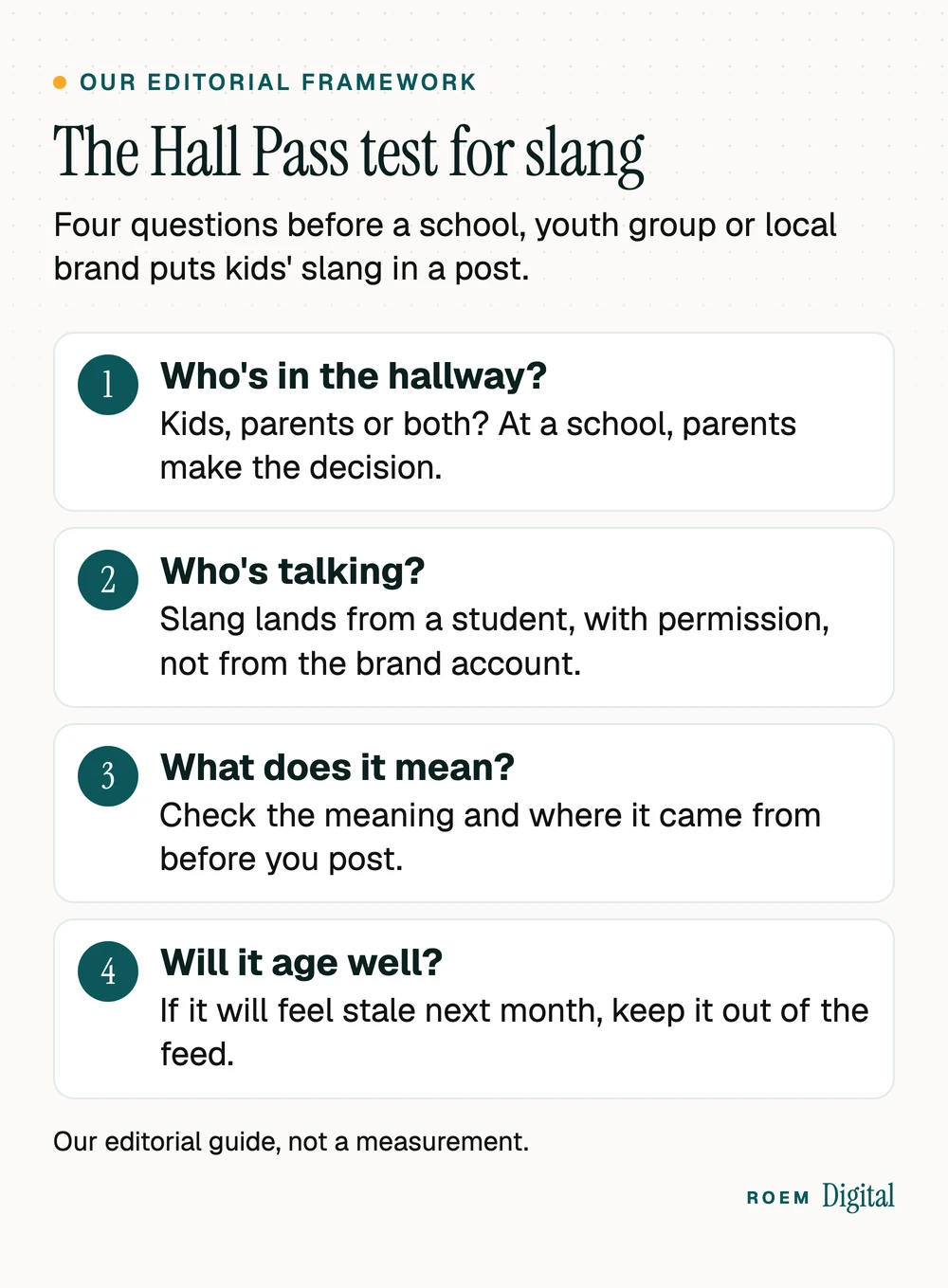
When a staff member or volunteer wants to post a meme, run it through what we call the Hall Pass test. It's our editorial framework for schools, youth groups and local brands, and every answer should come back clean:
- Who's in the hallway? Picture everyone who follows the account. At a private school, the people deciding on enrollment are parents, not students.
- Who's talking? Slang sounds natural from a student, with their family's permission, and forced from a logo. Let kids be the voice.
- What does it mean, and where did it come from? Look it up in a real dictionary before you post, not after a parent emails.
- Will it age well? If the joke will feel stale next month, use Stories, which disappear after a day, instead of a permanent feed post.
The same thinking applies to any trend, not just slang. Our guide to newsjacking covers how to join a big moment without forcing it.
Should a school, youth group or local brand use it? Three different answers
Private schools: talk to parents, let students have the fun
A school's public feed is read by current families, prospective families, alumni and staff. A student-led spirit week video where a class shouts "six-seven" at the end can be charming, if every family has cleared their child's photo first. A 67 graphic from the school's own logo, aimed at parents comparing tuition, usually isn't. Our private school marketing page explains what parents look for online before they call.
Church youth groups: in the room, yes, on the main page, carefully
Youth leaders often use slang in person to connect, which is exactly what Lindsay recommends. Online is different. A youth group account that students follow can play along now and then. The church's main page, which visitors check before their first Sunday, should sound like the church. If you run a youth event, keep the details clear for parents first: dates, location, cost and who to call. We built the site for Youth Revival 2026, and you can see it with our other church and school work.
Local brands: only if kids are already your customers
Most Gen Alpha marketing for a local business is really marketing to their parents. Kids may ask for the frozen yogurt, the trampoline park or the summer camp, but an adult usually books it, pays for it and reads the reviews first.
A frozen yogurt shop that fills up with middle schoolers every afternoon can get away with one well-timed 6-7 meme. An insurance office can't, and shouldn't try. If young customers aren't already walking through your door, slang won't bring them, and it may confuse the adults who do. Keep it out of paid ads entirely, where a dated joke runs for weeks.
If you do use the 6-7 meme, do it like this
- Let a student be the star, with written permission from their family for any photo or video. Our guide to what a local service business should post makes the same point: never post children's faces without clear permission.
- Laugh with kids, never at a kid. Don't repost a child's viral video, and never make one child the punchline.
- Use Stories, not the grid. A joke that disappears after a day is far less likely to embarrass you next semester. Our notes on the Instagram algorithm explain why Stories reach the people who already follow you.
- Do it once. One post is a wink. A campaign is a brand trying too hard.
- Keep it out of ads, emails to prospective families and anything printed.
- Have a reply ready for the parent who asks what it means: "It's an inside joke the kids love. Dictionary.com says it doesn't really mean anything."
Measure the same way you would any post: did it bring messages, tour requests or event sign-ups, or only likes? Our guide to the numbers every marketing report should show explains what to count.
How ROEM helps schools, churches and local brands sound like themselves
We're a small, senior team based in Davenport, Florida, working with organizations across Central Florida and nationwide. We've built websites for Still We Rise Excellence Academy, a Christ-centered Montessori school in Kissimmee, for Solid Rock Community Church and for Youth Revival 2026. Our social media management covers the strategy, the content calendar, the creative, the posting and the day-to-day community management, and for schools every child's photo is cleared by the family first.
We'd rather help you sound like yourselves on every post than borrow the kids' words for one. You keep ownership of every profile and every photo.
“ROEM is a first class all systems partner. Their expertise extends from organizational infrastructure, communications, and digital marketing, to web design, graphic design, IT support, and so much more. Still We Rise Excellence Academy is better because of ROEM!”
Frequently asked questions
What does 6 7 mean?
6 7, said six-seven, is a slang phrase kids use, often with a palms-up hand gesture, that has no fixed meaning. Some use it to mean so-so, and others use it as an answer to just about any question. Dictionary.com named 67 its 2025 Word of the Year and says its defining feature is that it is impossible to define.
Where did the 6-7 meme come from?
NPR traces it to the song Doot Doot (6 7) by the Philadelphia rapper Skrilla, released in December 2024. It spread through viral basketball videos, including clips of 6-foot-7 NBA guard LaMelo Ball, then to other sports and to schools. Dictionary.com says searches for 67 rose more than sixfold from June 2025.
Why do kids say 6 7?
Mostly for the feeling of belonging. Dictionary.com says 67 stays meaningful to the people who use it because of the connection it fosters, and that a well-timed 67 signals you are part of an in-group. A parenting expert quoted by NPR put it this way: it is meaningless in content but not in feeling.
Should a school use the 6-7 meme on social media?
Rarely, and in a student's voice rather than the school's. A student-led spirit week video can work if every family has cleared their child's photo. Avoid it in posts aimed at prospective parents, in ads and in print, because slang ages quickly and parents are the ones choosing a school.
Is 6 7 a bad word?
It is not profanity, and Dictionary.com describes it as meaningless. The rapper who coined it told XXL, as NPR reported, that it started with a negative connotation and changed to a positive one. Dictionary.com notes that teachers traded tips on getting students to stop saying it all day, which is about classroom focus, not meaning.
What is Gen Alpha slang?
Gen Alpha slang is the shifting set of words and inside jokes used by today's kids and young teens, such as 67. It moves fast, often borrows from music, sports clips and online videos, and, as one teacher told NPR, can start to feel cringe once adults pick it up, so check a word before borrowing it.