Short answer: The Instagram algorithm is several: Feed, Stories, Explore and Reels each rank posts by predicting what you'll do next, according to Instagram. In 2026 Instagram extended its originality rules to photos and carousels and its topic controls across the app. For a local business, that means original video for reach, real work in the feed and Stories for regulars.
How the Instagram algorithm works: there isn't just one
The Instagram algorithm is a set of separate ranking systems, one each for Feed, Stories, Explore and Reels, that predict what each person is most likely to watch, like or share. Adam Mosseri, the head of Instagram, put it plainly in Instagram Ranking Explained on May 31, 2023: "Instagram doesn't have a singular algorithm that oversees what people do and don't see on the app."
That post is still Instagram's own reference on ranking, and it lays out the steps. Instagram gathers the posts it could show you, looks at thousands of signals, then makes "educated guesses" about how you'll respond. In Feed, Mosseri wrote, "the five interactions we look at most closely are how likely you are to spend a few seconds on a post, comment on it, like it, share it, and tap on the profile photo."
The Feed signals, roughly in order of importance, are your activity, information about the post, information about the person who posted, and your history of interacting with them. So the algorithm isn't judging your business in the abstract. It's asking, person by person, whether this viewer is likely to care. That's good news for a local business with real work to show. If you're starting from zero, read what a local service business should post first.
The Instagram algorithm in 2026: originality and Your Algorithm
Two changes Instagram announced on its own pages matter most in 2026. Here they are by date, with what each means for a local business:
| Date | What Instagram announced | What it means for a local business |
|---|---|---|
| December 10, 2025 | Your Algorithm for Reels: people can see an AI-generated summary of the topics shaping their recommendations and add or remove topics | Viewers can now ask for more of a topic. Posts that are clearly about one thing are easier to match. |
| April 15, 2026 | Your Algorithm extended from Reels to Explore | The same topic controls now shape Explore, where most of what people see comes from accounts they don't follow. |
| April 30, 2026 | Originality rules extended from reels to photos and carousels. Accounts that mostly re-upload others' work lose recommendations. | An account that mostly reposts other people's photos and memes unchanged can lose reach to new people. Your own photos and video keep you eligible. |
| June 10, 2026 | Your Algorithm live across all of Instagram, including Feed, Reels and Explore | Topic consistency matters everywhere, not only in Reels. |
Instagram's April 30 post, Rewarding original creators on Instagram, says "75% of recommendations in the US now coming from original posts" and that content aggregators "will no longer be eligible for recommendations across Instagram." It also says the update "does not impact how we show people content from accounts they follow." An account can become eligible again when a significant percentage of its recent posts are original over a 30-day period.
The Your Algorithm announcement describes the controls in Instagram's words: people can "view an AI-generated summary of the topics influencing the posts and recommendations you see" and "tell us what you want to see more or less of, or add new topics entirely." If you're tempted to fill gaps with generic, machine-made filler, our piece on AI slop explains why that's a poor trade.
What each part of Instagram rewards, in Instagram's own words
Each part of the Instagram algorithm has its own predictions and signals. This table pulls them from the ranking post above, with a practical note for a local business in the last column:
| Surface | What Instagram says it weighs | What to post |
|---|---|---|
| Feed | Whether you'll spend a few seconds on a post, comment, like, share or tap the profile photo | Clear photos and carousels of finished work, with captions that answer a real question |
| Stories | Viewing history, engagement history and closeness to the account | Everyday moments for people who already follow you, with replies welcome |
| Explore | Likes, saves and shares, with popularity mattering "much more" than in Feed or Stories | Save-worthy posts: checklists, before and afters, how-to carousels |
| Reels | Whether you'll reshare a reel, watch it all the way through, like it or open its audio page | Short, complete videos worth finishing and sending to a friend |
The same post lists what Instagram makes "less visible" in Reels: "low-resolution or watermarked reels, reels that are muted or contain borders, reels that are majority text, or reels that have already been posted on Instagram." That rules out a lot of lazy habits at once, like reposting a clip with another app's watermark or turning a flyer into a text-only reel. Instagram also says it surveys people with the question "is this post worth your time?" and learns from the answers, which is a good test to run on your own drafts.
Organic reach to new people is never certain. When you need to reach your service area on a schedule, ads do that job, and our comparison of Facebook and Instagram ads vs Google Ads explains when they make sense.
Stop chasing reach: the followers you have are the ones who book
Here's our contrarian view, and it's editorial judgment rather than an Instagram rule: most local businesses should spend less energy trying to beat the Instagram algorithm with a viral hit and more on the people who already follow them. A reel that reaches a stranger across the country does nothing for a pool cleaner in Kissimmee. A Story that reminds a past customer you exist can turn into a booking this week.
Instagram's own description supports the logic. Stories are ranked on viewing history, engagement history and closeness, so the people who already watch and reply to you see you first. Its originality update doesn't change how followers see your posts. And everything a follower does, from replying to a Story to sharing a post, feeds the signals that decide what they see next.
Reach still matters, but chase the local kind. Original Reels about your area and your work, shared by customers to their friends nearby, are worth far more than a viral clip that fills your comments with people who can't hire you, which our guide to rage bait explains in more detail.

The three-lane plan: a weekly Instagram routine for a local business
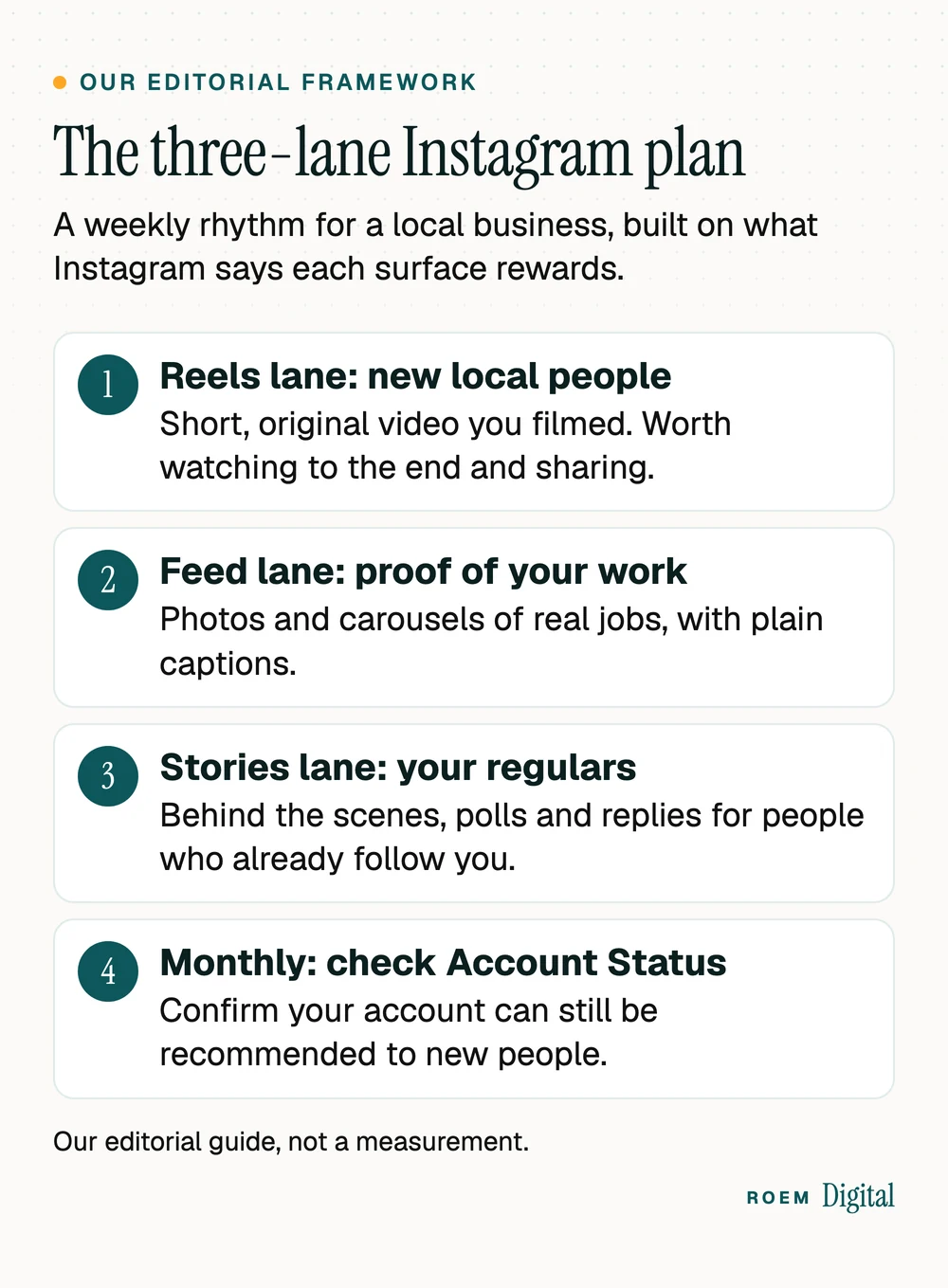
We call this the three-lane plan. It's our editorial framework, built on what Instagram says each surface rewards, sized for an owner who has a business to run. If you'd rather not run all three lanes yourself, our social media management can take them on:
- Reels lane, for new local people. One or two short, original videos a week that you filmed: a job from start to finish, a 30-second answer to a question customers ask, a quick tour of your space.
- Feed lane, for proof. One or two photo or carousel posts a week of real, finished work, with plain captions that name the service and the general area.
- Stories lane, for regulars. A few Stories most days you're open: behind the scenes, a poll, a reshared customer post with permission, a reminder of open dates.
- Monthly check. Open Account Status. Instagram calls it "the best way to understand if your account and content is eligible to be recommended."
| Day | Lane | Example for a local business |
|---|---|---|
| Monday | Stories | The first job of the week, before the work starts |
| Tuesday | Reels | A 30-second answer to the question customers ask most |
| Thursday | Feed | A carousel of finished work with a two-line caption |
| Friday | Stories | A poll or a question box, then replies to every answer |
| Weekend | Stories | A customer's post about you, reshared with permission |
Instagram for small business: what to skip and what to check
Most Instagram algorithm problems for small businesses come from a handful of habits that Instagram has already said it discourages. Skip these:
- Reposting other accounts' content as your own. Instagram's original content guidelines say that if your account primarily posts unoriginal reels, photos or carousels, it "may not be seen in recommendations to new audiences." Share others' posts to your Stories instead, which the same page recommends.
- Watermarked, bordered or text-heavy reels. Film in the Instagram app or export a clean file, and let the video carry the message.
- Engagement bait. "Comment YES" posts are the kind Meta has demoted on Facebook since 2017, as our rage bait guide explains.
- Chasing every trend. Join a trend only when it fits your business, using the checks in our newsjacking guide.
Then check the things that turn attention into customers. Your profile link should go to the page that takes a booking or a call, not just the homepage. Count calls, messages and bookings from Instagram, not only likes, as our guide to the numbers every marketing report should show explains. Tag the link in your profile with UTM parameters so your analytics show which visits, calls and forms came from Instagram.
How ROEM runs Instagram for local businesses
We're a small, senior team based in Davenport, Florida, working with businesses across Central Florida and nationwide. Our social media management covers the strategy, the content calendar, the creative, the posting and the day-to-day community management, with reports on what's resonating so the plan keeps improving. We build the calendar around your real work and your busy season, not around the latest algorithm rumor.
You keep ownership of every profile and every photo. If we ever part ways, the account and everything in it stay with you.
Frequently asked questions
How does the Instagram algorithm work in 2026?
Instagram uses separate ranking systems for Feed, Stories, Explore and Reels. Each predicts how likely a person is to interact with a post, such as watching, liking, sharing or tapping the profile. In 2026 Instagram also extended its originality rules to photos and carousels and its topic controls across the app.
Does Instagram show my posts to my followers first?
Feed mixes posts from accounts you follow with recommendations, and Stories come from accounts you follow, ranked by viewing history, engagement and closeness. Instagram says its April 2026 originality update does not change how it shows people content from accounts they already follow, so steady posting for followers still matters.
What content does Instagram make less visible?
Instagram says it makes reels less visible when they are low resolution, watermarked, muted, bordered, mostly text, or already posted on Instagram. Since April 30, 2026, accounts that mostly re-upload other people's photos or carousels, not just reels, can lose eligibility for recommendations to people who don't follow them.
How often should a small business post on Instagram?
Instagram's ranking explainer doesn't name an ideal number. Post at a pace you can keep through your busy season. A workable rhythm for many local businesses is one or two Reels, one or two feed posts and a few Stories each week, adjusted to what brings in messages and bookings.
What is Your Algorithm on Instagram?
Your Algorithm is an Instagram feature that shows an AI-generated summary of the topics shaping your recommendations and lets you ask for more or less of a topic or add new ones. It launched for Reels in December 2025, reached Explore in April 2026 and went live across all of Instagram in June 2026.
How do I know if Instagram is limiting my reach?
Check Account Status in your Instagram settings. Instagram calls it the best way to understand whether your account and content are eligible to be recommended. If your account is ineligible for recommendations under the originality rules, Instagram says you can remove the content in question or appeal its decision.