
Short answer: AI slop is low-quality content produced in bulk with AI and published without real checking. Merriam-Webster named "slop" its 2025 Word of the Year. Google doesn't penalize content for using AI, but mass-producing pages to game rankings breaks its spam policies, so check every AI-assisted page before it goes live.
What AI slop means, and why slop became the word of 2025
AI slop is low-quality content made in bulk with AI and published with little or no human checking. Think generic blog posts, images of things that don't exist and filler copy that could describe any business in any town.
Merriam-Webster put the word on the record. As Fortune and The Associated Press reported on December 15, 2025, the dictionary named "slop" its 2025 word of the year. The word first meant soft mud in the 1700s, and the newer definition describes low-quality digital content "produced usually in quantity by means of artificial intelligence." Merriam-Webster's president told the AP that the spike in lookups showed people have grown more aware of fake or shoddy content, and want the opposite.
That last point matters for a small business. Your customers now have a word for the content they skip. If your website, blog or social posts read like slop, they'll treat you the way they treat it. Our free AI Marketing Playbook is a practical guide to using AI with a person in charge of every step.
Is AI content bad for SEO? What Google actually says
No, not by itself. Google's guidance about AI-generated content, published on February 8, 2023, says "Appropriate use of AI or automation is not against our guidelines." On rankings, it's just as plain: "Using AI doesn't give content any special gains. It's just content." What Google objects to is using automation, AI included, to produce content mainly to manipulate rankings, which the same post calls a violation of its spam policies.
Google's spam policies name the problem "scaled content abuse": "when many pages are generated for the primary purpose of manipulating search rankings and not helping users." The first example listed is "Using generative AI tools or other similar tools to generate many pages without adding value for users."
| Within Google's guidance | Against Google's spam policies |
|---|---|
| Using AI to research a topic or structure your own original content | Generating many pages with AI without adding value for users |
| A useful page that AI helped draft and a person fact-checked | Content made mainly to manipulate search rankings, however it's produced |
| A disclosure of how content was made, where readers would expect one | Stitching together content from other pages without adding value |
| Accurate bylines where readers would ask who wrote it | Many pages that make little sense to a reader but contain search keywords |
Google's guidance on generative AI content, updated on October 1, 2026, adds the practical rule: "It is critical to manually factcheck and review all AI-generated content for accuracy and trustworthiness before publishing." It applies that review to the small things too: title elements, meta descriptions, structured data and image alt text. If you'd rather not police every draft yourself, our SEO and content service covers content optimization and blogs.
On disclosure, Google's AI guidance says notes about AI or automation "are useful for content where someone might think 'How was this created?'" and suggests adding them when readers would reasonably expect it. Its generative AI page also points to the Search Quality Rater Guidelines, which tell human raters how to judge main content created with little effort, originality or added value. Google adds that those raters' ratings don't directly influence ranking, but the guidelines show plainly what Google means by low quality.
Slop is a volume problem, not an AI problem
Here's the angle most coverage misses: the dictionary and Google both put volume at the center. Merriam-Webster's definition names AI, but it hinges on content made "usually in quantity." Google's scaled content policy applies "no matter how it's created." Google's 2023 AI guidance recalls an earlier wave of mass-produced content written by people, about 10 years before that post, and says the answer then was to reward quality rather than ban a method.
So the useful question for a small business isn't "Did AI write this?" It's "Would this page exist if search engines didn't?" A page written to answer the question your customers ask on the phone passes, whoever typed the first draft. Fifty near-identical city pages fail, even if a person wrote every one. The same logic decides which pages AI answers quote, as our guide to showing up in AI search explains: engines cite specific, checkable pages, not interchangeable ones.
You can hear the difference in a single sentence. Compare two lines a plumbing company might publish. Slop: "We provide top-quality plumbing services tailored to your unique needs." Specific: "We lay drop cloths from your front door to the water heater, and we haul the old tank away the same day." The second one could only come from a business that does the work, and that's exactly what readers and search engines are looking for.
The sign-off test: four checks before you publish AI-assisted content
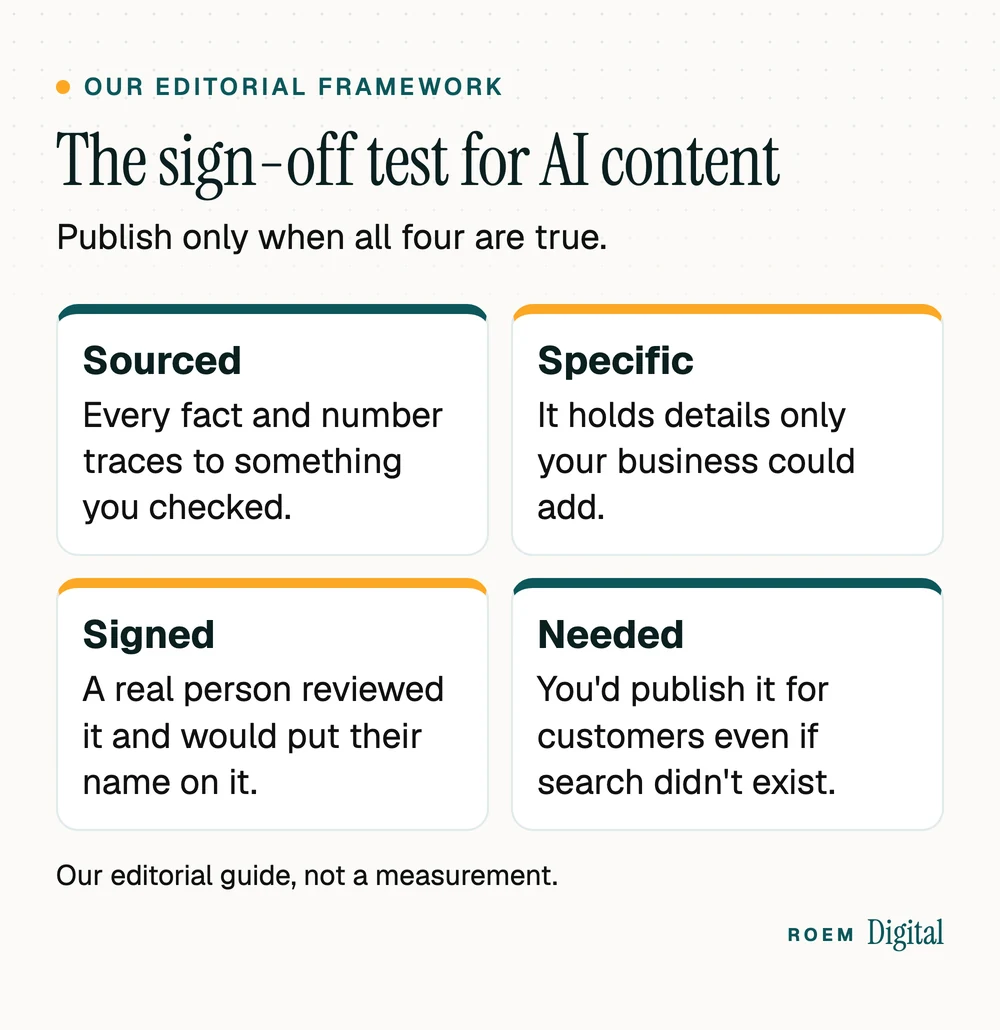
Here's a simple gate we call the sign-off test (our editorial framework, built on Google's guidance). A page goes live only when all four checks pass:
- Sourced. Every fact, number, price, date and claim traces to something a person checked. Google warns that generative models "don't retrieve facts" and that outputs may contain hallucinations.
- Specific. The page holds details only your business could add: your process, your photos, the areas you serve, the questions customers actually ask. Google's helpful content questions ask whether a page provides "original information, reporting, research, or analysis."
- Signed. A real person reviewed it and would put their name on it. Google suggests bylines where readers would ask who wrote something, and says giving AI an author byline "is probably not the best way" to be clear about AI's role.
- Needed. You'd publish it for your customers even if search didn't exist. Google's warning signs include "producing lots of content on many different topics in hopes that some of it might perform well."
"Specific" is the check most AI drafts fail, and it looks different for each kind of content:
| Content | What specific looks like |
|---|---|
| Service page | Your process step by step, what's included, the towns you serve and photos of real jobs. Our 12 must-haves for a service business website lists the rest. |
| Blog post | A question a customer asked this month, your answer and an example from your own work |
| Google Business Profile post | This week's real offer, event or finished job, with your own photo. See our guide to Google Business Profile posts. |
| Social post | A real photo or video from your business, never an AI image passed off as your work |
| Email to customers | News only you can share: a schedule change, a new service, a seasonal reminder |
Signs of AI slop on a small business website
Slop rarely announces itself. On a local business site, it usually looks like this:
- City pages that differ only by the town name. Our guide to local SEO for service-area businesses explains what a useful city page includes instead.
- Blog posts about services you don't offer, written because a keyword tool said people search for them.
- Answers with no names, numbers or places, the kind that could sit on any competitor's site unchanged.
- Facts nobody checked: an old phone number, a service you dropped, a statistic with no source.
- AI images posing as real work, such as a "team photo" of people who don't work for you or a finished job you never did.
- AI-written reviews or testimonials, which you should never publish. Our guide to AI for small business marketing covers the rules on fake reviews.
Writing is where most slop starts, and where it's easiest to fix. If you write your own pages, our website copywriting guide shows how to pull words from real customer calls and reviews instead of a blank prompt.
Online stores have one more rule to know. Google's generative AI guidance notes that Google Merchant Center requires AI-generated product images to carry IPTC DigitalSourceType TrainedAlgorithmicMedia metadata, and AI-generated product titles and descriptions to be specified separately and labeled as AI-generated. If you sell through Google Shopping, check those labels before you upload a single AI image.
How to fix AI slop you've already published
The next problem is the backlog: pages you or a past vendor published in bulk. Work through them in this order:
- List every page from your sitemap and Search Console, and mark the ones produced in bulk or never reviewed.
- Run each one through the sign-off test. Note which check fails.
- Improve the pages worth keeping: add the specifics, verify every fact, put a reviewer's name on them.
- Merge near-duplicates into one stronger page, and redirect the old addresses to it.
- Remove or exclude what can't be saved. Google's spam policy says that if you host scaled content, you should "exclude it from Search."

Google's core update guidance makes a related point about cleanup: if you're thinking of deleting whole sections of a site, those sections were likely made for search engines first, and removing unhelpful content can help the good content perform better. If a ranking drop sent you looking, check our guide to what to do after a Google core update first, and expect improvements to take time.
Publish less, make it specific, and put a name on it
AI can make a small business faster without making it sloppier. Use it to outline, to draft from your own notes and to check your writing, then hold every page to the sign-off test. One specific, checked page will do more for you than ten interchangeable ones.
We're a small senior team based in Davenport, Florida, working with businesses across Central Florida and nationwide. Our SEO and content service covers keyword research, content optimization and blogs, written for people first. You own your domain, your website and your analytics accounts.
Frequently asked questions
What does AI slop mean?
AI slop is low-quality digital content produced in bulk with artificial intelligence and published with little human checking, such as generic articles, fake-looking images and filler copy. Merriam-Webster named slop its 2025 word of the year, with a definition centered on low-quality digital content usually produced in quantity with AI.
Is AI-generated content bad for SEO?
Not because AI made it. Google says appropriate use of AI is not against its guidelines and that using AI gives content no special gains. Problems start when many pages are produced mainly to manipulate rankings without adding value, which Google's spam policies call scaled content abuse.
Can Google detect AI-generated content?
Google's guidance doesn't describe any check for whether text was AI-written. It focuses on quality rather than method, and says its systems, including SpamBrain, look for spam however it's produced. The practical takeaway: don't count on hiding AI use, and don't worry about it either. Make every page accurate, specific and useful.
Should I disclose that I used AI to write content?
Google says AI or automation disclosures are useful where someone might reasonably wonder how a piece of content was created, and suggests adding them when readers would expect it. It also says listing AI as the author is probably not the best approach. A named person who reviewed the page is clearer.
How can a small business use AI without creating slop?
Use AI for outlines, first drafts from your own notes and editing help, then have a person check every fact and add details only your business knows. Publish only pages you would want customers to read even if search engines didn't exist, and put a reviewer's name on each one.
When was slop named word of the year?
Merriam-Webster announced slop as its 2025 word of the year on December 15, 2025, as reported by Fortune and The Associated Press. The dictionary's newer sense of the word covers low-quality digital content usually produced in quantity by artificial intelligence. The word originally meant soft mud, dating to the 1700s.