
Short answer: Good website copywriting tells a visitor what you do, where, for whom, why to trust you and what to do next, in plain words they can scan on a phone. Write each page in the order a good first phone call goes, use your customers' own words, and cut anything that sounds like an ad.
What website copywriting has to do for a service business
Website copywriting is the words on your pages that turn a visitor into a call, booking or quote request. For a service business, good copy answers five questions fast: what you do, where you do it, who it's for, why to trust you and what happens next.
That's it. Nobody hires a plumber because the homepage said "excellence." They call because the page said what the plumber fixes, which towns they cover, how fast they come out and what the first visit costs to book. The rest of this guide is how to write that, page by page, without a copywriter.
If your site is also missing pieces (a tap-to-call number, service pages, reviews), start with our list of 12 things every service business website needs. Copy can't fix a page that isn't there.
How people read website copy: mostly, they scan
Write for scanning, because that's what visitors do. In a 1997 article now published by Nielsen Norman Group, Jakob Nielsen reported that 79% of test users always scanned a new page and only 16% read word by word. In the same research, a version of a site that was concise, scannable and objective scored 124% better on measured usability than the promotional original.
The pattern has held up. NN/g's later eyetracking work on the F-shaped pattern found it still applies on desktop and on mobile: first lines get more attention than later ones, and the first few words on the left of each line get more attention than the rest. It also describes a layer-cake pattern, where readers scan headings and skip the text below. What that means for your copy:
- Put the point in the first words of every heading, paragraph and bullet.
- Write headings that work alone, since some readers will only read those.
- Keep one idea per paragraph, and keep paragraphs short on a phone.
- Start bullets with different words. NN/g notes that readers skip the opening words when every line in a list starts the same way.
- Bold the few words that carry the answer, not whole sentences.
The same research found users disliked "marketese," boastful promotional claims, and that credibility suffers when a site plainly exaggerates. That's the best argument for cutting adjectives.
On a phone, a short desktop paragraph turns into a long block of text, so check your analytics to see how many of your visitors arrive on one. People who click an ad came for one specific answer, which is why ads should never send people to your homepage.
How to write website copy: the phone-call outline
Most owners already know how to sell their service. They do it on the phone every day. So write each page in the order a good first call goes. This outline is our editorial judgment rather than a published formula: what and where, who it's for, how it works, proof, price, next step.
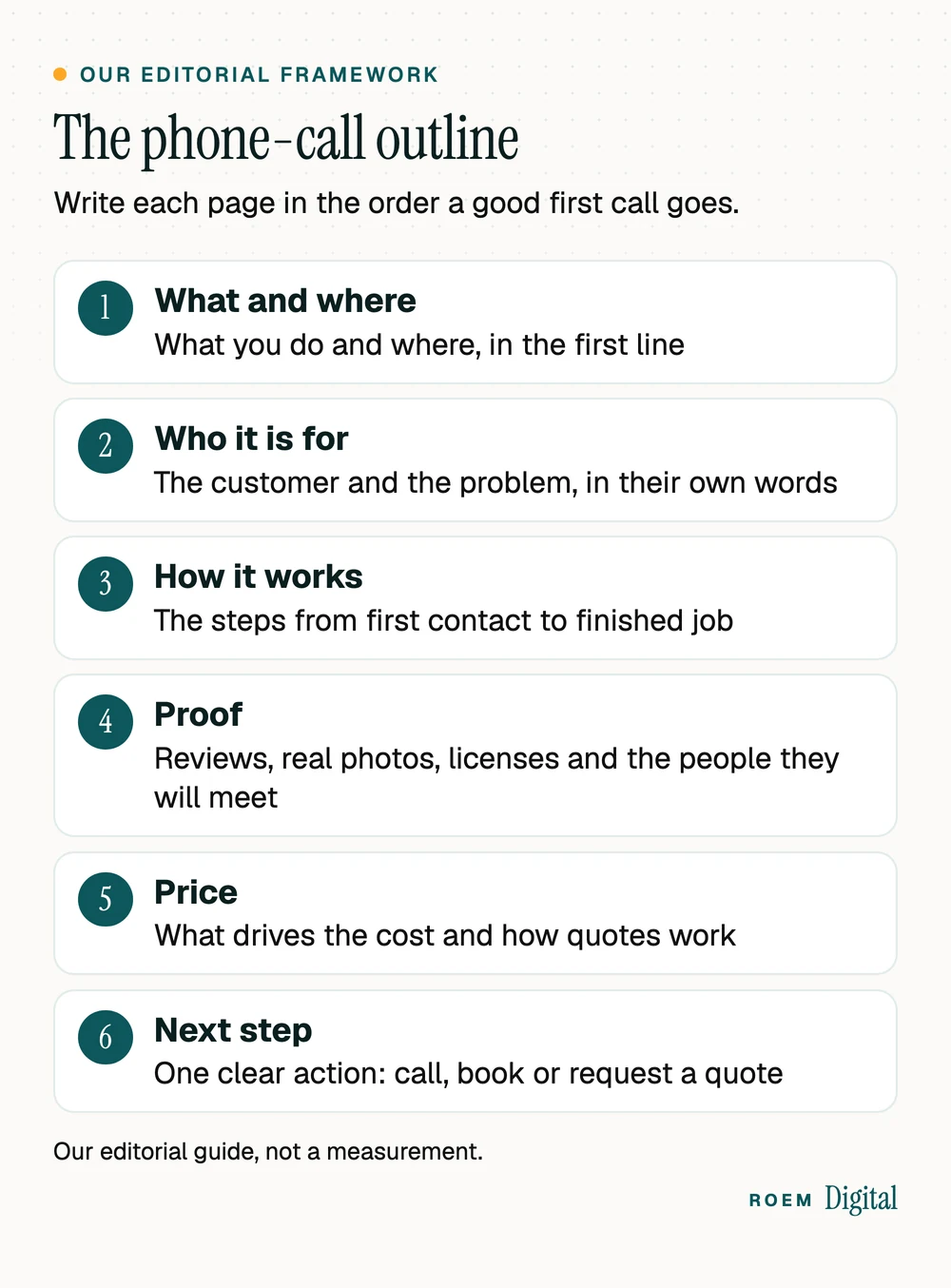
- What and where. The first line names the service and the area. "Cabinet painting in Madison" beats "Transforming spaces."
- Who it's for. Describe the customer and the problem in their words: the dated oak kitchen, the AC that quits in July.
- How it works. List the steps from first contact to finished job, so nobody wonders what happens after they call.
- Proof. Reviews near the button, real photos of real work, licenses, and the faces of the people who'll show up.
- Price. If you can't list prices, explain what drives the cost and how quotes work. Silence reads as expensive.
- Next step. One clear action, repeated: call, book or request a quote.

You can run the outline on one page of your own site tonight. If you'd rather hand the whole site off, see our brand and web services.
Find your website copy in reviews and phone calls, not a thesaurus
The best website copy is mostly borrowed from your customers. Before you write a page, collect their words:
- Your reviews. Copy every phrase customers use to describe the problem and the result. Those are the words the next customer will search.
- Your phone calls and emails. Write down the first question people ask. That question becomes a heading.
- Search Console. The Performance report lists the searches your pages already show up for. If people search "cabinet refinishing" and your page says "cabinet restoration," change the page.
- Your own answers. Record yourself explaining the service to a new customer, then transcribe it. It's usually better copy than anything you'd type.
This is the same research our SEO and content work starts with: what customers actually search, matched to pages that answer it. If you don't have many reviews to mine yet, our guide to getting more Google reviews helps.
Website copywriting tips: before and after rewrites
Plain language isn't dumbing down. Digital.gov's plain language guide says content is easier to understand with shorter words, short sections, active voice and present tense. Active voice, it adds, makes it clear who should do what. Here's what that looks like on a service site:
| Before | After | Why it works |
|---|---|---|
| We are a premier provider of comprehensive HVAC solutions. | We repair and replace AC systems in Kissimmee and St. Cloud. | Names the service and the towns |
| Quality and customer satisfaction are our top priorities. | Every job ends with a walkthrough before you pay. | Shows the promise instead of claiming it |
| Appointments can be scheduled via our online portal. | Book online anytime, or call and we'll book it for you. | Active voice and two clear options |
| Pricing is determined on a case-by-case basis. | Price depends on the size of the room and the condition of the walls. We quote in writing before we start. | Explains what drives cost without a number |
| Learn more | See our cabinet refinishing process | Tells people where the link goes |
Read each page out loud before it goes live. If you wouldn't say a sentence to a customer standing in front of you, rewrite it.
A ten-minute edit for any page
- Delete the first paragraph if it's a warm-up. The second one usually says what you do.
- Replace every adjective you can with a fact: a town, a step, a time frame, a warranty you really offer.
- Turn passive sentences into active ones, so it's clear who does what.
- Split any paragraph that looks like a wall on your phone.
- Make every button say what happens next: call, book, get a quote.
Button and link wording is one of the cheapest things to change, so measure it. Our guide to website conversion rate shows how to tell whether a rewrite brought in more calls.
What to write on each page of a small business website
- Homepage: the service and area in the first line, your top services as links, proof, and one main button. It's a signpost, not the place to explain everything.
- Service pages: one page per main service, written with the phone-call outline. Give them the most time, since they answer the questions that come right before a call.
- About page: who you are, why you do the work and who they'll meet. Our post on about us page examples shows what works.
- Service area pages: only where you have something true and specific to say about the place.
- Contact page: the phone number, the form, what happens after someone submits it and how fast you reply.
Start with the pages that get the most visits or the most calls, not the homepage. A rewrite of your top service page usually matters more than a new tagline.
One website copywriting habit pays off on every page: write each heading as the customer's question, or as the answer to it. "How much does cabinet refinishing cost?" tells a scanning reader exactly what's below. "Our pricing philosophy" tells them nothing, and they'll scroll past it.
Website copy for search: write for people, then check the words
Google's guidance on creating helpful, reliable, people-first content asks whether your content shows first-hand expertise and leaves readers feeling they've learned enough to reach their goal. It also answers the length question directly: asked whether you're writing to a word count because Google has a preferred one, it says it doesn't.
- Use the service name your customers search in the page title, the main heading and the first paragraph, once each, where it reads naturally.
- Answer the questions people ask on calls, in the words they use.
- Show first-hand detail only you can give: your process, your photos, your area.
- Cut sections that exist only to repeat a keyword.
AI tools can help you outline or tighten a draft, but pages that read like everyone else's won't win the call. Our post on AI slop covers how to use AI without publishing generic copy.
When to write it yourself, and when to get help
Write it yourself if you know the work, can describe it the way you'd say it on the phone and have an afternoon per page. Get help when the copy keeps coming out generic, when you're also rebuilding the site, or when pages that used to rank have slipped. If you hire help, ask for one sample page written from your own reviews and calls before you commit to the whole site.
We're a small senior team based in Davenport, Florida. Emily leads strategy, design and content, and Robert handles builds, ads and tracking, with no hand-offs to juniors. See how we approach SEO and content and websites.
“I have been working with ROEM for the last few years. This has been the best business experience. He has made my website flawless. The look and feel is organic. Customers can't say enough great things about how the website is a good experience, easy to understand and use. Saying that I highly recommend this company feels like an understatement!”
Frequently asked questions
What is website copywriting?
Website copywriting is writing the words on a website's pages so visitors understand what a business offers and take the next step, such as calling, booking or requesting a quote. For a service business, that means plain, specific copy about the service, the area, the proof and the price approach.
How do you write website copy for a small business?
Collect your customers' words from reviews and calls, then write each page in the order a good first call goes: what you do and where, who it's for, how it works, proof, price and the next step. Read it out loud and cut anything you wouldn't say to a customer.
How long should website copy be?
Long enough to answer the questions customers ask before they call, and no longer. Google says it has no preferred word count. A service page usually needs more detail than a homepage, because it has to explain the work, show proof and set expectations about price and timing.
Should I write my own website copy or hire a copywriter?
Write it yourself if you know the work and can explain it plainly, since your own phrasing is often the best raw material. Bring in help when drafts keep sounding generic, when you're rebuilding the site at the same time, or when pages that used to rank have dropped.
Can I use AI to write my website copy?
You can use AI to outline or tighten a draft, but copy that reads like every other site in your field won't earn the call. Add what only you can say: your process, your area, your photos and the questions your customers really ask. Then check every fact before publishing.
What should my homepage say?
Your homepage should say what you do and where in the first line, link to your main services, show proof such as reviews and real photos, and offer one clear next step. Think of it as a signpost to your service pages rather than the place to explain everything.
How do I write website copy for SEO?
Write for people first, using the words customers search. Put the service name in the page title, main heading and first paragraph where it reads naturally, answer the questions people ask on calls, and add first-hand detail. Skip sections that exist only to repeat a keyword.