
Short answer: The best about us page examples answer four questions in order: who runs the business, why it exists, what proof a stranger can check, and what to do next. Real names and photos, verifiable credentials and one clear call to action should come before any mission statement.
What a good About Us page actually does
An About Us page tells a customer who's behind the business, why you're the right fit and what proof backs that up, then gives them one next step. For a local service business, it's where a careful customer goes to decide whether to call.
People arrive skeptical. In its 2019 research on About Us information, Nielsen Norman Group found users expect these pages to be clear, authentic and transparent, and that they compare what a company says about itself with third-party reviews before they get in touch. The pages that stood out used storytelling, realistic photography, unbiased reviews and more than one way to reach a real person.
Below are six about us page examples from small businesses whose sites we built, what each one does well, and a simple way to write your own. If your About page is one of several pages that need work, our website and branding service can look at the whole site.
Who, Why, Proof, Next: the four questions your About page answers
Most weak About pages answer only one question: why the business thinks it's great. We use a four-part check we call Who, Why, Proof, Next. It's our editorial framework, not a research finding, and it keeps the page about the customer's decision.
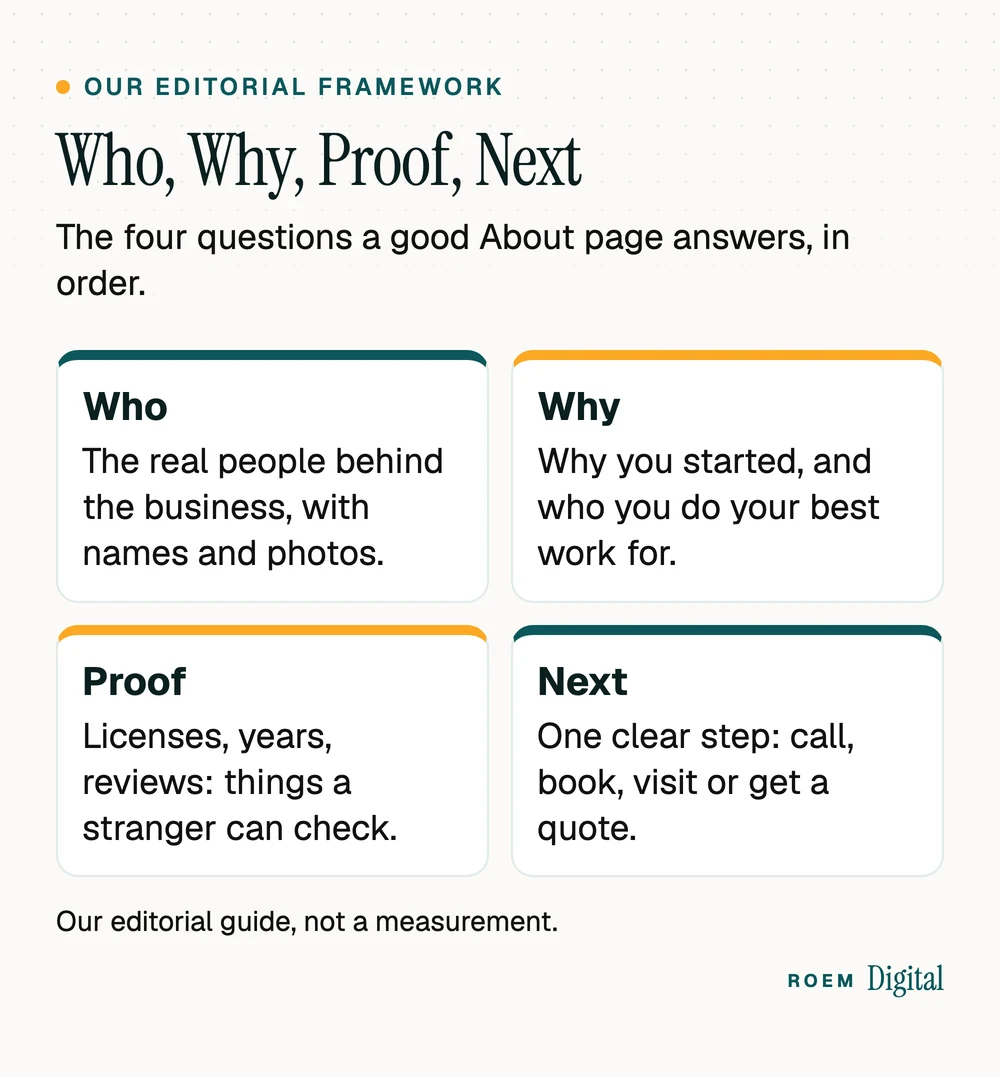
- Who: the real people behind the business, with names, roles and photos taken by someone who knows them.
- Why: why you started and who you do your best work for, in a few honest sentences.
- Proof: licenses, years in business, insurance and reviews, ideally things a stranger can check without trusting you.
- Next: one clear step, such as call, book, visit or request a quote, with your contact details easy to find.
Proof is the part weak pages skip, and the part that does the most work. Adjectives like trusted and experienced cost nothing to write. A license number or a link to a public record costs something to fake. Several items on our list of 12 things every service business website needs belong on an About page, including real photos of your people and contact details that match your Google Business Profile, and this framework is how we'd fit them together.
Six about us page examples from small businesses
Each of these is a live page on a site we built, described as it reads on November 15, 2026. They come from very different businesses, which is the point: the framework holds, but the proof changes with the trade.
Haven Noire: a philosophy, then a founder you can check
The Haven Noire About page opens with the spa's philosophy in a few plain lines, then says exactly what the business is: a boutique facial spa in Kissimmee. It introduces the founder by first name and role, shows her Florida license number, names the professional skincare lines the spa uses, and ends with the street address and a nearby landmark. Borrow this: put your license number where people can see it. Our Haven Noire case study covers the rest of that build.

Little Milo's Closet: the origin story in two sentences
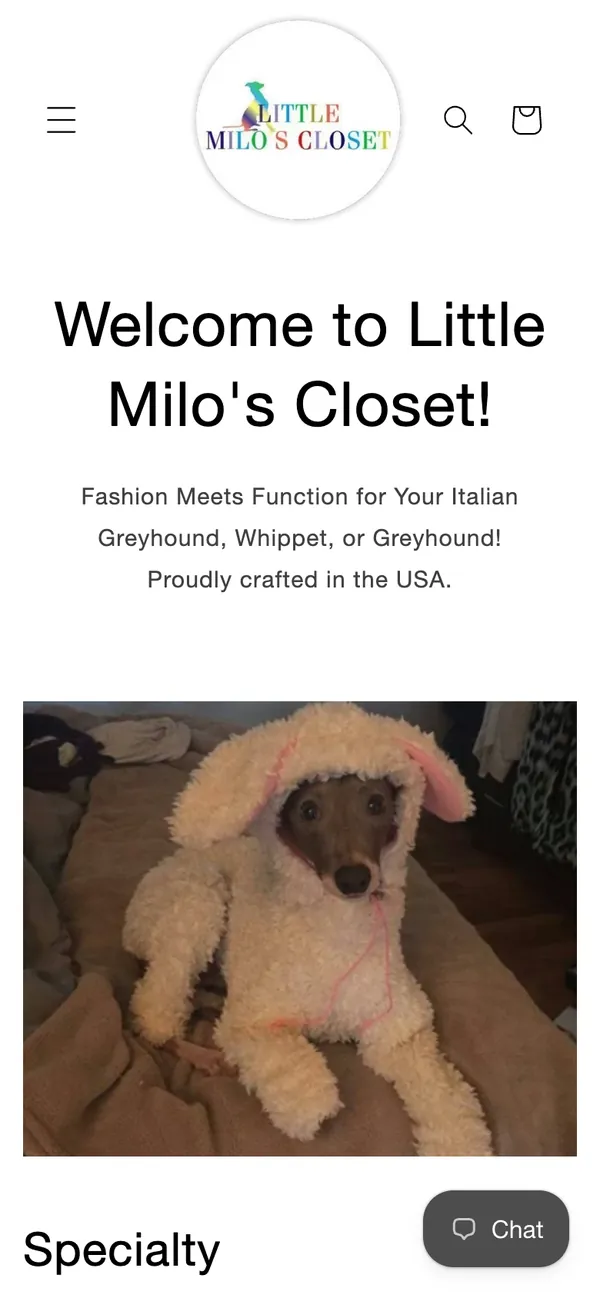
The Little Milo's Closet About page covers the whole origin story fast: decades of experience in clothing for people, a pet fashion business started in 2012, and an Italian Greyhound named Milo who inspired it. Then it moves quickly to what you can buy, ready-to-wear or custom-fit, and ends with a message form on the same page. Borrow this: if your story has a single moment that started it, lead with that moment. See the Little Milo's Closet project for more of that store.
Witter Tech: a one-person business that says so
The Witter Tech About page is written in the owner's own voice, and it opens by saying the business is just him. It gives his years in IT, lists his credentials, and openly marks two of them as still in progress. Borrow this: honesty about size and about what's unfinished reads as confidence, not weakness. A solo owner doesn't need to sound like a company of fifty.
GK Painting: who answers the phone, and who shows up
The GK Painting About page tells the owner's story, from learning the trade to moving his business to Wisconsin, then answers the questions homeowners actually worry about. His wife manages the projects and is often the first person you hear from. He's on every job himself. A short fact panel covers where the business is based, how long it has operated, insurance and reviews. Borrow this: tell people exactly who they'll talk to and who will be in their home.
MeliOra Elite Wellness: credentials you can verify
The MeliOra Elite Wellness About page introduces the physician behind the practice and lists her education, residency and board certification. Then it adds a section titled Credentials you can verify, with her state medical license among the records, noting that each record is kept by the organization that issued it and anyone can look it up for free. Borrow this: for any licensed profession, point people to the official record instead of asking them to take your word for it.
Still We Rise Excellence Academy: a new school with old roots
A brand-new business has little history to show. The Still We Rise Excellence Academy About page handles that head-on with the line "A new school with old roots." It opened in August 2026, sponsored by a Kissimmee church that has served the community since 1968, and the page introduces the head of school by name. Borrow this: if your business is new, lead with the roots you do have, such as your training, your partners or your years in the trade.
None of the six stops at a mission statement. Each gets to something specific a stranger can check, whether that's a founder's license, a dog, a list of credentials or a church's long history, and each makes the next step easy to find. That's the pattern to copy from these about us page examples, more than any layout.
How to write an about us page in six steps
- Say what you do and for whom, in one sentence, at the top. A visitor who reads nothing else should still know.
- Introduce the real people by name and role, with real photos. Google's guide to creating helpful content calls fabricated creator profiles, such as AI-generated headshots, made-up names or false credentials, a form of deception.
- Tell the origin story in a few sentences: why you started, and what you'd want a new customer to know about how you work.
- Add proof a stranger can check: license numbers, years in business, insurance, memberships and a link to your reviews.
- Say where you work and how to reach you, with the same name, phone number and service area as your Google Business Profile.
- End with one next step, a button to call, book or request a quote, not a list of five options.
The difference between a weak About page and a strong one is usually specificity. Compare the two versions of each part:
| Part | Weak version | Strong version |
|---|---|---|
| Who | Our dedicated team of professionals | The owner by name, with a real photo, and who answers the phone |
| Why | We're passionate about quality | The moment the business started, and the customers you do your best work for |
| Proof | Trusted, experienced, the best in town | A license number, years in business, insurance and a link to your reviews |
| Next | Contact us today! | One button to call, book or request a quote, with the phone number beside it |
Google's same guide asks whether content gives background about the site that publishes it, such as through links to a site's About page, as one sign of trustworthy content. A clear About page helps people first, and it supports the rest of your site's credibility too. For the writing itself, our guide to website copywriting covers plain, specific language.
About page for a small business: what to leave out
Nielsen Norman Group's research lists the factors that hurt how users felt about About Us content. Several apply directly to small business pages:
- Walls of text. Break the story into short sections with headings, and put the facts in a short list.
- Stock photography. A real photo of you at work, even an imperfect one, beats a polished stranger.
- Content that lacks substance. "We're passionate about quality" says nothing a competitor couldn't say. A detail only you could write says something.
- Aggressive sales tactics. Save promotions and pop-ups for other pages.
- Hard-to-find contact details. NN/g found users wanted several ways to reach a person, from phone to email to an address.
Also leave out claims you can't support: "best in town," awards you didn't win and team members who left last year. If you mention a warranty or a price, make sure it matches every other page. Our website maintenance checklist includes a quarterly read of this page for exactly that reason.
Keep your About story the same everywhere people check you
Your About page isn't the only place people read about you. NN/g found that skeptical users turn to social media and review sites to build a more realistic picture, and that they expect a consistent story across channels. It recommends keeping contact information on third-party sites accurate and up to date.
Read your About page next to your Google Business Profile description, your social bios and your directory listings. The years in business, the services, the service area and the founder's name should match. Our guide to business listings and citations shows which listings matter and how to keep them aligned.
How we approach About pages on the sites we build
We're a small senior team in Davenport, Florida, with Emily on strategy, design and content and Robert on builds, ads, tracking and optimization. Every site is hand-built, not templated, and the client owns the domain, the site and the accounts.
“Working with ROEM Digital has been a great experience for my business. From developing our website to guiding us through a complete rebrand, they took the time to understand my vision and bring everything together in a way that truly represents the business. What I’ve appreciated most is their continued support. They’ve remained responsive, reliable, and willing to help whenever needed. That level of commitment goes a long way, especially as a business owner. I’d highly recommend ROEM Digital to anyone looking to establish or strengthen their brand. Having a great website is important, but having the right people behind it makes all the difference.”
See more of our website and branding work, or browse the sites we've built for more about us page examples across different trades.
Frequently asked questions
What should be included on an about us page?
Include who runs the business with real names and photos, why you started and who you serve, proof a stranger can check such as licenses, years in business and reviews, where you work, and one clear next step. Keep the details consistent with your Google Business Profile and social profiles.
How long should an about us page be?
Long enough to answer who, why, proof and next, and no longer. Many small business About pages do that in a few short sections. Google says it has no preferred word count, so write for the customer deciding whether to call, and break the page up with headings and short lists.
Should a small business About page be written in first person?
If one person is the business, first person usually reads warmer and more honest, and customers know exactly who they'll deal with. A team can use we, with each person introduced by name. What matters most is that the voice matches how you actually talk to customers on the phone.
Should I put photos of my team on the about page?
Yes, if they're real. Nielsen Norman Group found stock photography hurt how users felt about About pages, while realistic photos helped. Use real photos of the people customers will meet, taken where you work. Never use stock models or AI-generated headshots presented as your staff.
Should I include reviews on my about page?
A few, with a link to where people can read them all. Nielsen Norman Group found users read testimonials on company sites but suspect they're curated, so they compare them with third-party review sites. Linking to your Google reviews lets visitors check for themselves and supports what the page says.
What's the difference between an About page and a homepage?
The homepage tells visitors what you offer and gets them to the right service quickly. The About page answers the next question, whether to trust you, with the people, the story and the proof. Keep the homepage short on biography and link to the About page for anyone who wants it.