
Short answer: A good appointment reminder text names your business, gives the date, time and place, says how to reschedule and says how to opt out. Keep it free of promotions: a coupon or upsell can turn an informational reminder into a marketing text, which carries stricter consent rules.
Appointment reminder text templates you can copy
These appointment reminder text message templates cover the moments from booking to a missed visit. Swap the words in braces for your own details, keep your business name first, and keep one clear action per text. Every template here is informational, with no offer or upsell, and each says how to stop. That's deliberate, for reasons covered further down.
| When to send | Template |
|---|---|
| Right after someone opts in | {Business}: You're signed up for appointment texts, about {n} per booking. Msg and data rates may apply. Reply HELP for help, STOP to opt out. |
| Booking confirmation | {Business}: You're booked for {service} on {Day}, {Date} at {Time}. To change it, call {Phone} or reply R. Reply STOP to opt out. |
| Two days before | {Business}: Hi {Name}, reminder of your appointment {Day} at {Time}, {Address}. Reply C to confirm or R to reschedule. Reply STOP to opt out. |
| The day before, with prep | Hi {Name}, it's {Business}. See you tomorrow at {Time}. Please bring {item}. Questions? {Phone}. Reply STOP to opt out. |
| A few hours before | {Business}: See you today at {Time}. Parking: {note}. Running late? Call {Phone}. Reply STOP to opt out. |
| Home service arrival window | {Business}: {Tech} is scheduled for {Date} between {Start} and {End}. We'll text when on the way. Reply R to reschedule, STOP to opt out. |
| On the way | {Business}: {Tech} is on the way, arriving in about {minutes} minutes. Reply STOP to opt out. |
| Reschedule confirmation | {Business}: Done. Your new time is {Day}, {Date} at {Time}. Reply STOP to opt out. |
| Cancellation confirmation | {Business}: Your {Date} appointment is canceled. If you'd like a new time, call {Phone}. Reply STOP to opt out. |
| Missed appointment | {Business}: We missed you today at {Time}. If you'd like to reschedule, reply R or call {Phone}. Reply STOP to opt out. |
| Class or group session | {Studio}: Your spot in {Class} is {Day} at {Time}. Can't make it? Reply X so we can release your spot. Reply STOP to opt out. |
| Health practice (minimal detail) | {Practice}: Reminder of your appointment {Day} at {Time}. Questions? Call {Phone}. Reply STOP to opt out. |
| Spanish reminder | {Negocio}: Le recordamos su cita el {día} a las {hora} en {dirección}. Responda C para confirmar o R para cambiarla. Responda STOP para no recibir más mensajes. |
| After someone opts out | {Business}: You're unsubscribed and won't get more texts from this number. |
Only promise replies your system really handles. If R doesn't reschedule anything, say "call {Phone} to reschedule" instead. And if you serve Spanish speakers, send reminders in the language each customer chose when they booked, and treat replies like ALTO or BASTA as opt-outs too. Under the FCC's rule in force today, a reply in other words counts if a reasonable person would read it as a request to stop. Our bilingual marketing service covers the rest of a two-language setup.
What every appointment reminder text needs, and what to leave out
The wireless industry group CTIA's Messaging Principles and Best Practices puts appointment reminders in the informational category: texts a customer asked for when they gave you their number. It also warns that adding a call to action, such as a coupon code, "may place the message in the promotional category," and that customers should agree in writing before promotional texts. (CTIA notes its guide isn't legal advice either.)
So build every appointment reminder text from the same parts:
- Your business name first, so nobody mistakes it for spam.
- The date, time and place, in that order.
- One action: confirm, reschedule or call.
- How to stop: CTIA recommends standardized STOP wording, such as "Reply STOP to opt out."
Leave out coupons, "book your next visit" offers, review requests and anything about a person's health or the reason for the visit. Review requests are worth sending, just as their own message with consent that covers them. Our guide to getting more Google reviews covers how to ask.
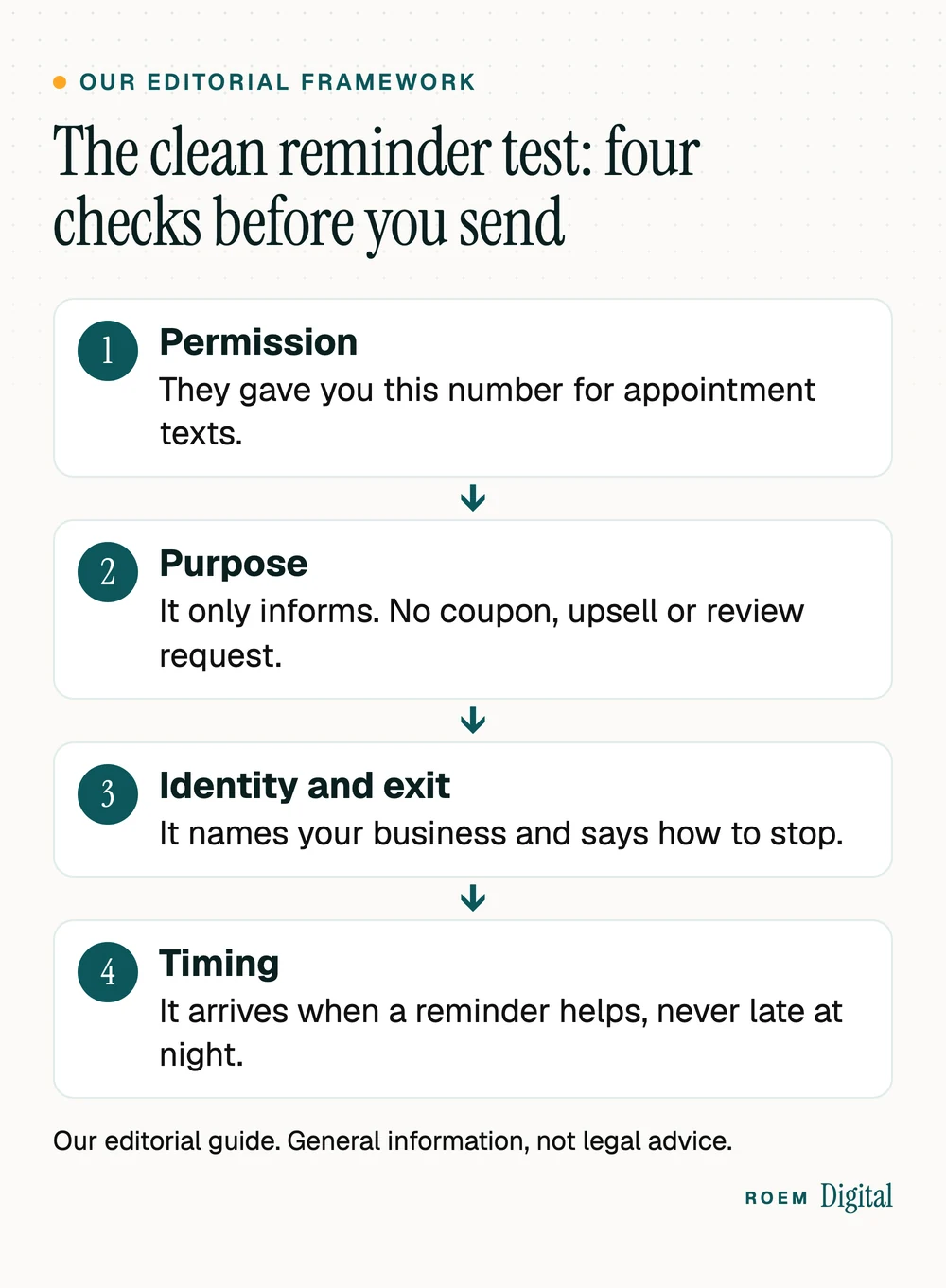
The clean reminder test: four checks before you send
We use a four-part editorial check, the clean reminder test, to keep reminders on the informational side of the line:
- Permission. The customer gave you this number for appointment texts, ideally with a checkbox or line on your booking form that says so.
- Purpose. The text only informs. No coupon, upsell or review request.
- Identity and exit. It names your business and says how to stop.
- Timing. It arrives when a reminder helps, never late at night.
Keep a record of each opt-in: when, where and the exact wording the customer agreed to. CTIA's guide suggests saving the timestamp, the method and the language used. If your booking setup itself needs work, our custom software service builds booking tools and client portals.
TCPA text message rules in plain English
This is general information, not legal advice. The federal rules come from the Telephone Consumer Protection Act and the FCC's regulations at 47 CFR 64.1200. Those rules speak of "calls or text messages" throughout their consent and opt-out sections, so automated texts are covered. SMS marketing rules and reminder rules overlap, but they aren't the same:
| Rule | Appointment reminders | Marketing texts |
|---|---|---|
| Consent (FCC) | Automated calls to a cell phone need the person's prior express consent | Ads and telemarketing need prior express written consent: a signed agreement naming the number |
| What counts | The FCC's 2026 rule calls a text informational when it contains no advertising or telemarketing | Anything encouraging the purchase of goods or services |
| Opt-outs (FCC) | Honor within 10 business days. "Stop," "quit," "end," "revoke," "opt out," "cancel" and "unsubscribe" all count | Same, and one opt-out covers all your marketing texts |
| Time of day | The FCC's time limits apply to telephone solicitations | No telephone solicitations before 8 a.m. or after 9 p.m. local time, per the FCC, which applies this to texts to cell phones |
| Florida | Florida's sales call law covers texts sent "for the purpose of soliciting a sale" | Automated sales texts need prior express written consent under section 501.059, and section 501.616 bars commercial telephone solicitation calls before 8 a.m. or after 8 p.m. |
What changes on November 25, 2026
The FCC published a rule on October 26, 2026 that takes effect November 25, 2026, according to the Federal Register notice. Two changes matter for reminders. First, you may designate an exclusive opt-out method, such as replying with one of the standard words, as long as you disclose it in every text. Including at least one standard word, such as "stop," in each text satisfies that disclosure, so long as you recognize any of the seven standard words ("stop," "quit," "end," "revoke," "opt out," "cancel" and "unsubscribe") as a valid opt-out. Second, an opt-out sent in reply to an informational text may be treated as covering only that category of messages, so a customer who stops billing texts can still get appointment reminders. Requests must still be honored within 10 business days.
Florida's extra rules
Florida's telephone solicitation statute, section 501.059, defines a "telephonic sales call" to include a text message sent to solicit a sale, requires prior express written consent for unsolicited automated sales texts, and lets a recipient sue for actual damages or $500, whichever is greater. Before suing over text solicitations, the recipient must reply "STOP," and the sender then has 15 days to stop. Separately, section 501.616 bars commercial telephone solicitation phone calls before 8 a.m. or after 8 p.m. local time, and more than three on the same subject in a 24-hour period. If an ad's landing page collects phone numbers for marketing texts, the consent wording has to say the person agrees to receive automated marketing texts at that number and that agreeing isn't a condition of buying anything. Both the FCC's rule and section 501.059 require those two points, and Florida counts a checked box as a signature. Our guide to landing pages for Google Ads covers the rest of the form.
Health, dental and med spa reminders need extra care
If your practice is covered by HIPAA, keep reminder texts to the basics: practice name, day, time and a phone number. The HIPAA Privacy Rule at 45 CFR 164.522 says a covered health care provider must accommodate reasonable requests from patients to receive communications by alternative means or at alternative locations. If a patient asks for calls instead of texts, note it on the chart and honor it. The FCC also lets health care providers text appointment reminders to the cell number a patient gave without the usual consent, under strict conditions: the patient isn't charged, the text names the provider and how to reach it, carries no marketing or billing content, stays within 160 characters and offers an easy opt-out, no more than one message a day and three a week go out, and opt-outs are honored immediately.

Florida adds one more trap for licensed health care practitioners in the professions the statute lists, such as physicians, nurses and dentists. Under section 456.062, any advertisement for a free, discounted or reduced fee service must carry a long required statement in capital letters about the patient's right to refuse payment for other services performed as a result of the ad and within 72 hours of responding to it. A dental reminder that tacks on a discount for your next cleaning becomes that kind of advertisement. Keep promotions out of reminders. Our med spa marketing guide covers the rest of a practice's marketing, from treatment pages to reviews.
Where reminders fit with booking and follow-up
An appointment reminder text works best as one step in a chain: online booking, an instant confirmation, reminders, a quick reply path for changes, and a follow-up when someone misses. Our post on choosing an online booking system for a small business covers the first link, and speed to lead covers what happens when a new inquiry comes in.
We also build our own software, including ROEMer, an online booking platform for local businesses, and our custom software page explains what we build for businesses whose booking needs don't fit an off-the-shelf tool.
When to talk to a lawyer about your texting program
This post is general information, not legal advice. Talk to an attorney who handles TCPA and consumer protection matters before you:
- Send any marketing or promotional texts, including offers to past customers.
- Text numbers you didn't collect yourself, such as a purchased or shared list. CTIA's guide says senders should not use rented, sold or shared opt-in lists.
- Change your opt-out process to use the exclusive-method option that starts November 25, 2026.
- Text patients about anything beyond the appointment itself.
- Receive a STOP reply followed by a demand letter or complaint.
If you're tracking which texts and calls actually bring customers back, our guide to call tracking for a small business explains how to measure it.
Frequently asked questions
What should an appointment reminder text say?
Start with your business name, then the date, time and place, one action such as reply C to confirm or call to reschedule, and how to opt out, such as reply STOP. Leave out coupons, upsells and review requests, which can turn a reminder into a marketing text with stricter consent rules.
Do you need consent to send appointment reminder texts?
For automated texts, yes. Under the FCC's rules, automated calls and texts to cell phones need the person's prior express consent, and marketing texts need prior express written consent. CTIA's guidance says customers should agree to texts for a specific informational purpose when they give you their number, so put that wording on your booking form.
How fast do you have to honor a STOP reply?
Under the FCC's rules, within a reasonable time not to exceed 10 business days, or immediately for health care reminders sent under the FCC's health care exemption. A single confirmation text that only confirms the opt-out is allowed, and one sent within five minutes is presumed to fall within the person's consent.
What changes in the FCC texting rules on November 25, 2026?
Senders may designate an exclusive opt-out method, such as a reply with a standard word, if they disclose it in each text. Naming one word like stop satisfies that only if any of the seven standard words still counts as an opt-out. A reply to an informational text may apply only to that category. Marketing opt-outs cover all marketing texts.
Can a dental or medical office text appointment reminders?
Many do, keeping the text to the practice name, day, time and a phone number. Under the HIPAA Privacy Rule, a covered provider must accommodate reasonable requests to communicate by alternative means, so honor a patient who prefers calls. Keep discounts out of reminders, since Florida requires a special statement on health care discount ads.
What time can you send text messages to customers in Florida?
Florida's section 501.616 bars commercial telephone solicitation phone calls before 8 a.m. or after 8 p.m. local time, and the FCC bars telephone solicitations before 8 a.m. or after 9 p.m. Those limits are written for solicitations, but sending reminders during the day is good practice and avoids waking anyone.