
Short answer: Lead generation for small business works best as a mix of three kinds of sources: ones you own (your website, Google profile and customer list), ones you earn (reviews, referrals, rankings) and ones you rent (ads). Start with what you own, because every paid lead lands on it, and track where every lead comes from.
Lead generation for small business, in plain terms
Lead generation is everything that gets a likely customer to contact you: a call, a form, a message or a booking request. It works best as a mix of sources you own, sources you earn and sources you rent.
Here's the short version of lead generation for small business, especially a local one that needs more inquiries:
- Fix what you own first: your Google Business Profile, a website that makes calling easy, and your list of past customers.
- Earn steadily: ask every customer for a review, make referrals easy, and build pages that rank for the services you sell.
- Rent when you need speed: ads can bring leads within days, as long as they land on pages that work.
- Track where every lead comes from, so you know which of the three to grow.
- Answer fast. A lead you paid for and never called back is the most expensive kind. Our guide to speed to lead covers the first hour.
The rest of this guide covers how to build each part, which to start with and how to tell what's working. It isn't a Google Ads or SEO manual. We link to those where they help.
Own, earn, rent: sort every lead source by who controls it
Most lead generation advice is a long list of tactics. We find it more useful to sort them by who controls the source, because that decides what happens when you stop paying attention, or stop paying. This is our editorial framework, not a study.
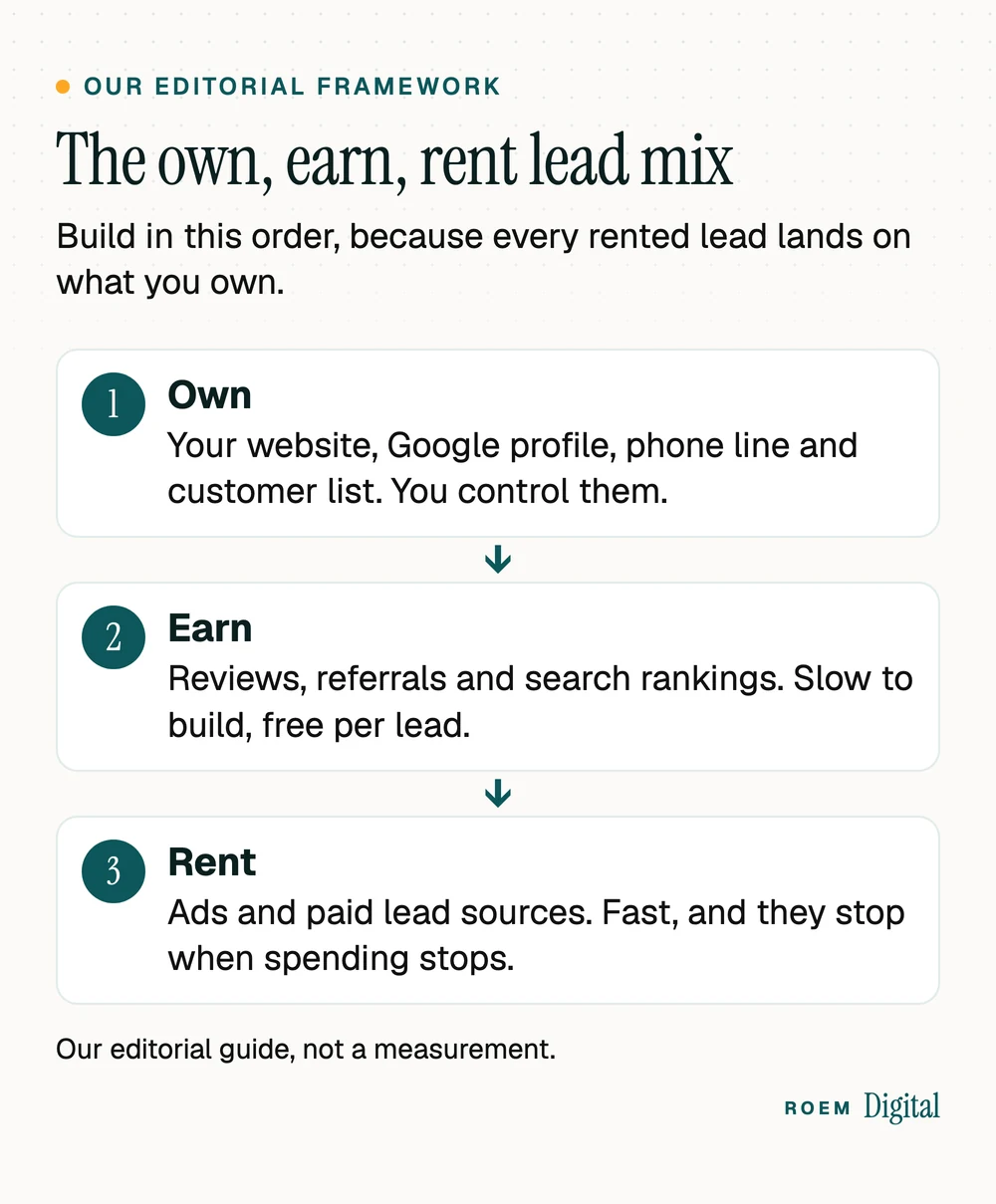
| Kind | Examples | What happens when you stop |
|---|---|---|
| Own | Your website, Google Business Profile, phone number and list of past customers | They keep working, though they slowly go stale |
| Earn | Reviews, referrals, partner businesses, search rankings and local press | They fade gradually, over months |
| Rent | Google Ads, Local Services Ads, Facebook and Instagram ads, paid directory placements | The leads stop when the spending stops |
Here's the contrarian part. Most owners start with rented leads because they're fast. We'd start with what you own, because every rented lead lands on it. An ad that sends people to a slow page with a hidden phone number pays for clicks that never call. Our guide to Google Ads vs. SEO covers where your first marketing dollar should go.
A note on "own": Google runs the platform your Business Profile sits on, so you don't own it the way you own your domain. You do control what's on it, and it keeps working without a monthly ad bill, which is why we file it here.
Start with the lead sources you own
Owned sources are the places a customer checks before they call. Get these right and every other channel works better.
Your Google Business Profile
Google's help page on local ranking says local results are mainly based on relevance, distance and popularity, and that more reviews and positive ratings can help your local ranking. You can't move closer to every customer, but you can make the profile complete: the right categories, the services you offer, current hours and real photos of your work. Fresh updates help it look cared for, and our guide to Google Business Profile posts has ideas. For local lead generation, the profile also has to agree with your website: the same business name, phone number, services and service area in both places.

A website that turns visits into calls
The site's job is to make contact easy on a phone: a tap-to-call button near the top, a short form, the areas you serve and proof of your work. If plenty of people visit but few get in touch, our guide to website conversion rate shows how to find the leak.
Your past customers
The easiest next job often comes from someone who already hired you. Keep a simple list of past customers who agreed to hear from you, and send something useful at the right time of year: a seasonal reminder, a maintenance tip or a note when you add a service. Only message people who said yes.
Earn leads that cost nothing per click: reviews and referrals
Earned sources take longer, but each lead costs nothing extra. Reviews come first, because they help twice: Google uses them in local ranking, and customers read them before they call.
- Ask every customer, every time. Google's tips for getting more reviews suggest sending customers a Google review link or QR code. Ask in person, then send the link the same day. Google's content policy also bars asking only the customers you expect to be happy.
- Never pay for reviews. The same page says offering incentives, like free or discounted goods or services, in exchange for reviews is considered fake and misleading content and is strictly prohibited.
- Reply to reviews, good and bad. A calm reply to a bad review can reassure the next reader more than another five stars. Health and legal practices shouldn't confirm the reviewer was a patient or client, as our guide to responding to negative reviews explains.
- Make referrals easy. Give customers a short message they can forward with your name, number and booking link.
- Partner with businesses that meet your customers first. A realtor, a property manager or a wedding planner can send work your way, and you can return the favor.
- Rank for the services you sell. Service pages and helpful articles earn search traffic over months, which is what our SEO and content service builds.
Then put that proof where leads land. Show your rating and real outcomes on your own site, near the button that asks for the call or booking.

Rent leads when you need them this month
Paid channels are the fast lever. You can turn them on in days and off whenever you like, which is also their weakness: the leads stop when the spending does.
| Channel | Best when | Watch out for |
|---|---|---|
| Google search ads | People already search for what you do, in your area | Clicks on searches you don't serve, and a landing page that doesn't match the ad |
| Local Services Ads | Your trade is eligible and you'd rather bid per lead than per click | Missed calls, which Google says may count against your responsiveness |
| Facebook and Instagram ads | Your work is visual or seasonal, or people don't search for it until they see it | Lower intent than search, so follow-up matters even more |
Our comparisons go deeper: Facebook and Instagram ads vs Google Ads and Local Services Ads vs search ads. If you'd rather hand the paid side to someone, that's our Paid Media & Lead Gen service.
Before you pay any lead marketplace or directory for leads, ask three questions in writing: does each lead go to you alone or to several businesses, what counts as a billable lead, and how do you dispute one that's spam or outside your area? The answers decide what a lead from them is really worth.
Which lead source to start with, by budget and urgency
No single order fits every business, but your budget and your calendar narrow it down fast.
| Your situation | Start with |
|---|---|
| You need calls this month and have an ad budget | Search ads or Local Services Ads, pointed at a page built for that service, with call tracking on |
| Small budget, some time | Your Google Business Profile, reviews and a referral ask to every past customer |
| Your busy season starts in a few months | Service pages and profile updates now, with ads ready to switch on as demand rises |
| Plenty of visits, few inquiries | Your website's contact path, before buying any new traffic |
| Lots of inquiries, few booked jobs | Follow-up speed and better qualifying questions, not more leads |
Whatever you pick, give it enough time and budget to learn something before you judge it, then add the next source. If inquiries are high but bookings are low, read our guide to answering leads within the hour before you buy more.
The most common mistake in lead generation for small business is splitting a small budget across five channels at once. Each one gets too little to show what it can do, and you end up judging all of them on a handful of leads. Pick one or two, measure them properly, then add the next.
Track where every lead comes from before you scale anything
The SBA's guide to marketing and sales says to compare your marketing and sales costs to the revenue they generate, to make sure you're getting a positive return on investment. You can't do that without knowing where each lead came from.
- Ask every new customer how they found you, and write the answer down in one place.
- Use call tracking or separate numbers, so calls from ads, your profile and your website can be told apart.
- Tag the links you control, like your Google Business Profile website link and email links, with UTM parameters.
- Once a month, count leads, booked jobs and cost for each source.
- Grow the source with the best cost per booked job, not the one with the most leads.
Cost per booked job is simple: what a source cost you that month, including ad spend and fees, divided by the jobs it booked. For reviews and referrals the cost is mostly your time. A source that sends lots of cheap leads and no jobs is worth less than one that sends a few good ones, so judge every channel by the work it books.
How we help small businesses build their lead mix
We're a small senior team based in Davenport, Florida, working with businesses across Central Florida and nationwide. Our Paid Media & Lead Gen service covers Google Ads, social ads, ad creative, landing pages and lead follow-up automation, with calls, forms and bookings tracked before ad spend starts. You own the website, the ad accounts and the analytics.
Owned assets carry a lot of weight in lead generation for small business. The Haven Noire case study shows a boutique spa brand in the Kissimmee area reaching 2.7x clients and 7x monthly revenue in 13 months with a new brand, online booking, a custom website and SEO.
Frequently asked questions
What is the best lead generation strategy for a small business?
For most local businesses, a mix works best: a complete Google Business Profile and a website that makes calling easy, a steady flow of reviews and referrals, and paid ads when you need leads quickly. Track where every lead comes from, then put more into whichever source books jobs at the lowest cost.
How can a small business get leads without paying for ads?
Start with what you own and what you can earn. Complete your Google Business Profile, ask every customer for a review, make referrals easy to pass along, partner with businesses that serve the same customers, and build service pages that rank. These take longer than ads but cost nothing per lead.
Is it worth paying for leads as a small business?
It can be, if the leads match the work you want and you answer them fast. Paid leads stop when spending stops, so they work best on top of a solid profile, website and review base. Judge any paid source by cost per booked job, not cost per lead.
How long does lead generation take to work?
Paid ads can bring inquiries within days of launch. Reviews, referrals and search rankings build over months, but they keep working without a cost per lead. Many businesses run ads for short-term demand while owned and earned sources grow, then lean on ads less once those sources carry more of the load.
What is local lead generation?
Local lead generation means getting inquiries from customers in the area you serve. It leans on your Google Business Profile, map results, reviews, local service pages, referrals and ads aimed at your service area. Google says local results are mainly based on relevance, distance and popularity, so a complete, well-reviewed profile matters.
How do I know which lead source is working?
Ask every new customer how they found you, use call tracking so calls from ads, your profile and your website show separately, and tag the links you control with UTM parameters. Each month, compare leads, booked jobs and cost by source, and grow the one with the best cost per booked job.