
Short answer: Marketing for therapists works when it adds trust and subtracts risk. Specialty pages, clear fees, directory profiles and referral partners bring the right clients in, while thin contact forms, no ad pixels on sensitive pages and no solicited testimonials protect the people who reach out.
How to get therapy clients: what works for a private practice
Marketing for therapists isn't louder marketing. People looking for a therapist may be anxious, searching late at night or reluctant to tell anyone. What wins them is clarity: who you help, how you work, what it costs and how to ask a question without exposing anything. These therapist marketing ideas work in roughly this order:
- Build a page for each specialty you treat, written in the words clients use, not clinical shorthand.
- Publish fees, insurance status and telehealth details so people can rule themselves in before they call.
- Keep a directory profile that matches your website and links to it.
- Claim your Google Business Profile if clients visit an office, using our Google Business Profile checklist.
- Build referral relationships with physicians, other therapists, school counselors and clergy who see your kind of client.
- Offer one simple way to request a consultation, and reply the same day when you can.
- Write articles that answer the questions people ask in a first session.
Reply speed matters. Someone who finally works up the nerve to ask may be contacting other practices too, and a quick reply with a clear next step makes yes easier. Our guide to speed to lead covers follow-up that stays warm without being pushy.

Our coaches and therapists page covers positioning, specialty SEO and booking in depth. This guide focuses on the part general marketing advice often skips: doing all of the above without putting client privacy or your license at risk. It's general marketing information, not legal advice.
Add trust, subtract risk: a framework for therapist marketing
A lot of marketing advice is about adding: more posts, more tools, more tracking. Our editorial view is that a therapy practice grows as much by removing things. We call it add trust, subtract risk: every addition should make a careful person more comfortable reaching out, and every tool that quietly collects or shares sensitive information should earn its place or go.
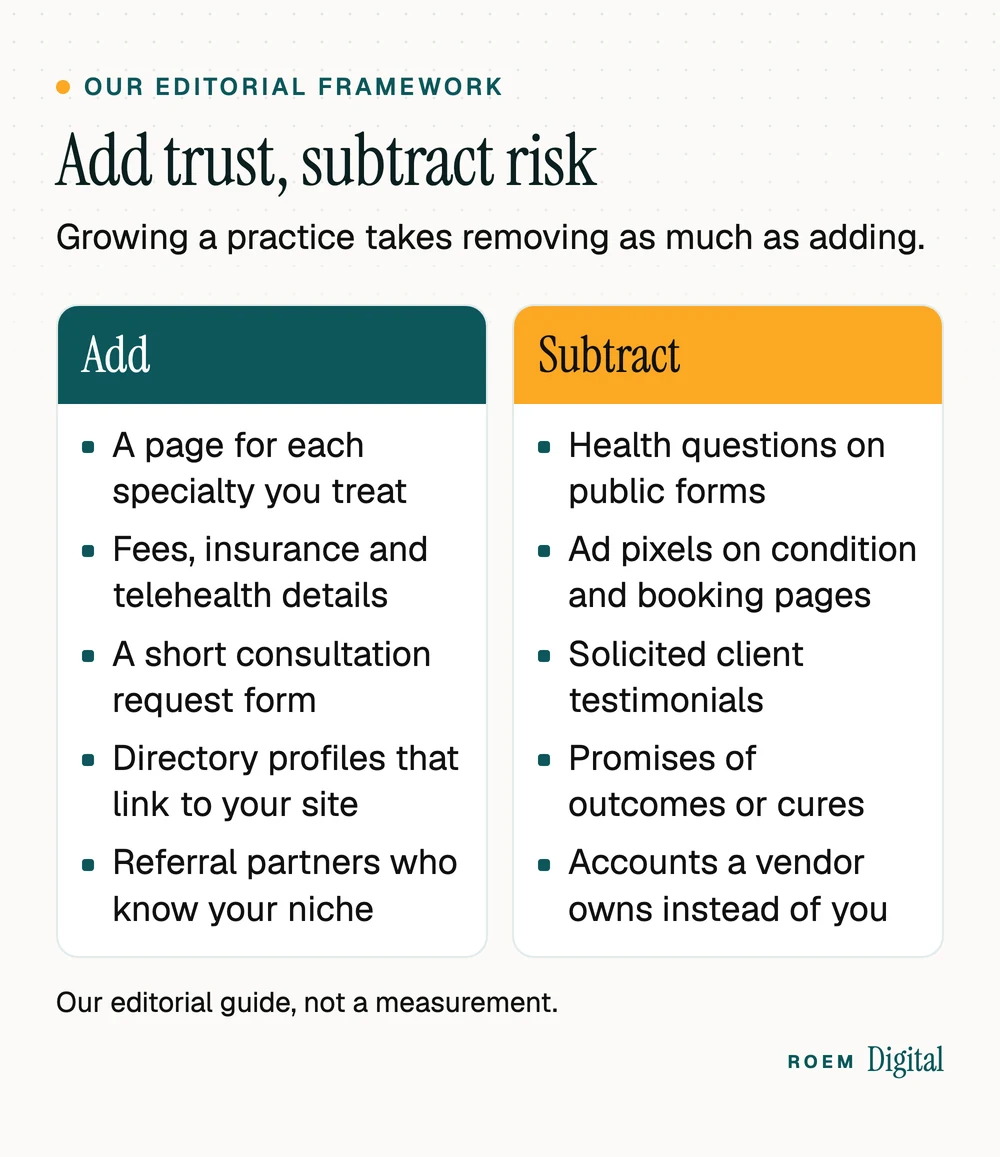
The rest of this guide walks through the subtract column, because that's where good intentions cause problems: forms, tracking, testimonials and advertising rules. If you'd rather hand the add column to someone, our SEO and content service builds specialty pages for practices.
Keep health details off your website forms
Start with whether HIPAA applies to you. The CMS page Are You a Covered Entity? says covered entities include health plans, clearinghouses and certain health care providers, and that providers who submit HIPAA transactions, like claims, electronically are covered. It lists psychologists among its examples and links to a Covered Entity Decision Tool, so how you bill can affect the answer.
If HIPAA applies and a vendor helps carry out your health care functions, the same CMS page says you must have a written business associate contract or other arrangement that sets out what the vendor was engaged to do and requires it to comply with HIPAA. That can include scheduling, intake, messaging and the tool that receives your website's form.
Whether or not HIPAA applies, your professional duty of confidentiality does, so keep the public contact form thin:
- Ask only for a name, a phone number or email, preferred times, and in-person or telehealth.
- Never ask about symptoms, diagnoses, medications or why someone is seeking care.
- Add one line asking people not to share health details until they're in your secure system.
- Send form emails to an inbox only you and your practice staff can open.
Our website and branding service builds therapist sites around that kind of form.
| Fine on the public form | Wait for your secure intake |
|---|---|
| Name and preferred name | Symptoms, diagnoses or history |
| Phone or email, and whether you may leave a message | Medications or past treatment |
| Preferred days and times | Insurance member ID or date of birth |
| In-person or telehealth | The reason they're seeking care |
| How they heard about you | Anything about another person's health |
Ad pixels and analytics on a therapy website
An ad pixel reports page visits back to an ad platform. On most business sites that's routine. On a therapy site, a visit to your page about panic attacks or your consultation form can say something sensitive about the person who made it.
The Federal Trade Commission has acted on this outside HIPAA. In a March 2, 2023 announcement, the FTC said its complaint alleged that BetterHelp, an online counseling service, used and revealed consumers' email addresses, IP addresses and health questionnaire information to Facebook, Snapchat, Criteo and Pinterest for advertising purposes, despite promising consumers it would not use or disclose their personal health data except for limited purposes, such as providing counseling. The proposed order required the company to pay $7.8 million to consumers.
HHS has also issued guidance on tracking technologies for HIPAA-regulated entities, and its legal status has been contested. In American Hospital Association v. Becerra, a federal court in Texas noted that HHS's revised bulletin said it does "not have the force and effect of law," and on June 20, 2024 vacated one part of it: treating the combination of a visitor's IP address and a visit to a public page about specific health conditions or providers as individually identifiable health information. The court said the vacatur shouldn't be read as limiting the rest of the guidance.
The practical answer doesn't depend on the guidance's legal status. Keep ad pixels off condition pages, the consultation form and the thank-you page. Analytics needs the same care. Google's HIPAA and Google Analytics page says Google does not offer business associate agreements for Google Analytics, that customers subject to HIPAA may only use it on pages that are not HIPAA-covered, and that unauthenticated pages related to providing health care are more likely to be HIPAA-covered.
So if HIPAA applies to your practice, count consultation requests in your own intake or scheduling system, or in a tool whose vendor signs a business associate agreement with you, and decide with your compliance advisor which pages, if any, carry analytics. If it doesn't apply, count requests without sending what anyone typed. Either way, review every script on your site with whoever advises you on compliance. For pages you've cleared, our guide to tracking calls and form fills in GA4 covers the setup.
Testimonials and reviews: what professional ethics codes say
Coaches can lean on testimonials. Licensed clinicians face limits, and their own ethics codes spell them out:
- The 2014 ACA Code of Ethics, Standard C.3.b, says counselors who use testimonials do not solicit them from current clients, former clients or anyone who may be vulnerable to undue influence, and that they discuss the implications with clients and obtain permission for any testimonial.
- The NASW Code of Ethics, Standard 4.07(b), says social workers should not solicit testimonial endorsements, including consent to use a client's prior statement, from current clients or others vulnerable to undue influence.
- The ACA has been revising its 2014 code since January 2025, according to the National Board for Certified Counselors, so check the version in force when you read this.
Psychologists, marriage and family therapists and other licensed clinicians should read the advertising section of their own association's code and their state board's rules. Build trust instead with credentials, specialty pages, an About page in your own voice and articles that answer first-session questions, and leave out promises of outcomes or cures.
If former clients leave public reviews on their own, reply carefully: even confirming someone was a client can raise confidentiality concerns. Our guide to responding to negative reviews covers safer wording. For the contrast with unlicensed practices, see our guide to marketing for coaches.
Advertising a free consultation in Florida
If you practice in Florida and advertise a free consultation, section 456.062 of the Florida Statutes applies to any advertisement for a free, discounted fee or reduced fee service by practitioners licensed under a list of chapters that includes chapter 490 (psychological services) and chapter 491 (clinical, counseling and psychotherapy services). It requires this statement in capital letters, clearly distinguishable from the rest of the text:
THE PATIENT AND ANY OTHER PERSON RESPONSIBLE FOR PAYMENT HAS A RIGHT TO REFUSE TO PAY, CANCEL PAYMENT, OR BE REIMBURSED FOR PAYMENT FOR ANY OTHER SERVICE, EXAMINATION, OR TREATMENT THAT IS PERFORMED AS A RESULT OF AND WITHIN 72 HOURS OF RESPONDING TO THE ADVERTISEMENT FOR THE FREE, DISCOUNTED FEE, OR REDUCED FEE SERVICE, EXAMINATION, OR TREATMENT.
Copy it from the statute rather than retyping it, and ask your attorney where it belongs on your site, your directory profile and any ad that mentions the free consultation. If you run ads, our paid media service builds this kind of requirement into the ad and landing page from the start.
When to talk to a healthcare attorney or compliance advisor
A marketing team can build the pages and set up the tools. Decisions about HIPAA, state privacy law and your license belong with a healthcare attorney, a compliance advisor, your professional association's ethics resources or your state board. Talk to one:
- Before you add an ad pixel, a chat widget or any new analytics tool to your site.
- Before you choose a scheduling, intake or email tool that will hold client information.
- If you're unsure if HIPAA covers your practice, or how your billing affects that.
- Before you use any client's words in your marketing, in any form.
- Before you advertise a free or discounted service, in Florida or anywhere else.
- If you offer telehealth to clients in other states.
- Right away if you suspect client information was exposed.
Bring a list of every tool on your website and who owns each account. Our guide to who owns your marketing accounts shows how to build that list.
How ROEM helps therapists market a private practice
We're a small senior team based in Davenport, Florida, working with practices across Central Florida and nationwide by video. We build custom therapist websites, hand-built rather than templated, with forms that never ask for health details, write specialty pages, and choose tools with your compliance needs in mind, flagging where a vendor offers a business associate agreement. We don't give legal advice, and we don't set up campaigns that ask clients for testimonials. You own the domain, the website and every account.
See how we work with practices on our coaches and therapists page.
Frequently asked questions
What is the best marketing for therapists?
Clear specialty pages, published fees and insurance details, a directory profile that links to your site, a Google Business Profile if clients visit an office, referral relationships and one simple way to request a consultation. Pair those with careful privacy choices, such as thin forms and no ad pixels on sensitive pages.
How do new therapists get clients?
Pick one or two specialties and build a page for each, set up a directory profile and a simple website, and introduce yourself to physicians, therapists and school counselors who see your kind of client. Reply quickly to every consultation request, and write articles that answer what people ask in a first session.
Can therapists use testimonials?
Professional codes limit them. The 2014 ACA code says counselors don't solicit testimonials from current or former clients or others vulnerable to undue influence, and the NASW code says social workers shouldn't solicit them from current clients or others vulnerable to undue influence. Check your own association's code and your state board's rules.
Is it safe to use Facebook or Google ad pixels on a therapy website?
It's risky on pages that reveal sensitive information, such as condition pages, consultation forms and thank-you pages. The FTC has taken action over an online counseling service's alleged sharing of health data for advertising. Talk to a healthcare attorney or compliance advisor before adding any pixel. This is general information, not legal advice.
Does HIPAA apply to my therapy website?
It depends on whether you're a covered entity. CMS says covered entities include certain health care providers, including those who submit transactions like claims electronically, and offers a Covered Entity Decision Tool. Either way, keep health details off public forms and ask a compliance advisor about the tools that handle client information.
Do Florida therapists need a disclaimer for a free consultation?
Florida Statutes section 456.062 requires a specific capitalized statement in advertisements for free, discounted or reduced fee services by practitioners licensed under listed chapters, including chapters 490 and 491. Copy the exact wording from the statute and ask your attorney where it should appear on your site and ads.