
Short answer: Marketing for coaches works when four things are in place before you chase reach: a clear statement of who you help, honest proof from real clients, a free taste of how you work, and one simple path to a discovery call. Then grow through referrals, speaking, partners and search.
How to get coaching clients: the short answer
Coaching is bought on trust, and people can't try it before they pay. Marketing for coaches is mostly about lowering that risk: say exactly who you help, show what real clients said, let people experience how you think, and make the first conversation easy to book. Here's the order we'd work in if you need more clients this quarter:
- Write one sentence naming who you help and the moment they usually reach out.
- Collect three to five testimonials from past clients, with permission and in their own words.
- Create one free taste: a talk, a podcast episode, a short workshop or a guide.
- Put one booking button for a discovery call on every page of your website.
- Ask for referrals from happy clients and from professionals who serve the same people.
- Pitch yourself as a speaker or podcast guest to groups your clients already belong to.
- Build a page for each specialty people search for, then add ads only when the pages convert.
Our coach and therapist marketing page covers positioning, booking and specialty SEO in depth. This guide is the how-to for a coach who wants a plan for the next 90 days.
The trust sequence: name, proof, taste, path
When a coach needs more clients, the usual instinct is more reach: post daily, run ads, join another platform. Our editorial view is different. More reach only multiplies what your marketing already says, so if a visitor can't tell who you help or why to trust you, more visitors means more people leaving. We call the fix the trust sequence.
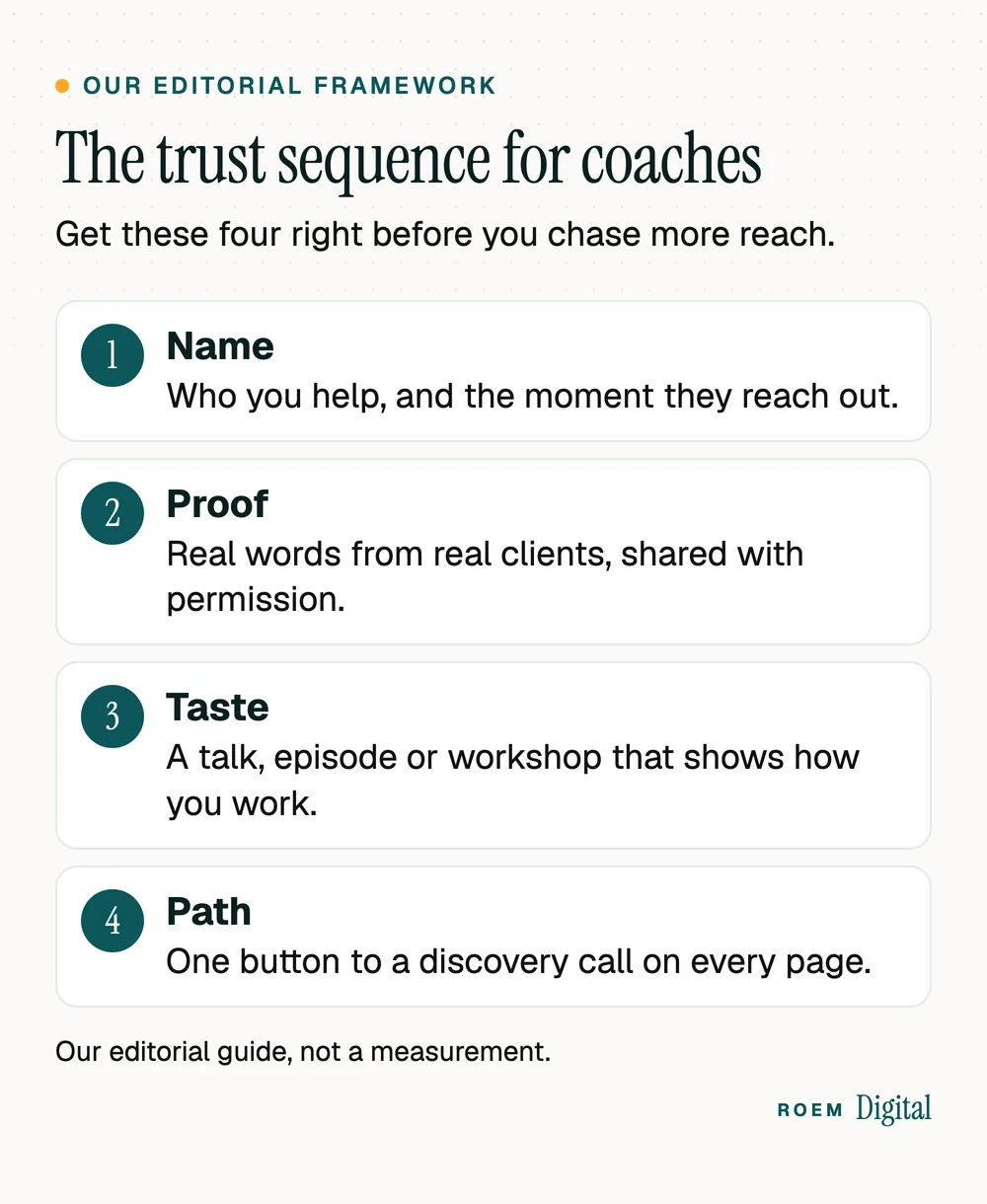
- Name. "I help new managers in their first year lead people who used to be their peers" beats "I help people reach their potential." A specific sentence tells the right person they're in the right place.
- Proof. Testimonials, a short story of a client's progress told with permission, your training, and where you've spoken or been interviewed.
- Taste. Something free that shows how you think: a 30-minute workshop, a podcast episode, a worksheet or a talk recording.
- Path. One button, the same words everywhere, leading to a calendar or a short request form for a discovery call.
Once those four are in place, reach starts to pay off, because every new visitor lands on something that answers their questions. If you need help with the first step, our consulting and strategy service starts there.
Coach testimonials that stay within the FTC's rules
Testimonials are the strongest proof a coach has, and they're covered by federal advertising rules. The Federal Trade Commission's guide FTC's Endorsement Guides: What People Are Asking answers the questions coaches run into. This is general marketing information, not legal advice. Here's what it says, in plain terms:
- Endorsements must reflect the honest opinions or experiences of the endorser. Use real words from real clients, and don't rewrite them into something they didn't say.
- Specific results read as typical. The FTC says endorsements claiming specific results usually will be interpreted to mean others can expect the same, and that statements like "Results not typical" or "Individual results may vary" won't change that interpretation.
- No incentives for positive reviews. The guide says you can't condition an incentive, such as a discount, on a review being positive.
- Don't hand-pick only the happiest clients when you ask for reviews. The FTC says asking only customers you expect to be happy can be misleading if it substantially skews the overall picture.
- Disclose connections. If a relative, an employee or someone you paid or gave something of value praises you, the guide says that connection should be made clear.
In practice, that favors testimonials about the experience ("she helped me see what I actually wanted") over promised numbers ("I doubled my income in 60 days"). Ask every client the same short questions at the end of an engagement, get written permission to publish, and keep a copy of the original wording. For public reviews, our guide to getting more Google reviews covers how to ask within Google's rules.
Three questions tend to produce testimonials that are both honest and useful to the next reader:
- What was going on when you decided to reach out?
- What changed during our work together, in your own words?
- What would you tell someone who's unsure whether coaching is for them?
Before you publish client results, income figures or before-and-after stories, or offer anything in return for a review or testimonial, run the wording past an attorney who handles advertising law.
What a coaching website needs to turn visitors into calls
Your website is where the trust sequence lives. A visitor should be able to answer four questions within a few seconds on a phone: is this for me, can I trust this person, what is it like to work with them, and how do I start.

We built Bridging the Gap for Rachel Nelson's faith-driven life coaching, speaking and sister circles for women. Coaching, speaking and the podcast each have their own clear path from the homepage, so a woman looking for a coach and an event host looking for a speaker both find their way. A few habits make a coaching site work:
- Lead with the person you help, not your credentials. Credentials belong on the About page and near the booking button.
- Explain your method in plain words: how many sessions, what happens in them, and what clients do between them.
- Say what coaching isn't. If someone needs mental health care, point them toward a licensed professional.
- Keep one call to action worded the same on every page, such as "Book a free discovery call."
Our guide to website copywriting walks through writing each page, and our website and branding service builds custom sites for coaches who'd rather not use a template.
Where coaching clients come from: referrals, speaking, partners and search
Once the website holds up, pick two or three channels and work them steadily. Spreading thin across eight platforms can mean none of them gets enough attention to work.
| Channel | Works best when | First step |
|---|---|---|
| Client referrals | You have past clients who got real value | Ask at the end of every engagement, and make it easy with a link they can forward |
| Professional partners | Others serve your clients before or after you | Meet two therapists, HR leaders, pastors or financial planners and agree when to refer |
| Speaking and podcast guesting | Your clients gather in groups or listen to shows | Build a speaker page with topics and a short reel, then pitch five hosts a month |
| Search | People search for your specialty, not your name | Write one page per specialty that answers what they ask on a first call |
| Social media | You can post consistently in one place | Pick one platform and share the same ideas you teach in sessions |
| Paid ads | Your pages already turn visitors into calls | Start small, send ads to one specialty page and track every booked call |
If you meet clients at an office, a Google Business Profile helps local searches find you. Google's guidelines for representing your business say a Business Profile is for a business that has a physical location customers can visit or that travels to customers, and that a rented mailing address you don't operate from, known as a virtual office, isn't eligible. A coach who works only by video meets neither test, so put that effort into your website and specialty pages instead. Our Google Business Profile checklist covers the setup if you qualify.
Therapists are a natural referral partner for coaches, and the reverse is true too. Our companion guide on marketing for therapists explains the stricter rules licensed clinicians work under.
A 90-day coaching business marketing plan
Ninety days is long enough to fix the foundation and test two channels. Work through it in this order, and resist the urge to start with ads:
| When | Focus | Done when |
|---|---|---|
| Weeks 1 to 4 | Name and path: write your one-sentence statement, rewrite the homepage around it, set up discovery call booking and tracking | A stranger can tell who you help and book a call from a phone |
| Weeks 5 to 8 | Proof and taste: collect testimonials with permission, record one talk or workshop, build a speaker page | You have something free to share and real words from clients on the site |
| Weeks 9 to 12 | Reach: ask for referrals, meet partners, pitch hosts and publish your first specialty page | You know which channel booked the most calls |

Search visibility takes time to build, so start specialty pages by the third month and keep adding one at a time. Our SEO and content service builds those pages around the searches your clients actually type.
Measure discovery calls, not followers
Followers and likes are easy to count and hard to pay rent with. Track four numbers instead, and note where each call came from:
- Discovery calls booked, counted as a key event on your website.
- Show rate: how many booked calls actually happen.
- Clients won from those calls.
- Source: referral, a talk, search, social or an ad. Ask on the booking form and confirm on the call.
Reply to every request quickly, because a person who asked for help today may not still be looking next week. Our guide to speed to lead covers follow-up, and our guide to tracking calls and form fills in GA4 shows how to count booked calls.
How ROEM helps coaches get booked
We're a small senior team based in Davenport, Florida, working with coaches across Central Florida and nationwide by video. We build custom coaching websites, hand-built rather than templated, write specialty pages, set up discovery call booking and track booked calls back to their source. You own the domain, the website, the email list and every account.
“ROEM Digital Company listens, cares about your vision, and makes communication easy. They deliver beautiful, professional results and are a pleasure to work with. Highly recommend!”
See what we build for practices like yours on our coaches and therapists page.
Frequently asked questions
What is the best way to market a coaching business?
Start with a clear statement of who you help, honest testimonials, a free taste of how you work and one booking button for a discovery call. Then focus on two or three channels you can keep up, usually referrals, speaking or podcast guesting, professional partners and search pages for your specialties, before adding paid ads.
How do new coaches get their first clients?
Tell everyone you already know exactly who you help, offer a few discounted pilot engagements in exchange for honest feedback, and ask permission to share those clients' words, noting the discount if you publish them. Speak to small groups your ideal clients belong to, and make sure your website has one clear way to book a call.
Can coaches use client testimonials in their marketing?
Yes, with care. The FTC says endorsements must reflect honest opinions and experiences, that specific results are read as typical, and that disclaimers like results not typical don't change that. Get written permission, use the client's real words and disclose any connection, such as a free session given in exchange.
Do life coaches need a website?
Yes, if you want people who don't already know you to book. Social profiles and directories help people find you, but a website you own holds your full story, your testimonials, your specialty pages and your booking path, and it keeps working if a platform changes its rules or reach.
Should a coach run Facebook or Google ads?
Only after your website turns visitors into booked calls. Ads multiply what a page already does, so start with a small budget sent to one specialty page, track every booked discovery call back to the ad, and stop or adjust anything that brings clicks without calls.
Can an online coach have a Google Business Profile?
Only if you meet clients in person. Google's guidelines say a Business Profile is for a business with a location customers can visit or one that travels to customers, and a virtual office you don't work from isn't eligible. A coach who sees clients at a staffed office may qualify. A video-only coaching practice doesn't fit those rules.