
Short answer: A good marketing plan for small business owners answers six questions on one page: who buys, why they pick you, how a sale happens, what you'll count, what you'll do and what it costs, and how you'll check it. Plan the next 90 days in detail, then review the page every month.
What a marketing plan for small business owners actually does
A marketing plan turns your goals into a short list of actions, a budget and a way to measure them. It tells you what to do this quarter, what it will cost, and what you'll stop doing if it doesn't work.
The U.S. Small Business Administration's guide to marketing and sales describes the plan as the actions you'll take to persuade potential customers to buy, and says your business plan holds the strategy while the marketing plan turns it into action. It suggests sections for your target market, competitive advantage, sales plan, goals, action plan and budget, plus a way to measure and update the plan.
Those sections are right. The trouble is length. Most small businesses don't need a 30-page document. They need one page they'll actually open on a Monday morning, which is what the rest of this guide builds. If you'd rather build it with a senior partner across the table, that's what our marketing consulting is for.
The one-page plan: six boxes and a 90-day horizon
Here's our editorial take: a plan that fits on one page gets used, and a long one gets filed. So we fold the SBA's sections into six boxes, and we plan only the next 90 days in detail. Ninety days is long enough to run a real test and short enough to change course before a whole year is gone.
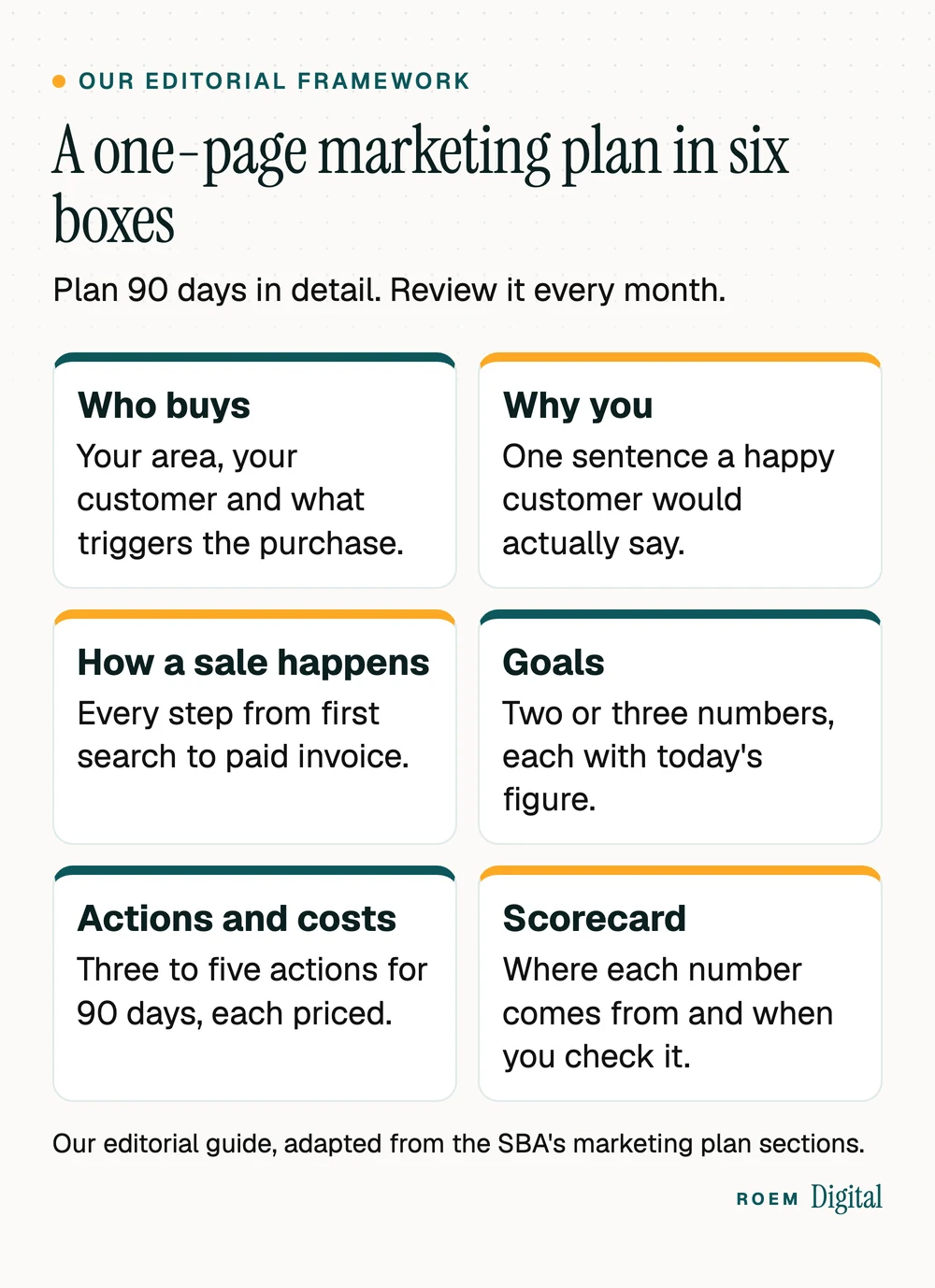
The SBA says marketing plans should be maintained at least once a year. We'd look at yours every month and rewrite the 90-day part every quarter. The rest of the year gets a sentence or two, because you'll know far more about it in three months than you do today. If you need actions to fill the plan, our list of small business marketing ideas sorts them by the problem each one fixes.
How to write a marketing plan in one afternoon
Writing your marketing plan takes an afternoon, not a month. Gather last year's numbers and work through these steps in order. Each one fills a box.
- Pull last year's numbers first: leads by source, customers won, revenue by service, and your busiest and slowest months. If you can't find them, your first action is tracking, and our guide to tracking calls and form fills in GA4 shows where to start.
- Describe who buys, in one paragraph: where they live, what they search for, what triggers the purchase, and what they compare you with. The SBA's market research guide suggests demographic data such as age, wealth, family and interests, and asking customers directly where they might go instead of you.
- Write your edge in words a customer would use. Skip "quality service". Something closer to "they show up when they say they will" or "the only crew nearby that does this".
- Map how a sale happens, from the first search to the paid invoice: search, Google profile, website, call or form, quote, booking. Every step is a place to lose people, which our guide to website conversion rate helps you measure.
- Set two or three goals you can count, each with today's number and a target.
- Choose three to five actions for the next 90 days, each with an owner, a date and the goal it serves.
- Put a cost next to every action and add them up. That's your budget.
- Pick the day you'll review it each month, and put it on the calendar now.
A small business marketing plan template you can copy
Copy this table into a document or spreadsheet and replace the third column with your own answers. The examples describe a made-up two-van pressure-washing company, there only to show the level of detail that's useful.
| Box | What to write | Example (fictional) |
|---|---|---|
| Who buys | Area, customer type, what triggers the purchase, what they compare you with | Homeowners within a 20-minute drive, often before selling a house or hosting family. The alternative is a rented machine. |
| Why you | One sentence a customer would say | Shows up on the day promised and sends before and after photos |
| How a sale happens | Each step from first search to paid invoice | Google search, Google profile, photo gallery, text or call, quote, booking |
| Goals | Two or three numbers, each with today's figure and a target | Calls from the Google profile per month, quotes sent, jobs booked |
| Actions and costs | Three to five actions for 90 days, each with an owner, a date and a cost | Weekly before and after posts, a review request after every job, postcards to two neighborhoods |
| Scorecard | Where each number comes from and when you check it | Google profile performance and a lead log, checked the first Monday of each month |
Notice what's missing: a list of every channel you could use. A plan is as much about what you won't do this quarter as what you will. Choosing between ads and search is a common first fork, and our guide to Google Ads vs. SEO helps you pick the first channel.
Put the 90 days on a calendar
A template tells you what to do. A calendar tells you when, and it's where most plans quietly slip. Open a 13-week calendar and mark three things before you schedule a single action:
- Your busy and slow weeks, from last year's numbers. If you work in Central Florida, mark the tourism peaks and school breaks too: our guide to Central Florida's busy and slow seasons shows how.
- Fixed dates you can use, such as Small Business Saturday on November 28, 2026, a local festival or the week your best customers usually call.
- Your monthly review days, so the plan gets checked before the next batch of actions starts.
Then place each action in the weeks before demand rises, not during the rush, when nobody has time to post, print or follow up.
Five mistakes that sink a small business marketing plan
Most plans that fail were written with good intentions and one of these flaws. Check yours against the list before you print it:
- Copying a big company's template. A small business plan should fit the hours you actually have. Fifteen channels on paper usually means none done well.
- Goals nobody can count. "Be the go-to name in town" feels good and tells you nothing in March. Put a number and a starting point on every goal.
- Actions without an owner. "Post on social" isn't an action until a name and a day sit next to it.
- A plan that depends on accounts you can't open. If a former vendor holds your ad account, website or analytics, sort that out first with our guide to who owns your marketing accounts.
- Measuring activity instead of customers. Posts published and ads launched are tasks, not results. Leads, customers and revenue are the results.
Set goals you can count, not goals you can feel
"Grow the brand" can't fail, which means it can't teach you anything. The SBA's examples of common goals include growing email subscribers, growing market share and increasing sales by a certain percent. For a local service business, the most useful goals sit closer to the phone:
- Leads by source: calls, forms and bookings, split by where each one came from.
- Customers won from those leads, and what each one cost you.
- Revenue from new customers, even as an estimate from your average job.
Your Google Business Profile already counts part of this. Google's guide to profile performance defines calls as the number of times a customer clicked the call button on your profile, counts website clicks from the profile, and shows the search terms people used to find you. Our guide to the five numbers every marketing report should show covers the rest of the scorecard.
Give every action a cost, then check it against revenue
The SBA asks for a complete breakdown of the costs in your plan, and suggests comparing your marketing and sales costs to the revenue they bring in so you know whether you're getting a positive return. That comparison is the whole reason to write costs down next to each action.
Count your own time too. An owner who spends Saturday mornings on social posts is paying for them, just not in cash. How large the total should be is its own question, which we answer in how to set a marketing budget for a small business. For ad spend alone, see how much to spend on Google Ads.
Keep the plan alive after week three
Most marketing plans don't fail. They fade, usually when the busy season starts and nobody opens the page again. A short monthly review keeps yours alive:
- Check the scorecard against last month and the same month last year.
- Mark each action done, late or dropped, and write one line on why.
- Keep, change or cut each action based on its number, not on how it feels.
- Rewrite the 90-day section every quarter, and the whole page once a year.

The SBA notes that some tactics, like print advertising and word of mouth, are hard to measure, and advises measuring them the same way every time. The simplest fix is to ask every new customer how they heard about you and write the answer in your lead log.
If you'd rather not run the review alone, our marketing consulting includes monthly strategy reviews with our small senior team. We track calls, forms and bookings before any ad spend starts, so each review works from real numbers.
“Both Robert and Emily were extremely helpful and easy to work with. We had multiple strategy calls regarding a client's new business website direction, all were a breeze.”
Frequently asked questions
What should a small business marketing plan include?
Who your customers are, why they choose you, how a sale happens, two or three goals you can count, the actions you'll take with a cost next to each, and how you'll measure results. The SBA's guide lists the same sections: target market, competitive advantage, sales plan, goals, action plan, budget and measurement.
How long should a small business marketing plan be?
Short enough that you'll reread it every month. One page works for most owners: six boxes, the next 90 days in detail and a sentence or two about the rest of the year. A longer plan is fine if you'll actually use it, but length on its own adds nothing.
How often should I update my marketing plan?
The SBA says to maintain it at least once a year. We'd check the numbers every month, rewrite the next 90 days every quarter and redo the whole page once a year, or sooner if your prices, services or area change.
What is the difference between a marketing plan and a business plan?
A business plan describes the whole company: what you sell, how you'll make money and how you'll run it. The SBA says the business plan should hold the central elements of your marketing strategy, and the marketing plan turns that strategy into specific actions, a budget and a way to measure them.
Do I need a marketing plan if most customers come from referrals?
Yes, even a short one. Referrals are a channel like any other: you can ask for them more often, thank the people who send them and track how many arrive. A plan also tells you what to do if referrals slow down, before a quiet month turns into a quiet quarter.
Can I write a marketing plan without a big budget?
Yes. Many of the best actions for a small business cost time rather than cash, such as finishing your Google Business Profile, asking every customer for a review and answering leads quickly. Put your time in the budget column too, so you can see what each action really costs.