
Short answer: Retargeting ads, also called remarketing, show your ads to people who already visited your website or engaged with your business. They pay off for decisions people take days or weeks to make. Businesses promoting health care, criminal defense or divorce services can't target Google audiences built from their own visitor data, so check the rules first.
What retargeting ads are and how they find past visitors
Retargeting ads are ads shown to people who already visited your website, used your app or gave you their contact details. A tag on your site adds each visitor to an audience list, and the ad platform shows your ads to that list as they browse, search or watch videos elsewhere.
Google has renamed the feature. Its page about your data segments says remarketing is now referred to as "your data," and lists the ways to use it: past visitors on the Display Network, past visitors as they search Google again, people who interacted with your YouTube videos, customer contact lists you upload (Customer Match) and people who submitted a lead form in your ads. Facebook and Instagram do the same thing with custom audiences built from your website visitors or a customer list.
| Option | Who sees the ad | Good for |
|---|---|---|
| Website visitors on the Display Network | Past visitors browsing other sites and apps | A reminder during a long decision |
| Your data segments for Search | Past visitors searching Google again | Bidding harder when a past visitor searches again |
| YouTube | People who watched or engaged with your videos | Showing proof: a walkthrough, a testimonial, a finished project |
| Customer lists | Customers whose contact details you uploaded | Repeat work, renewals and review requests |
| Facebook and Instagram custom audiences | Website visitors or customers on Meta's apps | Local businesses whose customers spend time there |
Retargeting and remarketing mean the same thing inside the ad platforms. Some marketers save "remarketing" for email to past customers, which is a separate channel with its own rules. If you're still choosing a platform, our comparison of Facebook and Instagram ads vs Google Ads for local businesses explains how intent differs between them.
When retargeting ads pay off, and when they only follow people around
Retargeting works when people need time. A kitchen remodel, a private school, a wedding venue or a new roof is a decision someone sleeps on, compares and comes back to. Seeing your name again while they decide is useful. Google's own guidance on how your data segments work makes the same point about timing: it suggests a membership duration of a few days for movie tickets and a few months for cars, and says the duration should generally be similar to the length of your sales cycle.
It works less well in three situations:
- Emergencies. Someone with a burst pipe calls a plumber within minutes. By the time a retargeting ad shows up, the job is done.
- A leaky website. If visitors leave because the page is slow, confusing or hides the phone number, retargeting pays to bring them back to the same problem. Fix the page first. Our guide to landing pages for Google Ads covers what a page needs to turn a click into a call.
- Very little traffic. Google won't serve ads to a list below its minimum size, covered below.

Health and legal businesses: the remarketing limits that apply to you
This is the part most retargeting guides skip. Google's personalized advertising policy says advertisers promoting products and services in sensitive interest categories are unable to use advertiser-curated audiences. Those include your data segments, Customer Match and lookalike segments. Predefined Google audiences, such as in-market and affinity segments, remain allowed because Google says sensitive signals are excluded from them. This is general marketing information, not legal advice.
| Google category | Examples from Google's policy pages | What it means for retargeting |
|---|---|---|
| Health | Invasive procedures including cosmetic surgery and injections, chronic conditions, mental health counseling | No website-visitor or customer-list audiences on Google |
| Commission of a crime | Criminal defense lawyers, bail bonds services | Same: predefined Google audiences only |
| Relationship hardships | Divorce services, family or relationship counseling, bereavement services | Same: predefined Google audiences only |
| Negative financial status | Bankruptcy services, debt-focused products and support | Same: predefined Google audiences only |
So a med spa promoting injectables, a therapist or a family law firm can't simply tag the site and follow visitors around on Google. If your business sits near one of these lines, read the full category pages and your ad copy together. Our post on med spa advertising covers the other rules that practice faces, and our guide to law firm PPC covers search ads for attorneys.
Meta's rules for health data and ad copy
Meta has two layers. Its Business Tools Terms, effective November 3, 2025, say advertisers won't share data through Meta's business tools that includes or is based on health information or financial information. Its ad standards on personal attributes bar ads that assert or imply a person's physical or mental health. Meta's own examples allow "Depression counseling" and reject "Depression getting you down? Get help now." A retargeting ad that says "Still thinking about your treatment?" carries the same risk, because it tells the viewer you know they looked.
If you're a HIPAA-covered practice, there's a third layer. The HIPAA Privacy Rule at 45 CFR 164.508 says a covered entity must obtain an authorization for any use or disclosure of protected health information for marketing, with narrow exceptions. Uploading a patient list to an ad platform is exactly the kind of decision to clear with your compliance officer first.
Retargeting: four questions to answer before you tag the site
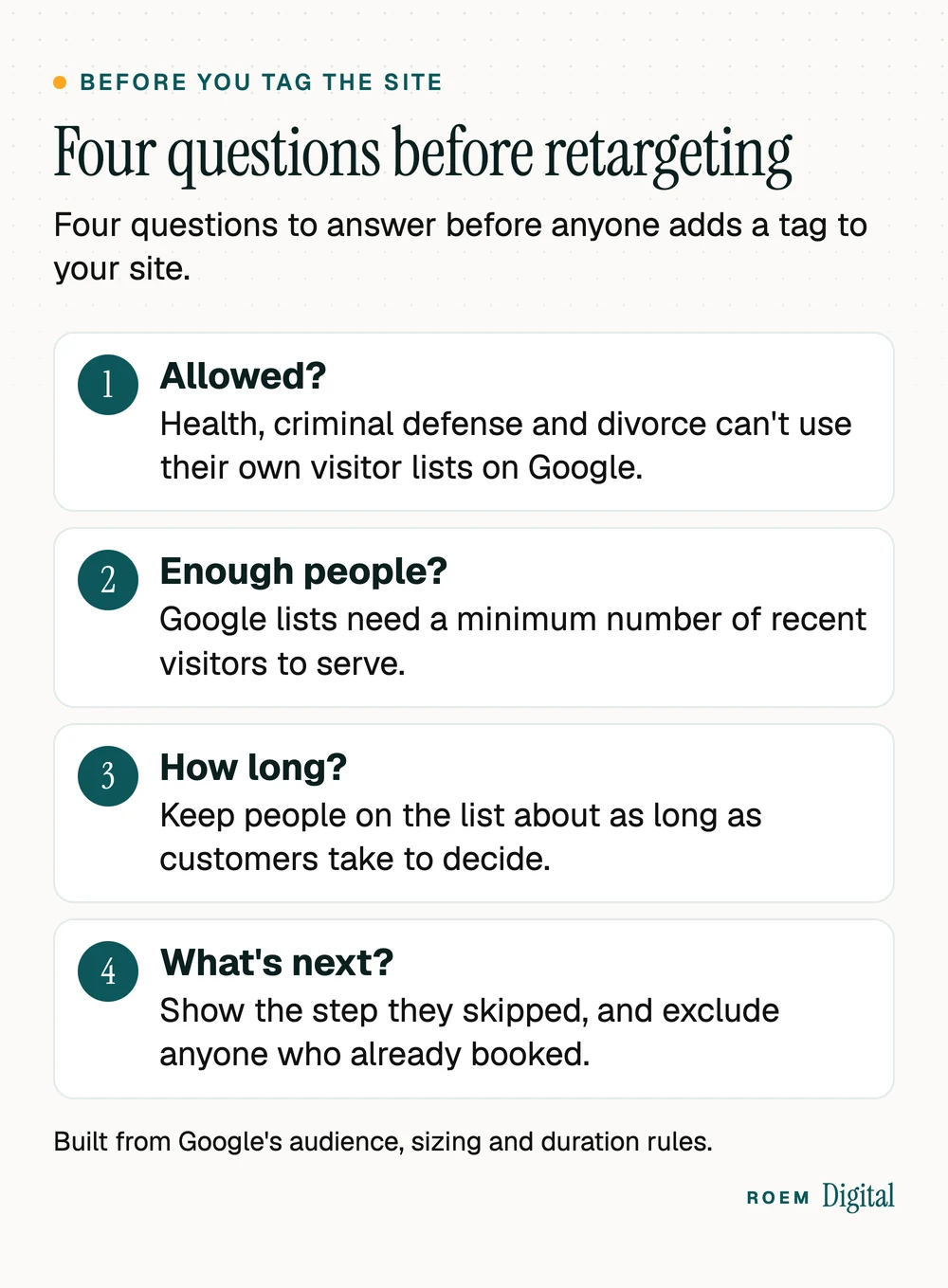
Before anyone adds a tag, answer four questions. We built them from Google's audience rules above and its sizing and duration guidance below.
- Allowed? Does your business fall in a sensitive interest category on Google, or near Meta's health data line? If so, plan for predefined audiences and contextual targeting instead of your own visitor lists.
- Enough people? Google's page on how data segments work says Display, Search and YouTube lists need at least 100 active visitors or users within the last 30 days. Its separate page on data segments for Search ads says a Search list needs at least 1,000 cookies. The two pages disagree, so plan for the larger number on Search.
- How long? Google's default membership duration is 30 days and the maximum is 540. Match it to how long your customers take to decide, not to the longest setting available.
- What's the next step? Show people the step they skipped (a price guide, a booking link, proof from a real project), and exclude people who already called or booked.
If the answer to the second question is no, retargeting isn't your bottleneck yet. More of the right visitors is. Our guide to lead generation for small businesses covers building that first source of traffic.
Setting up Google Ads remarketing and Facebook retargeting without wasting the list
Once all four answers check out, set it up in this order. Each step protects the one after it.
- Track calls, forms and bookings first. Without conversions you can't tell a working audience from an expensive one. Our walkthrough of Google Ads conversion tracking covers the setup.
- Update your privacy policy and consent. Google's personalized advertising policy tells advertisers using data segments what to include in their privacy policy, and lets you turn off data collection for visitors who don't want personalized ads.
- Build lists by intent, not just "all visitors." Pricing or service page visitors, contact page visitors who didn't submit, and past customers each need a different message.
- Exclude people who converted. Nobody who booked yesterday should see "Book your visit" for the next month.
- Keep lists broad enough. Google's policy bars combining data segments with other targeting so tightly that an ad reaches a relatively small number of users, and it bars sending personally identifiable information through the tags.
- Write the ad for the reason people left. Answer the price question, show the finished work or name the next opening. Never imply what you know about the person.
One more setting to understand: in campaigns with optimized targeting, including Performance Max, Google's data segments page says your audience selections become signals, and ads may serve to people outside them. Our explainer on Performance Max covers what you can still control.
How to tell if retargeting ads are working, not just taking credit
Retargeting reaches people who were already interested, so it always looks efficient in the ad account. Some of those people would have called anyway. Judge it on what changes in the business, not on what the platform credits to the campaign:
- Total leads, not campaign leads. If retargeting adds real customers, your total calls, forms and bookings should rise, not just shift between columns.
- Cost per new customer. Compare it with your search campaigns. A cheap retargeting lead from someone who was about to call costs more than it looks.
- Complaints. If customers mention seeing your ads everywhere, shorten the duration or narrow the list.
Our guide to what return on ad spend means explains why brand and retargeting campaigns post high returns, and the five numbers every marketing report should show covers the totals worth watching instead.
When to talk to a lawyer or compliance officer before you retarget
This post is general marketing information, not legal advice. Talk to an attorney, or to your practice's compliance officer, before you:
- Upload patient or client lists to any ad platform.
- Add ad tags to pages where patients book, fill in intake forms or log in.
- Run retargeting for criminal defense, family law, bankruptcy, mental health or addiction services.
- Market a teen program, camp or school to students themselves. Google's policy says users under 18 aren't eligible for personalized advertising of any kind.
- Receive a policy disapproval you don't understand, before you appeal it.
For practices weighing the wider picture, our med spa industry page explains how we work with aesthetics businesses.
Where retargeting fits in a tracked ad plan
Retargeting is a supporting player. It only earns its place once the campaigns that bring new visitors are tracked, the website turns visits into calls, and the policy check above says your business may use its own lists. Keep the ad accounts, the analytics and any audience lists in your business's name, so they stay with you if a vendor changes.
We're a small senior team based in Davenport, Florida, working with businesses across Central Florida and nationwide. We track calls, forms and bookings before any ad money is spent, and you own the ad accounts and the analytics. Read more about our paid media and lead generation service.
Frequently asked questions
What is the difference between retargeting and remarketing?
Inside Google Ads and Meta they mean the same thing: showing ads to people who already visited your site or engaged with your business. Google now calls it your data segments. Some marketers use remarketing for email to past customers and retargeting for paid ads, so ask which one someone means.
How many website visitors do you need for Google Ads remarketing?
Google's page on how data segments work says Display, Search and YouTube lists need at least 100 active visitors or users in the last 30 days. Its separate page on Search segments says Search lists need at least 1,000 cookies. Because the pages disagree, plan for the larger number before you count on Search remarketing.
Can a med spa use retargeting ads on Google?
Not with its own visitor lists if it promotes injections or cosmetic surgery. Google's Health category includes invasive procedures such as injections, and businesses in sensitive interest categories can't use advertiser-curated audiences like your data segments or Customer Match. Predefined Google audiences, such as in-market segments, remain available to them.
Can lawyers use retargeting ads?
It depends on the practice area. Google lists criminal defense lawyers under Commission of a crime, divorce services under Relationship hardships and bankruptcy services under Negative financial status, all sensitive interest categories that can't use advertiser-curated audiences. Other practice areas should check Google's full list, and every lawyer ad remains subject to the state bar's rules.
How long should someone stay on a retargeting list?
About as long as your customers take to decide. Google's default membership duration is 30 days and the maximum is 540, and Google says the duration should generally be similar to your sales cycle. A few days suits quick purchases, while a remodel or school choice may need months.
Are retargeting ads worth it for a small business?
They can be when customers take days or weeks to decide, your site already converts visitors and you have enough traffic to meet Google's list minimums. They rarely help emergency services or sites that lose visitors to slow pages. Track total leads before and after, not just the campaign's own conversion count.