
Short answer: Med spa advertising has to clear the ad platforms, Florida law and federal truth-in-advertising rules. Google lets US ads mention prescription drugs such as Botox or semaglutide but requires certification to bid on those terms as keywords. Meta requires cosmetic procedure ads to target adults, and Florida requires a capitalized statement on free or discounted offers.
Med spa advertising in 2026: the short answer
Med spa advertising is paid promotion for an aesthetics practice: search ads, social ads and the offers and landing pages behind them. Because many treatments involve prescription drugs or injections, the rules are tighter than for a day spa. As of November 25, 2026, the main ones are:
- Google, drug terms: US campaigns may use prescription drug terms in ads and landing pages without certification, but keyword-targeting those terms requires certification.
- Google, audiences: injections and cosmetic surgery are a sensitive health category, so your own audience lists can't be used to target them.
- Meta: ads for cosmetic procedures must target people 18 or older, and ads promoting prescription drugs fall under a separate policy that requires LegitScript certification.
- Florida: ads for free or discounted services by many licensed practitioners need a required statement in capital letters, and ads that name a provider must state the provider's license type.
- Federal: health claims need a reasonable basis before the ad runs.
Our med spa marketing guide covers the whole plan, and our med spa marketing page explains how we run campaigns. We run ads for MeliOra Elite Wellness, a physician-led concierge aesthetics and wellness practice in Lutz, Florida, and built its website. This post is the rulebook for the ads themselves. This is general marketing information, not legal advice or medical advice.
Four checks for every med spa ad
Most disapproved or risky med spa ads fail one of four checks, so run every ad, keyword list and landing page through them in order. The checks are our own, not a platform or legal standard:
- Does Google or Meta allow this treatment, this term and this audience?
- Is the treatment a prescription drug, a brand name or a compounded drug?
- Can you back every claim about results and safety with reliable evidence?
- Is anything free or discounted? Then Florida's required statement applies.
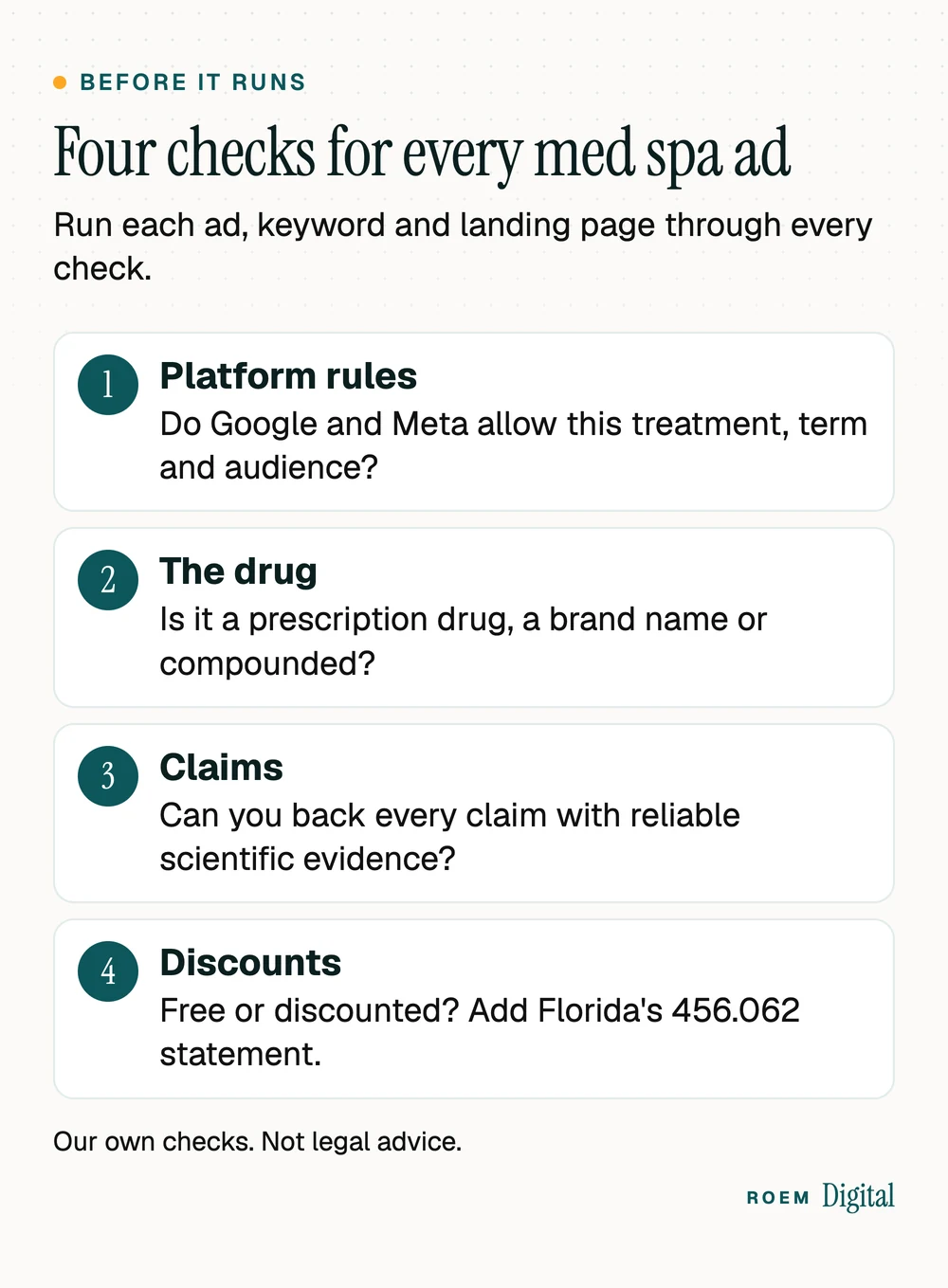
Here's one ad run through the four checks: a headline reading "Botox special this week, book online." On platform rules, Google allows the brand name in US ad text, but bidding on it as a keyword needs certification. Botox is a prescription drug, so the ad needs care on Meta too. The ad claims no result, so it passes the claims check. And "special" means a discount, and a search ad has no room for Florida's required statement, so drop the offer from the ad and carry it, with the statement, on the landing page. The sections below take each check in turn. If you'd rather have an outside look at the campaigns you run now, our paid media service starts with a free audit.
Med spa Google Ads: Botox, brand names and keyword certification
Med spa advertising on Google starts with the drug list. Google's restricted drug terms policy says campaigns targeting the United States may use prescription drug terms for promotional purposes, in line with local law. It adds: "While you don't need to be certified in order to use prescription drug terms in ads and landing pages, you must be certified in order to keyword-target these terms."
Google's non-exhaustive list of prescription drugs includes botox, botulinum toxin, dysport and xeomin, along with semaglutide, ozempic, wegovy, tirzepatide, mounjaro and zepbound. So a med spa can write "Botox" in a headline, but bidding on "botox near me" as a keyword needs certification. The same policy tells advertisers not to apply for a certification category that doesn't match their business model, so ask Google Ads support which one, if any, fits your practice before you build a brand-name keyword list.

Audiences are the second limit. Google's health policy for personalized advertising lists invasive medical procedures, "including cosmetic surgery, surgical procedures, or injections," as a sensitive interest category that can't use advertiser-curated audiences such as Customer Match or your data segments. Campaigns win on search intent, location and the landing page instead. Our guide to landing pages for Google Ads covers that page, and the batch post on retargeting ads covers which audiences remain.
Botox advertising rules on Facebook and Instagram
Meta splits health ads across two standards. Its Health and Wellness ad standard says ads for cosmetic products, procedures or surgeries "must be targeted to people at least 18 years or older," and bars ads that contain "statements of inferiority about physical appearance." Its current text allows before-and-after depictions of general cosmetic procedures for that adult audience. The page's version history shows the wording changed during 2026, so reread it before you build new creative.
Ads that promote a prescription drug fall under Meta's Drugs and Pharmaceuticals standard. It says qualified advertisers actively certified with LegitScript can run ads promoting prescription drugs, limited to people 18 or older in the United States, Canada or New Zealand, with a disclaimer to consult a licensed health professional. The standard doesn't spell out how a clinic's treatment ads are classified, so an ad built around a drug's brand name is the one to check first.
| Question | Google Ads | Meta |
|---|---|---|
| Brand drug names in ad text | Allowed in US campaigns, per local law | Prescription drug promotion needs LegitScript certification |
| Bidding on drug names as keywords | Needs certification | No keyword bidding on Meta |
| Your own audience lists | Not for injections or cosmetic surgery | Not covered on the standards we read |
| Age targeting | No personalized ads to users under 18 | 18 or older for cosmetic procedures |
| Online prescribing or telehealth | LegitScript or NABP, plus Google certification | LegitScript certification |
Copy matters as much as creative. Meta's personal attributes standard bars ads that assert or imply a person's physical or mental health, including medical conditions, so speak about the treatment rather than the reader's body. Our comparison of Meta ads vs Google ads for local businesses covers where each fits.
GLP-1 advertising: compounded isn't FDA approved
Weight-loss injections draw the closest scrutiny. The FDA's page on unapproved GLP-1 drugs used for weight loss, current as of October 1, 2026, says compounded drugs "are not FDA approved" and that the agency doesn't review them for safety, effectiveness or quality before they're marketed. Its red flags for consumers include a company that "makes claims such as the compounded drug is the same as an FDA-approved drug" or offers medicine at deep discounts. The page also says the FDA has warned telehealth companies for marketing unapproved drugs.
For GLP-1 advertising, that turns into three rules of thumb:
- Never call a compounded drug the same as a brand-name one, and don't use the brand name for a product that isn't it.
- Lead with the medical visit, including that a licensed provider decides whether a prescription is appropriate.
- Check the platform rules twice. Semaglutide and tirzepatide are on Google's drug list, and telemedicine providers need LegitScript or NABP accreditation plus Google certification under its healthcare and medicines policy.
Results claims need the same discipline. The FTC's Health Products Compliance Guidance says advertisers must have a reasonable basis for their claims before an ad runs, and that claims about the health benefits or safety of drugs and other health-related products require competent and reliable scientific evidence. A headline promising a set amount of weight loss by a date needs that evidence behind it. On Meta, the Health and Wellness standard sends prescription weight-loss products to the Drugs and Pharmaceuticals policy, and it bans weight-loss ads that promise specific outcomes within a set timeframe without disclaimers or qualifiers. Our post on med spa SEO covers why clinical pages need a licensed provider's review.
Specials and free consults: Florida's required statement
Florida adds a rule to med spa advertising that national guides often skip. Section 456.062 says any advertisement for a free, discounted fee or reduced fee service, examination or treatment by a practitioner licensed under the chapters it lists, including medicine, osteopathic medicine and nursing, must carry a statement in capital letters, clearly distinguishable from the rest of the text. The statement tells patients they may refuse to pay, cancel payment or be reimbursed for other services performed as a result of, and within 72 hours of, responding to the ad.
Copy the exact wording from the statute rather than paraphrasing it. Three places it gets missed:
- Search ads, where character limits leave no room for the statement. The statute says "in any advertisement," so keep the free or discounted offer out of the ad text, put it on a landing page that carries the statement, and ask a health care attorney before an offer goes into the ad itself.
- Social ads and posts for a holiday special or a membership launch.
- Flash promotions sent by text or email, which are ads too.
A second Florida rule covers ads that name a provider. Section 456.072(1)(t) says any advertisement for health care services naming the practitioner must identify the type of license the practitioner holds, so an ad that features your injector by name also states their license.
Our guide to med spa website design shows how to design a specials page with room for the statement, and our holiday marketing ideas cover December promotions.
When to bring in your medical director or a health care attorney
This is general marketing information, not legal advice or medical advice. Platform policies change often, and the ones quoted here were read on November 25, 2026. Bring in a professional when:
- An ad makes a clinical claim. Your medical director signs off on results, safety and who a treatment suits.
- You offer compounded or weight-loss drugs. A health care attorney should review the offer, the claims and the platform route before launch.
- You run a free or discounted offer. Confirm whether section 456.062 applies to your licenses and where the statement must appear.
- An ad or account is disapproved. Google Ads and Meta support can say which certification, if any, applies.
Our paid media service tracks calls, forms and bookings before ad spend starts, and every account stays in your name. For the medical and legal calls, your medical director and attorney decide.
Frequently asked questions
Can a med spa advertise Botox on Google Ads?
Yes, in the United States, with limits. Google's restricted drug terms policy lets US campaigns use prescription drug terms such as Botox in ads and landing pages without certification, but keyword-targeting those terms requires certification. Ask Google Ads support which certification, if any, fits your practice before building a brand-name keyword list.
Can med spas run GLP-1 or semaglutide ads?
They can, but carefully. Semaglutide and tirzepatide are on Google's prescription drug list, so keyword-targeting them needs certification, and Meta routes prescription weight-loss products to its drugs policy, which requires LegitScript certification. Never claim a compounded drug is the same as an FDA-approved one, and have a health care attorney review the offer.
What does Florida require on med spa specials?
Florida Statute 456.062 requires a specific statement, in capital letters clearly set apart from the rest of the text, in any ad for a free, discounted or reduced fee service by practitioners licensed under the chapters it lists, including medicine and nursing. Copy the exact statutory wording onto each ad and landing page.
Can med spas use before-and-after photos in Facebook ads?
Meta's current Health and Wellness standard allows before-and-after depictions of general cosmetic procedures in ads targeted to people 18 or older, and bans statements of inferiority about appearance. The page's version history shows its wording changed during 2026, so reread it first, and get written client consent for each specific use.
Can a med spa retarget its website visitors on Google?
Not with its own audience lists for injection or cosmetic surgery ads. Google lists invasive procedures, including injections, as a sensitive health category that can't use advertiser-curated audiences such as Customer Match or your data segments. Predefined Google audiences, search intent and location targeting remain available.
Can a med spa say its compounded semaglutide is the same as Ozempic?
No. The FDA says compounded drugs are not FDA approved and lists the claim that a compounded drug is the same as an FDA-approved drug among its warning signs for consumers. Describe what you actually offer, who prescribes it and how patients are evaluated, and have counsel review the wording.