
Short answer: Good med spa website design shows a qualified, licensed provider in charge first, then makes booking easy on a phone, then carries the calm of the space. Show who performs each treatment and their license type, give every treatment its own page, keep health details out of general forms, and leave room for Florida's required statement on specials.
Med spa website design starts with trust, then booking
Med spa website design has three jobs, in this order: show a nervous first-time client that a qualified, licensed provider is in charge, make booking easy on a phone, and feel like the experience they'll get in the room. Redesigns that start with the third job often run out of space for the first.
Booking still decides whether you get the appointment, which is why our med spa page calls web design mostly a booking problem. The button just doesn't get tapped until the first screen has shown who's in charge.
That's because a med spa client is shopping for something closer to a medical procedure than a massage. Before booking, they want to know who will treat them, what it will feel like, what the downtime is, roughly what it costs and whether their information is safe. Every page should answer those questions somewhere obvious:
| Page | The question it answers | What it needs |
|---|---|---|
| Homepage | Is this practice legitimate, and does it offer what I want? | Who leads the practice, top treatments, location, one booking button |
| Treatment pages | What is it, is it for me, and what happens? | One page per treatment with who performs it, downtime and how pricing works |
| Provider pages | Who will actually treat me? | Real names, license types, training and a real photo |
| Results gallery | Does it look natural? | Consented photos, labeled by treatment, consistent lighting |
| Pricing and memberships | Can I afford it, and how do visits add up? | Prices or a clear explanation of how quotes work, membership terms |
| Booking and contact | How do I book, and is my information private? | Booking in a few taps, short forms, what happens next |
For the marketing side (local SEO, ads within healthcare policies and tracking bookings to source), see how we work with med spas. This guide stays on the website itself.
Clinic first, spa second: how to judge med spa website examples
Plenty of design advice says a med spa site should feel like a luxury spa or a beauty magazine. We'd put it the other way around, and it's our editorial judgment rather than an industry rule: clinic first, spa second. The calm, premium look matters, but it's the second thing a client checks. The first is whether a qualified person is in charge.
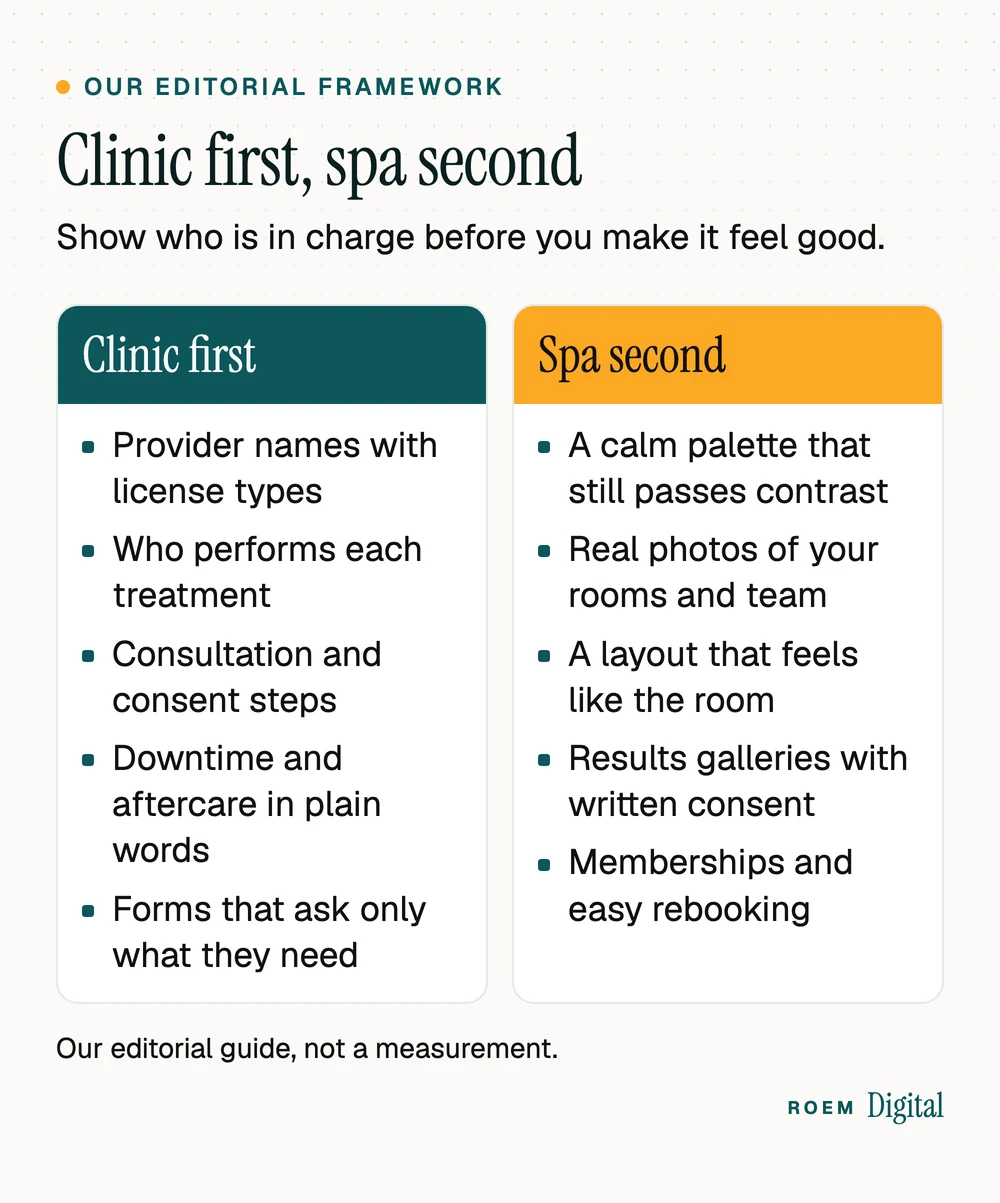
Use that order when you look at med spa website examples, including your competitors'. Open each homepage on your phone and ask: within the first screen, can you tell who performs the treatments and how to book? If the answer is a slideshow of serums and a menu, the site is spa first.
A two-minute test for any med spa website example
- Can you see who performs treatments, and their license type, without scrolling?
- Is there a booking button in the first screen and on every treatment page?
- Can you read every line of text without zooming or squinting?
- Does a treatment page tell you the downtime and how pricing works?
- Are the photos of the real rooms and providers, or stock models?
One example we know well is MeliOra Elite Wellness, a physician-led concierge aesthetics and wellness practice in Lutz, Florida, whose site we built. Its first screen puts the physician, her credential and her booking button side by side.

Treatment pages that answer a first-timer's questions
Treatment pages do most of the selling and most of the ranking, so give every treatment its own page. On a phone, order each page the way a first-timer's questions come:
- What it is, in one plain sentence, with a booking button right under it.
- Who it's for and who it isn't for, in everyday words.
- Who performs it, by name and license type, linked to their provider page.
- What a visit involves, from consultation to the last step.
- Downtime and aftercare, stated honestly.
- How pricing works: a starting price, a range, or an explanation of what a consultation covers.
- Questions people ask, answered in short paragraphs, then the booking button again.
Link treatments to each other where clients naturally compare them, and link every provider name to that provider's page. A client who reads about one injectable often wants to see the alternatives, and a client who likes the provider wants to book with that person.
Describe the treatment, never promise an outcome, and write it the way you'd explain it at a consultation. Our guide to website copywriting shows how. Our med spa marketing guide covers the rest of what a treatment page needs to rank, and how before and after galleries work best with written consent for every photo.
Booking on a phone: the design details that lose clients
In med spa website design, the prettiest site still loses the booking if the button is hard to find or the text is hard to read. These details matter most on a phone:
- Book and call buttons always within reach, on every page, without opening a menu.
- Booking inside your site where your tool allows it, so clients don't land on an unfamiliar page and wonder if it's still you.
- Short forms. Ask only what you need to book or call back.
- Fast pages. Large gallery photos are the usual culprit. Our guide to checking whether a slow website is costing you calls takes five minutes.
- Readable text. Thin, pale fonts on cream backgrounds look elegant and often fail contrast.

That last point is measurable. WebAIM's contrast checker explains that WCAG 2.0 level AA asks for a contrast ratio of at least 4.5:1 for normal text and 3:1 for large text. We ran some typical soft palettes through it:
| Text and background | Ratio | Verdict |
|---|---|---|
| Taupe #B5A99A on cream #FAF7F2 | 2.15:1 | Fails for all text |
| Mocha #8C7B6B on cream #FAF7F2 | 3.80:1 | Large text only |
| Deep brown #6B5B4D on cream #FAF7F2 | 6.08:1 | Passes for body text |
| White on champagne #C8A97E (a button) | 2.22:1 | Fails, so darken the button or the text |
| Charcoal #3A3A3A on cream #FAF7F2 | 10.6:1 | Passes easily |
You can keep the soft look and still pass: use the pale tones for backgrounds and lines, and a deep shade for words. Our guide to brand guidelines shows how to write the passing pairs down so every new page uses them.
Forms and privacy: keep health details out of the contact form
A general contact form is the wrong place for medical history. Keep it to name, phone, email, the treatment someone is interested in and a preferred time. Collect health and intake details through the intake or booking system your practice already uses for that purpose.
Whether HIPAA applies to your practice depends on what you do. The CMS page on HIPAA covered entities explains that covered entities include health plans, clearinghouses and certain health care providers, and that providers who submit HIPAA transactions, like claims, electronically are covered. It also says a covered entity that engages a business associate must have a written business associate contract or other arrangement, and it links a decision tool for practices that aren't sure.
Practices outside HIPAA aren't off the hook. When the FTC and HHS warned hospital systems and telehealth providers about online tracking tools in July 2023, the FTC's announcement said companies not covered by HIPAA still have a responsibility to protect against the unauthorized disclosure of personal health information, even when a third party developed their website.
For the website, that raises practical questions for your compliance advisor: which forms collect health information, where those submissions go, which vendors touch them, and what tracking tags run on booking and intake pages. This is general marketing information, not legal advice. Our guide to tracking calls and form fills in GA4 explains how lead tracking works, so you can bring a clear picture to that conversation.
Specials on a Florida med spa website need room for a required statement
If you run free consultations or discounted treatments, design for the fine print from the start. Florida Statute 456.062 says that any advertisement for a free, discounted fee or reduced fee service, examination or treatment by a practitioner licensed under the listed chapters, which include medicine, osteopathic medicine and nursing, must carry a specific statement in capital letters, clearly distinguishable from the rest of the text. The statement covers the patient's right to refuse to pay for other services performed as a result of, and within 72 hours of, responding to the ad.
- Build promotion banners and special-offer sections with space for the full statement, not a link to it.
- Keep the statement in capital letters and set apart, on the page and in any matching ad.
- Show provider names with their license type, a separate Florida rule covered on our Orlando med spa page.
- Retire expired specials on a schedule so old offers don't sit on the site.
Which practitioners and offers the statute covers is a question for your medical director or attorney, not your web designer.
When to bring in your medical director, a compliance advisor or an attorney
A good web team can build pages that are easy to keep compliant. It can't decide what's compliant. Bring in the right person before launch:
- Your medical director for every treatment description, provider credential and before and after caption.
- A compliance advisor for intake forms, booking and intake vendors, and any tracking on pages where clients share health information.
- A health care attorney for promotions, the 456.062 statement, and anything you're unsure your licenses allow you to advertise.
Our med spa marketing guide has more on reviews and photos. This article is general information, not legal advice.
Rebuilding a medical spa website without losing bookings
If your current site already brings in bookings, protect what works before a new med spa website design changes the look. Record which treatment pages get the most visits and bookings, keep those addresses or redirect each one to its new page, and test every booking path on a real phone before launch. Our website redesign checklist walks through each step.
Plan a photo session before the build, too. Real photos of your rooms, your providers and your front desk do more for a medical spa website than any stock image of a model, and they make the clinic-first signals believable.
We're a small senior team based in Davenport, Florida, and we design and hand-build websites, not templates, as part of our brand and web services. Calls, forms and bookings are tracked before ad spend starts, every old URL gets a permanent redirect in a rebuild, and you own the domain, the website and every account.
Frequently asked questions
What should a med spa website include?
A homepage that shows who leads the practice and how to book, one page per treatment, provider pages with names and license types, a consented results gallery, a clear pricing or consultation explanation, booking that works in a few taps on a phone, and short contact forms that leave health details to your intake system.
What makes a good medical spa website design?
It shows that a qualified, licensed provider is in charge before anything else, then makes booking easy on a phone, then carries the calm feel of the space. Practically, that means providers and credentials in the first screen, readable text that passes contrast checks, fast pages and booking buttons on every page.
Should a med spa website show prices?
Many clients want at least a starting price before they book. If you publish prices, keep them current. If you prefer not to, explain how pricing works and what a consultation includes. In Florida, free or discounted offers by covered practitioners need the statement required by Statute 456.062.
Does a med spa website need to be HIPAA compliant?
It depends on whether your practice is a HIPAA covered entity, which CMS ties to things like submitting claims electronically. Either way, keep medical history out of general contact forms and ask a compliance advisor about intake forms, vendors and tracking. This is general information, not legal advice.
What are good med spa website examples to study?
Look at practices whose first screen on a phone shows who performs treatments, their credentials and a booking button. MeliOra Elite Wellness in Lutz, Florida, a site we built, is one example. Judge any example on trust and booking first, and on design style second.
How long does it take to build a med spa website?
It depends on the number of treatment pages, how much new photography and copy you need, your booking tool and how quickly your medical director reviews content. Ask for a written schedule with a date for each stage, and plan launch away from your busiest promotion season.