Short answer: Med spa SEO rests on four things: a page for every treatment you perform, a complete Google Business Profile with steady genuine reviews, medical content a licensed provider has reviewed, and a booking path that turns visits into consults. Build town pages only where you have something true and different to say.
Med spa SEO starts with one page per treatment
Med spa SEO is how your practice shows up when someone nearby searches for a treatment you offer, both in the regular results and in the map pack. Four things carry most of the weight: one page for each treatment you actually perform, a complete Google Business Profile with a steady flow of genuine reviews, medical content that a licensed provider has reviewed, and a booking path that turns a visit into a consult.
This guide stays on search. For paid ads, social and tracking bookings to their source, our guide to med spa marketing ideas that fill a calendar covers the wider plan. Here we go deeper on the decisions that trip up aesthetic practices in Google: which pages to build, which town pages to skip, how health topics raise the trust bar, and which schema types to keep off treatment pages. For the pages themselves, our guide to med spa website design covers what each one needs.
Google ranks pages, not practices. One Services page can't be the best answer to every treatment search at once. Each treatment you perform regularly needs its own page, named the way clients search for it.
Name and group pages the way clients search
Clients search by treatment name, by brand name, by concern and by price question. Give each page one main search to answer and let the others support it in the copy. Where a brand name is what most people type, your medical director decides how the page uses it.
Then group related pages under a few category pages (injectables, skin, body, wellness) so visitors and Google can see how they connect. Link every treatment page to the bio of the provider who performs it, and link back.
What each treatment page needs
- What the treatment is, in one plain paragraph at the top
- Who performs it, with name, license type and training
- What a visit involves, from consult to aftercare, with no promised outcomes
- How pricing works: a starting price, a range or how the consult sets it
- Answers to the questions your front desk hears every week
- A booking button on the first screen of a phone
- Real photos of your rooms and team, and results photos only with written consent
Writing and building these pages is the core of our SEO and content service, and it's often where the quickest gains hide.
The treatment-by-town matrix: which local pages deserve to exist
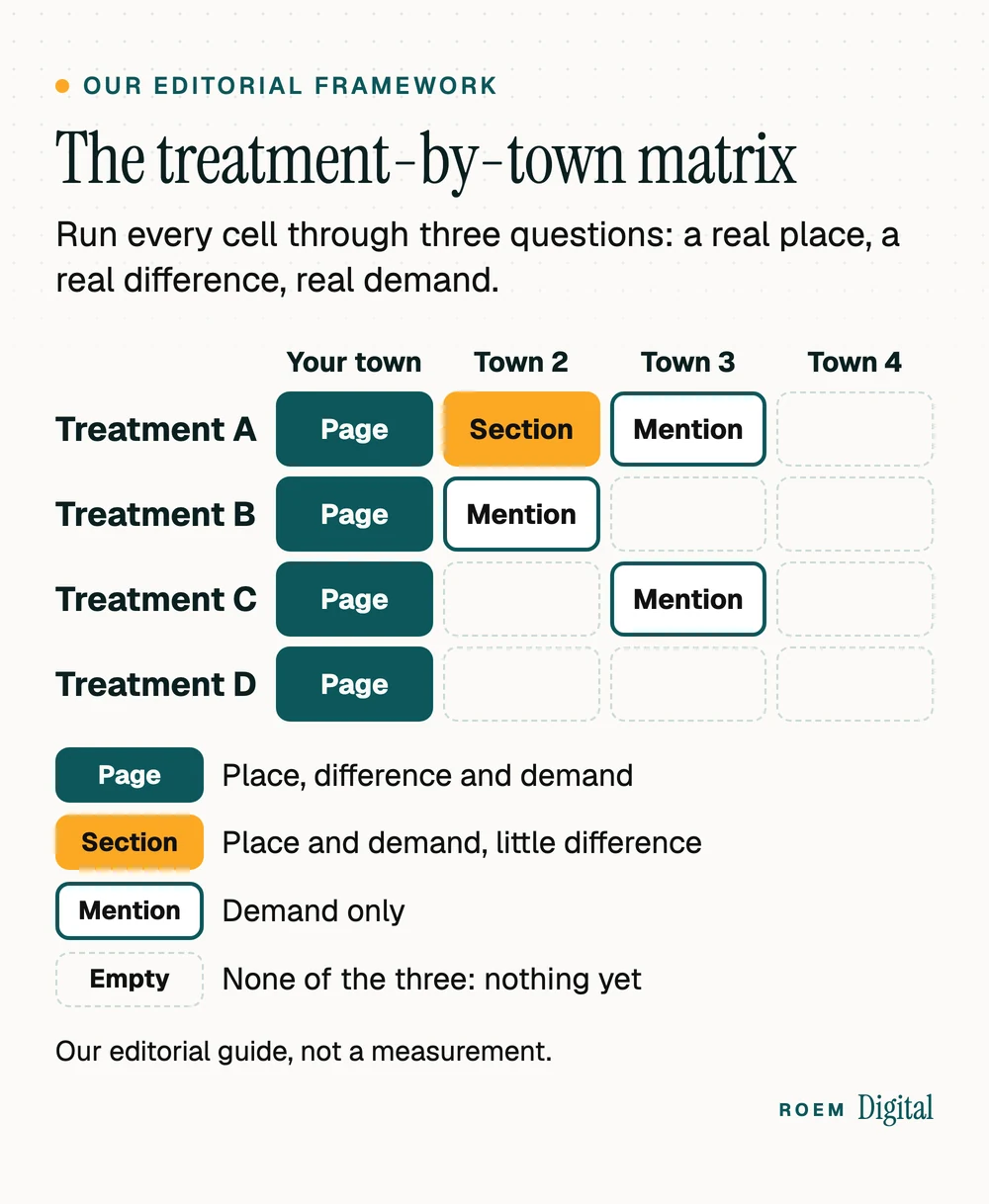
The treatment-by-town matrix is a grid with your treatments down the side and the towns your clients come from across the top. Each cell gets one verdict: build a page, add a section, mention it, or leave it empty.
When it comes to SEO for med spas, town pages tend to go wrong in one of two directions. Some practices never mention the towns their clients drive from. Others publish a page for every treatment in every nearby town with only the town name changed. Google's spam policies define doorway abuse as pages "created to rank for specific, similar search queries," and their examples include "pages targeted at specific regions or cities that funnel users to one page." Town-swapped treatment pages fit that description.
Run every cell through three questions:
- A real place? You have an office in that town, or you genuinely provide the treatment there, such as concierge visits or a set clinic day.
- A real difference? A visitor from that town would learn something your main treatment page doesn't say: who treats there, which days, how to get there, what that location offers.
- Real demand? Your Search Console queries, booking records or call notes show people from that town looking for that treatment.
| The cell passes | What to build | Example |
|---|---|---|
| Place, difference and demand | Its own page for that treatment at that location | A second office where a different provider performs laser treatments on set days |
| Place and demand, little difference | A section on that location's page, linked from the treatment page | A second office with the same injectables menu as the first |
| Demand only | A line on the treatment or location page about where clients come from, with directions | Clients who drive in from a neighboring town where you have no office |
| None of the three | Nothing yet | A town you've never booked a client from |
Most single-location practices end up with a full column of treatment pages, one strong location page and very few town pages. That's the right shape. If you travel to clients or run without a storefront, our guide to city pages for service-area businesses covers the extra rules.
Your Google Business Profile is your entry in the map pack
For "near me" searches, your Google profile is often the first thing a client sees, and sometimes the only thing. It has to be complete, current and set up the way Google's Business Profile guidelines require. A few of those rules catch med spas more than most businesses:
- Your real name only. The name should match what's on your storefront, website and stationery. Google says extra information in the name isn't permitted and can get the profile suspended, so leave treatments and towns out of it unless they're part of your real-world name.
- As few categories as possible. Google asks for categories that complete "This business IS a," not "this business HAS a." Treatments belong in the services list.
- Provider profiles follow their own rules. Google treats doctors as individual practitioners. Where several public-facing practitioners work at one location, the practice gets its own profile, separate from theirs, and no practitioner should hold several profiles for different specialties.
- No promotions in the description. The business description can't focus on specials, prices or sales.
- A booking link to your booking page, plus real photos of your rooms and team, kept current.
Our Google Business Profile checklist walks through every field.
Reviews: ask everyone the same way
Reviews feed the decision to book, and Google says more reviews and positive ratings can help your local ranking. Its Maps content policy doesn't allow businesses to offer incentives for reviews, discounts included, or to selectively ask happy clients. So no free add-on for a review, and no survey that only sends five-star clients to Google. Ask every client after every visit, with a direct link. Send it after the client leaves, since the same policy says businesses shouldn't pressure customers to write reviews on the premises or ask for specific content.
Replies need extra care in health care. Thank the reviewer without confirming they were a patient or naming a treatment, and move anything specific to a phone call. Google's own tips for review replies say never to share a reviewer's private information. Our guide to getting more Google reviews by the rules has request wording you can adapt.

Health topics raise the trust bar for med spa SEO
Google holds health pages to a higher standard. Its guide to creating helpful, reliable content says its systems give even more weight to content with strong E-E-A-T (experience, expertise, authoritativeness and trustworthiness) on topics that could significantly affect people's health, and that such content must be highly accurate and consistent with established expert consensus. Injectables, lasers and medical weight loss sit squarely in that group.
Who writes and who reviews
A writer or marketer can draft a treatment page. A licensed provider who performs the treatment should review it before it goes live, and the page should say so: the reviewer's name, license type and the date of the last review. Google's guide asks whether content is "written or reviewed by an expert" who knows the topic well, and it calls made-up names and false credentials a form of deception. A real reviewer beats an impressive invented one. Pages full of specific, checkable facts are also the kind AI answers in search tend to cite, as our guide to AI search optimization explains.
In Florida, Fla. Stat. 456.072(1)(t) requires any advertisement for health care services that names a practitioner to identify the type of license that practitioner holds. It's sensible to apply the same habit to provider names on treatment pages and bios, and your attorney can confirm what counts as an advertisement for you.
Results photos and claims
Results photos persuade, and they're where pages most often overstate. Our med spa marketing page covers consent and consistent photography. On the page itself, label each set by treatment, describe what was done, and leave out promises about results.
Specials pages in Florida
If you advertise specials or free consults, check Fla. Stat. 456.062. It covers "any advertisement for a free, discounted fee, or reduced fee service, examination, or treatment by a health care practitioner licensed under" chapters 458, 459, 460, 461, 462, 463, 464, 465, 466, 467, 478, 483, part I of 484, 486, 490 or 491 of the Florida Statutes. Those ads must carry this statement "in capital letters clearly distinguishable from the rest of the text":
THE PATIENT AND ANY OTHER PERSON RESPONSIBLE FOR PAYMENT HAS A RIGHT TO REFUSE TO PAY, CANCEL PAYMENT, OR BE REIMBURSED FOR PAYMENT FOR ANY OTHER SERVICE, EXAMINATION, OR TREATMENT THAT IS PERFORMED AS A RESULT OF AND WITHIN 72 HOURS OF RESPONDING TO THE ADVERTISEMENT FOR THE FREE, DISCOUNTED FEE, OR REDUCED FEE SERVICE, EXAMINATION, OR TREATMENT.
Your attorney can confirm which of your providers and offers it covers. A specials page and a profile offer post are both places to check. If you practice in another state, check its rules too.
Schema for a med spa: mark up the practice, never the treatment as a product
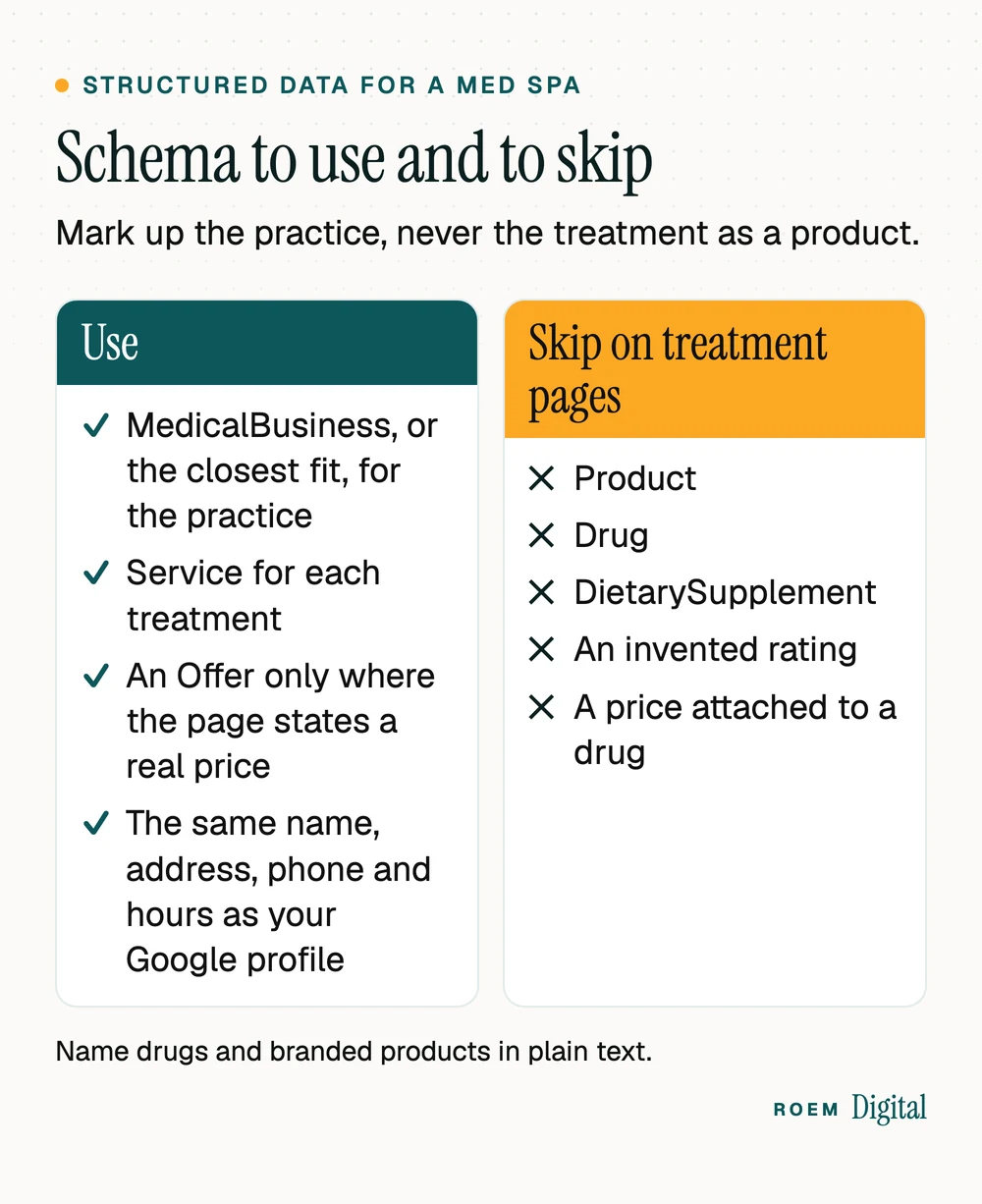
Structured data tells Google who you are, where you are and what you offer. Google's LocalBusiness documentation says to use the most specific LocalBusiness sub-type possible, and schema.org lists MedicalBusiness as a LocalBusiness type for businesses run by health professionals. Use it, or the closest fit, for the practice and each location, with the same name, address, phone and opening times as your Google profile.
Then keep Product and its subtypes, such as Drug and DietarySupplement, off your treatment pages. Schema.org files Drug under Product, and Google's product snippet rules require a review, a rating or an offer for product snippets, so a Drug node on a treatment page can be flagged as a product listing with missing fields. Run new markup through the Rich Results Test and check Search Console's rich result reports for invalid items, as that Google page advises.
Don't clear those checks by inventing a rating or attaching a price to a drug. Google's structured data guidelines say markup must be a true representation of the page content, so name drugs and branded products in plain text. Offer is a different case: schema.org files Offer under Intangible, not Product, so a treatment marked up as a Service can carry an Offer when the page states a real price. Where the consult sets the price, leave the Offer out and let the pricing paragraph explain.
Plugins and themes can add markup you never chose, so check the code your pages actually serve, not just your settings. Our comparison of custom builds and website builders covers how much control each one gives you.
The next problem: traffic that never becomes a booked consult
Rankings sit in the middle of the funnel. The real test of med spa SEO is booked consults by treatment, and that needs the path from search to booking plus tracking that shows it. Work in this order:
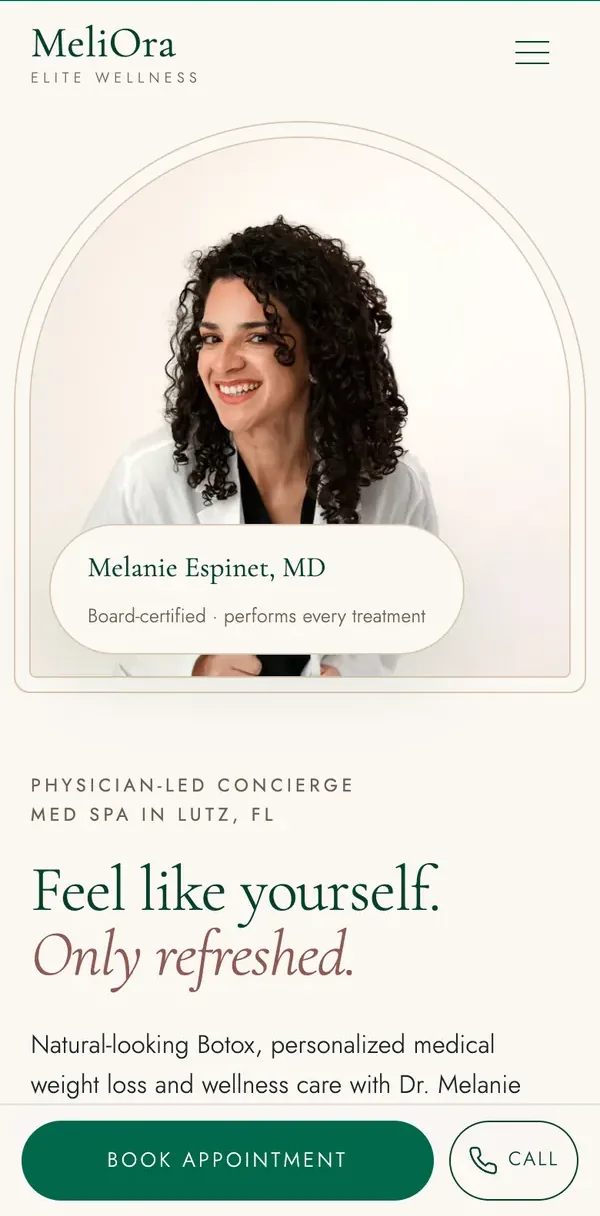
- Put a booking button and a call button on every treatment page, visible on the first screen of a phone.
- Point the Google profile's booking link at your booking page, not the homepage.
- Track calls, form fills and completed bookings as key events, with the treatment attached where your booking tool allows.
- Compare organic bookings by treatment each month, and fix the pages that get visits but no bookings first.
- Before any analytics or ad tag goes on booking or intake pages, ask your compliance advisor which tags are allowed there.
Our walkthrough on tracking calls and form fills in GA4 shows the setup step by step. When we build a practice's site, it's custom-built rather than templated. Calls, forms and bookings are tracked before any ad spend starts, and the practice owns the domain, the site and every account.
When to talk to a professional instead
This is general marketing information, not legal or medical advice. Your marketing team should raise these questions early, and your licensed team should answer them:
- Clinical content: your medical director, or the provider who performs the treatment, approves every treatment page, FAQ and results caption.
- Advertising rules: a health care attorney confirms how Florida's rules, or your state's, apply to your pages, promotions and provider names.
- Privacy and tracking: a compliance advisor decides which tags can run on booking and intake pages and how staff reply to reviews.

See how we work with aesthetic practices on our med spa marketing page, where every account stays in the practice's name.
Frequently asked questions
What is med spa SEO?
Med spa SEO is the work of getting an aesthetic practice found in Google's regular results and map pack when nearby people search for its treatments. It covers treatment pages, the Google Business Profile, reviews, provider-reviewed medical content, structured data and a booking path that turns visits into booked consults.
Does each provider at a med spa need their own Google Business Profile?
It depends on who is public-facing. Google treats doctors as individual practitioners. With several public-facing practitioners at one location, the practice keeps its own profile and each practitioner may have one under their name only. A solo practitioner at a branded practice is best off sharing one profile with the practice. Nobody should hold several profiles for different specialties.
Should a med spa create pages for nearby cities?
Only where the page can say something true and different: a real office, a provider who treats there, or details a visitor from that town needs. Pages that only swap the town name fit what Google's spam policies describe as doorway abuse. Most single-location practices need strong treatment pages far more than town pages.
Who should write medical content for a med spa website?
A writer or marketer can draft it, but a licensed provider who performs the treatment should review and approve it before it goes live. Show the reviewer's name, license type and review date on the page. Google gives extra weight to trustworthy content on health topics and treats invented credentials as deception.
What schema markup should a med spa use?
Mark up the practice with the most specific LocalBusiness type that fits, such as MedicalBusiness, using the same details as your Google profile. Keep Product and its subtypes, such as Drug, off treatment pages, because Google checks Product markup for reviews, ratings or offers. A Service with an Offer is fine where the page states a real price.
Can a med spa ask clients for Google reviews?
Yes. Google lets businesses ask for reviews as long as you ask every client the same way, offer nothing in return and don't pressure anyone to write one in the office. Discounts, free add-ons and surveys that only send happy clients to Google break its rules. When you reply, thank the reviewer without confirming they were a patient.
Is medical spa SEO different from med spa SEO?
No. They're two names for the same work, and people search both. Use whichever term your clients use on your own pages, but don't build separate pages for each phrase. One strong page per treatment, written for the person deciding, answers both searches.