
Short answer: Performance Max is a Google Ads campaign type that runs across Search, YouTube, Display, Discover, Gmail and Maps from one campaign, steered by your conversion goals and assets. It can work for a local business, but only after conversion tracking counts real leads, exclusions are set and Search keywords cover your core services.
What Performance Max is, and the short answer to just running it
Performance Max (PMax) is a goal-based Google Ads campaign that can show your ads across all of Google's inventory, including YouTube, Display, Search, Discover, Gmail and Maps, from a single campaign. That's how Google's PMax overview describes it. You supply conversion goals, assets such as headlines, images and video, and optional audience signals. Google's AI decides where, when and to whom the ads show.
So should you just run it? In our view, not as the first campaign for most local service businesses. PMax can work well, but it steers by the conversions you track. If those conversions are phone taps, page views or spam form fills, it will optimize toward more of them. Run it after three things are true: conversion tracking counts real leads, your exclusions are set, and Search keywords already cover your core services. Our Google Ads management starts from the same question.
Performance Max vs Search: which campaign gets the search
When a Search campaign and a PMax campaign could both answer the same search, Google uses a set order. Its page on keyword matching options explains it: an exact match keyword identical to the search wins over PMax. Phrase and broad match keywords identical to the search share priority with identical PMax search themes. After that, the most relevant ad groups are considered, and Ad Rank breaks any tie.
Google also lists why your keyword might show up in PMax instead: the Search campaign is limited by budget, the keyword has low search volume, its ads or landing pages are disapproved, or its targeting requirements aren't met. A starved Search campaign hands its searches to PMax.
| Search campaign | Performance Max | |
|---|---|---|
| Where ads can show | Google search results, plus search partners and the Display Network if you opt in | Search, YouTube, Display, Discover, Gmail and Maps |
| How it finds searches | Your keywords and their match types | Your goals, assets, landing pages and search themes, with no keyword list |
| What you control | Keywords, negatives, match types, ads, bids, networks | Goals, assets, exclusions, search themes, URL rules, some channel settings |
| Best use | The searches that already bring you work | Extra reach once tracking and Search are solid |
If you're still building the Search side, start with our guide to Google Ads for small business and our explainer on keyword match types.
PMax campaigns multiply their inputs: check four of them first
Here's our contrarian read, and it's our opinion: PMax doesn't find customers. It finds more of whatever you count as a conversion. That rests on Google's own description, where you define the conversion actions you care about and Smart Bidding bids in each auction based on the chance of that conversion. So check four inputs before any PMax campaign launches.
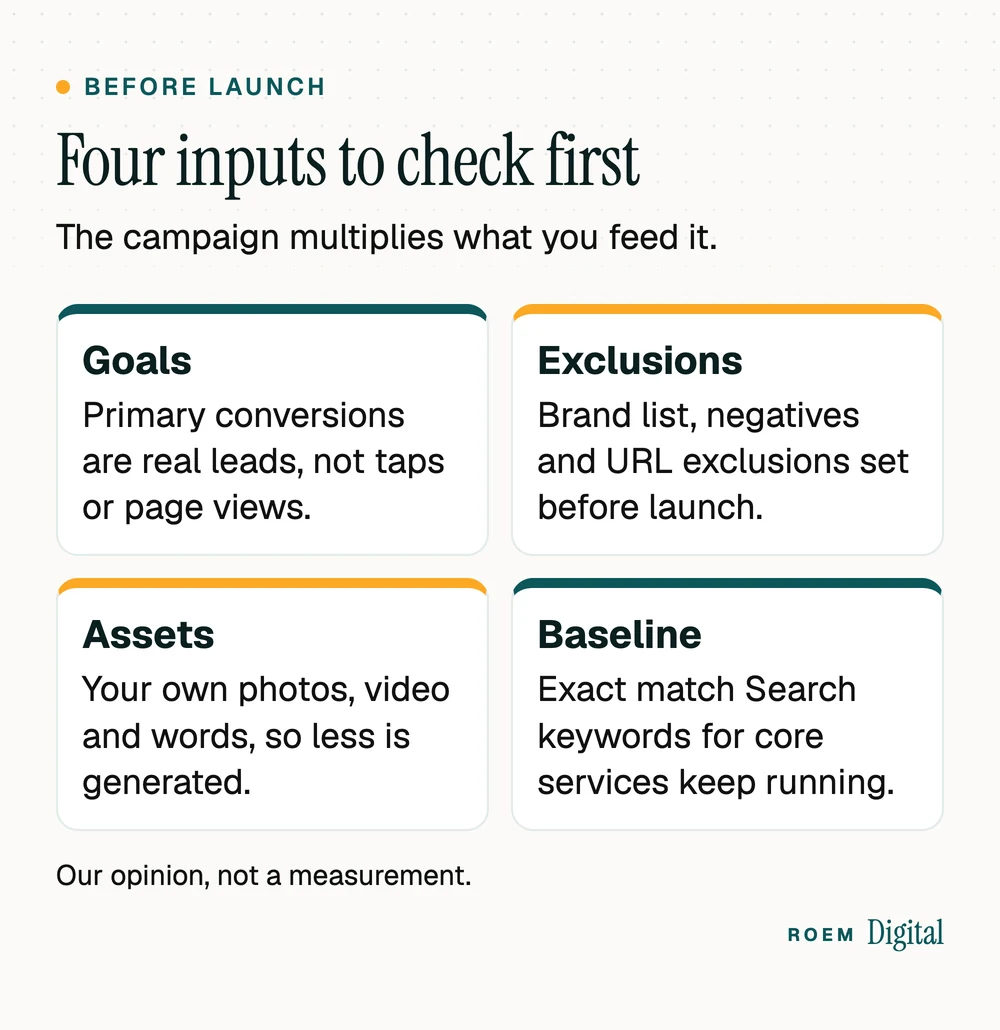
- Goals. Primary conversions are real leads: calls past a minimum length, completed forms and bookings. Our guide to Google Ads conversion tracking shows how to check.
- Exclusions. Your brand list, negative keywords and URL exclusions are in place before launch, not after the first bill.
- Assets. Your own photos, video and words fill the asset group, so Google generates less on your behalf.
- Baseline. Exact match Search keywords for your core services keep running with enough budget, so you can compare.
The PMax controls you have in 2026
PMax used to be called a black box. It now has real controls, collected in Google's guide to search targeting and controls for PMax. Set these before launch.
Brand exclusions
Google calls brand exclusions the most effective way to control how your ads appear on searches for a brand, because they block the brand name, common misspellings and subsidiary brands. Use them to keep PMax off your own name if a separate campaign covers it, or off competitors' names. You build brand lists at the account level from brands in Google's library. Its help pages mention requests for new brands going through review, so a small business name may not be listed right away.
Negative keywords
PMax now takes negative keywords at the campaign level, at the account level and, since Google's August 2025 PMax update, as shared lists. They apply to Search and Shopping inventory only. Google calls them a highly restrictive control and recommends them only for brand safety and completely irrelevant terms, such as the job and DIY searches in our negative keywords guide.
Search themes and landing page rules
- Search themes: up to 50 per asset group, describing what your customers search for that your website doesn't make obvious.
- Final URL expansion: lets Google send people to a different page on your site than the one you chose, with a matching headline. Google says URL exclusions only work while it's on, so exclude the blog, careers, privacy and other pages that can't produce a lead.
- Page feeds: turn Final URL expansion off and attach a page feed to keep ads on a fixed list of pages. Google calls this maximum control.
Channels, devices and ages
Google's overview now describes channel prioritization: Search, YouTube, Maps, Gmail and Discover are grouped as Google channels, while search partners and the Display Network can get separate priority tiers and optional daily budget allocations. Device and age targeting became fully available in the August 2025 update. Use them when a channel or age group clearly can't buy from you.
Asset quality: what PMax builds from your photos and words
An asset group is the set of headlines, descriptions, images, logos and videos Google mixes into ads for every placement. Google's asset group guide allows up to 15 headlines and up to five long headlines, asks for wide and square images plus a logo, and says that if you don't add a video, one or more may be auto-generated from your other assets. Text customization, which Google recommends keeping on, also writes extra headlines and descriptions from your landing page and existing ads.

For a local service business, the best assets are the ones only you have: photos of finished jobs, your team at work, a short phone video walking through a project. Write headlines that name the service and the area, not slogans. Then keep your landing pages accurate, because Final URL expansion and text customization both draw on them. Our guide to landing pages for Google Ads covers what those pages need. After launch, review the assets Google generated and remove any that don't sound like you, which Google's August 2025 update made possible.
Performance Max for local business: the pay-per-lead version
There are now two kinds of PMax for local businesses, and they work very differently. Google's Local Services Ads transition page says existing Local Services Ads campaigns are being migrated into Performance Max campaigns with pay-per-lead goals. Google's developer documentation explains that these campaigns serve Local Services Ads.
- Timeline: the first phase began in August 2026 for select U.S. home and storefront services. Late 2026 adds service-area businesses without storefronts, and 2027 covers non-U.S. accounts and the remaining categories.
- What you pay for: valid leads such as calls and messages, with bookings added from October 2026, according to Google's pay-per-lead overview. Standard PMax charges per click.
- Where ads show: only Google Search and Google Maps. Standard PMax serves across all of Google's networks.
- Targeting: keywordless, built from your verified Google Business Profile, service areas, categories and ad schedule.
- New campaigns: Google says you can't create one directly in Google Ads yet, so new advertisers still start on the Local Services page.
If you already run Local Services Ads, watch for Google's advance email, which goes to the account administrator 14 days before your migration date, and download your history first, because past performance reports don't carry over. Our comparison of Local Services Ads vs Search ads explains how the lead model differs from paying for clicks.
Reading PMax results: search terms, channels and your lead log
- Search terms: Google's PMax search terms report sits in the Search terms report under Search terms and landing pages for Performance Max. Use it to find irrelevant searches to block and good ones to write new headlines around.
- Channel performance: a report under Campaigns that shows how each channel contributes to your goals, with a status column that flags problems such as missing assets.
- Your own lead log: Google says to prioritize conversion data over clicks and impressions. Go one step further and compare PMax leads with what your team actually booked.
If PMax reports cheap leads that your phone and inbox never saw, check your conversion settings before you raise the budget. Google's lead generation best practices say that lead-specific goals, such as qualified lead, book appointment or request quote, automatically trigger invalid traffic protections built for lead generation campaigns. Spam form fills are a separate problem, which our guide to click fraud and fake leads covers. For the numbers worth reporting each month, see the five numbers every marketing report should show.
How we decide whether PMax belongs in your account
We're a small senior team based in Davenport, Florida, working with businesses across Central Florida and nationwide. Robert handles the ads and the tracking, calls, forms and bookings are tracked before any ad spend starts, and you own the ad account either way. If you're weighing PMax, check the four inputs above first: tracking, exclusions, real assets and a Search baseline.
Read more about our paid media service, or start with a free audit.
Frequently asked questions
Is Performance Max good for small businesses?
It can be, once conversion tracking counts real leads and a Search campaign already covers your core services. Performance Max steers by your conversions, so weak tracking gets scaled along with everything else. In our view, a first campaign teaches a small service business more as a focused Search campaign it can read keyword by keyword.
Does Performance Max replace Search campaigns?
No. Google describes Performance Max as a complement to keyword-based Search campaigns. When a search exactly matches an eligible exact match keyword, the Search campaign is prioritized. A Search campaign limited by budget can lose searches to Performance Max, so keep your core Search campaigns funded.
Can I see search terms in Performance Max?
Yes. Open the Search terms report and choose Search terms and landing pages for Performance Max. Google says the report shows the searches that triggered your ads, including ones that didn't convert, with data available from March 2023. Block irrelevant searches with negative keywords at the campaign or account level.
How do I stop Performance Max from showing on my brand name?
Use brand exclusions. Create a brand list at the account level in the Shared library, add your brand, then apply the list in the campaign's settings. Google says brand exclusions also block common misspellings, which is why it recommends them over negative keywords for brand searches.
What is Performance Max with pay-per-lead goals?
It's the new home for Local Services Ads. Google is migrating those campaigns into Performance Max with pay-per-lead goals, starting in August 2026 in the U.S. You pay for valid leads such as calls and messages, and ads show only on Google Search and Maps, unlike standard Performance Max.
Do I need a video for Performance Max?
You don't have to upload one, but Google says that if you don't add a video, one or more may be auto-generated from the other assets in your asset group. A short video of your real work, shot on a phone, usually represents your business better than one generated from your still images and text.