
Short answer: Law firm PPC works when each campaign covers one practice area at one level of case value, runs only where and when someone can answer, and uses ad copy that follows your bar's rules. Then import signed cases from your case management system into Google Ads, so bidding and reporting follow cases instead of clicks.
Split law firm PPC campaigns by practice area and case value
Law firm PPC pays off when each campaign covers one practice area at one level of case value, runs only where and when someone can answer the phone, uses ad copy that follows your bar's rules, and reports signed cases back into Google Ads. Waste tends to hide in broad campaigns that mix cheap and valuable searches, ads that run when nobody picks up, and tracking that counts every call the same.
If you practice outside Florida, your own bar's rules apply, and Florida's also apply to ads aimed at Florida residents.
One campaign stuffed with every legal keyword lets Google spend your budget wherever clicks come easiest, which may not be where your best cases are. We use a case-value campaign map instead. It's our editorial framework, not a Google rule: each campaign holds one practice area at one level of value and urgency, so it gets its own budget, bids, hours, area and landing page.
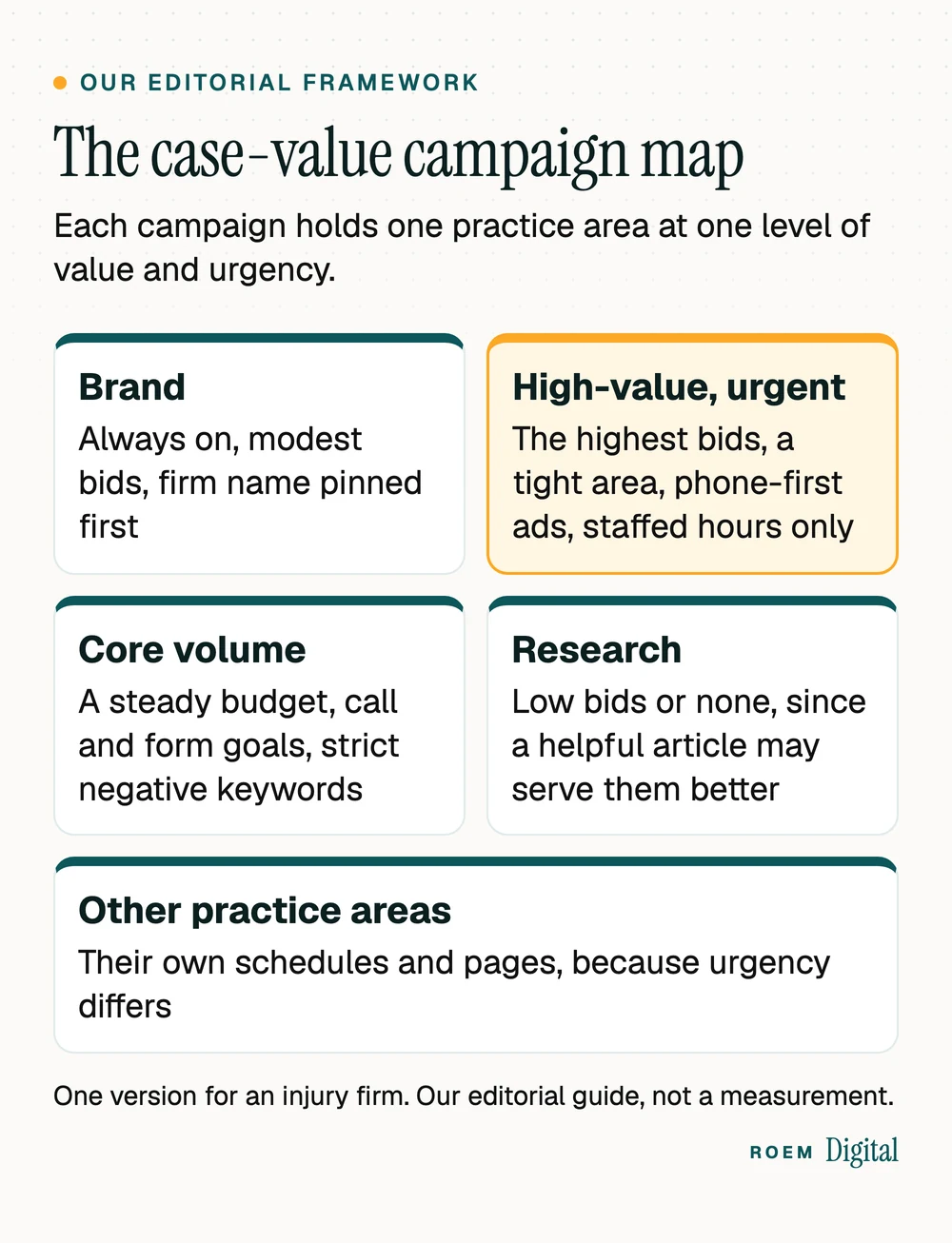
One version for an injury firm:
| Campaign | What goes in it | What it gets of its own |
|---|---|---|
| Brand | Searches for your firm's and your lawyers' names | Always on, modest bids, firm name pinned first |
| High-value, urgent | Serious-injury searches such as truck crashes or wrongful death, or an arrest in criminal defense | The highest bids, a tight area, phone-first ads, staffed hours only |
| Core volume | Your everyday case type, such as car accidents | A steady budget, call and form goals, strict negative keywords |
| Research | Searches like "how long do I have to file" or "what is my case worth" | Low bids or none, since a helpful article may serve them better |
| Other practice areas | Family law, estate planning and the like, one campaign each | Their own schedules and pages, because urgency differs |
Fill it with your own numbers: how often each case type signs and what it's typically worth. Then see our guides to setting a Google Ads budget from cost per lead and close rate, negative keywords and why ads shouldn't send people to your homepage.
Set where and when Google Ads for lawyers can show
Location: start with Presence
Google's default location option shows ads to people "in, regularly in, or who've shown interest in" the places you target. To reach only people likely to be physically there, Google's help page on preventing clicks outside your targeted locations says to switch to the Presence option, usually the safer start for a firm that takes cases in certain counties.
One Central Florida wrinkle: someone hurt on a Florida trip may search from home after flying back, and the interest setting can reach them. If those cases fit, test it in its own campaign, but ask ethics counsel first, since ads shown in other states may fall under those states' advertising rules too.
Schedule: run ads when someone answers
Google's ad scheduling help says campaigns show ads "All day" by default. If nobody answers at 2 AM, an ad at 2 AM buys a missed call. The same page notes that campaigns with ad schedules "pace toward a monthly spend of 30.4 times your average daily budget, regardless of how many days your campaign is active in a given month." Cut nights and weekends, and the same monthly budget squeezes into fewer hours unless you lower the daily budget.
If you do run overnight, settle who answers first. Our guide to personal injury lawyer marketing covers the intake side.

Write PPC ads for lawyers within Florida Bar rules
This is general marketing information, not legal advice. Google's responsive search ads help says you can provide up to 15 headlines (30 characters each) and 4 descriptions (90 each), which Google assembles into combinations. In lawyer PPC, every headline must stand on its own, because you don't control which ones appear together. Text that must appear in every ad has to be pinned to Headline position 1, Headline position 2 or Description position 1, though Google warns pinning can lower ad strength.
These parts of the Rules Regulating The Florida Bar matter most in search ads:
- Name and place. Rule 4-7.12 requires a lawyer's or the firm's name and the city, town or county of a real office. A description pinned to Description position 1 has room for both.
- No guarantees. Rule 4-7.13 bars anything a reader could reasonably take as a prediction of success. Its comment suggests modifiers such as try, pursue, may and seek.
- Fees. A "no fee if no recovery" claim must also disclose costs the client may owe. The Bar's sample wording is too long for a headline, so keep claim and disclosure together in one pinned description.
- Superlatives and specialties. "Best" generally fails because it can't be objectively verified. "Specialist" or "expert" needs Bar or accredited certification, or a claim the lawyer can objectively verify, and a firm-wide claim needs a disclaimer if not every lawyer qualifies.
- Other firms' names. The rule's comment calls it impermissible when another firm's name triggers an ad that doesn't clearly show it's a different firm. It isn't misleading if the first text displayed is your firm's name (plus the responsible lawyer's for a trade name), so pin your name to Headline position 1 in any such ad group, and ask ethics counsel first.
| Instead of | Consider |
|---|---|
| "I will get you money for your injuries" (the rule's example of a forbidden prediction) | "We'll pursue compensation for your injuries" |
| "No fee unless we win" | "No Fee if No Recovery, but Client is Responsible for Costs" (a permissible version in the rule's comment, if it matches your fee agreement) |
| "Best injury lawyer in town" | "[Firm name], injury lawyer in [office city]" |
| "Car accident specialists" | "We focus on car accident cases" (if true) |
Filing: what changed on October 22, 2026
Florida requires every ad to be filed with the Bar at least 20 days before first use unless Rule 4-7.20 exempts it. Responsive search ads made that impractical: a 2025 Florida Bar News report quotes Bar ethics counsel on one proposed campaign that could generate more than 65,520 combinations. Since October 22, 2026, Rule 4-7.20 exempts "sponsored search engine results that do not include any images, audio, or video other than the permissible content of advertisements set forth in Rule 4-7.16."
Exempt from filing isn't exempt from the rules, as the Bar's filing requirements page points out. Other ads generally still need filing, and the Bar's advertising regulation page lists fees of $250 per ad filed on time and $750 per ad filed late, treating any change of any kind as a new ad. Our law firm offer includes copy checked against attorney advertising rules.
Copy and images Google adds on its own
Google can also add copy and images your firm never wrote. Text customization, part of AI Max, generates extra headlines and descriptions from your site, and Google says it "uses a combination of extractive techniques and generative AI to generate assets that are more relevant to people's search queries." With account level automated assets, a line on your landing page such as Google's own example, "25 years of experience," can show with your ad as a dynamic callout. The Bar's rule comment calls "over 20 years' experience" misleading when it's the combined experience of all the firm's lawyers. And "Dynamic image assets allow Google to curate relevant visuals from your ad's landing page to complement your existing search ads."
The Bar's content rules apply to every version a searcher sees, and the filing exemption covers only results that "do not include any images, audio, or video other than the permissible content" of Rule 4-7.16. A crash photo or stock model pulled from your landing page can take an ad outside it. Leave text customization off unless you'll review what it writes, and turn off the automated assets you can't review, which Google lets you do in your account settings.
Local Services Ads for lawyers: verification and the new badge
Local Services Ads charge per lead instead of per click (Google's Local Services Ads requirements warn against trying "to avoid paying for a lead"). Our comparison of Local Services Ads and Search ads covers the general trade-offs. For lawyers, four details matter.
The badge changed. The Google help page that used to explain the Google Screened badge now describes the Google Verified badge, "a single badge for all advertisers."
Verification takes time. Google's screening requirements for a personal injury lawyer are below, and Google says the process averages 3 to 4 weeks after you submit documents.
| Requirement | What Google lists |
|---|---|
| Identity | Business owner identity verification |
| Insurance | Professional liability insurance, where local law requires it |
| License | State bar license checks for each personal injury lawyer in the firm |
| Profile | A public, verified Google Business Profile |
| Business checks | Background and registration checks, for select users only |
Leads stay with your firm. The same requirements page says you "cannot sell or pass leads to other businesses." Firms that refer many inquiries to co-counsel should read that line first. Your profile is also advertising under the Bar's rules.
Pay-per-lead can raise a Bar question. Rule 4-7.22 covers anyone paid for connecting prospective clients with lawyers or providing leads, and qualifying providers come with a 15-day reporting duty. The Bar's qualifying providers page asks lawyers to call its Ethics Hotline about whether an entity counts, so ask before you join.
Prove which law firm PPC clicks became signed cases
This is the hard part of law firm PPC. Google Ads counts calls and forms, your case system knows who signed, and until they connect, automated bidding chases whatever you told it to count:
- Count calls with care. Google can count a call "by analyzing call recordings using Google's AI to identify high-quality leads, or by counting calls that last longer than a minimum duration you set," per its calls from ads help. Recording shares the call with Google, which says the data is used "to evaluate lead quality, prevent fraud, and improve reporting accuracy." Florida also requires every party's consent to record (section 934.03), so settle consent and confidentiality with your lawyer before you turn it on.
- Capture the click. Keep the Google click ID, or the intake form's email and phone, with each new contact, and carry it into the matter.
- Mark the stages that matter. Qualified, consultation held and signed, each with a date.
- Import the outcomes. Google's offline conversion import help says importing lets you "measure what happens in the offline world after your ad results in a click or call to your business," and recommends enhanced conversions for leads to new adopters. Uploading which people signed, even as hashed emails and phone numbers, shares client information with Google, so have ethics counsel approve what you send and update your privacy notice first.
- Bid toward the stage you have volume for, which may be qualified leads, and report on signed cases.
- Reconcile every month against your case system before you change budgets.
| Action | Counts when |
|---|---|
| Calls from ads | A call passes your minimum length or Google's review |
| Website form | The thank-you page loads |
| Qualified lead (imported) | Intake marks a matter your firm takes |
| Signed case (imported) | The fee agreement is signed |
For the tracking pieces, see how to track calls and form fills in GA4 and call tracking for small businesses, and if calls fall while reports look healthy, read why law firm calls drop while reports look fine.
How our law firm offer handles Google Ads
Robert, on our small senior team in Davenport, Florida, builds and manages our ad campaigns and tracking, and under our law firm offer he would set up yours the same way: call, form and booking tracking before ad spend starts, every account in the firm's name, and reports by signed cases and cost per case. Ad spend is paid directly to the platforms. We aren't your lawyers, so your firm approves every ad before it runs. Our paid media and lead generation service explains the rest.
“I can’t say enough great things about ROEM Digital! They did an amazing job bringing my vision to life with our beautiful website and continue to do a great job with our marketing and ads. They really take the time to understand my brand and what I’m trying to accomplish. They’re creative, professional, responsive, and genuinely care about helping my business grow. As a business owner, having a team I can trust means so much. I’m truly grateful for their work and highly recommend them!”
When to talk to a professional instead
This article is general marketing information, not legal advice. Talk to your lawyer or ethics counsel before you:
- Bid on another firm's or lawyer's name.
- Record calls, or upload client or prospective client data to Google Ads.
- Let Google generate ad text, callouts or images.
- Run image, video or audio ads in Florida, or change ones already filed.
- Join Local Services Ads or any other pay-per-lead program.
- Advertise fees, results, testimonials or a specialty.
For questions about your own contemplated conduct, Florida Bar members in good standing can ask the Bar's Ethics Hotline for an oral advisory opinion, which isn't binding. The hotline doesn't answer questions of law, such as recording consent. Rule 4-7.19 also lets you request an advisory opinion on a draft before an ad is produced. For the marketing side, start with a free marketing audit.
Frequently asked questions
How much should a law firm spend on Google Ads?
There's no standard figure. Work backward from your own numbers: the typical fee for a case type, how often leads of that type sign, and the cost per lead you can afford. Start with a test budget large enough to produce real data, then raise spend only where your cost per signed case holds steady.
How long does Local Services Ads verification take for lawyers?
Google says screening and verification averages 3 to 4 weeks after you submit documents. For a personal injury lawyer it includes business owner identity verification, state bar license checks for each personal injury lawyer in the firm, and a public, verified Google Business Profile. Start well before you need the leads.
Do Google search ads for lawyers have to be filed with The Florida Bar?
Since October 22, 2026, Rule 4-7.20 exempts sponsored search results that contain no images, audio or video beyond the presumptively valid content listed in Rule 4-7.16. They must still follow every content rule. Images Google adds automatically count too, so turn off dynamic image assets or review them. Other ads need filing unless exempt.
Can a law firm bid on a competitor's name in Google Ads?
The Florida Bar's rule comment calls it impermissible when the triggered ad doesn't clearly show it's a different firm. It says the ad isn't misleading if the first text displayed is your firm's name, plus the responsible lawyer's name for a trade name. Talk to ethics counsel before bidding on another firm's name.
Should law firm ads run 24 hours a day?
Only if someone answers. An ad that runs when nobody picks up buys missed calls. Use an ad schedule or staff the phones. Google says scheduled campaigns still pace toward 30.4 times the average daily budget each month, so lower the daily budget if you cut the hours ads run.
How do I know which Google Ads clicks became signed cases?
Save the Google click ID with each lead, or let enhanced conversions for leads match the hashed email and phone. Mark qualified and signed matters in your case system, then import them as separate conversion actions. Bid toward the stage with enough volume and report on signed cases. Clear the data sharing with ethics counsel.