
Short answer: Personal injury lawyer marketing works when every channel is judged by the cases it signs, not the leads it sends. Combine channels you own with paid ones, answer every call fast, including after hours, and track each lead to a signed fee agreement. Bought leads, testimonials and outreach to prospective clients all fall under bar advertising rules.
Score personal injury marketing channels by signed cases, not leads
Personal injury lawyer marketing works when you judge every channel by the cases it signs, not the leads it sends. The usual mix combines a handful of channels: a strong Google Business Profile and website, paid search or Local Services Ads, referrals from past clients and other lawyers, and sometimes leads bought from a vendor. The right mix for your firm comes down to one number you can measure yourself: what each channel costs per signed case.
That number is harder to get than it sounds, because many leads never become clients for reasons unrelated to the ad that produced them. Count leads and you pay for volume. Count signed cases and you can see which channels deserve more budget. If you practice outside Florida, your own state's rules govern, and Florida's also apply to ads aimed at Florida residents.
For personal injury lawyer marketing, we use a tool we call the signed-case ladder. It's our editorial framework, not an industry standard. Every inquiry climbs the same five rungs, and each channel loses people at different ones:
- Found: someone sees your firm in search, on a map, in an ad or through a referral.
- Contacted: they call, fill in a form, start a chat or send a text.
- Qualified: the matter fits criteria you've written down, such as injury, timing, where it happened and your practice areas.
- Consulted: they have a real consultation with an attorney or your intake team.
- Signed: they sign your fee agreement.
Count each channel at every rung for the same period, then divide what you spent on that channel by the signed cases it produced. That's your cost per signed case. It's an internal yardstick for comparing your own channels, never a basis for paying a lead vendor or referral service (more on that below). Fees arrive only when cases resolve, so signed cases are the number you can manage this quarter. They're also the honest answer to how to get personal injury clients without raising spend: fix the rung where your best channel leaks.
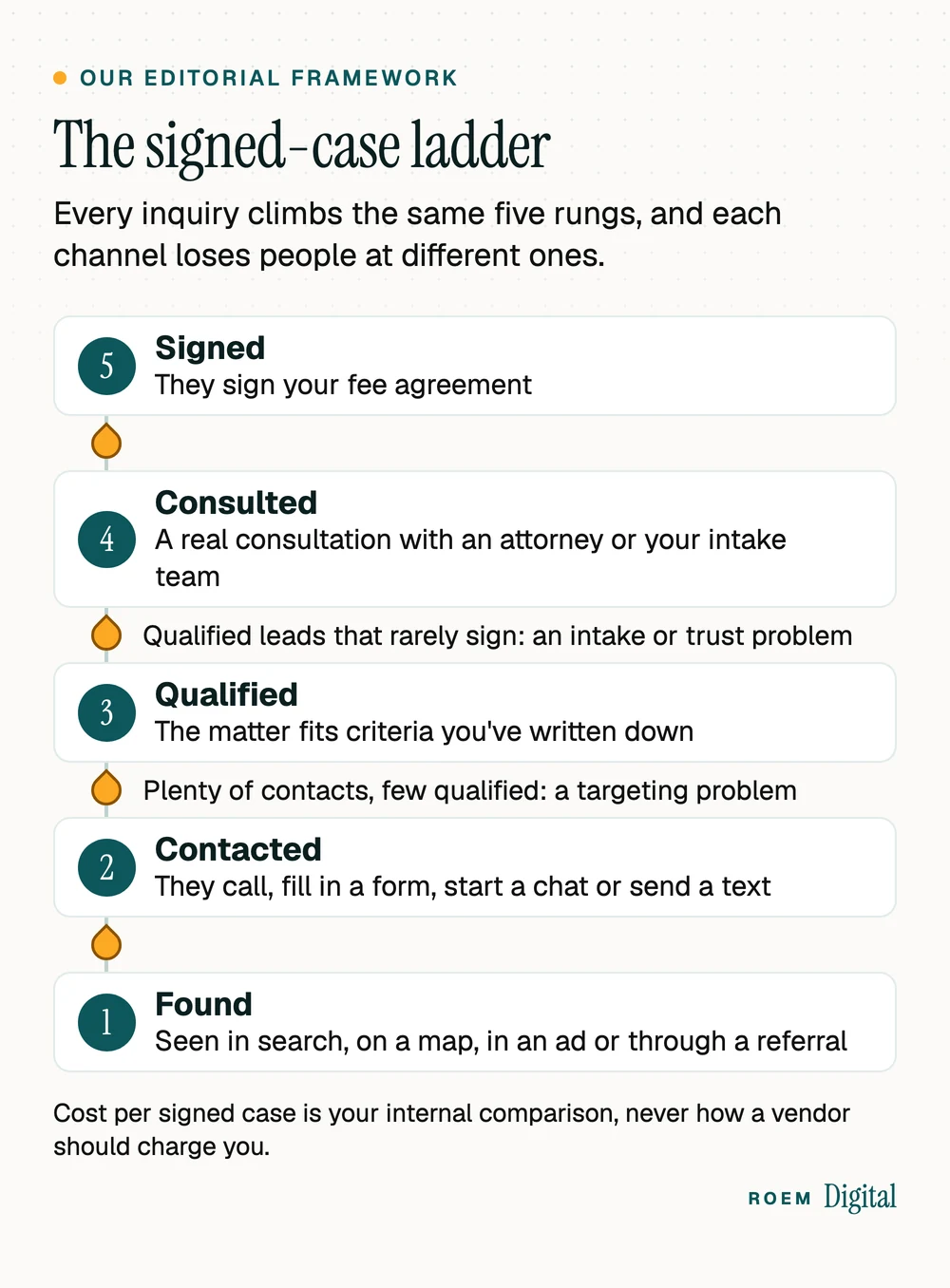
The ladder shows what to fix. Plenty of contacts but few qualified ones means a targeting problem. Qualified leads that rarely sign mean an intake or trust problem, which a bigger budget won't solve.
| Channel | Rung where it often leaks | What to check first |
|---|---|---|
| Google Business Profile and map results | Found to Contacted | Consistent name, address and phone, recent reviews and a working call button |
| Organic search (personal injury SEO) | Contacted to Qualified | Practice area pages that answer the real question and say which cases you take |
| Google Search ads | Contacted to Qualified | Search terms, negatives, location settings and landing pages |
| Local Services Ads | Qualified to Consulted | How fast each lead gets a call back, and which case types you selected |
| Bought leads | Qualified to Signed | Whether the person knows your firm's name and expected your call |
| Referrals from clients and other lawyers | Found | Whether anyone asks for and records referrals, and thanks people without gifts |
For the paid side, compare Local Services Ads and Google Search ads, then read our guide to running Google Ads for a law firm. For the long game, Google Ads vs SEO explains why SEO is slower to build but tends to lower your cost per lead over time.
Where personal injury leads leak before they sign
The next problem shows up quickly: leads come in and cases don't. When qualified leads stall below the Signed rung, look at intake before you blame the ads. Three leaks are common, and each one is fixable.
Missed calls, nights and weekends
An injured person who reaches voicemail can tap the next firm in the results in seconds. Someone trained on your intake questions should pick up during business hours, and every missed call should get a same-day call back with its source logged. Accidents don't keep office hours, so decide who answers at 9 PM on a Saturday before you buy the ad that produces that call: an answering service that follows your intake script, an on-call rotation, or ads scheduled to run only when someone can answer.

Leads that don't fit
Write down which cases your firm takes, and log a reason every time intake turns a lead away: wrong practice area, outside your area, already represented, no injury. If one channel produces most of your "outside our area" declines, its targeting is too wide.
Tracking that stops at the lead
Call tracking knows a call came from a Google ad. Your case management system knows whether the caller signed. Record the source on every new contact and carry it into the matter. Our guides to call tracking for small businesses and why law firm calls drop while reports look fine cover the setup and the gaps, and the numbers a marketing report should show explains why signed cases by source belong at the top of your report.
Buying personal injury leads vs building your own channels
Personal injury lead generation vendors sell shared leads, exclusive leads, live call transfers and places in matching or directory programs. Buying can fill a calendar quickly and test a new market. The hidden costs: the person may not know your firm's name, the same lead may reach competitors, and you build nothing you own.
In Florida, the Bar's guidance on qualifying providers counts "tips or leads generators" among qualifying providers, and Rule 4-7.22 sets conditions on working with them. This is general marketing information, not legal advice:
- Unless it's a Bar-approved lawyer referral service, the vendor can't take a fee that divides your legal fee: no percentage of your fee or the client's recovery, and nothing based on the success or perceived value of the case.
- Its ads and contacts must follow the rules that would apply if you made them yourself.
- It can't require or pressure you to send clients to its own doctors or other services.
- It must have lawyers from at least four different firms in its panel.
- You must report to the Bar within 15 days of agreeing to participate, and again within 15 days of ending it.
- If you skip due diligence before you start, you're responsible for the vendor's compliance.
Pricing deserves the closest look. The Bar's Ethics Opinion 18-1, as reported by The Florida Bar News, calls a flat charge per case you accept generally impermissible, even one that differs only by type of case. It lists reasonable, pre-arranged fixed charges per time period, per click, or per matter referred (not contingent on the outcome and not varying with the amount at issue) as generally permissible, and warns that a permissible price alone doesn't make a vendor compliant.
| Question | Bought leads | Your own channels |
|---|---|---|
| Who owns the contact data? | The vendor, which may sell it again | Your firm |
| Does the person know your firm? | Often not until you call | Yes, they chose you |
| How fast does it start? | Quickly | Ads quickly, SEO and reviews slowly |
| What's left if you stop paying? | No new leads | Reviews, rankings, referral relationships and content |
| Florida Bar duties | Due diligence and reporting under Rule 4-7.22 | The advertising rules for your own ads |
A sensible test: run one vendor for a fixed period, tag every lead, and compare its cost per signed case with your own channels over the same months. Work out that number yourself, and never ask the vendor to price that way. Confirm every lead asked to hear from a lawyer, since calling someone who didn't can be phone solicitation under Rule 4-7.18. Check the Bar's roster of qualifying providers with current reports, and sign an agreement you can end immediately if the vendor falls out of compliance.
Use a window long enough that one lucky or slow month doesn't decide it, and count the staff time each channel's leads take.
Referrals deserve the same tracking, within Rule 4-7.17(b) of the Rules Regulating The Florida Bar, which bars giving anything of value to a person for recommending your services.
Your own channels are slower, but you keep them. Keep the accounts, analytics and listings in your firm's name (who owns your marketing accounts shows how to check), and see how our paid media and lead generation service tracks every lead before spend starts.
Florida Bar rules that shape personal injury advertising
Florida's lawyer advertising rules sit in Subchapter 4-7 of the Rules Regulating The Florida Bar, and Rule 4-7.11 applies them to all forms of communication, print or electronic, including websites, social networking, email, internet ads and video sharing. Here's what they mean for personal injury lawyer marketing in practice.
| Rule | What it means for your marketing |
|---|---|
| 4-7.12, required content | Every ad names at least one lawyer or the firm, plus the city, town or county of a real office. If you plan to refer cases out, the ad says so, in every language the ad uses. |
| 4-7.13, misleading ads | No predictions or guarantees, such as the rule's own example, "I will get you money for your injuries." Past results must be verifiable, and "the best" won't pass. |
| 4-7.13, testimonials | Real clients' actual experience, nothing of value given, with a results disclaimer. Our law firm website design guide covers results and testimonials. |
| 4-7.14, fees | "No fee if no recovery" must also disclose the costs a client may still owe. |
| 4-7.15, manipulative ads | A photo of a damaged car can be fine. A dramatized crash showing graphic injuries is not. |
| 4-7.18, direct contact | No in-person, phone or live video solicitation of people you have no family or prior professional relationship with, and no written outreach about an accident until more than 30 days after it. |
| 4-7.19 and 4-7.20, filing | Ads must be filed with the Bar at least 20 days before first use unless Rule 4-7.20 exempts them. Your own website and, since October 22, 2026, text-only sponsored search ads are exempt from filing, but not from the rules. |
Two of these are easy to break by accident in digital work. The first is reviews. Ask every client the same way at the same point, such as when the file closes, whatever the outcome, and never suggest what to write. Google's fake engagement policy prohibits businesses that "selectively solicit positive reviews from customers," and nothing of value can change hands. Once you quote a review on your website or in an ad, it's a testimonial and must meet the rules above. Our guide to getting more Google reviews covers review links and replies.
The second is automated outreach. Messages to someone who asked for help are treated differently, but unsolicited written outreach about an accident must wait more than 30 days, and a permitted email must start its subject line with "Advertisement." Unsolicited emails must also be filed with the Bar at least 20 days before use and must describe the lawyer's background, training and experience. Automated texts raise a second question: Florida's Telephone Solicitation Act bars unsolicited automated sales texts sent without the recipient's "prior express written consent," and whether it reaches a firm's texts is a legal question. Before you automate follow-ups, ask your counsel how the 30-day rule and Florida's texting law apply.
What our law firm offer measures
We're a small senior team, veteran-owned and based in Davenport, Florida. Our law firm marketing offer measures personal injury law firm marketing the way this guide does, by signed cases. It includes call and form tracking tied to signed cases, monthly reporting by signed cases and cost per case, and copy checked against attorney advertising rules. We aren't your lawyers, so your firm approves every claim before it runs. Every account stays in the firm's name, and it's one flat monthly fee. Ads are optional. If you run them, we track calls, forms and bookings before spend starts.
“Both Robert and Emily were extremely helpful and easy to work with. We had multiple strategy calls regarding a client's new business website direction, all were a breeze.”
When to talk to a professional instead
This article is general marketing information, not legal advice. Talk to ethics counsel or the Bar before you act when:
- You're about to sign with a lead vendor, referral service or matching program.
- A vendor prices per signed case, by case type or by what a case might be worth.
- You want to advertise a past result, a settlement amount or a client testimonial.
- You plan texts, emails or letters to people who haven't contacted you.
- You're not sure whether an ad must be filed, or whether it's exempt.
Florida Bar members in good standing can call The Florida Bar's Ethics Hotline for an oral advisory opinion about their own contemplated conduct. Those opinions aren't binding, and the hotline doesn't answer questions of law, such as how the texting statute applies. Rule 4-7.19 also lets you request an advisory opinion on a specific ad or website page for a fee. For the marketing side, our free marketing audit reviews your website, Google listing, ads and tracking.
Frequently asked questions
What is the best marketing for personal injury lawyers?
Personal injury lawyer marketing has no single best channel. A common mix combines a strong Google Business Profile and website, paid search or Local Services Ads, and referrals from clients and other lawyers. The right mix has the lowest cost per signed case for your firm, so track every lead from first contact to a signed fee agreement.
Should a personal injury firm buy leads?
It can be a reasonable test if you compare the vendor's cost per signed case with your own channels over the same months. In Florida, lead generators are qualifying providers under Rule 4-7.22. A Bar ethics opinion says a flat charge per case you accept is generally impermissible, so have ethics counsel review pricing first.
How do personal injury lawyers get clients after hours?
Decide who answers before you advertise at night. Common options are an answering service that follows your intake questions, an on-call rotation, or ads scheduled to run only when someone can pick up. Every missed call should get a call back the next morning, with the marketing source recorded.
Can a personal injury lawyer text or email accident victims in Florida?
Not right away. Florida Bar Rule 4-7.18 bars unsolicited written communications about an accident until more than 30 days after it, permitted emails must begin the subject line with "Advertisement," and direct emails must be filed with the Bar first. Automated texts can also raise questions under Florida's Telephone Solicitation Act. Have counsel review any sequence.
How do you track which marketing produced a signed case?
Record the source on every new contact at first touch, using call tracking numbers and form fields, then carry it into the matter in your case management system. Mark when each lead qualifies, consults and signs. Divide each channel's spend by its signed cases to get cost per signed case.
Is personal injury SEO worth it for a small firm?
Usually, as a long-term channel. Search visibility builds slowly but keeps working after you stop paying for clicks. Start with an accurate Google Business Profile, honest reviews and practice area pages that answer real questions, then judge the work by signed cases, not rankings or traffic alone.
Can a Florida personal injury lawyer pay for referrals?
Only in limited ways. Rule 4-7.17(b) bars giving anything of value to a person for recommending your services. You may pay the reasonable cost of permitted advertising and the usual charges of a lawyer referral service, directory or qualifying provider. Fee division with another firm falls under separate fee rules, so ask ethics counsel.