
Short answer: Good law firm website design walks a prospective client from a search to a booked consultation. That takes a page for each practice area, bios that name who handles the matter, proof that follows the Bar's advertising rules, one-tap calling and an intake form that warns before it asks.
What the best law firm websites have in common
Good law firm website design has one job: walk a stranger with a legal problem from a search result to a booked consultation, without a single claim the Bar's advertising rules forbid.
The look matters less than most firms expect. This guide covers what a small law firm website needs, how to map the path a prospective client takes through it, and where Florida's lawyer advertising rules shape the design. It's general marketing information, not legal advice.
Search for "best law firm websites" and you'll find roundups of big-firm homepages with video backgrounds. A small firm's site is judged by someone who is worried, usually on a phone, and deciding within minutes whether to call. The sites that serve that person well share a few traits:
- Who, what and where in the first screen: firm name, practice areas, city and a call button.
- A page for each practice area, written about the client's situation.
- Named lawyers, with real photos and plain bios.
- Easy, safe contact: tap to call, and a short form with a clear warning.
- Advertising rules built into the layout, with disclaimers beside the claims they modify.
Our list of 12 must-haves for a service business website covers what every local business needs. Weighing a template against a custom build? Our guides to custom-built sites vs website builders and what a small business website costs cover the trade-offs. We've left out screenshots of other firms' sites on purpose: copying a competitor's look tells you nothing about whether it books consultations.

Map the consultation path before you design a single page
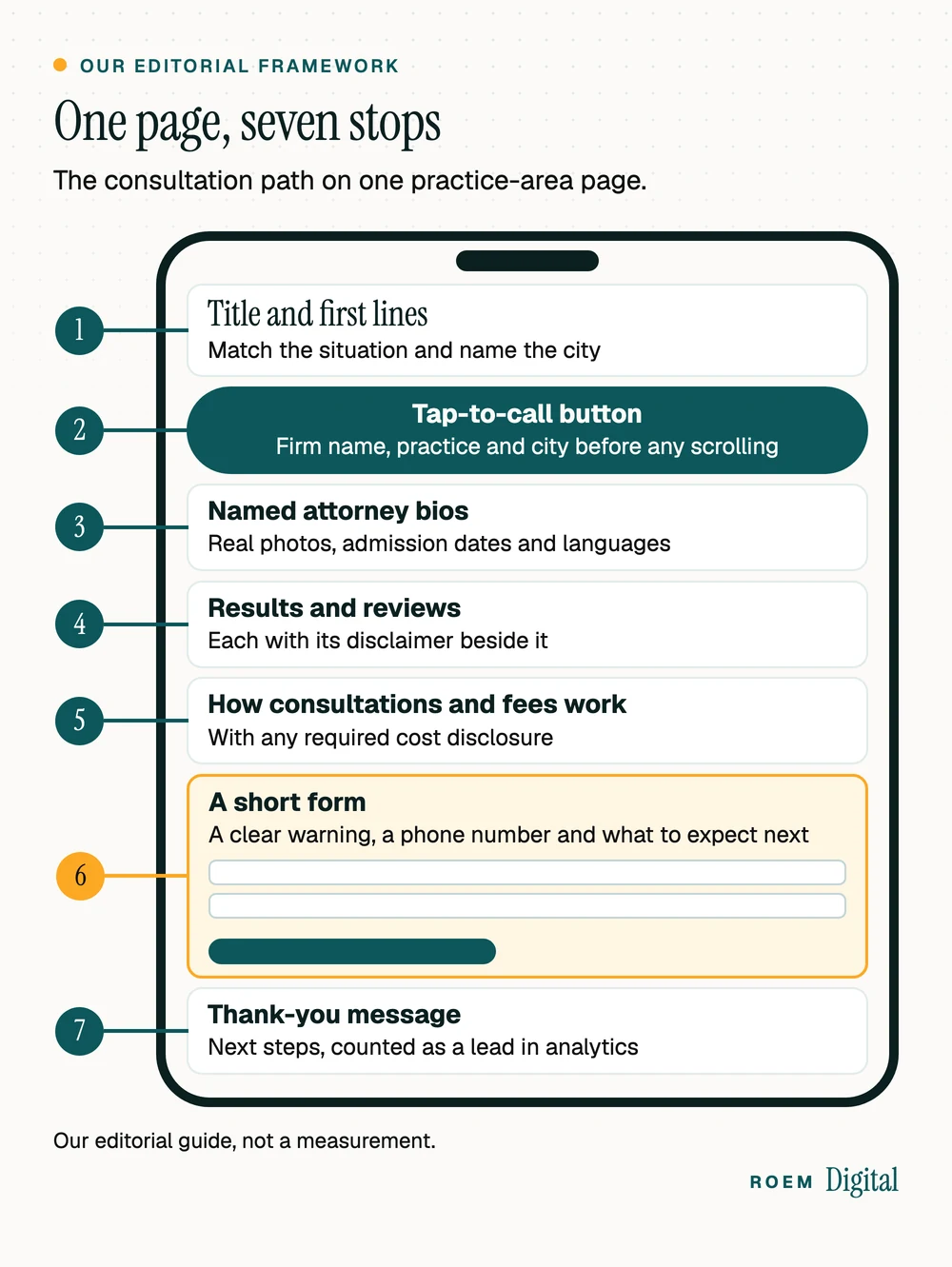
Good law firm website design starts with the path, not the colors. We call it the consultation path map: one row for each stop a prospective client makes between the search and the booked consultation, and what the page must do there. It's our editorial framework, and it turns the design from a style choice into a list of jobs.
| Stop | What the visitor is asking | What the page has to do |
|---|---|---|
| 1. The search result | Does this firm handle my problem, near me? | A practice-area page whose title and first lines match the situation and name the city. |
| 2. The first screen | Is this a real firm I can reach now? | Firm name, practice, city and a tap-to-call button before any scrolling. |
| 3. The trust check | Who would handle this? | Named attorney bios with real photos, admission dates and languages. |
| 4. The proof | Have they done this before? | Results and reviews that meet the Bar's rules, each with its disclaimer beside it. |
| 5. The cost question | Can I afford to talk to them? | How consultations and fees work, with any required cost disclosure. |
| 6. The hand-off | What happens if I reach out? | A short form with a clear warning, a phone number and what to expect next. |
| 7. The confirmation | Did it go through? | A thank-you message with next steps, counted as a lead in analytics. |
Walk the map on your own phone, once per practice area. If a stop sends you hunting through a menu, it needs a page or a button. If you run ads, walk it again from each landing page, as our guide to law firm PPC explains.
Practice-area pages and attorney bios do the selling
One page per practice area, written from the client's side
A page that lists "personal injury, family law, wills" answers nobody's real question. Give each practice its own page, and within broad practices add pages for common situations, such as a car crash or a DUI arrest. Each one needs what any good service page needs, written about the client's situation, plus a fee line that follows the rules.
Fees need care. Under Rule 4-7.14(a)(7), any fee statement, including "no fee unless we win," must disclose the costs the client might still owe, and the Bar's website checklist flags the line without it. The rule's comment offers wording such as "No Fee if No Recovery, but Client is Responsible for Costs" when that matches the fee agreement.
List only practices the firm handles. Rule 4-7.13(b)(4) treats a reference to an area the firm doesn't practice, or intend to practice, as deceptive and inherently misleading.
Attorney bios that name who will handle the matter
People hire a lawyer, not a logo. Show a real photo against a plain background, the date of admission to the Bar, education, practice areas and languages spoken, all on the Bar's list of presumptively valid content in Rule 4-7.16. Give each lawyer's own years of experience, since the rule commentary calls "over 20 years' experience" misleading when it's the firm's combined total. And use photos of your own people: a stock model who appears to be a member of the firm needs a clear disclaimer under Rule 4-7.13(b)(5).

Results, reviews and disclaimers under the Florida Bar's rules
Florida treats a firm's website as advertising. The comment to Rule 4-7.11 of the Rules Regulating The Florida Bar says websites "are treated the same as other advertising media." The Bar's quick reference checklist for lawyer websites adds that a firm's own site doesn't have to be filed for review, but it must comply with Rules 4-7.12 through 4-7.17 and 4-7.21. Other states have their own versions. Our guide to personal injury lawyer marketing applies the same rules to ads. These are the rules that shape a design most often:
| On the website | What the rules require |
|---|---|
| Site-wide | The name of a lawyer or the firm, and the city, town or county of a bona fide office (4-7.12(a)). A site-wide footer can carry both. |
| Past results | Objectively verifiable and not misleading in context (4-7.13(b)(2)), published with the affected client's informed consent. |
| Testimonials | The client's actual experience on things a client can judge, such as "courtesy, promptness, efficiency, and professional demeanor," typical of what clients generally experience, not written by the lawyer, nothing of value given for it, and a disclaimer that others may not get the same or similar results (4-7.13(b)(9)). |
| "Best," "expert," "specialist" | "The best" isn't verifiable. Expertise needs board certification or objectively verifiable education, training, experience or substantial involvement. A firm claiming it needs at least one such lawyer and, unless all qualify, a disclaimer that not all its lawyers specialize. A board certification claim names the area and the certifying organization, and a firm can't be described as having one (4-7.14(a)(4) to (6)). |
| Promises | Nothing that reads as a prediction or guaranty of success (4-7.13(b)(1)). "We will pursue" works where "we will win" doesn't. |
| Fees | Any fee statement, including "no fee if no recovery," discloses the fees and costs the client may owe, and an advertised fee is honored for at least 90 days unless the ad says otherwise (4-7.14(a)(7)). |
| Referrals | If some cases will go to another lawyer or firm, the site says so (4-7.12(b)). |
| Awards and badges | Bona fide awards only, by their actual name, with the year unless it's current (4-7.14(a)(3) and comment). |
| Hero images and video | Nothing designed to appeal to emotion over a rational choice, no judge or police officer endorsing the firm, no celebrity outside narrow exceptions (4-7.15). |
Put the disclaimer next to the claim
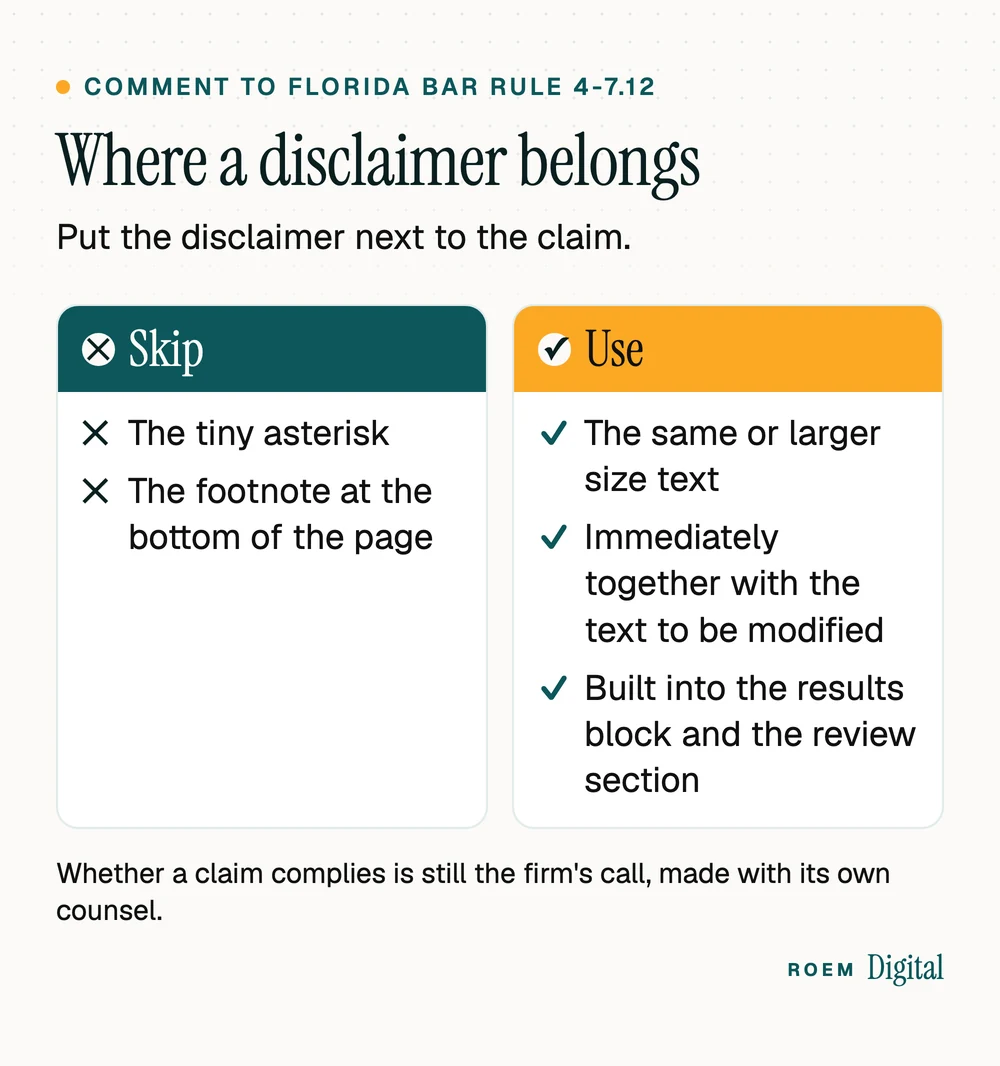
Under the comment to Rule 4-7.12, a disclaimer that modifies written text is generally clear and conspicuous when it appears "in the same or larger size text and immediately together with the text to be modified." So skip the tiny asterisk and the footnote. Build the results block and the review section with the disclaimer in place, at the same size. In our marketing program for law firms, every page is checked against your state's attorney advertising rules before it goes live, and you approve the core pages before launch. Whether a claim complies is still the firm's call, made with its own counsel.
Intake forms that ask for less and warn first
An online form feels like a mailbox, but under Florida's rules it can start a consultation. The comment to Rule 4-1.18 says one is likely to have occurred when a lawyer's advertising invites information about a potential representation "without clear and reasonably understandable warnings and cautionary statements that limit the lawyer's obligations," and someone responds. The sender is then likely a prospective client, and the rule limits what the lawyer may use or reveal from what they shared, even if no representation follows. It can also create conflicts if the other side of a dispute fills in your form first.
- Ask only what intake needs to call back and check conflicts: name, phone, email, type of matter and the other parties' names. The rule's comment advises limiting the first consultation to what's reasonably necessary.
- Put a plain warning right above the submit button: sending the form doesn't make you a client, so keep confidential details for the consultation. Have the firm's lawyers approve the wording.
- Swap the "tell us everything" box for a one-line summary.
- Say on the confirmation screen when someone will reply.
- Count each confirmation as a key event, as our guide to tracking calls and form fills in GA4 shows.
Give any chat window that asks about a case the same review, since the comment covers advertising in any medium.

Lawyer website design for phones, Spanish speakers and screen readers
The first screen on a phone
Google uses the mobile version of a site's content for indexing and ranking, according to its mobile-first indexing guide, so the phone version is the real site. Its first screen should show the firm name, practice, city and a call button, as our guide to why a law firm's calls drop explains. Our guide to whether a slow website is costing you calls shows how to test speed in five minutes.
Spanish-language pages
Give Spanish-speaking clients real pages, not a translation widget. Google recommends a separate URL for each language version and advises against automatically redirecting visitors to another language. Florida's Rule 4-7.12(c) adds that every required statement must appear in each language used, so a Spanish results page needs its disclaimer in Spanish. We built English and Spanish sites for Solid Rock Community Church and Elizabet Maria, and our bilingual marketing service covers how we plan both languages.
Accessibility
ADA regulations list the "office of an accountant or lawyer" as a place of public accommodation, in the Title III regulations on ADA.gov. The Justice Department's guidance on web accessibility says it has consistently taken the position that the ADA applies to what these businesses offer online, and it names WCAG as helpful technical guidance, though it notes its guidance documents have no legally binding effect. The barriers it lists include low-contrast text, images without alt text, videos without captions, unlabeled form fields and menus a keyboard can't reach. Start with the intake form.
The next problem: a handsome site that books no consultations
A site can look right and still fail at the hand-off: a call button that dials an old number, a form that emails someone who left, a thank-you page nobody counts. Before you judge the design, confirm three things:
- Calls and forms are counted by page and source, so you compare practice pages by consultations, not visits.
- Intake notes which consultations came from the site, and which became clients.
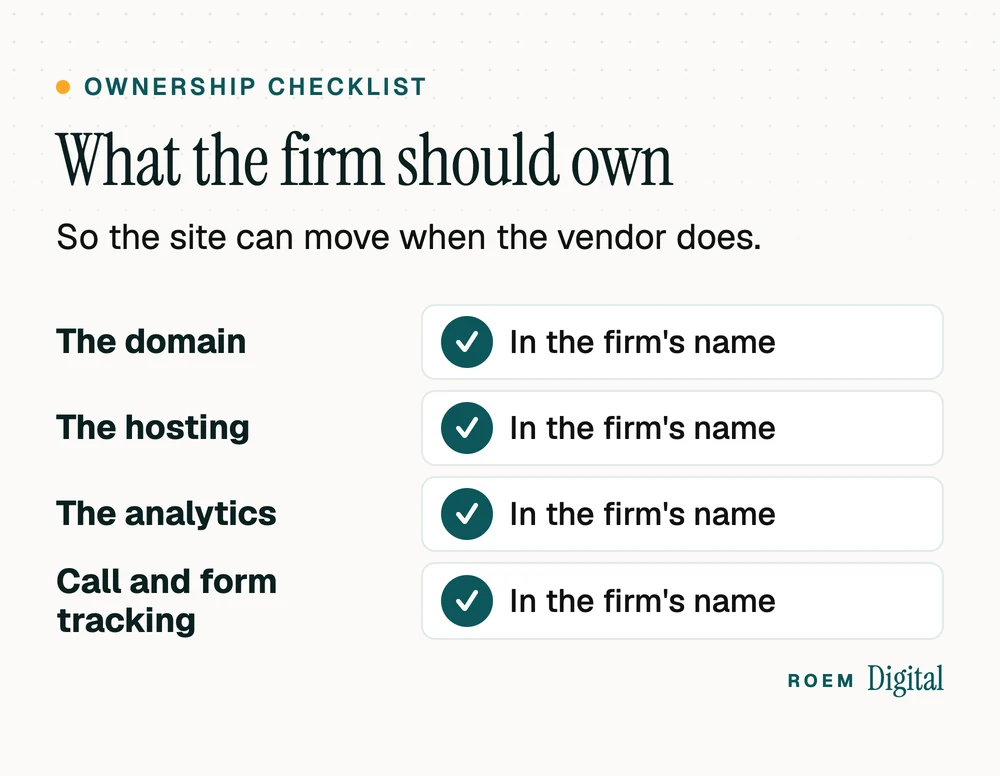
- The firm owns the domain, hosting and analytics. Check yours with our guide to who owns your website and ad accounts.
Replacing an old site? Every old address needs a permanent redirect, as our website redesign checklist explains.
When we build a site it's custom-built, not templated, with call and form tracking set up during the build, and you own every account. Our brand and web design service explains the approach.
When to talk to a professional instead
A designer can build the page. Only a lawyer can decide whether a claim on it complies. Bring in a professional when:
- You want to publish results, testimonials or an expertise claim. Ask your ethics counsel, or contact The Florida Bar's Ethics Hotline, which gives members in good standing an oral advisory opinion on their own contemplated conduct. Those opinions aren't binding.
- One page worries you. The Bar accepts a voluntary filing of a specific part of a website, for a fee, but not a whole site, per its website checklist.
- You're licensed outside Florida, or in several states. Each bar sets its own rules.
- Your form or chat asks about the facts of a case. Have counsel approve the warning and the questions.
- You've received an accessibility demand letter. Talk to an ADA attorney before you reply, and have an accessibility specialist test the site.
We aren't your lawyers, and the firm makes the final call on every claim. For an outside look at your current site first, our free audit reviews your website, Google listing, ads and tracking from the outside, with no logins needed.
Frequently asked questions
What should a law firm website include?
At minimum: a page for each practice area, a bio and real photo for each lawyer, the firm name and office city on every page, a tap-to-call number, a short intake form with a clear warning, and a privacy policy. Add results or testimonials only when they meet your state bar's advertising rules, with any required disclaimer beside them.
How much does law firm website design cost?
It depends on the number of practice-area pages, custom design or a template, who writes the copy, Spanish-language pages, intake and scheduling integrations, and ongoing hosting and care. Ask for a written scope that lists every page and feature, who owns the domain and accounts, and what happens to the site if you leave.
Can a Florida law firm website show case results?
Yes, with care. Florida's rules allow references to past results only when the information is objectively verifiable and not misleading in context, and the rule's comment requires the affected client's informed consent. Omitting facts such as a default judgment can make a result misleading. Have the firm's ethics counsel review every result before it goes live.
Do law firm websites need a disclaimer?
Often, yes. In Florida, testimonials need a disclaimer that others may not get the same or similar results, and a "no fee unless we win" line must disclose the costs a client may still owe. Each disclaimer belongs right beside the statement it modifies, at the same text size, in every language the page uses.
Does a website contact form create an attorney-client relationship?
Not by itself, but it can make the sender a prospective client. Under the comment to Florida's Rule 4-1.18, inviting details about a matter without clear warnings can count as a consultation, which brings confidentiality duties and possible conflicts. Keep forms short, put a plain warning above the submit button and have counsel approve the wording.
Should a small law firm use a template or a custom website?
A template can work for a solo practice with a few practice areas and a tight budget, if the firm owns the account and can export its content. A custom-built site makes more sense when you need many practice-area pages, Spanish versions, careful intake forms or features your template can't support.
Do law firm websites have to be accessible?
The Justice Department's position is that the ADA applies to what businesses open to the public offer online, and federal regulations list lawyers' offices among those businesses. It points to WCAG as helpful technical guidance. Building to WCAG from the start is far easier than retrofitting after a demand letter. This is general information, not legal advice.