
Short answer: SMS marketing for small business means texting offers and news to customers who agreed in writing to get them. Use texts for time-sensitive news and leave the rest to email. The FCC now lets senders designate a reply word like STOP as the opt-out method, and platform texts from a standard 10-digit number need carrier 10DLC registration.
SMS marketing: what it is and when a text beats email
SMS marketing is sending promotional or news texts to customers who agreed to receive them: a same-day opening, an event reminder, a seasonal offer, a back-in-stock notice. Texts get noticed quickly, which makes them right for anything time-sensitive and wrong for anything that could wait.
That's the whole strategy in one line: text what's urgent, email what isn't. A customer who gets one useful text a month stays subscribed. One who gets a promotion every few days replies STOP, and once they do, the rules covered below mean that one reply can end every marketing text from you.
| Question | Text message | |
|---|---|---|
| Best for | Same-day openings, event day, last-minute changes | Details, photos, receipts, seasonal tips |
| Length | One short message, one link or action | As long as the content needs |
| Permission for marketing | Prior express written consent for automated marketing texts | CAN-SPAM rules on every commercial email, opt-out based |
| Opt-out | A reply word such as STOP | An unsubscribe link |
Our guide to email marketing for small businesses covers the email side, including CAN-SPAM. This post is the texting strategy. For appointment reminders and the full table of texting rules, read our guide to appointment reminder texts alongside it.
Four checks before you send a marketing text
A text makes someone's phone buzz wherever they are, so make sure it's worth it. Before you send one, run it through four checks. They're our own rule of thumb for text message marketing, separate from the legal rules, and they keep a list healthy.
- Asked for it. This person agreed to marketing texts from you, and this message is the kind they agreed to.
- Time-sensitive. It matters today or this week: an opening, an event, a deadline. If it could wait a month, email it.
- One action. One short message, one link or one reply. If it needs a paragraph, it's an email.
- Easy exit. It names your business and says how to stop, such as "Reply STOP to opt out."
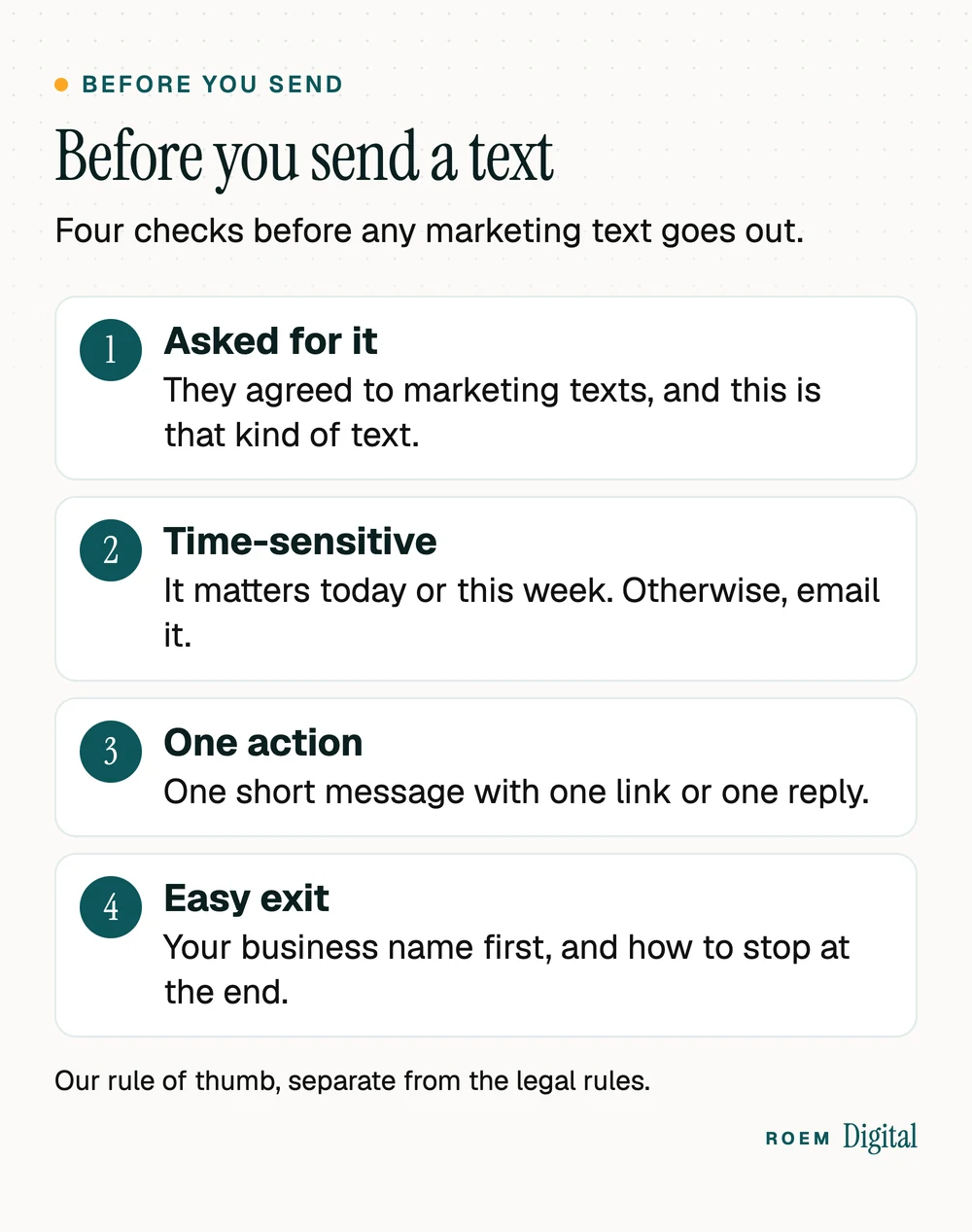
Texts that pass all four are the ones customers thank you for. If you're thinking about texting new leads from your ads, our guide to speed to lead covers that first reply, which follows different rules from marketing texts.
Business texting consent: get it in writing before the first marketing text
This is general marketing information, not legal advice. Under the FCC's rules at 47 CFR 64.1200, automated calls or texts that include an advertisement or constitute telemarketing need the recipient's prior express written consent. The rule defines that as a written agreement, signed by the person (electronic signatures count where federal or state law recognizes them), that authorizes the seller to send them ads or telemarketing at a named phone number. The agreement has to disclose clearly that the person is not required to sign as a condition of buying anything.
The wireless industry group CTIA's Messaging Principles and Best Practices adds what the sign-up should say: the program description, the number texts will come from, who's sending, any fees or charges, and how to opt out. For recurring messages, CTIA says to send an opt-in confirmation first that includes customer care contact information, how to opt out, and a disclosure that messages are recurring and how often. CTIA also notes its guide isn't legal advice. A sign-up line on a booking form might read:
- Checkbox (unchecked by default): "Yes, text me offers and openings from {Business} at the number above. Up to {n} msgs/month. Msg and data rates may apply. Reply STOP to cancel, HELP for help. Agreeing isn't a condition of any purchase."
- Confirmation text: "{Business}: You're signed up for offers and openings, up to {n} msgs/month. Msg and data rates may apply. Reply HELP for help, STOP to cancel."
Keep a record of every opt-in: when, where, the number and the exact wording the person agreed to, ideally on the customer's record in a CRM built for a small business. Collect numbers yourself. A list someone else gathered never carries consent for your texts. If the sign-up sits on a page your ads send people to, our guide to landing pages for Google Ads covers the rest of that form.
What changed for marketing texts on November 25, 2026
The FCC's opt-out rule, published in the Federal Register on October 26, 2026, took effect November 25, 2026, according to the Federal Register notice. For text message marketing, four points matter:
- One marketing opt-out covers all your marketing texts. The FCC says a revocation sent in response to a call or text that contains an advertisement or constitutes telemarketing revokes consent to all future ones from that sender.
- You may name one opt-out method. A sender can designate an exclusive method, such as a standardized reply word disclosed clearly in every text, and our appointment reminder text guide covers the exclusive-method details.
- Without a designated method, any reasonable request counts. If you don't clearly designate an exclusive method, the rule says you must process opt-outs made by any reasonable means, such as a reply saying "please stop texting me."
- Opt-outs still have a deadline. The FCC's rule requires honoring revocation requests within a reasonable time not to exceed ten business days.
If the eCFR copy of 47 CFR 64.1200 you open still says senders may not designate an exclusive opt-out method, it hasn't caught up yet: the Federal Register rule applies from November 25, 2026. Florida adds its own law for automated sales texts, and our appointment reminder text guide covers it alongside the FCC's time-of-day limits.
10DLC registration: why your texting platform asks about your business
Many businesses text from ordinary 10-digit numbers, and carriers want to know who's behind that traffic. The Campaign Registry describes 10DLC as a messaging channel in which brands and campaign service providers are verified before they're allowed to send messages, with the brand, the provider and the message content all known upfront.
As a business, you're the "brand." The Campaign Registry says brands can't currently register with it directly and must work with a registered messaging service provider that handles registration for them. In practice:
- Pick a texting platform that handles 10DLC registration before you build anything else.
- Register your business and each campaign type (marketing, reminders, customer care) with accurate descriptions and sample messages.
- Show your sign-up wording where the platform asks how people opt in. It should match what's on your forms.
- Don't send from a personal cell phone. Texting customers in bulk from a number that isn't registered skips the verification carriers expect.
Open the texting account in your business's name, with your own login, so the registration and the subscriber list stay with you if a vendor changes. Our guide to who owns your marketing accounts explains why that matters. Registration also forces a useful discipline: describing your campaign in writing before you send. If you can't explain what you'll text and why people agreed to it, the program isn't ready.
SMS marketing tips: what local businesses can text, with examples
Every example below passes all four checks. Put your business name first, keep one action, and end with how to stop.
| Moment | Example text |
|---|---|
| Same-day opening | {Business}: A 2 p.m. spot opened today. Want it? Reply YES and we'll confirm. Reply STOP to opt out. |
| Event day | {Business}: Our open house starts at 10 today at {place}. Details: {link}. Reply STOP to opt out. |
| Seasonal window | {Business}: {Season} bookings open this week, and our calendar fills fast. Book: {link}. Reply STOP to opt out. |
| Back in stock | {Business}: The {item} you asked about is back. We're holding a few at the counter. Reply STOP to opt out. |
| Spanish list | {Negocio}: Hoy se abrió un horario a las 2 p.m. ¿Lo quiere? Responda SÍ. Responda STOP para no recibir más mensajes. |
Keep promotions out of appointment reminders, which have their own consent and content rules. If you serve customers in Spanish, text each one in the language they chose at sign-up, and it's safest to treat replies like ALTO or BASTA as opt-outs too. Our bilingual marketing service covers the rest of a two-language setup.

Measure each text, not just the program
Tag every link so GA4 shows which text brought the visit; our guide to UTM parameters shows how. Then count replies, bookings and opt-outs per message. A text that books three slots and loses ten subscribers may not be worth repeating. Compare each message with your own past sends, not with open-rate figures from a vendor's blog.
When to talk to a TCPA attorney before you text customers
This post is general information, not legal advice. Talk to an attorney who handles TCPA and consumer protection matters before you:
- Text any number you didn't collect yourself with marketing consent, including old customer lists.
- Designate an exclusive opt-out method under the FCC's November 25, 2026 rule.
- Text marketing to patients if you're a health practice, or mix offers into reminders.
- Use any automated dialing or texting tool you don't fully understand.
- Receive a demand letter or complaint after a STOP reply.
To see whether your texts actually bring customers back, our guide to call tracking for a small business covers tying calls and replies to the message that caused them.
Where texting fits in a tracked lead plan
SMS marketing for small business works best as part of a plan where every lead is tracked from the first ad to the paid job. We're a small senior team based in Davenport, Florida, working with businesses across Central Florida and nationwide, and we track calls, forms and bookings before any ad money is spent. Read more about our paid media and lead generation service, which includes lead follow-up automation.
Frequently asked questions
Is SMS marketing legal for small businesses?
Yes, with the right permission. Under the FCC's rules, automated marketing texts need the recipient's prior express written consent, and every opt-out must be honored within a reasonable time not exceeding ten business days. Carriers also require 10DLC registration for platform texts from a standard 10-digit number, which your provider handles. This is general information, not legal advice.
How do I get consent for text message marketing?
Ask in writing, separately from your terms. A checkbox left unchecked by default, naming your business, the kind of texts, how often, how to stop, and that agreeing isn't a condition of purchase, reflects what the FCC's definition and CTIA's guidance ask for. Send a confirmation text, and keep a record of when and how each person agreed.
What does the FCC's November 25, 2026 rule mean for marketing texts?
A reply that opts out of a marketing text revokes consent to all your future marketing texts. Senders may designate one opt-out method, such as a reply word, if every text discloses it, and must otherwise honor any reasonable request. Either way, opt-outs must be honored within ten business days, per the Federal Register notice.
What is 10DLC registration?
10DLC is the system U.S. carriers use to verify businesses that send texts from ordinary 10-digit numbers. The Campaign Registry says businesses can't register with it directly and must work through a registered messaging provider, which submits your business and campaign details on your behalf. Ask about it before you choose a platform.
How often should a small business send marketing texts?
Only as often as you have something time-sensitive, and never more than you promised at sign-up. CTIA's guidance asks senders to disclose how often recurring messages will arrive, so pick a number you can keep. If opt-outs rise after a send, slow down or move that kind of message to email.
Can I text customers who gave me their number for appointments?
Not marketing texts, unless they also agreed to those. A number given for appointment reminders supports informational texts about the appointment. Offers and promotions need separate prior express written consent for marketing. Ask for that consent with its own checkbox, so customers can say yes to reminders and no to offers.