
Short answer: Law firm SEO is the work of getting your website and Google Business Profile in front of people searching for your practice in your area. In Florida, every page you publish for it is also lawyer advertising, so each tactic has to pass two rulebooks: Google's spam and profile policies and The Florida Bar's content rules.
What law firm SEO covers, and why Florida adds a second rulebook
Law firm SEO is the work of making your website and Google Business Profile the answers Google shows when someone near you searches for help with a legal problem you handle. It has four parts: your Google profile, your practice pages, your site's technical health, and the reviews and links that show you're trusted.
Most SEO guides for lawyers stop there. In Florida, there's a second rulebook. Rule 4-7.11 of the Rules Regulating The Florida Bar applies the advertising rules to all forms of communication in any print or electronic forum, and it names websites, social networking and video sharing. Every page you publish to rank is part of your website, so it's lawyer advertising too.
You don't file it, though. The Bar's quick reference checklist for websites says a lawyer's own website, social media pages and video channels aren't filed for review unless posts are sponsored, boosted or promoted. They still have to follow the substantive rules in 4-7.12 through 4-7.17 and 4-7.21. This is general marketing information, not legal advice.
Our law firm offer checks every page against attorney advertising rules before it goes live. If you're rebuilding the site itself, our guide to law firm website design covers layout, bios and intake forms. This post covers what makes those pages rank, and what keeps them inside the rules.
Four questions for any lawyer SEO tactic
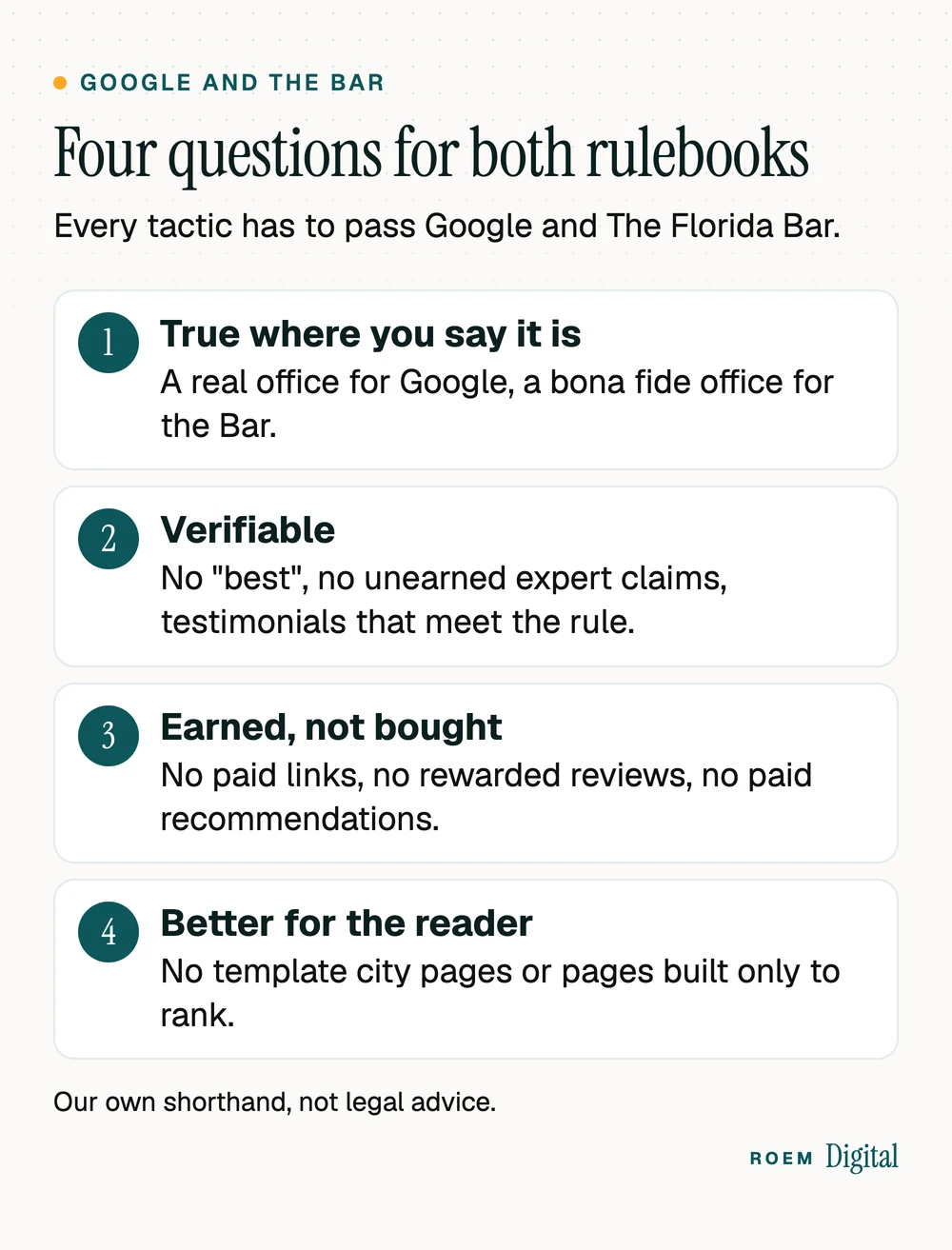
Google publishes spam policies for Search and guidelines for Business Profiles. The Bar publishes Subchapter 4-7. Most lawyer SEO mistakes break both at once, so run every tactic through four questions. They're our own shorthand, not an official test:
- Is it true where you say it is? Google won't list a virtual office, and the comment to Rule 4-7.12 says an ad can't state or imply an office where you don't have a bona fide one.
- Can every claim be verified? The Bar rules out "the best," unverifiable claims about skill and testimonials that miss the conditions in Rule 4-7.13(b)(9).
- Was it earned, not bought? Google treats paid links as link spam and removes incentivized reviews. Rule 4-7.17(b) bars giving anything of value to a person for recommending you.
- Is a reader better off for finding it? Google calls pages made mainly to rank scaled content abuse or doorway abuse. Those pages rarely earn a call either.
If a tactic fails any question, fix it or drop it. If you'd like an outside view of your current tactics, see our law firm offer.
Your law firm Google Business Profile: real offices, real lawyers
For a local search, the map results often show before any website. Google's local ranking page says local results are mainly based on relevance, distance and popularity, and that there's no way to request or pay for a better local ranking. Prominence, it adds, draws on how many websites link to your business and how many reviews you have.
Google's Business Profile guidelines name lawyers as individual practitioners. Google says a lawyer should create a dedicated profile if they're public-facing and can be contacted directly at the verified location during stated hours. No lawyer should have several profiles to cover different specializations. Where several lawyers practice at one location, the firm gets its own profile, separate from theirs.
- Virtual offices aren't eligible. A rented mailing address you don't operate from can't have a profile, and a co-working office needs clear signage, staff and customers received during business hours.
- The Bar has its own definition. The comment to Rule 4-7.12 calls a bona fide office a physical location where you reasonably expect to furnish legal services in a substantial way on a regular and continuing basis.
- Ask every client for a review, the same way. Google's Maps content policy bans incentives for reviews and selectively asking for positive ones.
Our Google Business Profile checklist walks through setup, and our post on how to rank higher on Google Maps explains what you can change and what you can't.

Practice area pages beat city pages built from one template
Many law firm SEO plans eventually propose dozens of city pages: the same text with a new town name. Google's spam policies call it doorway abuse when pages target specific regions or cities and funnel users to one page, and scaled content abuse when many pages are generated mainly to manipulate rankings, no matter how they're created. Our guide to why law firm calls drop while reports look fine shows how those pages add volume, not calls.
Florida adds its own limit. The comment to Rule 4-7.12 says an ad can't state or imply that you have offices where you don't. It may say you're "available for consultation" or "available by appointment" in a place, or have a satellite office there, if that's true. A page titled "Our [Town] Office" needs a real office in that town.
Many legal questions also fit what Google calls "Your Money or Your Life" topics. Its guide to helpful content says its systems give even more weight to content with strong E-E-A-T on topics that could significantly affect people's health, financial stability or safety, and that trust is the most important part. For a firm, that means a page per practice and per common situation, reviewed by a named lawyer, with the firm name and office city that Rule 4-7.12 requires. Our local SEO audit shows how to check the pages you already have.
Attorney SEO keywords you can target, and claims you can't make
Keyword tools will show you searches like "best divorce lawyer near me." You can serve that searcher. You can't answer them by calling yourself the best. The comment to Rule 4-7.13 says the ban on comparisons that can't be substantiated precludes saying a lawyer or firm is "the best" or "one of the best" in a field of law. That covers title tags and meta descriptions, which are part of your website.
| What people search | A page that fits | Rule to watch |
|---|---|---|
| Best [practice] lawyer near me | A guide to choosing a lawyer for that matter, with your background stated as facts | Rule 4-7.13 comment: no "the best" or "one of the best" |
| [Practice] expert or specialist | A bio listing education, training and experience | Rule 4-7.14(a)(5): only if certified or objectively verifiable |
| Board certified [practice] lawyer | A bio naming the certification area and The Florida Bar as the certifying organization | Rule 4-7.14(a)(4) and its comment: certification belongs to a lawyer, never the firm |
| [Practice] lawyer in a town with no office | A page on serving that area, only if it's true and useful | Rule 4-7.12 comment: no implied office |
| A rival firm's name | No page built around it. Any ad it triggers must show your firm's name as the first text | Rule 4-7.13(b)(12) and its comment: nothing that leads a searcher to the wrong firm |
| [Practice] verdicts or results | A results page with verifiable facts and the client's informed consent | Rule 4-7.13(b)(2) and its comment |
Claims also hide in meta descriptions, headings and image alt text, so give them the same review as the page. Our guide to website copywriting covers writing claims plainly and specifically. For search ads triggered by another firm's name, our post on law firm PPC covers what the rule's comment allows.
Links and legal directories: earned, never bought
Links still feed prominence, but Google's link spam policy lists buying or selling links for ranking purposes, including exchanging goods or services for links, excessive link exchanges, and links with optimized anchor text in guest posts or press releases distributed on other sites. A talk, an interview or a local news story that mentions you on its merits is a link worth having. A sponsorship link is fine too, but Google expects paid links to carry a rel="sponsored" or rel="nofollow" attribute, so count it as visibility, not ranking credit. A package of paid guest posts is link spam.
Legal directories are where the two rulebooks meet. The Bar's qualifying providers page lists directories alongside referral services, matching services and leads generators, and lawyers may take part only when the provider complies with Rule 4-7.22. Under the rule, you must report to the Bar within 15 days of agreeing to participate or ceasing participation, and the comment says to do due diligence before you join. How the provider charges matters too. The Bar's Ethics Opinion 18-1, which isn't binding, says a fixed monthly or per-click charge is generally permissible, while a percentage of your fee or the client's recovery, or a flat charge per case you accept, generally is not.
Keep your firm name, address and phone number identical on every listing. Our business listings and citations guide covers which listings matter and how to clean up the rest.
Measure law firm SEO by consultations and signed cases
Rankings are a means. Law firm SEO earns its keep when calls and forms from search become consultations and signed cases. Three numbers tell you whether it does:
- Clicks by page in Search Console, so you know which practice pages people choose. Our guide to Google Search Console shows where to find them.
- Calls and forms by source, set up as our guide to call tracking for a small business explains.
- Signed cases by source, logged at intake. Our post on the legal intake process shows where in the process to record it.
If impressions climb while calls fall, our guide to the marketing report numbers that matter explains which figures to trust. In our law firm offer, every call and form is tracked before anything else changes, and reports count signed cases and cost per case.
Comparing attorney SEO agencies? Ask each one to show you those three numbers from a current monthly report, and how they check new pages against advertising rules before launch. Our attorney SEO and marketing offer explains how we handle both, and our guide to monthly SEO services lists what you should get each month from any agency.
When to call the Bar's ethics hotline or an ethics lawyer
This article is general marketing information, not legal advice. The rules quoted here come from the Bar's Chapter 4 dated October 22, 2026. Talk to The Florida Bar or a lawyer who advises on professional responsibility before you:
- Publish results, testimonials, awards, or an "expert" or "specialist" claim.
- Add pages for towns where you don't have a bona fide office.
- Pay a directory, matching service or leads generator.
- Market in another state too, since each state's bar sets its own rules.
Members in good standing can call the Bar's Ethics Hotline at 800-235-8619 for an oral advisory opinion about their own contemplated conduct, and the Bar notes those opinions aren't binding. For a single page you're unsure about, the website checklist says you can file that page, statement, illustration or photo for review for a $250 fee, though the Bar won't accept a whole site. We aren't your lawyers, and the firm makes the final call on every claim. For the marketing side, start with our free audit.
Frequently asked questions
What is law firm SEO?
Law firm SEO is the work of making your website and Google Business Profile show up when people near you search for help with a legal problem you handle. It covers your Google profile, practice area pages, technical health, reviews and links. In Florida, every page you publish for it also follows the Bar's advertising rules.
Do Florida lawyers have to file their website with the Bar?
No. The Bar's website checklist says a lawyer's own website, social pages and video channels aren't filed unless posts are sponsored, boosted or promoted. They still have to follow Rules 4-7.12 through 4-7.17 and 4-7.21. You can voluntarily file a specific page, statement or photo for a $250 fee, but not the whole site.
Can a law firm use best lawyer in its title tags?
Not as a claim about itself in Florida. The comment to Rule 4-7.13 says the ban on comparisons that can't be substantiated precludes calling a lawyer or firm the best or one of the best in a field of law. You can still publish a useful page about choosing a lawyer, with your background stated as facts.
Can each lawyer at a firm have a Google Business Profile?
Usually. Google treats lawyers as individual practitioners who may have their own profile if they're public-facing and reachable at the verified location during stated hours. One lawyer shouldn't have several profiles for different specializations. With several lawyers at one location the firm keeps its own profile, and a lone lawyer at a branded firm should share the firm's.
Are city pages bad for law firm SEO?
Not when each one is true and useful. Google's spam policies call pages built for specific cities that funnel visitors to one page doorway abuse. In Florida, the comment to Rule 4-7.12 also bars implying an office where you don't have one, though you may say you're available by appointment there if that's true.
Should a law firm buy links or pay for directory listings?
Don't buy links. Google's spam policies treat buying links, or trading goods or services for them, as link spam. Paid directories are qualifying providers under Florida's Rule 4-7.22: check that one complies, report joining to the Bar within 15 days, and avoid charges based on your fee or on each case you accept.