
Short answer: A legal intake process moves a prospective client from first contact to a signed engagement or a clear decline: answer, screen, check conflicts, consult, decide and record the outcome. Run the conflict check on names before anyone hears the story, because Florida's Rule 4-1.18 protects what a prospective client shares even if you never take the case.
The legal intake process in six steps
A legal intake process is the path a prospective client takes from first contact to a signed engagement or a clear decline. A good one answers fast, screens for fit, clears conflicts before the details, gets the person to a lawyer and records what happened.
- Answer. Every call, form and chat gets a reply, including after hours. Our guide to speed to lead covers response times and follow-up.
- Screen. Confirm the practice area, the location and whether the matter is one the firm takes.
- Check conflicts. Collect the names of everyone involved and run them before anyone hears the full story.
- Consult. A lawyer meets the prospective client and decides whether to take the matter.
- Decide in writing. Send the engagement terms, or tell the person clearly that the firm won't take the matter.
- Record the outcome. Log the source of the lead and whether it signed, so marketing is judged by cases, not calls.
Most law firm intake guides cover these steps. The part they skip is the order of steps 2 to 4, which decides what the firm learns before it knows whether it can help. The rest of this guide covers that order, the form, who answers, where intake leaks and how to measure it. Our law firm offer ties call and form tracking to signed cases, which is where intake and marketing meet.
Why the conflict check comes before the story
Florida's Rule 4-1.18 says a person who consults with a lawyer about possibly forming a client-lawyer relationship is a prospective client. Even if no relationship follows, the lawyer may not use or reveal what the prospective client shared, except as the former-client rule would allow. If that information could be used against the person, the rule can bar the lawyer, and through imputation the firm, from representing the other side in the same or a substantially related matter.
The rule's comment says the duty exists regardless of how brief the first conversation is. It also says a lawyer considering a new matter should limit the initial consultation to only the information that reasonably appears necessary. We turn that into an intake order: collect the names first and save the story for the lawyer. It's our suggested order, not a Bar requirement:
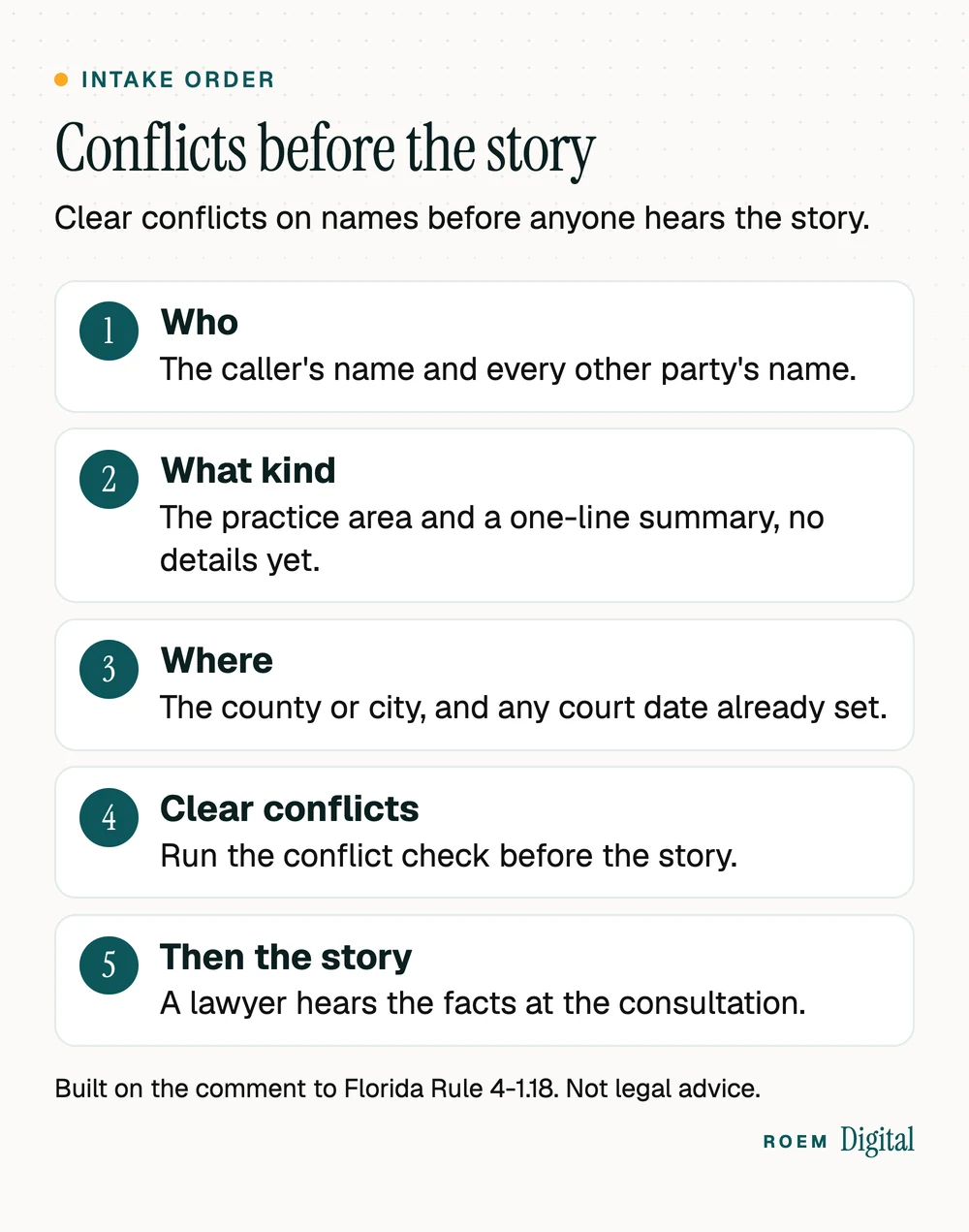
Who counts as everyone involved
The names list changes by practice, so give intake a short prompt for each one the firm handles:
- Family law: the spouse or other parent, and any new partner named in the matter.
- Injury: the other driver or property owner, and any business involved.
- Estate planning and probate: who is calling and for whom, since the caller may be an adult child asking for a parent.
- Business disputes: every company on the other side, plus its owners.
Family law shows why the order matters. Both spouses may call the same firm in the same week. The comment to Rule 4-1.18 also notes that a person who consults a lawyer only to disqualify them, with no intent to hire, has engaged in a sham and shouldn't be able to invoke the rule to create a disqualification. A firm that has the second caller's story on a notepad before it runs the names has a harder problem than one that stopped at "who else is involved?" Our post on family law marketing covers the marketing side of those calls.
What a legal intake form should ask, and what it should warn
Online forms raise the same question. The comment to Rule 4-1.18 says a consultation is likely to have occurred if a lawyer's advertising, in any medium, invites information about a potential representation without clear warnings that limit the lawyer's obligations, and someone responds. Our guide to law firm website design covers the warning above the submit button. Here's how the fields line up with the intake order:
| Field | Why intake needs it | When to ask |
|---|---|---|
| Name, phone, email and best time to call | To call back | On the form |
| Names of the other people involved | To run the conflict check | On the form |
| Type of matter in one line | To route it to the right lawyer | On the form |
| County or city, and any court date already set | To confirm the firm can help in time | On the form or first call |
| What happened, documents, evidence | To evaluate the case | At the consultation, after conflicts clear |
A short form is also easier to finish on a phone, and it's easier to track. Count each confirmed submission as a key event, as our guide to tracking calls and form fills in GA4 shows.
Who handles law firm intake: staff, answering services and AI tools
Intake is usually run by nonlawyers, and Rule 4-5.3 makes the lawyers responsible for how they do it. Its comment says a lawyer must give assistants appropriate instruction and supervision on the ethical side of their work, "particularly regarding the obligation not to disclose information relating to representation of the client," and should consider safeguards when assistants use technologies such as generative artificial intelligence. It adds that an activity requiring the lawyer's independent judgment can't be delegated to a nonlawyer.
The same comment covers nonlawyers outside the firm, naming examples such as a paraprofessional service, generative AI and an internet-based service that stores client information. The lawyer must make reasonable efforts to ensure those services work in a way compatible with the lawyer's obligations. That's the question to ask an answering service, a chat vendor or an AI receptionist before it takes a single call.

In practice, the script does three things: collects the fields above, books the consultation and explains what happens next. It never tells a caller whether they have a case. Our guide to why law firm calls drop while reports look fine shows what happens when nobody owns the phone.
Where the client intake process leaks
Most leaks in a legal intake process happen between steps, not inside them. Watch these four:
- After hours. A call that rings out at night can become a call to another firm. Decide who answers, or what the voicemail promises and when.
- Between the form and the call back. Our post on speed to lead covers a reply that goes out before anyone is free to talk.
- After the consultation. People who don't sign that day often go quiet. A written summary of next steps and fees gives them something to act on.
- The decline. The comment to Rule 4-1.18 says that where a conflict or another reason for non-representation exists, the lawyer should inform the prospective client or decline. Say it clearly, in writing if the firm's lawyers prefer, so nobody assumes you're working on their matter.
When the firm does take the matter, Rule 4-1.5(e) says the basis or rate of the fee and costs must be communicated to a new client, preferably in writing, before or within a reasonable time after the representation starts, and Rule 4-1.5(f) requires contingent fee agreements to be in writing. Engagement terms are the lawyers' document. Intake's job is to get the signed copy filed and the source of the case recorded.
Measure law firm intake from first call to signed case
Intake is where marketing data ends for most firms. The ad or listing gets credit for a call, and nobody records whether the call became a client. Track four counts by source each month: new inquiries, consultations booked, consultations held and engagements signed. The drop between each pair shows where the legal intake process needs work.
If you run Google Ads, the last two counts can flow back into the account. Google's help page on qualified and converted leads describes a qualified lead as one further qualified offline in your CRM, and a converted lead as one that completed a step you choose, such as a closed deal. Mark a held consultation as qualified and a signed engagement as converted. Uploading which people signed, even as a click ID or a hashed email, tells Google who became a client, and Florida's Rule 4-1.6 bars revealing information relating to a client's representation without informed consent, unless an exception applies. Have the firm's lawyers approve what you send, and update your privacy notice, before the first import. Our guide to Google Ads conversion tracking covers the setup, and our post on law firm PPC covers bidding toward signed cases.
Calls need the same treatment. Our guide to call tracking for a small business shows how to connect each call to its source without changing the number clients already know.
When to talk to the Bar or an ethics lawyer about intake
This is general marketing information, not legal advice, and the rules quoted come from the Bar's Chapter 4 dated October 22, 2026. Whether a particular call, form or chat created a prospective client relationship is a question for the firm's lawyers, not for intake staff or a marketing vendor. Talk to The Florida Bar or a professional responsibility lawyer before you:
- Write or change the warning on your intake form or chat window.
- Ask prospective clients to consent in advance that what they share won't prevent you from representing someone else, which the Rule 4-1.18 comment allows only with informed consent.
- Hand intake to an outside answering service, chat vendor or AI tool.
- Screen a lawyer who heard too much from a prospective client.
- Send prospect or client data to an ad platform for conversion tracking.
Members in good standing can call the Bar's Ethics Hotline at 800-235-8619 for an oral advisory opinion about their own contemplated conduct. The Bar notes that advisory opinions aren't binding. For the marketing half of intake, tracking where each case came from, start with our free audit.
Frequently asked questions
What are the steps in a legal intake process?
Most firms follow six: answer every inquiry, screen for practice area and location, run a conflict check on everyone's names, hold a consultation with a lawyer, send engagement terms or a clear decline, and record where the lead came from and whether it signed. The order of screening and conflict checks matters most.
When does someone become a prospective client in Florida?
Rule 4-1.18 says a person who consults with a lawyer about possibly forming a client-lawyer relationship is a prospective client. Its comment says a consultation is likely if the lawyer's advertising invites details about a matter without clear warnings, and the person responds. Whether that happened in a given case is a question for the firm's lawyers.
Why should a law firm run conflicts before the consultation?
Because Florida's Rule 4-1.18 bars a lawyer from using or revealing what a prospective client shared, even if the firm never takes the case, and it can disqualify the firm from the other side. Its comment says to limit the first conversation to information reasonably necessary, so names come first and the story waits.
What should a legal intake form ask?
Only what intake needs to call back and check conflicts: name, phone, email, the names of other people involved, the type of matter in one line, and the county or city. Save the detailed story and documents for the consultation, and place a lawyer-approved warning right above the submit button.
Can nonlawyer staff handle law firm intake?
Yes, under supervision. Florida's Rule 4-5.3 makes lawyers responsible for supervising assistants, and its comment says to instruct them on confidentiality, consider safeguards when they use generative AI, and keep work that needs a lawyer's independent judgment with the lawyer. Staff collect information and book consultations, but they don't tell callers whether they have a case.
How do you measure a law firm's intake process?
Count four numbers by source each month: new inquiries, consultations booked, consultations held and engagements signed. The biggest drop shows where to work first. If you run Google Ads and the firm's lawyers approve sharing that data, import held consultations as qualified leads and signed engagements as converted leads so bidding follows cases, not calls.