
Short answer: Family law marketing works when it reaches people who are often researching in private and under stress, sometimes on a shared phone. Win the local search, publish a page for each situation you handle, ask every client for a review and give prospects a safe way to say how to reach them, all inside The Florida Bar's advertising rules.
What works in family law marketing, and what makes it different
Family law marketing is how a firm that handles divorce, custody, support and related matters gets found and chosen by people in a family crisis. The channels are familiar. What's different is the reader: often searching in private, sometimes living with the other party, and rarely calm.
These family law attorney marketing ideas tend to earn consultations:
- A complete Google Business Profile for each real office, because many searches are local. Our guide to law firm SEO covers the profile and the Bar's office rule.
- A page for each situation, such as an uncontested divorce, a custody modification or a relocation request, written in plain English.
- Clear fee information, where the firm is willing to publish it, within the rules covered below.
- Reviews from every client, asked the same way.
- Spanish-language pages if your community needs them. Florida's Rule 4-7.12(c) requires any required statement to appear in each language an ad uses.
- Search ads for high-intent searches, with the targeting limits covered below.
For general ideas that fit any practice, read our law firm marketing ideas. This post covers what changes when the reader is going through a separation. Our law firm offer notes that its approach fits family law as well as injury and criminal defense.
Four checks for divorce lawyer marketing
In family law marketing, picture the reader as someone who may not be safe to contact and who hasn't decided anything yet. Then run every ad, page, email and follow-up through four checks. They're our own, not a Bar standard:
- Would this be safe if the other spouse saw it on a shared screen, in a shared inbox or on the voicemail?
- Did the prospect choose how and when you reach them?
- Does it describe how you help, rather than predict what a court will do?
- Would a reasonable person feel informed, not frightened or guilted?
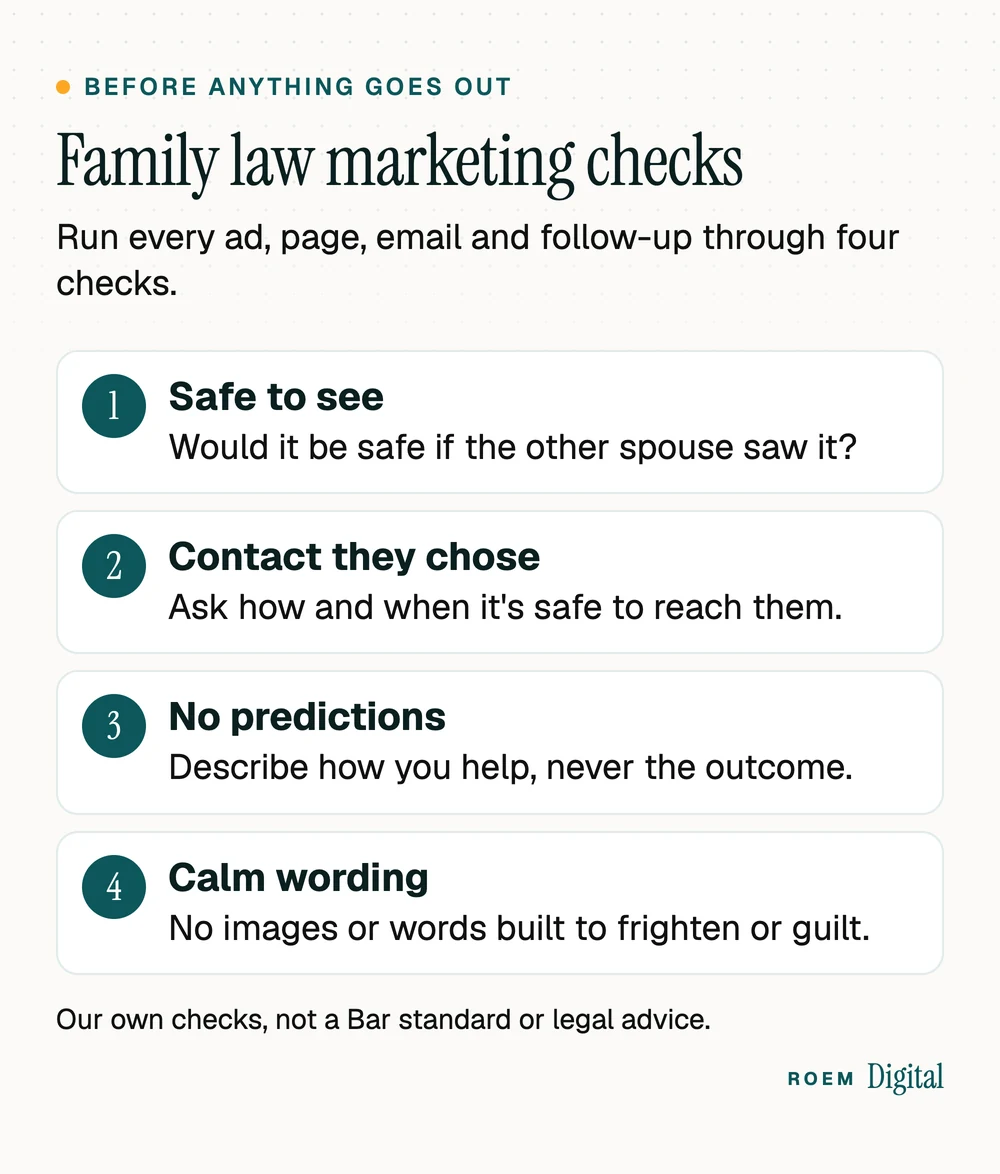
The first two checks are judgment, not rules. The last two map closely to Rules 4-7.13 and 4-7.15, covered below. If you'd like an outside read on how your current marketing does against them, our law firm offer starts with a free review.
Make every family law touchpoint discreet by design
Discretion starts on the contact form. Add one question most firms skip: how and when is it safe to reach you? Offer call, text or email, a time window and a yes or no on voicemail, then make intake follow the answer. Unless the prospect said voicemail is safe, a callback message should leave a first name and a number, not the firm's name and the word divorce. Our post on the legal intake process explains why intake should also collect the other party's name for a conflict check before hearing the story.
Then check the channels that can expose a client:
- Remarketing. Google lists divorce services as an example in its relationship hardships policy, a sensitive interest category that can't use advertiser-curated audiences such as Customer Match or your data segments. Predefined Google audiences remain available. Our post on retargeting ads covers the wider rules.
- Email. Under Rule 4-7.18(b), an unsolicited email to a prospective client needs a subject line that begins with "Advertisement." Replies to someone who asked to hear from you are exempt from those requirements, so answer inquiries promptly and plainly.
- Mail. A letter prompted by a specific occurrence must not reveal the nature of the recipient's legal problem on the envelope, under Rule 4-7.18(b)(2)(H).
- Injunction respondents. Rule 4-7.18(b)(1)(G) bars written solicitation about an injunction for protection against violence to the respondent if you know or should know they haven't been served.
The email, mail and injunction rules come from the Bar's Chapter 4, dated October 22, 2026. Rule 4-7.18(b)(1)(F) adds a broader limit: no written solicitation when you know or should know the person's physical, emotional or mental state makes it unlikely they'd exercise reasonable judgment in hiring a lawyer.
What Florida's advertising rules mean for family law ads
Family law ads invite the claims the rules restrict: promises about children, fees and outcomes. The comments to the rules give unusually concrete guidance here. A statement that a firm will protect the client's family describes the legal process, not a result, and is generally permissible under the Rule 4-7.13 comment. The Rule 4-7.15 comment gives a depiction of a child being taken from a crying mother as an example of an impermissible image.
| Ad line or image | Status | Why |
|---|---|---|
| "We'll get you custody" | Not allowed | Rule 4-7.13(b)(1): a prediction or guaranty of results |
| "We protect your family through every step" | Generally allowed | Rule 4-7.13 comment: describes the process, not a result |
| A child pulled from a crying parent | Not allowed | Rule 4-7.15 comment: unduly manipulative |
| "Board certified in marital and family law" | Only if true for that lawyer | Rule 4-7.14(a)(4): name the area and The Florida Bar |
| "Uncontested divorce: flat fee" with a price | Only with costs disclosed | Rule 4-7.14(a)(7): disclose all fees and costs, honor the fee at least 90 days |
| A client's quote about the outcome | Only with conditions met | Rule 4-7.13(b)(9): six conditions, including a results disclaimer |
| "Collaborative divorce for every family" | Write it carefully | Rule 4-1.19(c): lawyers must ask about coercion or violence first |
Case results need extra care in family law, because many outcomes sit in public court files. The comment to Rule 4-7.13 says a lawyer who wants to advertise a past result must have the affected client's informed consent, and that information being in the public record doesn't remove that need. It also says a result that's atypical for people in similar circumstances is likely to be misleading.
Marital and family law, adoption law and juvenile law each appear on The Florida Bar's list of board certification areas. Certification belongs to the individual lawyer. If the firm's website needs Spanish pages with the same disclaimers, our bilingual marketing service explains how we plan both languages.
Reviews and testimonials when family law clients want privacy
Reviews matter in family law marketing, but many clients would rather not post anything, and that's their call. Ask every client the same way when the matter closes, and accept a no. Google's Maps content policy bans offering incentives for reviews and selectively asking only happy customers. The Bar's 2025 advertising handbook adds a lawyer-specific example: a gift card in exchange for liking the firm's Facebook page is an economic incentive Rule 4-7.15(d) doesn't allow.

Replies need the most care. A reply that confirms someone was a client, or mentions their case, can disclose information Rule 4-1.6 protects. Read our guide on how to respond to negative reviews before you answer one, and our guide to getting more Google reviews for timing and wording. If you put a review on your own website, it becomes a testimonial, and the Rule 4-7.13(b)(9) conditions apply.
Measure marketing for family law firms by consultations
Divorce searches produce plenty of clicks from people who aren't ready, and some who are looking for free answers. Judge each family law marketing channel by consultations held and engagements signed, not calls. Track calls and forms by source, as our guide to call tracking for a small business explains, and have intake record which consultations signed.
The decision can take longer than in injury work, and someone may read your custody page more than once before calling. Pages that answer the questions people ask before they're ready, such as how a Florida divorce starts or what a parenting plan covers, keep your firm in their mind. Our guide to why law firm calls drop while reports look fine covers what to check when traffic grows and calls don't.
Pages that answer the questions people ask before they call
Plan one page or post for each question a person asks before they're ready to talk, written by or reviewed by a lawyer at the firm:
- How a divorce starts in your state, and what the first weeks look like.
- What a parenting plan covers, in plain English.
- What changes when one parent wants to move.
- How a support or custody order gets modified.
- What to bring to a first consultation, and what it costs at your firm.
Each page should end with a quiet next step, such as a short form with the safe-contact question, not a pop-up. Search Console shows which of these pages people find, and our law firm website design guide covers how to lay them out.
When to call the Bar's ethics hotline or an ethics lawyer
This is general marketing information, not legal advice. Rules change, and these are quoted from the version dated October 22, 2026. Talk to The Florida Bar or a professional responsibility lawyer before you:
- Advertise a fee, a flat fee or a free consultation.
- Send mail, email or texts to people who haven't contacted you.
- Publish a result, testimonial or certification claim.
- Market a domestic violence or injunction practice.
Members in good standing can call the Bar's Ethics Hotline at 800-235-8619 for an oral advisory opinion about their own contemplated conduct. The Bar notes those opinions aren't binding. The firm makes the final call on every claim. For the marketing side, start with our free audit.
Frequently asked questions
What is family law marketing?
Family law marketing is how a firm that handles divorce, custody, support and related matters gets found and chosen by people in a family crisis. It usually combines a Google Business Profile, a page for each situation, reviews, referrals and search ads, done discreetly and inside the state bar's advertising rules.
Can a divorce lawyer use remarketing ads on Google?
Not with the firm's own audience lists. Google lists divorce services as an example of its relationship hardships category, which can't use advertiser-curated audiences such as Customer Match or your data segments. Predefined Google audiences remain available. Florida's lawyer advertising rules still apply to every ad that runs.
Can a Florida family lawyer advertise a flat fee for an uncontested divorce?
Florida's Rule 4-7.14(a)(7) treats fee information as potentially misleading unless the ad discloses all fees and costs the client might owe. A lawyer who advertises a specific fee must honor it for at least 90 days unless the ad states a shorter period. Check the wording with the Bar before it runs.
Can a family law ad say we protect your family?
Generally, yes. The comment to Florida's Rule 4-7.13 says statements that a firm will protect the client's rights, assets or family describe the legal process rather than promise a result. Predicting an outcome, such as promising custody, is a different matter and isn't allowed.
How should a family law firm ask for reviews?
Ask every client the same way when the matter closes, and accept a no without pressure. Never offer a gift, discount or anything else in exchange. When you reply to a review, don't confirm the person was a client or mention their case, and treat any review you republish as a testimonial.
Can a family lawyer mail people named in an injunction petition?
Not unserved respondents: Florida's Rule 4-7.18(b)(1)(G) bars written solicitation about an injunction for protection against violence to a respondent not yet served. Rule 4-7.18(b)(1)(F) also bars mail to someone whose emotional state makes sound judgment unlikely, and the other party may read a petitioner's mail. Ask the Bar before mailing anyone in a petition.