
Short answer: The law firm marketing ideas worth your time in Florida are the ones that fit the Bar's advertising rules: a clean Google profile, plain-English answers on your website, educational posts, client newsletters, text-only search ads and local sponsorships. Before you spend on any idea, check whether The Florida Bar requires you to file it first.
12 law firm marketing ideas, sorted by what the Bar requires
Most lists of law firm marketing ideas skip what matters most to a Florida lawyer: Rule 4-7.11 of the Rules Regulating The Florida Bar applies the advertising rules to all forms of communication seeking legal employment, websites, social networking and video included. The question is how to run each idea inside the rules.
Here are 12 ideas for small and midsize firms, with their status under the rules as amended October 22, 2026. This is general marketing information, not legal advice.
| Idea | Florida Bar status | What to watch |
|---|---|---|
| Fix your Google Business Profile and directory listings | Google profile: not addressed in the Bar pages we read. Law lists and bar publications: exempt, Rule 4-7.20(c) | A paid directory listing lawyers together is a qualifying provider under Rule 4-7.22: check it complies, and report joining to the Bar within 15 days. See our Google Business Profile checklist. |
| Answer common client questions on your website | Exempt from filing: Rule 4-7.20(g) | Every page still follows the content rules. |
| Post educational tips on your firm's own social pages | Not filed, per the Bar's social networking guidelines | Remove posts others leave on your page about your services that break the rules. |
| Boost a post or run social media ads | File at least 20 days before first use, unless limited to safe harbor content | Narrowly targeted posts can also fall under the direct solicitation rules. |
| Run text-only search ads | Exempt since October 22, 2026: Rule 4-7.20(i) | Images, audio, video or a firm logo, including ones Google adds automatically, bring filing back. |
| Email a newsletter | Exempt from filing if sent only to current and former clients, other lawyers and people who asked for it | Anyone else: file it and follow Rule 4-7.18(b). |
| Ask every client for a Google review | Not addressed in the Bar pages we read | Never offer anything for a review, and ask every client, not only happy ones. |
| Show client testimonials | Exempt from filing on your website | Six conditions in Rule 4-7.13(b)(9), including a results disclaimer. |
| Sponsor a local charity or event | A brief announcement is exempt: Rule 4-7.20(b) | Add more than safe harbor content and the exemption no longer applies. |
| Teach a free community seminar | Announcements generally must follow the advertising rules | Mailed or emailed announcements to prospects are filed 20 days ahead and follow Rule 4-7.18(b). |
| List awards and certifications | Follows the medium you use | Only bona fide awards with objective criteria (Rule 4-7.14(a)(3)). Name the award and its date. Say "board certified" only as Rule 4-7.14(a)(4) allows. |
| Build referral relationships | Rule 4-7.17(b) limits what you can pay | Never give anything of value for a recommendation. |
The Bar Lane Test: four questions for any law firm marketing strategy
We call it the Bar Lane Test, our editorial shorthand for the filing and content rules in Subchapter 4-7. Run every idea through it before it joins your law firm marketing strategy:
- Does it promote your practice? Then assume the advertising rules apply. The Bar's guidelines for social networking sites draw that line: pages used solely for family and close friends aren't covered, pages that promote the practice are.
- Is it exempt from filing? Rule 4-7.20 lists the exemptions, including your website, communications mailed only to existing clients, former clients or other lawyers, communications a prospective client asked for, brief charity sponsorship announcements and, since October 22, 2026, text-only sponsored search results.
- Is it sent directly to a prospect, or targeted at a specific legal problem? Unsolicited direct mail and email must be filed at least 20 days before use, according to the Bar's filing requirements page, and Rule 4-7.18(b) adds conditions such as an "advertisement" label and a statement of your background and experience. Pitching strangers in person, by phone or by live video isn't a filing question at all: Rule 4-7.18(a) bars that kind of solicitation.
- Does the content pass? This question applies in every lane. Rule 4-7.12 requires the name of at least one lawyer or the firm and the city, town or county of a bona fide office. Rule 4-7.13 rules out predictions or guarantees of results, unverifiable claims about skill or reputation and testimonials that don't meet its conditions.
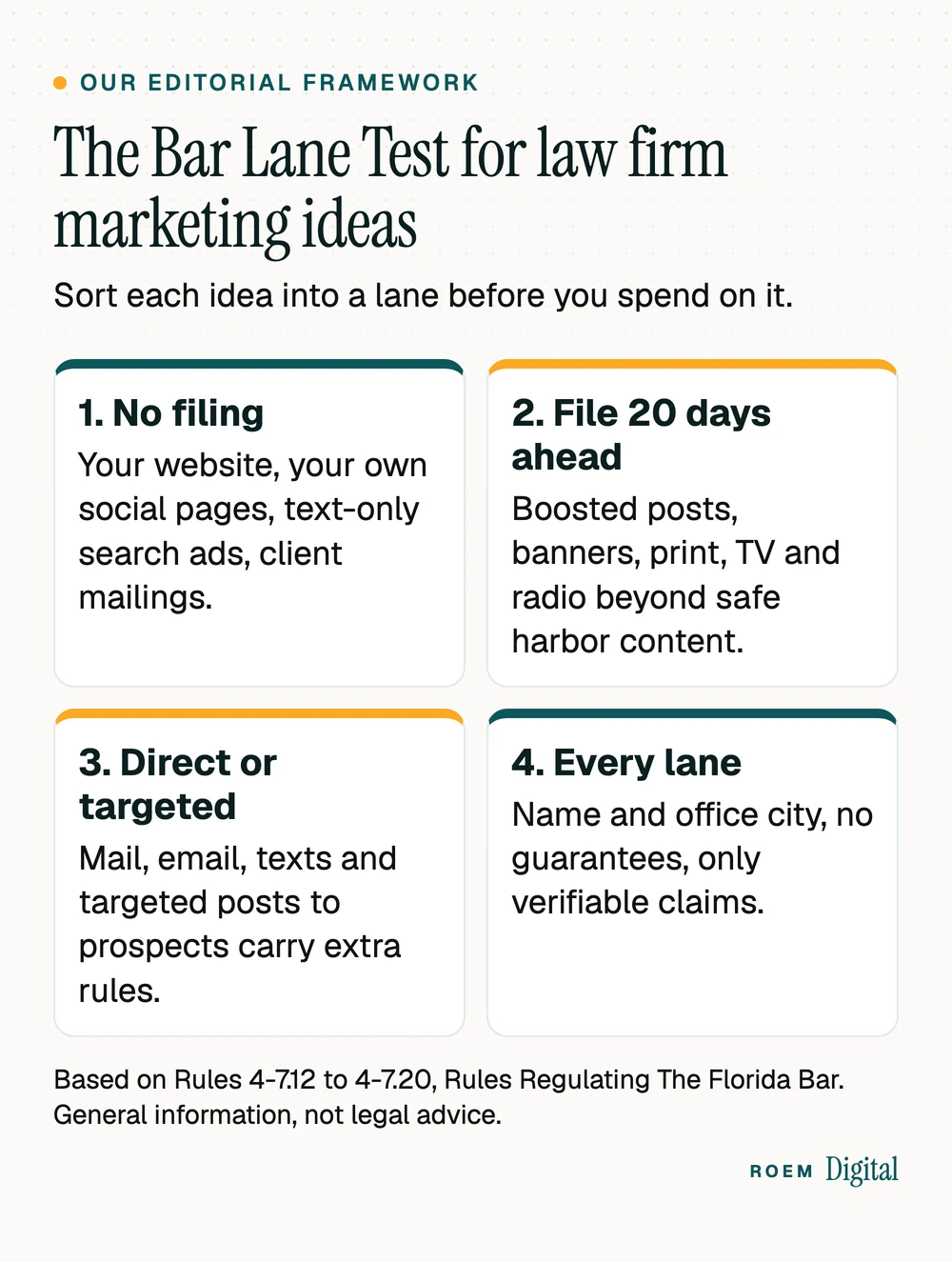
If an idea lands in lane 2 or 3, file at least 20 days before first use, which the filing page says allows a 15-day evaluation period and 5 days of mailing time. For a second set of eyes on the marketing itself, our law firm marketing offer starts with a free review from the outside.
What changed for Florida lawyer advertising in 2026
Three changes affect which law firm marketing ideas make sense for 2027:
- Text-only search ads no longer need filing. On October 22, 2026, the Florida Supreme Court adopted Rule 4-7.20(i), which exempts sponsored search engine results that don't include images, audio or video beyond the Rule 4-7.16 content. The Bar's article on the new exemption notes that lawyers previously had to file each of the hundreds or thousands of text variations a search ad can generate.
- Filing fees changed. Since July 1, 2026, the Bar charges $250 for each advertisement filed at least 20 days before first use and $750 for each one filed late, according to its advertising regulation page. Under a Board of Governors policy, any change of any kind, down to wording, layout or color scheme, makes it a new advertisement with a new fee.
- Filing moved online. In July 2026 the Bar launched an Online Ad Submission system in the MyFloridaBar member portal.
The search ad exemption is narrower than it sounds. The Bar's article gives the example that text such as "Injured in an accident" qualifies, while an ad with an image of a car crash or a firm logo doesn't. Exempt ads also still have to follow the content rules, including required content (Rule 4-7.12) and the ban on deceptive and inherently misleading ads (Rule 4-7.13). And if another firm's name triggers your ad, the comment to Rule 4-7.13 says the ad must clearly show it isn't that firm, for example by putting your own firm's name first.
Check what Google adds on its own. Google Ads can create a business logo from your website and show it with your ads, and dynamic image assets pull pictures from your landing page. Per the Bar's article, a firm logo takes an ad out of the exemption, as do images beyond the Rule 4-7.16 content, so turn those assets off or file the ad. Text customization also writes extra headlines from your landing page, so review each one or leave it off, and make sure the page itself passes the content rules. Our guide to landing pages for Google Ads covers what else it needs.
Reviews, testimonials and results: where attorney marketing ideas go wrong
The attorney marketing ideas that trip firms up most often involve proof: showcasing wins, posting testimonials and collecting five-star reviews. In Florida, each comes with conditions.
Testimonials
Rule 4-7.13(b)(9) treats a testimonial as deceptive or inherently misleading if the person isn't qualified to evaluate the matter, it isn't their actual experience, it doesn't represent what the firm's clients generally experience, the lawyer wrote it, the person received something of value for it, or it lacks a disclaimer that a prospective client may not obtain the same or similar results.
Case results
Rule 4-7.13(b)(2) treats references to past results as deceptive unless the information is objectively verifiable. The comment adds that a result atypical of people in similar circumstances is likely to be misleading, and that advertising a past result requires the affected client's informed consent, even when the information is in the public record.
Awards, "expert" and "the best"
The comment to Rule 4-7.14 permits listing bona fide awards by the award's actual name and the date it was given. Rule 4-7.14(a)(3) treats a recognition as potentially misleading unless the organization is generally recognized as bona fide and selects lawyers on objective, uniformly applied criteria. Calling a lawyer a specialist or expert is potentially misleading unless the lawyer is certified or can objectively verify it through education, training, experience or substantial involvement in the area (Rule 4-7.14(a)(5)). The comment to Rule 4-7.13 says descriptions such as "the best," "second to none" or "the finest" will generally run afoul of that rule.
Google reviews
Google's Maps content policy bars businesses from offering incentives for reviews and from selectively soliciting positive ones. Rule 4-7.17(b) separately says a lawyer may not give anything of value to a person for recommending the lawyer's services. So ask every client the same way, and never attach a gift. Once you show a review on your website or social pages, it fits the rule's definition of a testimonial, so the Rule 4-7.13(b)(9) conditions and the results disclaimer apply. Our guide to getting more Google reviews covers timing and wording. Replies need care too, because Rule 4-1.6 bars disclosing information about a representation without the client's informed consent, unless an exception applies. Read how to respond to negative reviews first.
Low-cost lawyer marketing ideas that build referrals the right way
These lawyer marketing ideas cost more time than money:
- Stay in touch with past clients. Communications mailed only to existing clients, former clients or other lawyers are exempt from filing under Rule 4-7.20(d).
- Network without soliciting. The comment to Rule 4-7.18 lets a lawyer exchange contact information with people at a business or professional gathering, or on a social platform built for professionals, as long as the lawyer doesn't start a discussion of a specific legal matter.
- Sponsor something local. A brief announcement naming your firm as a sponsor of a charity, community program or event is exempt from filing if it has only safe harbor content plus the fact of the sponsorship (Rule 4-7.20(b)).
- Teach. A free seminar for a community group or a professional audience builds trust in person. The Bar's advertising FAQ says seminar announcements generally must comply with the advertising rules, and those sent by mail, email or social media must meet Rule 4-7.18(b). Speaking doesn't create a professional relationship with attendees, the comment to Rule 4-7.18 notes, so don't pitch anyone one on one about their matter afterward.
- Choose lead sources carefully. Rule 4-7.17(b) lets lawyers pay the usual charges of a referral service, directory or qualifying provider, but Rule 4-7.22 bars working with a qualifying provider, including a leads service, that doesn't meet its requirements.

A listing in a law list or bar publication is exempt from filing (Rule 4-7.20(c)). Paid directories are different: a service paid to list lawyers together is a qualifying provider under Rule 4-7.22, so check that it meets the rule and report your participation to the Bar within 15 days. Consistent listings across the web support local search, as our business listings guide explains. For posting ideas that stay inside the rules, read our companion post on social media for lawyers.
Judge every idea by consultations and signed cases
A marketing idea earns its place by producing consultations, not likes. Track calls and forms by source, and make sure intake can say which matters were signed. Our article on why law firm calls drop while reports look fine covers six patterns to check, call tracking for a small business explains the setup, and speed to lead covers follow-up.
When to call the Bar's ethics hotline or an ethics lawyer
This article is general marketing information, not legal advice. Rules change, and these are quoted as amended October 22, 2026. Talk to the Bar or to a lawyer who advises on professional responsibility before you:
- Run a testimonial, case result, award or "expert" claim you're unsure about.
- Send mail, email or texts to people who haven't asked to hear from you.
- Target ads or posts at people with a specific legal problem.
- Pay anyone connected to referrals, leads or matching.
Members in good standing can call the Bar's Ethics Hotline at 800-235-8619 for an oral advisory opinion about their own contemplated conduct, and the Bar notes that advisory opinions are not binding. For an ad that's exempt from filing, Rule 4-7.19(d) still lets you request an opinion, which the rule's comment describes as a way to get a safe harbor from discipline. If an agency writes your ads, Rule 4-7.12 still requires each one to name the lawyer or firm responsible for its content. Ask how the agency handles the rules before you sign, a question our law firm page answers in its FAQ.
Where to start: three ideas from the no-filing lane
If you pick only three law firm marketing ideas this quarter, take them from lane 1: fix your Google profile, publish answers to the questions clients ask on the first call, and send a review request to every client when a matter closes. None carries a filing fee.
When you're ready for help, our law firm offer starts with a free review of your firm from the outside.
Frequently asked questions
Do Florida lawyers have to file Google search ads with the Bar?
Not if the ad stays text only. Since October 22, 2026, Rule 4-7.20(i) exempts sponsored search results with no images, audio or video beyond the Rule 4-7.16 content. A firm logo or image Google adds automatically ends the exemption. Exempt ads still need the firm name, office city and no misleading statements.
Does a law firm website need to be filed with The Florida Bar?
No. Rule 4-7.20(g) exempts information on a lawyer's own website from filing, but every page still has to follow the advertising rules. If you're unsure about one part, Rule 4-7.19(d) lets you submit a specific page, statement, illustration or photo for an opinion, though not the entire site.
How much does it cost to file a lawyer advertisement in Florida?
Since July 1, 2026, The Florida Bar charges $250 for each advertisement filed at least 20 days before first use and $750 for each one filed late. Under a Board of Governors policy, any change to an ad, even its layout or color scheme, makes it a new ad with a new fee.
Can a Florida law firm use client testimonials in marketing?
Yes, within Rule 4-7.13(b)(9). The testimonial must reflect the person's actual experience and what clients generally experience, can't be written by the lawyer or given in exchange for something of value, must cover matters the person can evaluate, and needs a disclaimer that a prospective client may not obtain the same or similar results.
Can a lawyer offer a gift card for a Google review?
No. Google's Maps content policy bans offering incentives such as payment, discounts or free services in exchange for reviews, and it bans selectively asking only happy customers. Rule 4-7.17(b) also says a lawyer may not give anything of value to a person for recommending the lawyer's services. Ask every client the same way.
What is a tombstone ad for lawyers?
It's an ad limited to the presumptively valid content listed in Rule 4-7.16, such as the lawyer's or firm's name, contact details, practice areas, bar admissions and languages spoken. An ad in the public media with no illustrations and no information beyond that list is exempt from filing under Rule 4-7.20(a).
What are good marketing ideas for a small law firm on a budget?
Start with ideas that carry no filing fee: an accurate Google Business Profile, answers to common client questions on your website, educational posts on your own social pages, a newsletter for current and former clients, and review requests sent to every client. Add paid reach once calls and forms are tracked by source.