
Short answer: Social media for lawyers works best as education: answer the questions clients already ask, explain the process and show the people behind the firm. In Florida, a firm's own pages don't have to be filed with the Bar, but they must follow the advertising rules, and boosted posts must be filed first unless limited to safe harbor content.
Social media for lawyers starts with teaching, not selling
People who need a lawyer rarely hire one from a single post. They follow, watch and remember who explained their problem clearly. So the job of social media for lawyers is to make the firm the one they remember when the need comes: plain answers, a look at the process and real faces, posted on one or two platforms you can keep up with.
Lawyer social media ideas that fit that job, and stay inside the advertising rules:
- Answer one common question per post, the kind clients ask on the first call. Keep it general, accurate and free of promises.
- Walk through a step of the process: what happens at a first meeting, what to bring, how long a typical stage takes in your court.
- Explain a law change in plain English, with the date it takes effect. Rule 4-7.13 treats a material statement that's factually or legally inaccurate as deceptive, so check every fact.
- Introduce your team. Real staff, real roles.
- Share community involvement: a charity drive, a free clinic, a talk at the library.
- Post holiday and office notices. Greetings like "happy holidays" and "proudly serving your community" are on the Bar's list of presumptively valid content (Rule 4-7.16).
Our guide on what a local service business should post covers formats and frequency. The rest of this post covers what's different for a law firm. This is general marketing information, not legal advice.
What The Florida Bar requires for each kind of post
For social media for lawyers in Florida, start with Rule 4-7.11, which applies the advertising rules to every form of communication seeking legal employment, social networking and video sharing included. The Bar's checklist for websites, social media pages and video channels puts it plainly: a lawyer's own pages and channels don't have to be filed for review "unless the posts or videos are sponsored, 'boosted,' or promoted," but they must comply with the substantive rules in Rules 4-7.12 through 4-7.17 and 4-7.21.
| What you post | Filing with The Florida Bar | Rules that apply |
|---|---|---|
| Posts on your firm's own page | Not filed | Rules 4-7.12 to 4-7.17 and 4-7.21: required content, nothing misleading, testimonial conditions |
| A personal page used only for family and close friends | Not subject to the advertising rules | You're still bound by the Rules Regulating The Florida Bar |
| Boosted or sponsored posts | File at least 20 days before first use, unless limited to safe harbor content (Rule 4-7.16) | Rules 4-7.11 to 4-7.18 and 4-7.21 |
| Posts targeted at people who self-identified with a specific legal need | File for review | Also the targeted direct electronic rules in Rule 4-7.18(b) |
| Unsolicited messages inviting someone to view your page | File for review: no Rule 4-7.20 exemption covers them | Rule 4-7.18(b), unless sent to a client, former client, relative, prior professional contact or another lawyer |
| Videos posted on a video sharing site | Not filed (treated as information the viewer requested) | Rules 4-7.11 to 4-7.18 and 4-7.21, including text posted with the video |
| Banner ads on a social or video site | File unless limited to safe harbor content | Rules 4-7.11 to 4-7.18 and 4-7.21 |
The sources are the Bar's guidelines for social networking sites and guidelines for video sharing sites. Since July 1, 2026, a filing costs $250 if it's at least 20 days early and $750 if it's late, and any change to a filed ad makes it a new ad, according to the Bar's advertising regulation page. That's why boosting every post adds up fast. Our companion post on law firm marketing ideas sorts other channels the same way.
The Feed Filter: four checks before any law firm post
Most social media marketing for law firms fails the rules in the same few places. We call our editorial checklist the Feed Filter: four questions, in order, before anything goes live.
- Who will see it? Your own page needs no filing. A boosted post does. A post aimed at people with a specific legal problem, or a direct message to a stranger, also brings in Rule 4-7.18(b).
- What does it claim? Results must be objectively verifiable. Skills and reputation claims need objective support. Testimonials must meet all six conditions in Rule 4-7.13(b)(9). A post that mentions a fee must disclose all fees and costs the client might owe (Rule 4-7.14(a)(7)).
- Who appears in it? If a voice or face could pass for someone at your firm and isn't, Rule 4-7.13(b)(5) requires a clear disclaimer. Actors and dramatizations need disclaimers too, celebrities are mostly off limits, and no judge, police officer or actor playing one can endorse or speak for you (Rule 4-7.15(b)).
- What does it offer? Rule 4-7.15(d) bars offering consumers an economic incentive to hire you or to review your advertising.
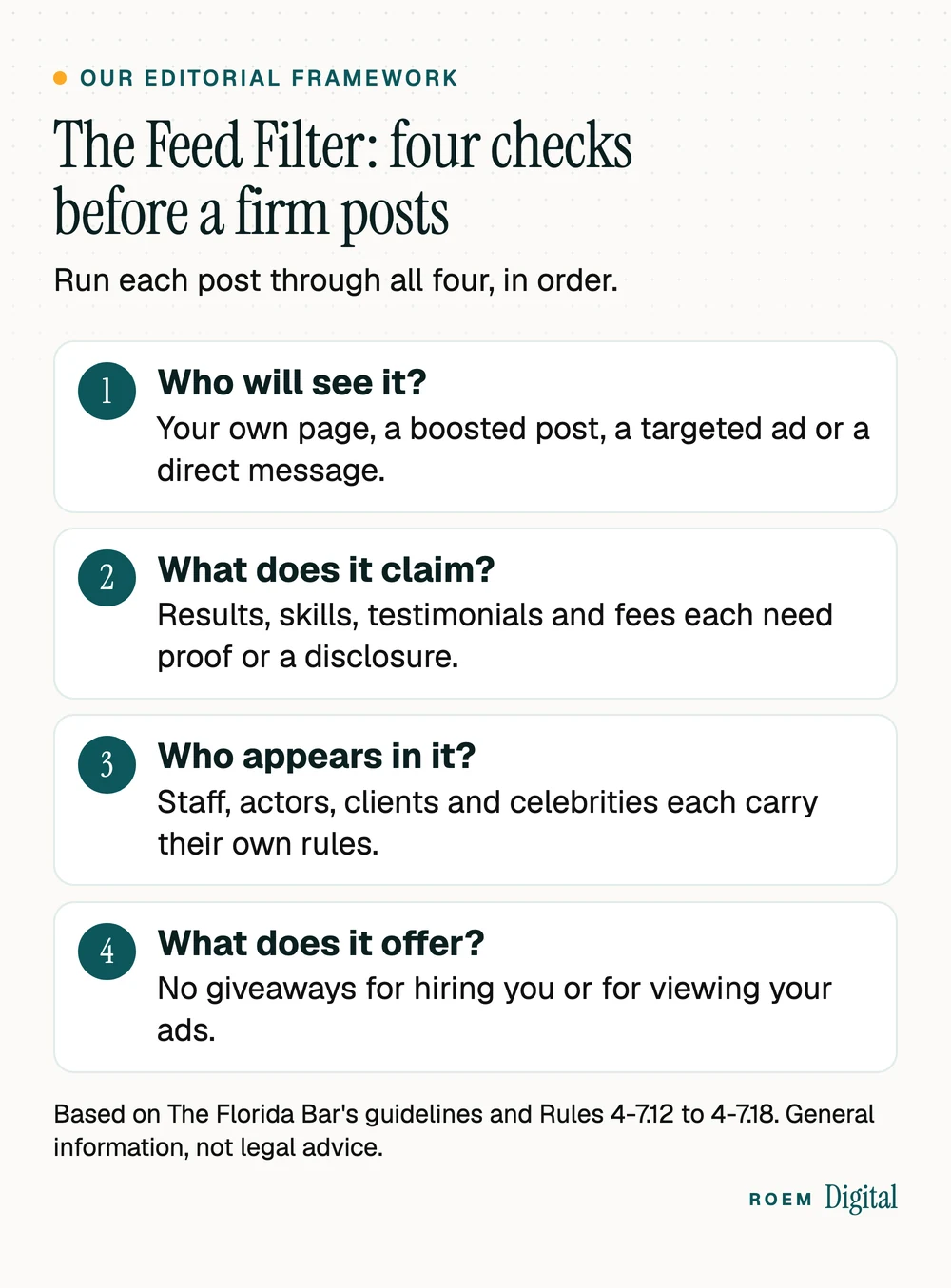
The filter is a planning tool, not a ruling. If a post fails a check and you still want to run it, that's the moment to ask the Bar. For help planning and posting, our social media management service handles the strategy, content calendar, creative and posting.
Giveaways, trends and celebrity clips: lawyer social media ideas to skip
Some of the most common advice for social media marketing for law firms runs into Florida's rules:
- "Follow and share to win" contests. The Bar's checklist flags any ad that offers "an economic incentive such as a give-away to hire the lawyer or review the advertisement." Rule 4-7.15(d) doesn't stop you from offering free legal information.
- Trending clips with a famous voice or face. Rule 4-7.15(c) bars an ad that contains the voice or image of a celebrity, with narrow exceptions for local announcers and testimonials from celebrity clients. The comment says a person can be a celebrity on a regional or local level.
- "Case win" posts. References to past results must be objectively verifiable, and the comment to Rule 4-7.13 says advertising a result needs the affected client's informed consent, even if it's in the public record.
- Calling yourself an expert or the best. Rule 4-7.14(a)(5) treats a specialist or expert claim as potentially misleading unless it's backed by certification or objectively verifiable experience, and the comment to Rule 4-7.13 says "the best" will generally run afoul of that rule.
- Dramatic reenactments. A dramatization a reasonable viewer wouldn't recognize as one needs a clear disclaimer (Rule 4-7.13(b)(6)), and Rule 4-7.15(a) bars images designed to appeal to emotions rather than a rational evaluation of the lawyer.
- Outrage bait. In our view it attracts arguments, not clients. Our post on rage bait explains why it backfires for local businesses.
Practicing outside Florida? Compare the ABA Model Rules
If you practice outside Florida, your own state's rules apply. Florida's rules still reach any lawyer, wherever admitted, who advertises legal services in Florida or targets ads at Florida residents (Rule 4-7.11(b)), so a boosted post aimed at Florida counts. The American Bar Association writes Model Rules that state courts can adopt: after amending them in August 2018, it asked state supreme courts to consider integrating the changes, as in this letter to Connecticut's chief justice that includes the amended text. The ABA's Model Rules table of contents still lists Rule 7.1 "Communications Concerning a Lawyer's Services," Rule 7.2 "Communications Concerning a Lawyer's Services: Specific Rules" and Rule 7.3 "Solicitation of Clients." Here's how that model compares with Florida's rules on the points that matter most for social media:
| Topic | ABA Model Rules | Florida Bar rules |
|---|---|---|
| Core standard | Rule 7.1: no false or misleading communication about the lawyer or the lawyer's services | Rules 4-7.13 to 4-7.15 list specific deceptive, misleading and manipulative content |
| Required content | Rule 7.2(d): name and contact information of a responsible lawyer or firm | Rule 4-7.12: name, plus the city, town or county of a bona fide office |
| Paying for recommendations | Rule 7.2(b): barred, with exceptions including nominal thank-you gifts | Rule 4-7.17(b): barred, with exceptions for advertising costs and usual referral service charges |
| Live calls, video and texts | Rule 7.3(b) still bars live person-to-person solicitation, including live phone and real-time video calls, but texts and chat now count as written messages | Rule 4-7.18(a) bars in-person, phone and real-time video solicitation, and written messages follow Rule 4-7.18(b) |
| Labels on targeted messages | The 2018 amendments dropped the labeling requirement for targeted mailings | Email subject lines must begin with "Advertisement," per Rule 4-7.18(b) |
Your state's adopted rules control, not the model. If your firm advertises in more than one state, check each state's version. Our law firm offer is open to firms outside Florida too.
When to ask the Bar or an ethics lawyer before you post
This post is general marketing information, not legal advice. Ask before you run a testimonial or case result, boost a post you haven't filed, target ads at people with a specific legal problem, message strangers about their legal matter, or put anyone other than your own staff on camera.
Florida Bar members in good standing can call the Bar's Ethics Hotline for an oral advisory opinion about their own contemplated conduct, which the Bar notes is not binding. You can also file a single post or video voluntarily under Rule 4-7.19(d) for a $250 fee, according to the Bar's checklist, though the Bar won't accept an entire account. For the measurement side, our guide to the numbers a marketing report should show explains how to judge social media for lawyers by consultations rather than likes.
Frequently asked questions
Do lawyers have to file social media posts with The Florida Bar?
Not posts on a firm's own page. The Bar's guidelines say a lawyer's own social pages don't have to be filed, though they must follow the advertising rules. Boosted or sponsored posts must be filed at least 20 days before first use unless their content is limited to the safe harbor list in Rule 4-7.16.
Can lawyers post client testimonials on social media?
In Florida, yes, if it meets all six conditions in Rule 4-7.13(b)(9), including the disclaimer that a prospective client may not obtain the same or similar results. Resharing a client's review on your page puts it in your advertising, so treat it as a testimonial and add the disclaimer. A boosted testimonial post also has to be filed.
Can a law firm run a social media giveaway?
Be careful. Rule 4-7.15(d) bars offering consumers an economic incentive to hire the lawyer or review the lawyer's advertising, and the Bar's checklist names a give-away as an example. Offering free legal information is allowed. Ask the Bar's ethics hotline before running any contest tied to your firm's page.
Are lawyers responsible for comments on their Facebook page?
Under the Bar's networking guidelines, a lawyer isn't responsible for third-party posts unless the lawyer prompted them or used the third party to get around the rules. But if someone posts information about the lawyer's services that breaks the rules on the lawyer's own page, the lawyer must remove it.
Can a lawyer send a LinkedIn message to a potential client?
In Florida, a lawyer may exchange contact information and profiles on a professional platform if the lawyer starts no discussion of a specific legal matter. An unsolicited message inviting someone to view the lawyer's page to get legal business must meet Rule 4-7.18(b), unless it goes to a client, former client, relative, prior professional contact or another lawyer.
What should a law firm post on social media?
Post plain answers to questions clients ask, short explanations of each step in the process, law changes with their effective dates, team introductions and community involvement. Keep every post accurate and free of predictions about results, and pick one or two platforms you can update consistently rather than spreading thin.
Comments, messages and reviews on a lawyer's page
Social media for lawyers is two-way, and the rules follow the conversation.
Our suggestion: assign one person to check comments and messages on a set schedule, with a short reply script that moves any specific legal question to a private, confidential channel.