
Short answer: Estate planning attorney marketing works when it meets people at the life events that make planning feel urgent, such as a new child, retirement or a death in the family. Seminars, referral partners and flat-fee offers all work in Florida, but each has Bar rules on who pays, what you claim and how you follow up.
Estate planning marketing runs on life events
Estate planning attorney marketing is how a firm that drafts wills, trusts and powers of attorney, and often handles probate, gets chosen by people who know they should plan but haven't. Nothing forces the decision, so the marketing that works shows up when a life event does.
These channels tend to carry estate planning marketing:
- A complete Google Business Profile for each real office, plus a page for each service and each life event. Our guide to law firm SEO covers both.
- Seminars and webinars for people near retirement, new parents and adult children of aging parents.
- Referral relationships with accountants, financial advisors and other professionals, inside the payment rules below.
- Clear pricing for flat-fee documents, if the firm offers them.
- Check-in letters to past clients after tax law changes or when their family changes.
For marketing ideas that fit any practice, see our law firm marketing ideas. Our law firm offer notes that its approach fits estate planning as well as injury and criminal defense. This post covers what's specific to marketing for estate planning attorneys in Florida. This is general marketing information, not legal advice.
Marketing estate planning attorneys around six life events
List the six moments that push people toward a plan, then give each one a page, a channel and a follow-up. This is a planning aid, not a measurement:
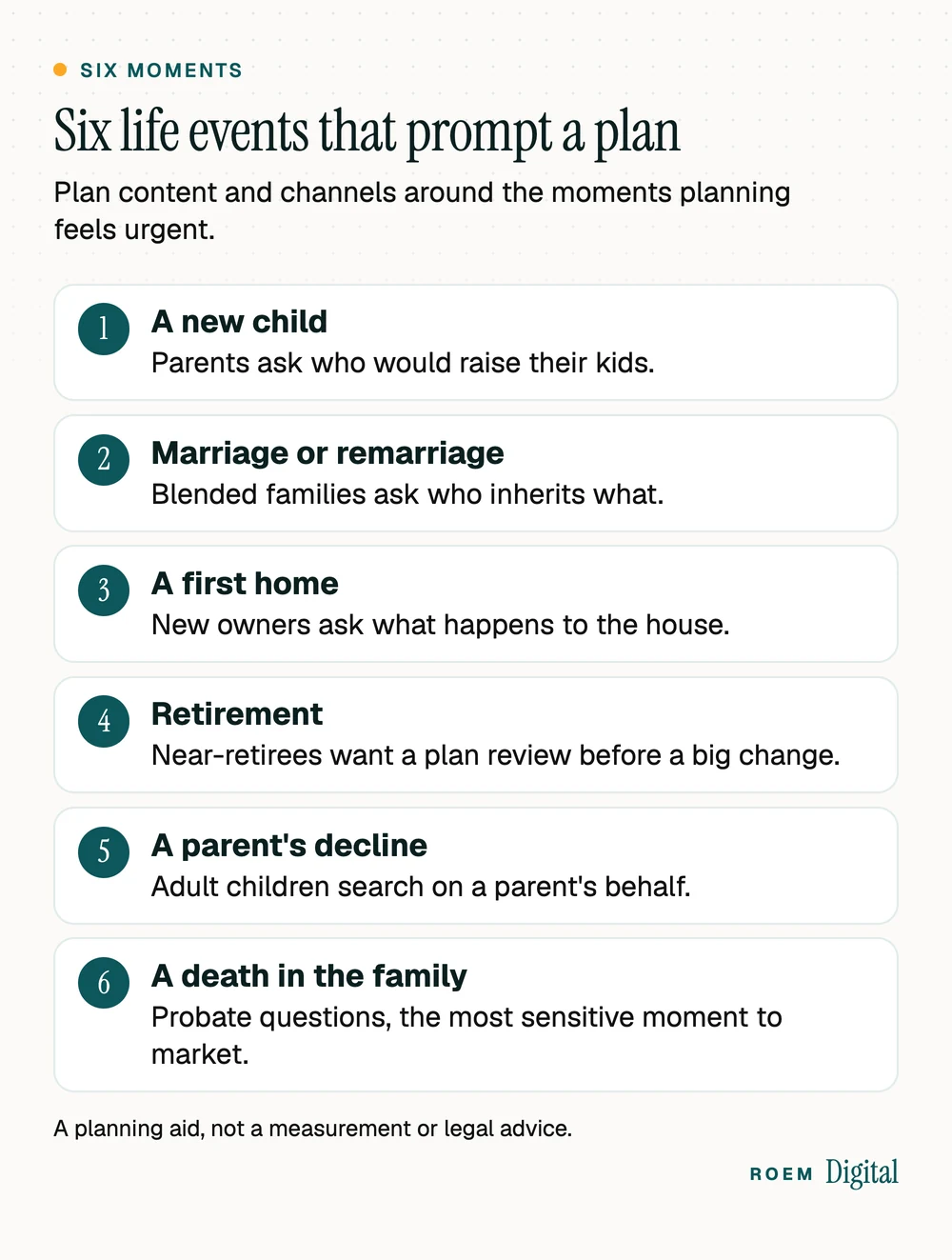
- New parents and blended families search with specific questions. Answer each on its own page, reviewed by a lawyer.
- Near-retirees respond to education. A seminar or webinar fits here.
- Adult children often call for a parent. Intake should note who is calling and for whom, as our post on the legal intake process explains.
- Families after a death are the most sensitive audience, covered in its own section below.
Measure estate planning attorney marketing by life event. Give each page and each seminar its own tracked form or number, ask "what prompted you to call?" at intake, and compare consultations held, not clicks. Because the decision has no deadline, judge a channel over a longer window than you would for an urgent practice area. When a page or a seminar brings a call, you want to know which life event it was. Our law firm offer sets up call and form tracking before anything else changes.
Estate planning seminar marketing under Florida Bar rules
Seminars are a classic for estate planning, and the Bar has addressed them directly. The Florida Bar's Handbook on Lawyer Advertising and Solicitation, effective December 10, 2025, says the advertising rules apply to announcements of and invitations to seminars sponsored by a lawyer or law firm. Announcements sent by mail, email or social media must also meet Rule 4-7.18(b), which includes marking them as advertisements.
Four practical consequences:
- Decide who is hosting. The handbook says an announcement may be exempt if the lawyer has no financial responsibility for the seminar and no control over its ads, such as a guest speaker at an event someone else sponsors and finances, decided case by case.
- If it's your seminar, you pay for it. Rule 4-7.17(c) says a lawyer may not permit a nonlawyer to pay all or part of the cost of the lawyer's advertisement, so a co-hosting advisor can't cover part of your promotion.
- Let attendees come to you. Rule 4-7.18(a) bars soliciting a prospective client in person when you have no family or prior professional relationship, and its comment says speaking at a seminar doesn't create one. Don't approach attendees about their matters afterward. Offer a sign-up form for a consultation instead.
- Check any free perk. Rule 4-7.15(d) bars offering consumers an economic incentive to hire you or review your advertising, while allowing free legal information. The rules we read don't mention meals, so ask the Bar before a free dinner becomes the draw.
For the logistics of running the event itself, our event marketing ideas cover promotion, reminders and follow-up. Follow-up emails to people who asked for them are a different case from cold invitations, and our guide to email marketing for small business covers the federal email rules.
Flat fees for wills and trusts: what an ad must disclose
Many estate planning firms price documents as flat fees, and price is one of the first things a reader wants. Rule 4-7.14(a)(7) treats fee information in an ad as potentially misleading unless the ad discloses all fees and expenses the client might owe. A lawyer who advertises a specific fee or range must honor it for at least 90 days unless the ad states a shorter period, or one year for yellow pages and other media published annually or less often.
The rule's comment uses estate planning as its example: a lawyer who charges a flat fee to create and execute a will, with no other costs, may state only the flat fee. If the client will owe costs, the ad must say so. The rules are in the Bar's Chapter 4, dated October 22, 2026.
| Ad line | Status | Why |
|---|---|---|
| "Simple will: one flat fee" with the price, when the client owes nothing else | Allowed | Rule 4-7.14(a)(7) and its comment: may stand alone if there are no other costs, and must be honored at least 90 days |
| "Trust package" with the price, when filing or recording costs apply | Allowed with the costs disclosed | Rule 4-7.14(a)(7): disclose all fees and expenses the client might owe |
| "We help protect your family's assets" | Generally allowed | Rule 4-7.13 comment: describes the process, not a result |
| "Avoid probate, guaranteed" | Not allowed | Rule 4-7.13(b)(1): a guaranty of a specific result |
| "Board certified estate planning lawyer" | Not as worded | Rule 4-7.14(a)(4) and comment: name the actual certified area, such as wills, trusts and estates, and The Florida Bar as the certifying organization |
Wills, trusts and estates and elder law both appear on The Florida Bar's list of board certification areas, and certification belongs to the individual lawyer, never the firm. Rule 4-7.16 also lists a fee for an initial consultation and a fee schedule as presumptively valid content, subject to the same disclosure rules.
A pricing page also helps the right people call. Our guide to website copywriting covers how to write one plainly.
Referral partners: accountants, advisors and the line on payment
Referral partners are the quietest channel in estate planning attorney marketing. Accountants, financial advisors and elder care professionals meet your future clients before you do. Two Florida rules shape those relationships. Rule 4-7.17(b) says a lawyer may not give anything of value to a person for recommending the lawyer's services, beyond paying for permitted advertising and the usual charges of a referral service, directory or qualifying provider. And Rule 4-7.11(c) applies the advertising rules to communications made to referral sources, so a newsletter to local accountants is lawyer advertising.
Two lower-risk channels come straight from the rules. A communication mailed only to existing clients, former clients or other lawyers is exempt from filing under Rule 4-7.20(d), though the content rules still apply, which suits check-in letters to past clients. And the handbook says Florida Bar consumer information pamphlets stamped with a lawyer's exempt contact information, placed in a business lobby where pickup is strictly voluntary, are exempt from filing. Keep your listings consistent so referrals can find you, as our Google Business Profile checklist explains.
Probate marketing after a death: the most sensitive moment
Probate is where estate planning attorney marketing needs the most restraint. Families who need probate help are grieving, and the rules reflect it. Rule 4-7.18(b)(1)(F) bars written solicitation when you know or should know a person's physical, emotional or mental state makes it unlikely they'd use reasonable judgment in hiring a lawyer. Mail prompted by a specific occurrence must disclose how you learned about it and must not reveal the legal problem on the envelope, under Rule 4-7.18(b)(2)(G) and (H). If a death followed an accident, the 30-day wait in Rule 4-7.18(b)(1)(A) may apply. Ask the Bar before any letter goes out.
Search ads raise a separate question. Google's relationship hardships policy lists bereavement products or services as an example of a sensitive interest category that can't use advertiser-curated audiences such as Customer Match or your data segments. Check whether your probate ads fall in it before you build remarketing lists, and read our post on retargeting ads for the wider limits. A calm probate page that answers the first questions, found through search when the family is ready, fits the moment better than a follow-up ad. Track the calls it brings, as our guide to call tracking for a small business explains.
When to call the Bar's ethics hotline or an ethics lawyer
This article is general marketing information, not legal advice. The rules quoted come from the version dated October 22, 2026, and the handbook from December 10, 2025. Talk to The Florida Bar or a professional responsibility lawyer before you:
- Co-host a seminar with an advisor, insurer or any other business.
- Offer a meal, gift or anything else free to seminar attendees.
- Advertise a flat fee, a package price or a free consultation.
- Mail families after a death, or anyone who hasn't asked to hear from you.
Members in good standing can call the Bar's Ethics Hotline at 800-235-8619 for an oral advisory opinion about their own contemplated conduct. The Bar notes those opinions aren't binding. The firm makes the final call on every claim. For the marketing side, start with our free audit.
Frequently asked questions
What is estate planning attorney marketing?
It's how a firm that drafts wills, trusts and powers of attorney gets chosen by people who know they should plan but haven't. It works best when it meets people at life events such as a new child, retirement or a parent's decline, through search, seminars, referral partners and clear pricing.
Do Florida Bar advertising rules apply to estate planning seminars?
Yes. The Florida Bar's 2025 advertising handbook says the rules apply to announcements of and invitations to seminars a lawyer or firm sponsors. Invitations sent by mail, email or social media must also meet Rule 4-7.18(b). A guest speaker at an event someone else sponsors and finances may be exempt, decided case by case.
Can a financial advisor pay for a seminar I co-host?
No. Florida's Rule 4-7.17(c) says a lawyer may not permit a nonlawyer to pay all or part of the cost of the lawyer's advertisement. If the advisor's firm sponsors, pays for and controls the event and you only speak, the handbook says the rules may not apply, case by case. Ask the Bar before splitting any costs.
Can an estate planning lawyer advertise a flat fee for a will?
Yes, with disclosure. The comment to Florida's Rule 4-7.14 says a flat fee for a will with no other costs may be stated alone, but any costs the client owes must be disclosed. An advertised fee must be honored for at least 90 days unless the ad states a shorter period.
Can I offer a free dinner at an estate planning seminar?
Ask the Bar first. The rules we read don't mention meals. Rule 4-7.15(d) bars offering consumers an economic incentive to hire a lawyer or review the lawyer's advertising, while allowing free legal information, and the handbook treats a gift card for liking a firm's Facebook page as a prohibited incentive.
How do estate planning attorneys get referrals from accountants and advisors?
By being useful to them: clear explanations they can pass on, quick answers and good care of the clients they send. In Florida you can't give anything of value for a recommendation under Rule 4-7.17(b), and communications to referral sources about your services count as lawyer advertising under Rule 4-7.11(c).