
Short answer: Branding for small business means choosing one name, one promise, one look and one voice, then using them the same way everywhere customers meet you. Write a one-line promise, check your name against trademark records, build a small kit, then fix the places customers see most, starting with your Google listing and website.
What branding for a small business actually includes
Branding is how customers recognize your business and what they expect from it. Branding for small business comes down to four decisions used the same way everywhere: your name, your promise, your look and your voice.
A logo is one piece of the look. It isn't the brand. If your truck says one name, your Google listing says another and your invoices still carry last year's colors, customers can't tell they're dealing with the same company, and a new logo won't fix that. In our reading, most small business branding problems are consistency problems.
| Term | What it means | Example for a house painter |
|---|---|---|
| Brand | What customers think and expect when they hear your name | The painter who shows up on time and leaves the house clean |
| Brand identity | The parts you control: name, logo, colors, fonts, photos and voice | A two-color logo, one serif font, real job photos and a plain, friendly voice |
| Branding | The work of choosing those parts and using them the same way everywhere | Matching the van, the website, the yard signs and the Google listing |
This guide is about the order to do that work in. If you already have the pieces and need written rules, our guide to brand guidelines covers what goes in them. If you'd rather hand the whole job to someone, that's what our brand, web and e-commerce service does.
How to brand your business: start with one sentence, not a logo
Inconsistent brands usually share one root cause: nobody wrote down what the business is. So the logo designer guessed, the sign shop guessed, and whoever set up the Facebook page guessed differently. Before anyone draws anything, write one sentence that answers four questions:
- Who you serve: homeowners, dog owners, families choosing a school.
- What you do, in the words customers use when they call.
- Where you work, if you're a local business.
- Why you over the next option: the one thing you'd want a customer to repeat to a friend.
A cabinet painter's version might read: We refinish kitchen cabinets for homeowners who want a new look without buying new cabinets. It isn't a slogan. It's a filter. Every color, photo, headline and post either supports that sentence or doesn't belong.
Then decide how that sentence sounds when you say it out loud. Our guide to finding your brand voice turns that into a one-page sheet, and our website copywriting guide shows how the same sentence becomes a homepage headline.
Check your business name before you design anything around it
Your name is the most expensive part of a brand to change later, because it's printed on everything. Check it before anyone designs a logo around it.
The U.S. Patent and Trademark Office's page on what a trademark is defines one as any word, phrase, symbol or design that identifies your goods or services. It makes two points owners often miss. You become a trademark owner as soon as you use the mark with your goods or services, but those rights are limited to the area where you do business. And you're not required to register, though a federal registration gives you nationwide rights.
The USPTO also explains why to search for similar trademarks before you apply: one of the most common reasons applications are rejected is a mark too similar to one already registered. A thorough clearance search covers the federal database, state trademark databases and the internet.
Registration is a separate question. The Small Business Administration's guide to launching your business lists four ways to register a business name: an entity name with your state, a trademark, a DBA (doing business as) name and a domain name. Each one is legally independent, so owning the domain doesn't give you the trademark, and the SBA notes that registering a DBA doesn't provide legal protection by itself.
This is general marketing information, not legal advice. When you're ready to pick a web address to match, our guide to choosing a domain name walks through it.
Build a small brand identity kit you can keep consistent
Big companies keep thick brand books. A small business needs a kit small enough that the people making things for you actually use it:
- A logo set: the full logo, a square version for profile photos and a one-color version for embroidery and stamps, saved as vector files and PNGs.
- Two or three colors, each with its exact code, so the van wrap and the website match.
- One or two fonts: one for headings, one for everything else.
- Photo rules: real photos of your work, team and place, and when stock photos are allowed.
- Voice lines: your one-sentence promise, a two-sentence description for directories and the words you always use for your services.
- One shared folder your business owns, and one person who answers questions about it.

Keep the master files in an account your business controls, not only in a designer's inbox. Our guide to who owns your marketing accounts explains why that matters the day you change vendors. The exact codes, sizes and rules for each item belong in your written brand guidelines.
Brand touchpoints: fix the places customers see most first
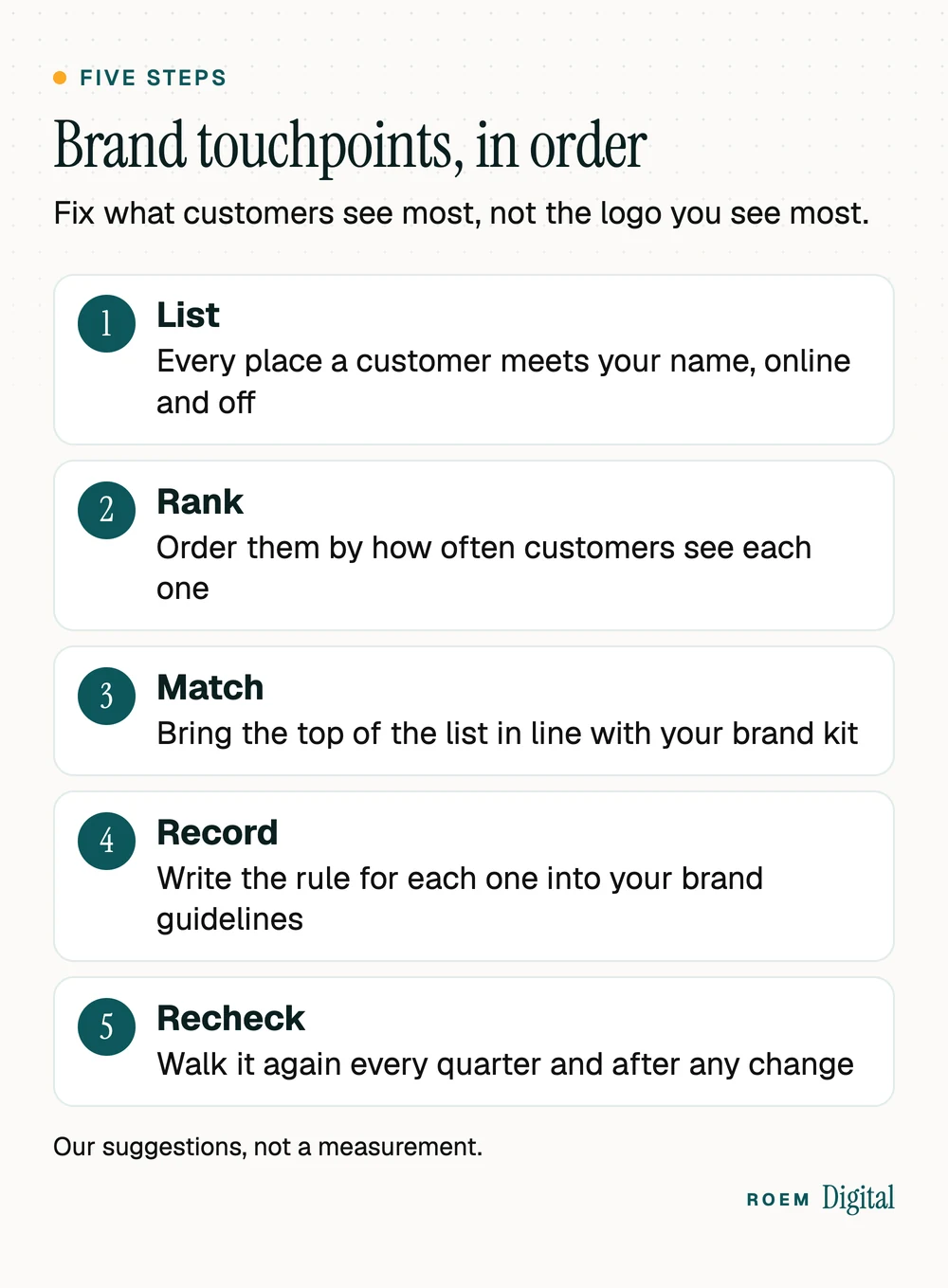
Here's where small business branding usually goes wrong. Owners start with the logo, the piece they look at most, instead of the places customers look at most. The fix is to work through those places in order:
- List every place a customer meets your name: search results, your Google listing, the website, the phone greeting, the van, signs, shirts, quotes, invoices, emails, social profiles and directories.
- Rank them by how often a typical customer sees each one, before and after they buy.
- Match the top of the list to your kit first: the exact name, logo, colors and one-line promise.
- Record the rule for each one in your guidelines, so the next vendor gets it right without asking.
- Recheck the list every quarter, and any time you change a phone number, address or name.
For most local service businesses, the top spots are digital: the Google listing and the website on a phone. The van and the yard signs matter, but they can wait for the next reorder. A Google listing under an old name confuses everyone who searches for you until it's fixed. If your website is the touchpoint that's furthest off, our guide to homepage design is a good next read.
Brand consistency across Google and directory listings
Listings are where inconsistency shows most, because customers and search engines compare them against each other. Google's Business Profile guidelines say your name should reflect your real-world business name, as used consistently on your storefront, website and stationery and as known to customers. They also warn that including unnecessary information in the name, such as marketing taglines or service keywords, isn't permitted and could get the profile suspended.
The same guidelines say that to include special characters or legal terms in the name, you must provide real-world proof, such as signage, business cards or invoices, that consistently shows them. That turns branding into evidence: when your sign, invoice and website all spell the name the same way, your listing has something to stand on. Check these first:
| Where it drifts | What it usually looks like | Fix |
|---|---|---|
| Google Business Profile | A tagline, a city or service keywords added to the name | Use the real-world name only, spelled the way your sign spells it |
| Directories and map apps | An old name, number or address copied years ago | Correct the source records first, then the big listing sites |
| Social profiles | A nickname, an old logo or a different description | The same name, square logo and two-sentence description everywhere |
| Invoices and email signatures | Last year's colors or a personal email address | Update the template once and share it with everyone who sends them |
| Vehicles, signs and shirts | The old logo, kept because it still works | Replace on the next reorder and note it in your guidelines |
Our guide to business listings and citations covers which directories matter, and our post on data aggregators explains how one wrong record spreads to dozens of sites. Going through your Google Business Profile field by field is usually the fastest first fix.
Small business branding on a small budget: what to pay for first
Spend where a mistake is expensive to undo or where customers look most. Our usual order, which is a judgment call rather than a rule:
- The name check, because changing a name later touches everything you own.
- Professional logo files in vector format, so every sign and shirt prints cleanly.
- Your website and Google listing, the places customers see before they call.
- Real photos of your work, team and place, which stock photos can't replace.
- Vehicles, signs and printed pieces, replaced as they wear out or get reordered.
Skip the work that looks like branding but doesn't change what customers see: a mission statement nobody reads, a fourth font, or a new logo when the old one is fine and the real problem is that nobody uses it the same way twice. If the name or look truly has to change, follow a rebranding checklist so your reviews and rankings come with you.
“Working with ROEM Digital has been a great experience for my business. From developing our website to guiding us through a complete rebrand, they took the time to understand my vision and bring everything together in a way that truly represents the business. What I’ve appreciated most is their continued support. They’ve remained responsive, reliable, and willing to help whenever needed. That level of commitment goes a long way, especially as a business owner. I’d highly recommend ROEM Digital to anyone looking to establish or strengthen their brand. Having a great website is important, but having the right people behind it makes all the difference.”
When to bring in a trademark attorney, a designer or an agency
- A trademark attorney before you invest in a name (signs, a vehicle wrap, a federal application), or when someone starts using a name close to yours. The USPTO's page on why to register a trademark notes that its search database only covers federal filings, so businesses with common law rights may not show up in it.
- A designer when your logo doesn't hold up small, in one color or on a phone screen.
- An agency when the drift is everywhere at once: the website, the listings, the ads and the voice all need to match, and nobody has time to go through the list.
That last case is where we help. We're a small senior team based in Davenport, Florida, working with clients across Central Florida and nationwide. Our brand and web work covers identity and hand-built websites, our SEO and content work keeps the listings that carry your name in line, and you own every file and account. Browse our portfolio for the brands we've built, including Haven Noire's case study.
Frequently asked questions
How much does branding cost for a small business?
It depends on how much you need: a name check, logo files, a small brand kit, a website and updated listings are separate pieces of work. Ask any designer or agency for a written scope that lists each deliverable, who owns the files afterward and what happens if you need changes later.
What is the difference between a brand and a logo?
A logo is a symbol. A brand is what customers think and expect when they hear your name. The logo is one part of your brand identity, alongside your name, colors, fonts, photos and voice. A great logo used inconsistently does less for a small business than a plain one used the same way everywhere.
Do I need to trademark my small business name?
Registration isn't required. The USPTO says you gain trademark rights by using a name as a brand for your goods or services, but those rights cover only your area, while federal registration gives nationwide rights. Search for similar marks before you invest in a name, and ask a trademark attorney about your situation. This is general information.
How do I keep my brand consistent across Google and social media?
Use the exact same business name, square logo and short description on every profile. Match your Google Business Profile name to the name on your sign, website and invoices, without added keywords. Then list every profile in one document and check it every quarter, or whenever your phone number, address or name changes.
Can I brand my small business myself?
Yes, for most of it. You can write the one-line promise, check the name, pick colors and fonts, and fix your listings yourself. Most owners hire help for vector logo files, a website and photography, because those are hard to redo cheaply. Keep every file in an account your business owns.
How often should a small business update its branding?
Change it only when something real changes: new services, a new name, a move or a look that no longer fits your customers. Otherwise, keep the same identity and spend the effort on consistency. Check your touchpoints every quarter and fix drift as you find it, rather than redesigning every few years.