Short answer: Data aggregators collect business names, addresses and phone numbers and pass them to search engines, maps, navigation systems and directories. When an old number reappears after you fixed it, an aggregator may still be sending it. Correct your website and Google profile first, then Data Axle, which is free for up to 10 listings.
What data aggregators are, and why wrong listings keep coming back
Data aggregators are companies that collect business details such as name, address, phone and hours, check them, and pass them on to search engines, map apps, navigation systems and directories. They're the wholesale layer behind many of the listings customers see.
You don't have to take our word for how much they matter. The platforms say so themselves. Bing's guide to managing your listing says it uses many internal and external data sources to build each listing, that other sources can take priority when their information is fresher, and that core details only publish if they align with trusted external data. Apple's guide to location attributes says place cards display content based on data from the Apple ecosystem and related partners.
That's why fixing a listing by hand can feel like bailing water. You correct the phone number on one directory, and a few weeks later the old one is back because a data feed upstream still carries it. Our guide to business listings and citations covers which listings to claim. This post covers the supply chain that fills them.
The wrong detail usually started somewhere ordinary: a phone number you dropped years ago, the business that rented your unit before you, the legal name on your state filing instead of the name on your sign, or a listing a former vendor created. Once one of those reached a data feed, it could be copied onward long after you forgot it existed.
Signs a data aggregator is behind your wrong listings
Not every wrong listing is an aggregator problem. Some are typos on a single site. These patterns point upstream:
| What you see | Likely cause | Check first |
|---|---|---|
| The same old address on many small directories at once | One feed carrying the old record | Your Data Axle record, then the Data from line on Bing |
| A fixed detail comes back weeks later | A fresher outside source overwriting your edit | Whether your website and Google profile match the fix |
| Listings you never created | Directories built from aggregator data | Claim them, then correct the source |
| Your legal name instead of your trading name | Records taken from business filings | Which name your website and signage use |
| A location you closed still shows as open | Nobody marked it closed upstream | Mark it closed on each platform rather than deleting it |
If you see two or more of these, start upstream. If it's one typo on one site, just fix that listing and move on. Either way, our local SEO audit guide shows where listings fit in a full checkup.
The local data aggregators that matter in the US
There are only a handful of networks worth knowing. BrightLocal, a listings tool, describes data aggregators on its Citation Builder page as massive databases, naming Data Axle and Neustar, that send your information to directories, GPS apps and maps at once. Here's what each one says about itself:
| Network | Where its data goes, by its own account | How a small business gets in |
|---|---|---|
| Data Axle | Top search engines and directories, in-car and mobile navigation, virtual assistants and 85% of large public libraries | Free for 1 to 10 listings through Data Axle Local Listings, with unlimited updates |
| Foursquare | Its Places data feeds other apps. Foursquare names Nextdoor and Redfin as users | Search for and claim your business at business.foursquare.com. Foursquare's claim page lists no fee, so confirm the price at checkout |
| TransUnion Digital Business Profile (formerly Neustar Localeze) | More than 80 directories, maps, apps and social platforms, per TransUnion's April 23, 2026 launch announcement | $99 a year per location for 1 to 24 locations, bought from TransUnion, or through listing services such as BrightLocal |
| GPS Network and YP Network | Two more networks on BrightLocal's list of five | BrightLocal submits to each for $30 |
Foursquare's Places product page says Nextdoor uses its data for in-app local business discovery and to simplify verifying and onboarding new businesses. That matters if neighbors find you there, which our guide to Nextdoor for business covers.
Fix wrong listings in the right order
Most cleanup goes wrong because it starts at the end of the chain. Work in this order instead:
- Settle one true version of your name, address, phone, website and hours, and make sure your website and Google Business Profile show exactly that.
- Correct the data aggregators so they pass that version along, starting with the free one.
- Claim and fix the listings customers actually see: Bing, Apple Maps, Yelp, Facebook and your industry directory.
- Look again once each platform's update cycle has passed, and note what came back.
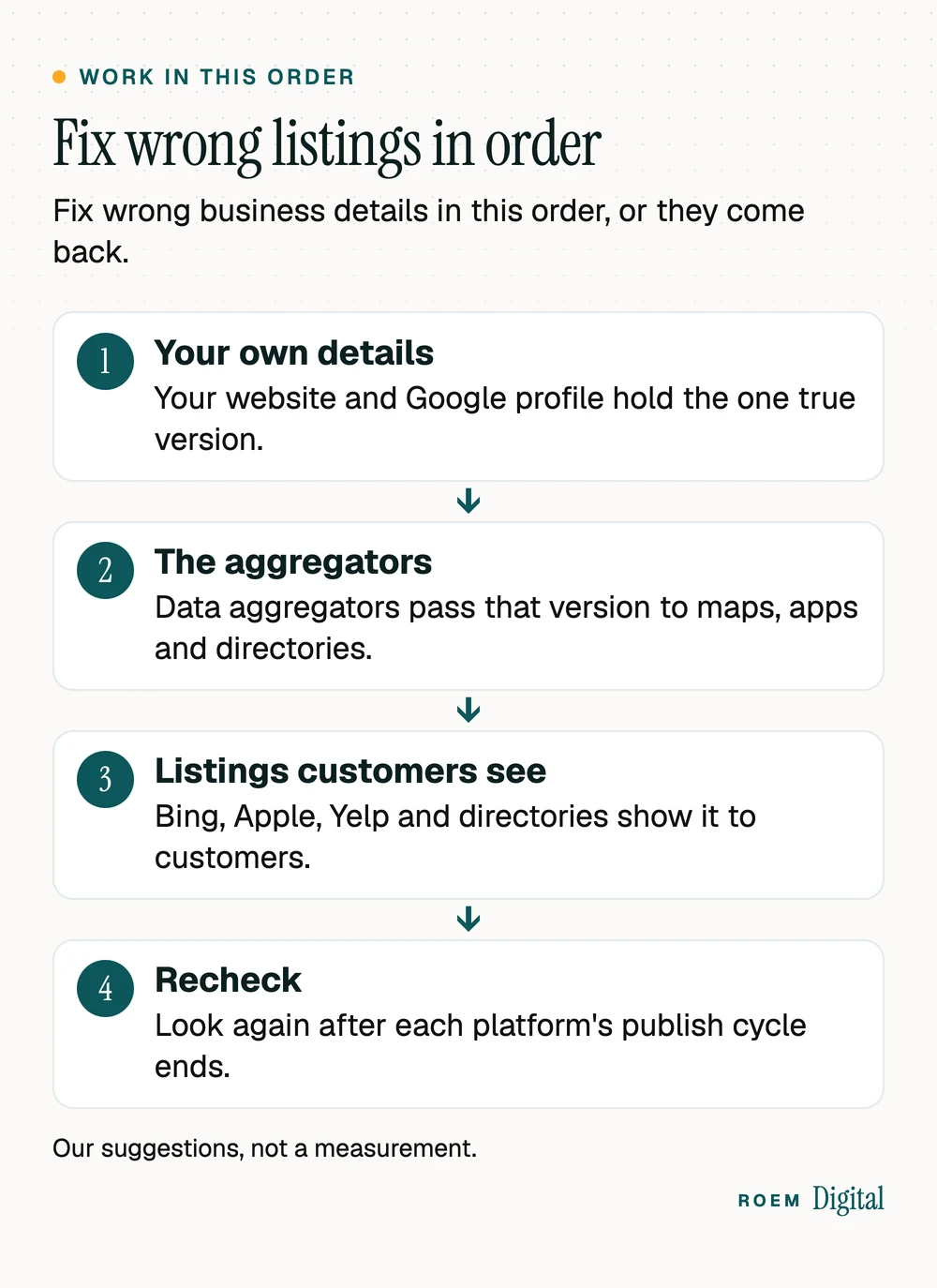
Reverse the order and you waste effort. Fix a directory before the aggregator and the aggregator can overwrite it. Fix the aggregator while your own website still shows the old suite number and you've spread the mistake further. If you need help deciding what the one true version is, our Google Business Profile checklist walks through each field.
Which data aggregator to fix first
For a single-location business, this order gets the most fixed for the least money:
- Data Axle, because it's free. Data Axle's Local Listings page says you search for your listing, make sure it's correct, and it sends the update to its partners, with as many updates as you need and no fee. Data Axle says new listings are checked by people and machines, and that submissions are matched against its database to avoid duplicates.
- Bing and Apple directly. Both say they blend outside data, but both also let you claim and verify. Our guides to Bing Places for Business and Apple Business cover each one.
- Foursquare, especially if you get customers through apps that use its data.
- The paid networks, only if wrong details keep returning after the steps above, or you manage several locations.
Keep your updates honest. Use the business name on your signage, a real address customers can visit or none at all, and the phone number you'll still answer next year. Aggregators exist to spread data widely, which is great for a correct record and painful for a wrong one.
If you work from home and customers never visit, think twice before sending a home address to any network. Once it spreads, it's hard to pull back. Bing lets you hide an address after you add service areas, while Apple's help pages describe no hide option, and our guide to local SEO for service-area businesses covers how to show up without a storefront.
With more than 10 locations, the free route runs out. Data Axle points larger companies to an enterprise service with custom reports on the status of updates, Bing offers grouped listings with bulk verification that its support team reviews in about 5 to 7 business days, and Apple added multi-location editing to Apple Business on October 8, 2026.
What data aggregator submissions cost in 2026
You can do the most important step for free. Buying direct, TransUnion's Digital Business Profile, the former Neustar Localeze, costs $99 a year per location for 1 to 24 locations, and larger companies are sent to sales. Beyond that, BrightLocal publishes its prices plainly, which makes it a useful benchmark. Its Citation Builder page lists:
- Aggregator submissions: five networks (Data Axle, Neustar, Foursquare, GPS Network and YP Network) at $30 each.
- Renewals: optional, at $120 a year for all five, which BrightLocal says helps keep your data from being overwritten by outdated third-party information.
- Manual citations: $3.20 per site, or as low as $2 with bulk credits.
- Timing: some sites can take up to 6 weeks to publish after submission.
- Logins: BrightLocal says it hands over the logins to every listing it creates, and that they stay live if you stop using it.

Whatever service you consider, ask three questions before you pay. Which networks, by name? Who owns the logins? And what happens to your listings if you cancel? Our guide to who owns your marketing accounts explains why the second question matters most.
Keep a listing log so the fix sticks
Wrong details come back quietly. A simple spreadsheet catches them before customers do. Track these columns for every listing:
| Column | Why it matters |
|---|---|
| Platform and URL | So you can find each listing again in seconds |
| Source it shows | Bing lists outside sources in a Data from line at the bottom of each listing |
| What was wrong | Tells you whether the error came from upstream or was typed in by hand |
| Date fixed and date rechecked | Bing publishes changes in about 7 to 12 days, so recheck after that |
| Who holds the login | You, not a former employee or vendor |
Review the log twice a year, and any time you move, change your phone system or rename the business. Moves need extra care on Bing, which asks for a new listing rather than an edited one, as our Bing Places guide explains. Bing says its own listing data can lose priority to fresher sources after six months without an update, so a small, regular edit helps. When a location closes for good, mark it closed rather than deleting it. Bing says a closed listing gradually loses visibility and is removed after about six months, which is slower but cleaner than a listing that vanishes and later reappears from an old feed.
How ROEM handles listing cleanup
Listing cleanup, from your Google profile to Bing, Apple and the data aggregators behind them, is part of our SEO and content service. You own every listing and login. We're a small senior team based in Davenport, Florida, working with businesses across Central Florida and nationwide.
Frequently asked questions
What are data aggregators in local SEO?
Data aggregators are companies that collect business details such as name, address, phone and hours and pass them to search engines, map apps, navigation systems and directories. Because many listings draw on them, a wrong detail at an aggregator can keep reappearing on sites where you already corrected it by hand.
Is Data Axle Local Listings free?
Yes, for small businesses. Data Axle says its Local Listings service is free for 1 to 10 listings, with as many updates as you need and no upgrade required. You search for your business, correct the details, and Data Axle sends the update to its partners. Companies with more than 10 locations are pointed to its enterprise service.
Do I need data aggregators if I have a Google Business Profile?
Usually yes, at least the free step. Google Business Profile controls your Google listing, but Bing, Apple and many directories blend in data from other sources. Correcting your record at Data Axle, and claiming Bing and Apple directly, keeps those other listings from showing details Google no longer has.
Why does my old phone number keep showing up online?
Most often because a source upstream still has it. Bing, for example, says it builds listings from many outside sources and may favor fresher data over yours. Fix your website and Google profile, update the data aggregators, then correct each listing and recheck it after that platform's update cycle.
How long do data aggregator updates take?
It varies by network and by the site receiving the data. Data Axle says it updates existing listings in real time. BrightLocal says some sites can take up to 6 weeks to publish after submission, and Bing says changes on its own platform typically publish in 7 to 12 days in North America.
Should I pay a service to submit to data aggregators?
Only after the free steps. Fix your website, Google profile and Data Axle record first. If wrong details keep returning, or you manage several locations, a paid service can help. Before paying, ask which networks it covers by name, who owns the logins, and what happens to your listings if you cancel.