
Short answer: Brand voice is the steady personality in how your business writes and speaks, while tone shifts with the moment. Find yours in words customers already use, set it on four tone dials, then write a one-page sheet with sample lines for a first hello, a price, a problem and a promotion.
Brand voice vs. tone: one personality, different moods
Brand voice is the steady personality in everything your business writes and says. Tone is how that voice adjusts to the moment: lighter in a holiday post, calmer when a customer is upset. The voice stays put. The tone moves.
The Nielsen Norman Group, a usability research firm, describes tone as how an organization feels about its message. Its article on the four dimensions of tone of voice advises keeping your brand personality consistent while varying the tone to fit the reader's emotional state and the topic.
| Question | Brand voice | Tone |
|---|---|---|
| How often does it change? | Rarely, usually only with a rebrand | With every message |
| What sets it? | Who you are and who you serve | The reader's mood and the topic |
| Example | Plain, friendly and straight about price | Upbeat in a promotion, calm in a complaint reply |
| Where is it written down? | Your voice sheet and brand guidelines | Sample lines for each kind of moment |
If your posts, emails and website sound like three different companies, the problem is voice. If the voice is fine but a cheerful auto-reply lands badly on an upset customer, the problem is tone. This guide covers both, and it's the writing half of our brand and web work. For logos, colors and fonts, see our guide to brand guidelines.
What tone of voice research says: trust beats charm
It's tempting to make a small business sound quirky so it stands out. NN/g's study of how tone of voice affects brand perception tested pairs of nearly identical web pages where only the tone changed, and the results argue for something plainer:
- Trust mattered most. Trustworthiness was a much stronger predictor of whether people would recommend a brand than friendliness. In NN/g's regression, trustworthiness explained 52% of the variability in willingness to recommend, and friendliness added only 8% more.
- Playful can backfire. A jokey car insurance page was rated friendlier than its serious twin but less trustworthy, and people were no more likely to recommend it.
- Conversational helps serious businesses too. A casual but serious bank page was rated both friendlier and more trustworthy than a formal one.
- Humor is a gamble. A funny home security page scored well in the survey, yet three interview participants disliked it, one calling its headlines corny, and NN/g notes that clever headlines often fail to say what is below them.
NN/g's own summary is that casual, conversational and moderately enthusiastic tones performed best across its samples. Our take for a small business, and it's an opinion rather than a finding: sound trustworthy before you try to sound memorable. A plumber, a spa or a school earns more by being clear and calm than clever. Our guide to website copywriting shows what that looks like on a page.
How to find your brand voice in words customers already use
You don't invent a brand voice. You find it, mostly in material you already have:
- Read your best reviews. Copy the phrases customers use about you. If several people say you explain everything, that's a voice trait. Our guide to getting more Google reviews helps if you need more to read.
- Listen to your best phone call. Write down how you explain your service to a new customer, word for word. Most owners sound better on the phone than on their website.
- Pull your best emails and texts. The replies that earned a thank-you are your voice at its best.
- List the words you use and the words you avoid. Free estimate or complimentary consultation? Crew or associates? Pick one and keep it everywhere.
- Choose a handful of tone words and a few anti-tone words. NN/g suggests keeping tone words to a handful so the rules stay easy to follow, and naming anti-tone words for what to avoid, such as authoritative without being pedantic.
Skip adjectives like friendly and professional. Every business claims both, so they don't help anyone write the next email. A sentence you'd really say to a customer does.
How to write a one-page brand voice sheet
Here's how we get a voice onto one page. The four dials come from NN/g's research. The four moments are our own pick: they're the messages small businesses most often get wrong.
Set the four dials
- Formal or casual: "We apologize for the inconvenience" versus "Sorry about that."
- Serious or funny: whether you attempt humor at all.
- Respectful or irreverent: how you treat the subject (not the reader).
- Matter-of-fact or enthusiastic: how much excitement shows.
Write a sample line for four moments
- The first hello: your homepage headline, the phone greeting, the first reply to a new lead.
- The price or the quote: how you talk about cost without dodging it.
- The problem: a late arrival, a mistake, a one-star review.
- The promotion: a holiday offer, a new service, a seasonal post.
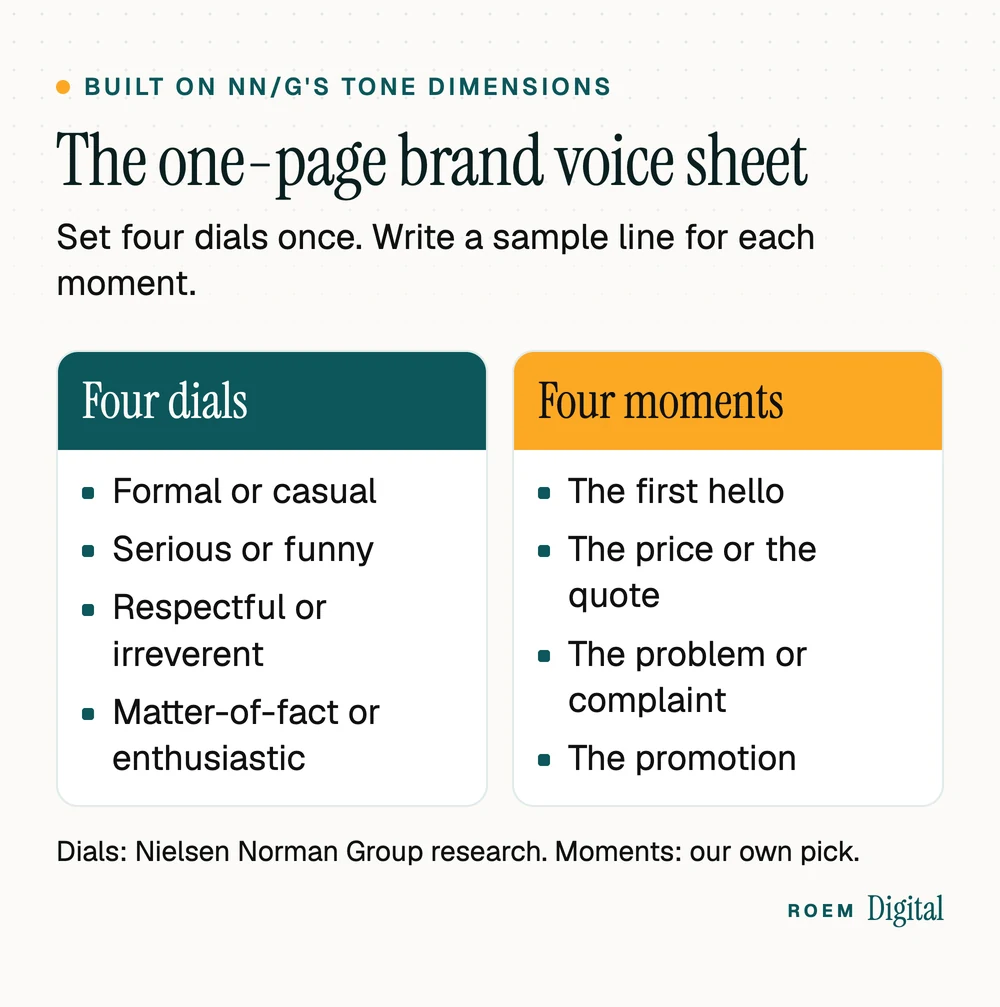
Add your words-we-use list and you have the whole sheet. Give it to anyone who writes for you, including AI tools: paste it in before you ask for a draft. Our guide to AI for small business marketing shows where that step fits.
Brand voice examples from small business sites we built
Big-brand examples are easy to find and hard to copy. Here are lines from live sites we built for small businesses and a church, with our reading of where each sits on the dials. Each voice fits its own customers. None of them is the one right voice.
| Business | A line from its website | Our read on the dials |
|---|---|---|
| Witter Tech, tech repair and IT support | "I diagnose the problem, give you a price before anything starts, and fix it right, then walk you through exactly what happened, in plain English." | Casual, serious, respectful, matter-of-fact. First person, so the reader hears the owner speaking. |
| GK Painting, cabinet refinishing in Madison, WI | "If your cabinets are solid and the layout works, you don't need new ones." | Casual and serious, and honest enough to tell a reader they may not need the bigger job. |
| Dorshorst Auctions, Deerfield, WI | A homepage button that reads "When is the next sale?" | Matter-of-fact. The button is the bidder's own question instead of a menu label. |
| Solid Rock Community Church, Kissimmee | "Welcome. Come as you are." | Casual, respectful and warm. Four words that answer a first-time visitor's worry. |
| Haven Noire, boutique spa, Kissimmee | "Boutique facials & corrective skincare crafted for melanin-rich and all skin types, in downtown Kissimmee." | More formal and polished, to match a premium service. |

Notice what they share: none of them tries to be funny, and every line tells the reader something specific. You can see more of them in our portfolio.
Plain language keeps any brand voice readable
A voice is a personality, not a license for long sentences. Selections of the federal government's plain language guidance, first published on PlainLanguage.gov, now live on Digital.gov. Its guide to writing for understanding says content is easier to understand with shorter words, short sections, active voice and present tense.
| Instead of | Write |
|---|---|
| Your appointment has been confirmed by our team. | We've confirmed your appointment. |
| We conduct a thorough inspection of the property. | We inspect the whole house. |
| Pricing will be provided upon completion of an assessment. | We'll give you a price before we start. |
| Customers are encouraged to reach out with any questions. | Questions? Call or text us. |
Two of the guide's rules do most of the work. Active voice "makes it clear who should do what," and hidden verbs (a verb turned into a noun, as in conduct an analysis instead of analyze) make writing longer and weaker. Run every sample line on your sheet through both. The same habits make short copy easier too, from meta descriptions to button labels.
Use one voice on your website, reviews, social posts and Spanish pages
NN/g's tone article points out that tone of voice applies to every touchpoint, including email and the in-store experience, not only the website. For a small business, these are the places it drifts most:
- Review replies. The tone should calm, not argue. Our guide to responding to negative reviews has examples.
- Social posts written in a hurry, or by a different person each week. Our guide to social media for local service businesses covers what to post.
- Automated messages: booking confirmations, reminders and the auto-reply after someone fills out your contact page form. Reread them once a year.
- Spanish pages. A bilingual site should sound like the same business in both languages, not a word-for-word copy of the English. Our post on bilingual websites covers planning both versions.
- AI drafts, which drift toward generic phrasing unless you hand them your voice sheet first.
When to write in your own voice, and when to get help
Write the first draft of your voice sheet yourself. Nobody knows how you talk to customers better than you do. Bring in help when:
- Your website, posts and emails are written by different people and it shows.
- You're rewriting a whole website and want the voice settled before the first page.
- You're adding a second language and want both to sound like one business, which our bilingual marketing service plans as one.
We're a small senior team based in Davenport, Florida, working with clients across Central Florida and nationwide. On our team, Emily leads strategy, design and content. See our brand and web service for how the words and the look come together on the sites we build.
“I can’t say enough great things about ROEM Digital! They did an amazing job bringing my vision to life with our beautiful website and continue to do a great job with our marketing and ads. They really take the time to understand my brand and what I’m trying to accomplish. They’re creative, professional, responsive, and genuinely care about helping my business grow. As a business owner, having a team I can trust means so much. I’m truly grateful for their work and highly recommend them!”
Frequently asked questions
What is a brand voice?
A brand voice is the consistent personality in how a business writes and speaks: its word choices, sentence length, level of formality and attitude. It stays the same across your website, emails, social posts and phone calls, so customers recognize you even when your logo isn't in view.
What is the difference between brand voice and tone?
Voice is who you are, and it rarely changes. Tone is how that voice adjusts to a situation: warmer when someone is upset, lighter in a holiday post, more direct on a price page. Nielsen Norman Group advises keeping the personality consistent while varying tone to fit the reader's emotional state and the topic.
How do I find my brand voice as a small business owner?
Start with what you already have. Read your best reviews, your best customer emails and a phone call where you explained your service well. Note the phrases that repeat, the words you always use and the ones you avoid, then write one sample line for a greeting, a price, a problem and a promotion.
What are the four dimensions of tone of voice?
Nielsen Norman Group describes four: formal versus casual, serious versus funny, respectful versus irreverent, and matter-of-fact versus enthusiastic. Each is a spectrum. Marking where your business sits on all four gives you a simple tone profile you can check every page, post and email against.
Should a small business use humor in its brand voice?
Use it carefully. In Nielsen Norman Group's tests, a playful car insurance page seemed friendlier but less trustworthy. A funny home security page did well in the survey, yet some interview participants disliked it, one calling it corny. If you handle people's homes, health, money or children, clear and calm usually serves you better than clever.
How do I keep AI writing tools in my brand voice?
Give the tool your voice sheet and two or three paragraphs you wrote yourself before asking for a draft. Ask for a few short options, then edit for truth and voice: read it aloud, check every fact and cut anything you wouldn't say to a customer in person.