
Short answer: Local SEO vs national SEO comes down to where the sale happens. If customers visit you or you go to them, lead with local SEO: your Google Business Profile, reviews and service pages. If you sell online across the country, lead with national SEO, and if you have both a shop and an online store, run both.
Local SEO vs national SEO: the short answer
Local SEO helps nearby customers find you in Google's map results and local listings. National SEO helps your website rank for searches from anywhere in the country, in the regular web results. The right one depends on where your customers buy from you.
You'll also see this framed as local SEO vs organic SEO. It's the same split seen from the results page: local SEO aims at the map results, and organic SEO aims at the regular web results, where national SEO competes and where local pages can rank too.
So the useful question in local SEO vs national SEO isn't how big you want to grow. It's where the sale happens: at your address, at the customer's door, or at an online checkout. A painter who works within driving distance gains little from ranking in another state. An online store that ships everywhere can't use the map results at all, because Google's Business Profile rules leave out online-only businesses.
Most of the work is the same SEO either way: pages that answer what people search, a site Google can crawl, and links you earned. What changes is where you aim it. Both kinds are part of our SEO and content service. This guide covers how Google ranks local results, what "near me" searches really depend on, a decision table by business type, and how to run both when you have a shop and an online store.
How Google ranks local results, and how national results differ
Google names its local ranking factors on its help page for improving your local ranking. When we read it on November 25, 2026, the summary line said local results are "mainly based on relevance, distance, and popularity," and the three headings under it were:
- Relevance: how well a Business Profile matches what someone is searching for.
- Distance: how far each business is from the person searching. If they don't share where they are, Google uses what it knows about their location.
- Prominence: how well known a business is, based partly on how many websites link to it and how many reviews it has.
The summary says popularity where the heading says prominence, so read them as one factor. The same page says there's no way to request or pay for a better local ranking. Our guide on how to rank higher on Google Maps works through each factor in detail.
National results draw on a wider set of signals. Google's page on how Search ranks results lists the words of your query, the relevance and usability of pages, the expertise of sources, and your location and settings. It also says its systems recognize that many queries have a local intent, so a search for "pizza" brings up nearby businesses that deliver. Google decides whether a search is local. You decide which searches your business can actually win.
| What differs | Local results | National results |
|---|---|---|
| What gets ranked | Your Google Business Profile, backed by your website | The pages of your website |
| Who can appear | Businesses that meet customers in person, at an address or at the customer's location | Any site Google can crawl and index |
| What the searcher's location does | Weighs how far each business is from the person searching | Shapes results when the search has a local meaning |
| Main levers | Category, complete details, reviews and links | Pages that answer the search, links from other sites, pages that work well on phones |
| Who you compete with | Businesses near the person searching | Every site targeting the same search, from any state |
What "near me" searches depend on, and why page copy isn't it
When someone types "dentist near me" or "painter near me," the words describe the searcher, not your website. Google already measures distance from the person searching. Google's page says local results are mainly based on relevance, distance and popularity, and that it keeps the algorithm details confidential. Two of those factors come down to your profile and your address: relevance, which rests on a Business Profile that's verified, complete and in the right category, and distance from the person searching. Prominence is the part you can keep building over time, through reviews, links and mentions.
That's why stuffing "near me" into pages is wasted effort, and some versions of it carry real risk:
- Keywords in the business name. Google's guidelines for representing your business say unnecessary information in the name isn't permitted and could result in the suspension of your Business Profile.
- Lists of towns on a page. Google's spam policies give "blocks of text that list cities and regions that a web page is trying to rank for" as an example of keyword stuffing.
- A near copy of the same page for every town. The same policies define doorway abuse as pages created to rank for specific, similar search queries, and give pages targeted at specific regions or cities that funnel users to one page as an example.
- A virtual office to look closer to a bigger city. Google's guidelines say a rented mailing address you don't operate from isn't eligible for a Business Profile.
What works instead: the right primary category, accurate hours, a real address or an honest service area, a steady flow of reviews, and a page on your site for each main service. If you go to your customers, our guide to local SEO for service-area businesses shows how to write area pages that help. Our Google Business Profile checklist covers every field, and a local SEO audit shows what to fix first on a profile you already have.

Which kind of SEO your business needs: a decision table
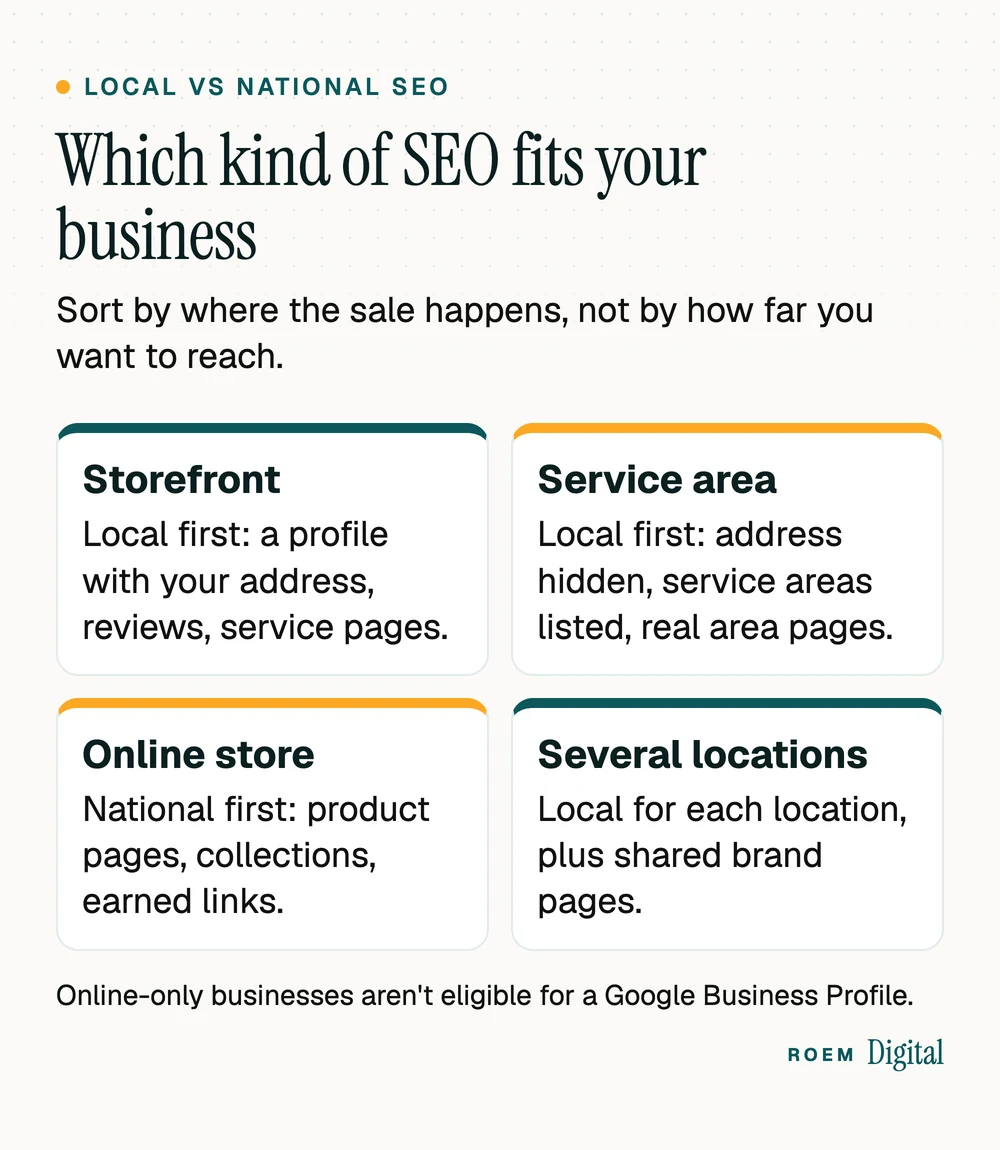
Sort your business by where the customer meets you, and local SEO vs national SEO mostly decides itself. Google's profile rules already draw most of the lines. Its eligibility guidelines say a business must make in-person contact with customers during its stated hours to qualify for a Business Profile, and they list brands, organizations, artists and other online-only businesses as ineligible.
| Your business | Where the sale happens | SEO to lead with |
|---|---|---|
| Storefront: a shop, studio, clinic or restaurant | At your address | Local: a Business Profile showing your address, reviews, and a page for each service |
| Service-area business, such as a painter, plumber or cleaner | At the customer's home or job site | Local: a profile with the address hidden and service areas listed, plus area pages with real local detail |
| Online store that ships nationwide | At an online checkout | National: product and collection pages, technical health and earned links, with no Business Profile |
| Several locations | At each location | Local for each location: one profile and one page per location, plus shared brand and service pages not tied to one town |
| A shop or studio that also sells online | In both places | Local for the shop and national for the products, covered in the next section |
Google's service-area help shapes the second row: a service-area business can have only one profile for the whole area it serves, and that area shouldn't stretch more than about 2 hours of driving time from where the business is based. Its guidelines shape the fourth: a business with separate locations, each with its own service area and staff, can have one profile per location, and every location of a chain should use the same name, and the same category where they offer the same service.
A few of the businesses we've built websites for show the spread: Haven Noire, a boutique spa brand in the Kissimmee area, GK Painting, a cabinet refinishing and painting company in Madison, Wisconsin, and Little Milo's Closet, a custom pet-apparel store that sells online. Same discipline, three different starting points. More are on our clients page.
Running both: a local business that also sells online
This is where local SEO vs national SEO stops being a choice, and where mixed businesses tend to stall. The shop and the online store pull in different directions, and the answer is to give each side its own job. In order:
- Keep one profile for the place. Google's guidelines say there should only be one profile per business, and the online side doesn't qualify for its own. Point the profile's website link at your shop or services page, not a product page.
- Split the website by intent. Service, location and contact pages target your town. Product and collection pages target the product, wherever the shopper is. Our Shopify SEO guide covers the store side.
- List products where both kinds of shopper look. Google's Merchant Center help on free listings says eligible products may show on Search, Images, the Shopping tab and the products module on Business Profile. Google's local ranking page adds that retail stores in eligible countries or regions can show in-store products on their profile.
- Earn links for each side. Local mentions, like a chamber listing or a neighborhood blog, suit the shop. Links from sites in your product's niche suit the store. Buy neither: Google's spam policies count buying links for ranking as link spam.
- Measure the two separately. Count calls and direction requests from the profile apart from online orders from search. Tag the profile's website link with UTM parameters so analytics can tell those visits apart.
Haven Noire is one example of the mix: the site we built for the spa includes online booking and a shop. When one side grows faster than the other, our guide to the numbers every marketing report should show helps you compare them fairly.

Local SEO agency or national SEO agency: what to ask
When you compare a local SEO agency with a national SEO agency, the label matters less than the fit. Plenty of agencies do both. Google's own page on hiring an SEO suggests asking about their experience in your industry and in your country or city, and what results they expect to see, in what timeframe. For the local or national decision, add these:
- Which results will you target for us: the map results, the regular results, or both, and why?
- How will you set up our Business Profile if we serve customers at their address, or sell only online?
- How will you keep town pages useful rather than near copies of each other?
- How will you count leads from the profile separately from online sales?
Walk away from anyone who promises a guaranteed spot in the map pack: Google's hiring page says no one can guarantee a #1 ranking on Google, and its local ranking page says there's no way to request or pay for a better local ranking. The same goes for anyone who suggests a virtual office address to look closer to a bigger city. For the wider list, see our questions to ask a marketing agency. Once you've chosen, our guide to monthly SEO services explains what each month should deliver, and how much SEO costs covers what drives the price.
We're a small senior team based in Davenport, Florida, working with businesses across Central Florida and nationwide, and our SEO and content service covers both: Google Business Profile optimization for the map results, and content and technical SEO for the pages that rank anywhere. Your Business Profile, Search Console and analytics stay in your name, whoever does the work.
“Moving to a new city and rebuilding your business isn’t an easy task, so we turned to Robert to help with our business website, run our social media and help get our Google biz profile back up and running! He was extremely thorough and even came on a job site to take photos for our website. What he built in a short amount of time is amazing. We would absolutely NOT have been able to do any of this without him. We would highly recommend for any website building and project management!!”
Frequently asked questions
What is the difference between local SEO and national SEO?
Local SEO helps nearby customers find you in Google's map results and local listings, using your Business Profile, reviews and location pages. National SEO helps your website rank for searches from anywhere in the country, using content, technical health and links. The right one depends on where your customers buy from you.
Can an online-only business do local SEO?
Not in the map results. Google's eligibility guidelines say a business must make in-person contact with customers during its stated hours to qualify for a Business Profile, and they list online-only businesses as ineligible. An online store can still rank in the regular results and show products through Merchant Center free listings.
Should I add near me to my website pages?
No. The words near me describe where the searcher is, and Google already uses their location. Google bases local results mainly on relevance, distance and popularity, so put the effort into a complete, verified Business Profile. Its spam policies treat blocks of city names as keyword stuffing, and keywords added to a business name can get a profile suspended.
Is national SEO harder than local SEO?
The field is usually wider, because every site targeting the same search competes with you, wherever it's based. Local results weigh distance from the person searching, so fewer businesses compete for each search. But difficulty depends on the search and the market, and a crowded city service can be as hard as a national product.
Do I need a different agency for local and national SEO?
Not necessarily. Many agencies do both, and the core work overlaps: useful pages, a sound site and earned links. Ask which results they would target for your business, how they would set up your Business Profile, and what experience they have in your industry and market, which Google itself suggests asking.
How does SEO work for a business with several locations?
Each location that serves customers in person can have its own Business Profile. Google asks chains to use the same name everywhere, and the same category where locations offer the same service. Give each location its own page with real local details, and keep shared brand and service pages free of any one town's name, so they don't compete.