
Short answer: The questions to ask a marketing agency cover who does the work, how leads are tracked, who owns the accounts, what results they can prove and how you leave. For every answer, ask to see the proof: a sample report, an access screen, a case study, a name.
Questions to ask a marketing agency before you sign: the short list
These are the questions to ask before hiring a marketing agency, whether it's for a website, ads, SEO or all of it. Ask them in the first or second call. Each has a plain answer, and a good agency gives it without hedging:
- Who, by name, will do the work on my account each month?
- Who will I talk to, and how quickly do you usually reply?
- How will you track calls, forms and bookings, and can I see a sample report?
- Will my business own the website, domain, ad accounts and analytics?
- Can you show me results for a business like mine, and can I talk to that client?
- What will you do in the first 90 days, step by step?
- How do you get reviews and links, and is anything ever bought?
- What can't you promise?
- What does the contract cover, what costs extra, and how do I leave?
- What do you need from me to make this work?
The rest of this guide covers what a good answer sounds like, the proof to ask for, and the questions a good agency asks you. If you're hiring for local SEO around Kissimmee, our guide to choosing a Kissimmee SEO company adds questions specific to that market. If you're still working out how to choose a marketing agency in the first place, start with our guide to choosing a digital marketing agency in Orlando.
The show-me test: ask for proof, not promises
Every agency says it tracks leads, puts clients first and gets results. Words cost nothing on a sales call. Our editorial rule for vetting is simple: for every claim, ask to see something. Google's own guide to hiring an SEO opens its list of interview questions the same way, with "Can you show me examples of your previous work and share some success stories?"
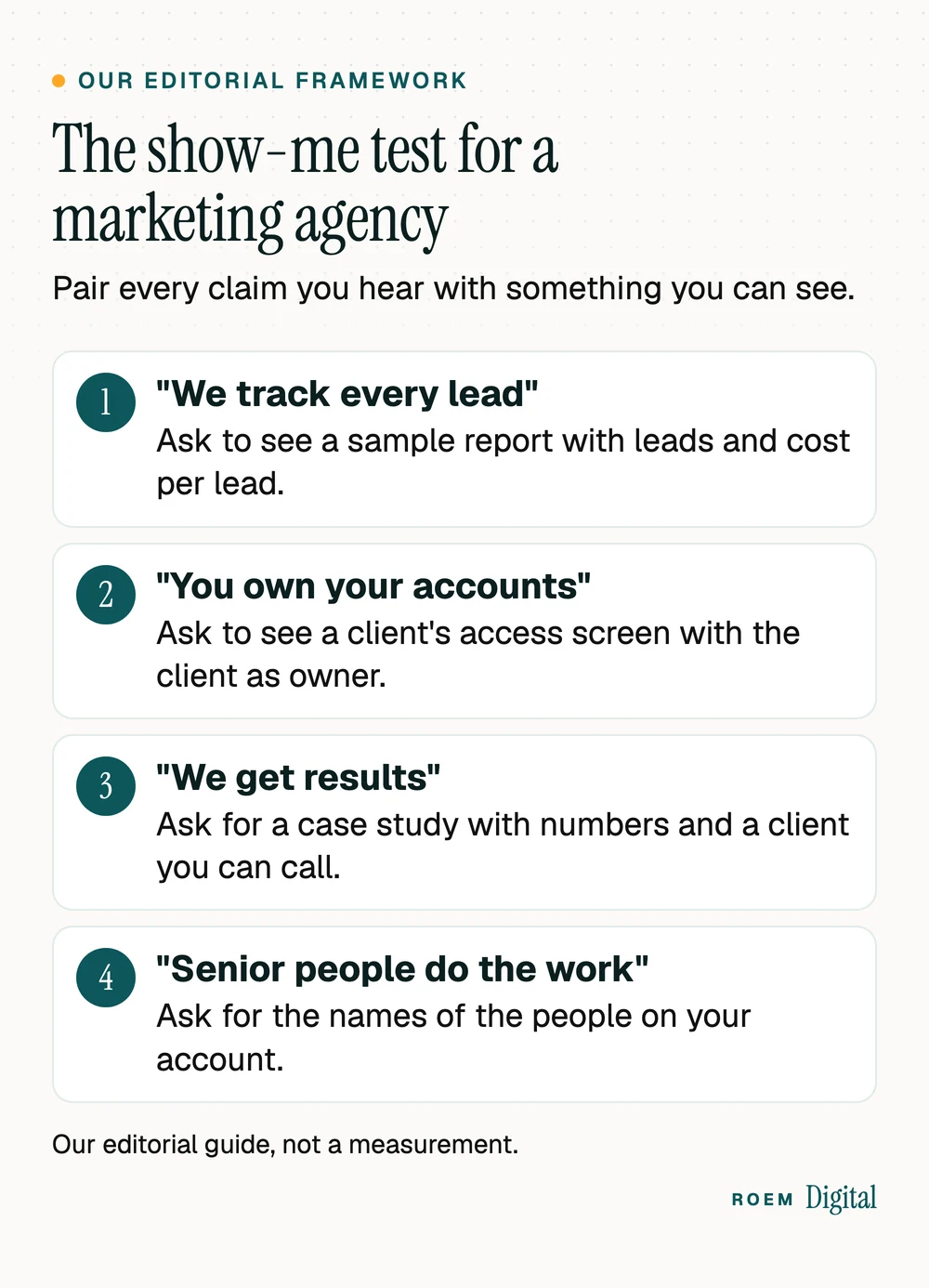
A good agency can show most of this on a screen share, with other clients' names hidden where they should be. If the answer to "can you show me?" is another slide, keep asking. It's a fair test to run on us too: our free audit is a low-stakes way to see how we work before any proposal.
Questions about the people and how you'll work together
- Who does the work? A good answer names people and roles. Find out whether the person selling is the person doing, or whether your account passes to someone you haven't met.
- Who's my contact, and how fast do you reply? Look for a named person and a normal reply time, in writing.
- How will you tell me what you changed? Google suggests asking an SEO whether they'll share all the changes they make to your site, with detailed information about their recommendations and the reasoning behind them. The same standard works for ads and social.
- Have you worked with businesses like mine, and in my area? Google lists both questions. Relevant experience helps, but it doesn't replace the other answers.
- How and how often do we meet? Video, phone or in person, and when you'll review results together.

If you're still deciding whether you need an agency at all, read our comparison of a marketing agency vs in-house hire first.
Questions about results, tracking and reporting
- How will you track leads? A good answer covers calls, form fills and bookings, set up before ads start. Ask for a sample report and check that it shows leads and cost per lead, not only clicks and impressions. Our guide to the five numbers every marketing report should show tells you what to look for.
- Can I talk to a client? Google's guide suggests checking references by asking past clients whether the work was useful, the provider was easy to work with, and the results were positive.
- What results do you expect, and when? Google lists this question too. A good answer gives ranges and conditions, and explains how they'll measure success.
- What can't you promise? The honest answer includes rankings. Google's guide is blunt: no one can guarantee a #1 ranking on Google, and if someone guarantees their changes will give you first place in search results, it says to find someone else.
- Will you ever buy reviews, followers or views? The answer must be no. The Federal Trade Commission's final rule on fake reviews, announced August 14, 2024, prohibits the sale or purchase of fake reviews and testimonials, and bars anyone from knowingly selling or buying fake indicators of social media influence for a commercial purpose, such as followers or views generated by a bot or hijacked account.
Google's policy on fake engagement adds its own line for reviews: businesses may not offer incentives such as discounts in exchange for a review, or ask only happy customers. This is general marketing information, not legal advice.
Questions about accounts, access and leaving
- Who will own the website, domain, Google Business Profile, ad accounts and analytics? Your business, with the agency added as a user. Our guide to who owns your website and ad accounts shows how to check each one.
- What access do you need for an audit? Less than you might think. Google advises that if an SEO offers an audit, you grant read access to Search Console only at that stage, not write access.
- Can I take the website with me if we part ways? Ask where it's hosted, who holds the logins, and whether the site, content and domain leave with you. Our comparison of custom-built sites and website builders explains why the platform matters here.
- What does the contract cover? Minimum term, notice period, what's included each month, what costs extra, and who pays the ad spend. If the contract runs a year or more or renews on its own, have your attorney read it before you sign.
- What happens on the way out? A good agency describes the handover plainly: reports and files delivered, its access removed, nothing held back.
Google's guide also reminds owners that you are responsible for the actions of any companies you hire. Keeping ownership and visibility on your side is how you stay in a position to know what those actions are.
The questions a good agency asks you
Your questions to ask a marketing agency are only half the interview. Google's guide says a good SEO should be interested in you and your business, and should ask what makes your business unique, who your competitors are and how your customers find you. If an agency pitches a package before asking anything, take note. Expect questions like these:
- What is a new customer worth to you, and how many more can you handle?
- Where do your best customers come from today?
- What have you tried before, and what happened?
- Who answers the phone and the forms, and how quickly?
- What's your budget, and what would success look like in six months?
Have your answers ready before the first call. Our guides to a one-page marketing plan and a marketing budget for small business cover most of them, and they make every agency's proposal easier to compare.
Compare agencies' answers side by side
Talk to two or three agencies, ask each one the same questions from the short list above, and fill in the same sheet right after each call while the details are fresh. When proposals arrive, ask each one to split the price into ad spend, monthly management and one-off work, so you compare like with like rather than headline numbers.
| Area | Strong answer | Weak answer |
|---|---|---|
| Who does the work | Named people, and you've met them | "Our team", with no names |
| Tracking | Calls, forms and bookings, set up before ads, with a sample report shown | Clicks, impressions and rankings only |
| Ownership | Your business owns every account, and the agency is a user | The agency holds the accounts "for convenience" |
| Proof | A case study with numbers and a client you can call | Logos and short quotes only |
| Promises | Ranges, conditions and what they can't control | Guaranteed rankings or a guaranteed number of leads |
| Leaving | A clear notice period and a written handover | Vague terms, or no answer |
Some answers end the conversation on their own. Google's guide warns about agencies that email you out of the blue, claim a special relationship with Google, or are secretive and won't clearly explain what they intend to do. Pressure to sign the same day belongs on that list too. Our guide to choosing a digital marketing agency in Orlando covers more red flags.
How we answer these questions
It's only fair to answer our own list. We're a small senior team based in Davenport, Florida, with no hand-offs to juniors. Emily leads strategy, design and content, and Robert handles builds, ads, tracking and optimization. We meet by video by default, and in person across Central Florida on request.
- Tracking: calls, forms and bookings are tracked before any ad spend starts.
- Ownership: clients own their domain, website, ad accounts and analytics.
- Websites: hand-built, not templated, and every old URL gets a permanent redirect in a rebuild.
- Proof: our Haven Noire case study shows 2.7x clients and 7x monthly revenue in 13 months for a boutique spa brand in the Kissimmee area. We hold a 5.0 Google rating and have profiles on Clutch and The Manifest.
- Promises: we don't promise rankings, leads or revenue.
- Price: we don't publish prices. Every plan starts with the free audit, and the quote comes after.
“ROEM Digital Company listens, cares about your vision, and makes communication easy. They deliver beautiful, professional results and are a pleasure to work with. Highly recommend!”
Frequently asked questions
What should I ask a marketing agency before hiring them?
Ask who will do the work by name, how they track calls, forms and bookings, whether your business will own every account, what results they can show for a business like yours, what they will do in the first 90 days, what they can't promise, and how you leave if it doesn't work.
How do I compare marketing agencies for a small business?
Talk to two or three agencies, ask each the same questions and score the answers on one sheet. Favor the one that names the people doing the work, shows you a sample report with leads, puts your business on every account as owner and can connect you with a client.
What are the red flags when hiring a marketing agency?
Guaranteed rankings or leads, agencies that keep your accounts in their name, reports with clicks but no leads, no named people or references, cold emails out of the blue, claims of a special relationship with Google, and pressure to sign the same day. Any one of these is reason to slow down.
Can a marketing agency guarantee results?
Not honestly for rankings. Google's guide to hiring an SEO says no one can guarantee a top ranking on Google and advises finding someone else if they promise first place. A good agency explains realistic ranges, what it controls and how it will measure progress instead.
Should my marketing agency own my ad accounts?
No. Your business should own the ad accounts, analytics, website, domain and Google Business Profile, with the agency added as a user. That way your history and data stay with you if you change agencies, and removing their access takes a few clicks.
How many marketing agencies should I talk to before choosing?
Two or three is usually enough to compare answers without losing weeks to meetings. Ask each the same questions, ask each to show you the proof, and write the answers down right after each call so you compare like for like instead of relying on memory.