
Short answer: For most small businesses, the marketing agency vs in-house question isn't either-or. Keep the work only you can do, rent specialist skills you need part of the time, and hire once there's a full-time week of daily work. Whoever does it, your business should own every account.
Marketing agency vs in-house: the short answer for a small business
Hire an employee when there's a full week of marketing work to do, every week. Until then, an agency or a specialist usually covers more skills for less fixed cost, and a mix of both often works best.
That's our editorial view, and it comes from how marketing work breaks down. A small business needs a little of a lot: a website that converts, a Google Business Profile, reviews, ads, tracking, social posts and photos. Few single hires do all of it well, and few small businesses have a full-time week of any one of them. Start from the actions in your one-page marketing plan, because they tell you how much work there actually is.
What an in-house marketing hire costs, in BLS numbers
The U.S. Bureau of Labor Statistics publishes national pay data for marketing roles in its Occupational Outlook Handbook:
- Marketing managers: a median annual wage of $166,790 in May 2025, according to the BLS profile of advertising, promotions and marketing managers. The lowest 10 percent earned less than $90,260. BLS says these managers typically need work experience in a related marketing, advertising, promotions or sales job, so this is the cost of an experienced lead.
- Market research analysts and marketing specialists: a median annual wage of $78,760 in May 2025, the figure the BLS market research analysts profile gives for that combined group. In our view, a small business's first marketing hire usually sits closer to this group than to a manager.
A median is the middle of a national range, so pay for your exact role and area can differ. Salary is also only part of the cost. In June 2026, benefits made up 30.0 percent of what private employers spent on employee compensation, according to the BLS Employer Costs for Employee Compensation release. Then add the costs that never show up on payroll:
- Software and tools the role needs to do the job.
- Training, because ad platforms and search keep changing their rules and features.
- Recruiting, plus the months before a new hire really knows your customers.
- Your own time managing the work and judging whether it's good.
- Cover for vacations, sick days and the day the person moves on.
Put the full figure into your marketing budget before you compare it with any agency quote. Comparing a salary with an agency's monthly fee, without the rest, flatters the hire.
What an agency costs you besides the fee
An agency isn't free of hidden costs either. Before you hire a marketing agency or an employee, price in these on the agency side:
- Your time for approvals, feedback and a monthly review. Less than managing a person, but not zero.
- Keeping them informed. New services, price changes and a slow week only reach an agency if you tell them.
- The contract terms: minimum length, notice period, what's included and what costs extra.
- Ad spend, which is paid to the platform on top of any management fee.
In-house marketing vs agency, side by side
Here's how the marketing agency vs in-house choice compares on the things that matter most to a small business owner:
| What matters | In-house hire | Agency |
|---|---|---|
| Cost structure | Fixed: salary and benefits every month, busy or slow | A fee or project price that's easier to change as needs change |
| Range of skills | One person's strengths, plus what they can learn | Several people with different specialties |
| Knowledge of your business | Deep, and it grows every day | Built through you, and kept current only if you share news |
| Speed to start | Recruiting and onboarding come first | Can start once access and goals are agreed |
| Availability | On site, on your schedule | Shared across clients, on agreed response times |
| Continuity | Know-how can leave with the person | Depends on documentation and on who owns the accounts |
| Management | You manage the person | You manage the results and the relationship |
One difference rarely makes the comparison charts: where judgment comes from. A single hire learns from your business alone, while an agency sees what works across several businesses at once. That cuts both ways, with wider pattern-spotting on one side and deeper time inside your business on the other.
Neither column wins everywhere, which is why a mix often makes sense. A freelancer is a third option, usually strongest for one skill such as design or a website build. If you lean toward an agency, take our list of questions to ask a marketing agency into every first call.
Keep, rent or hire: split the work instead of picking a side
Our framework for this decision sorts tasks, not people. List every marketing task your business needs in a typical month, then put each one in a bucket:
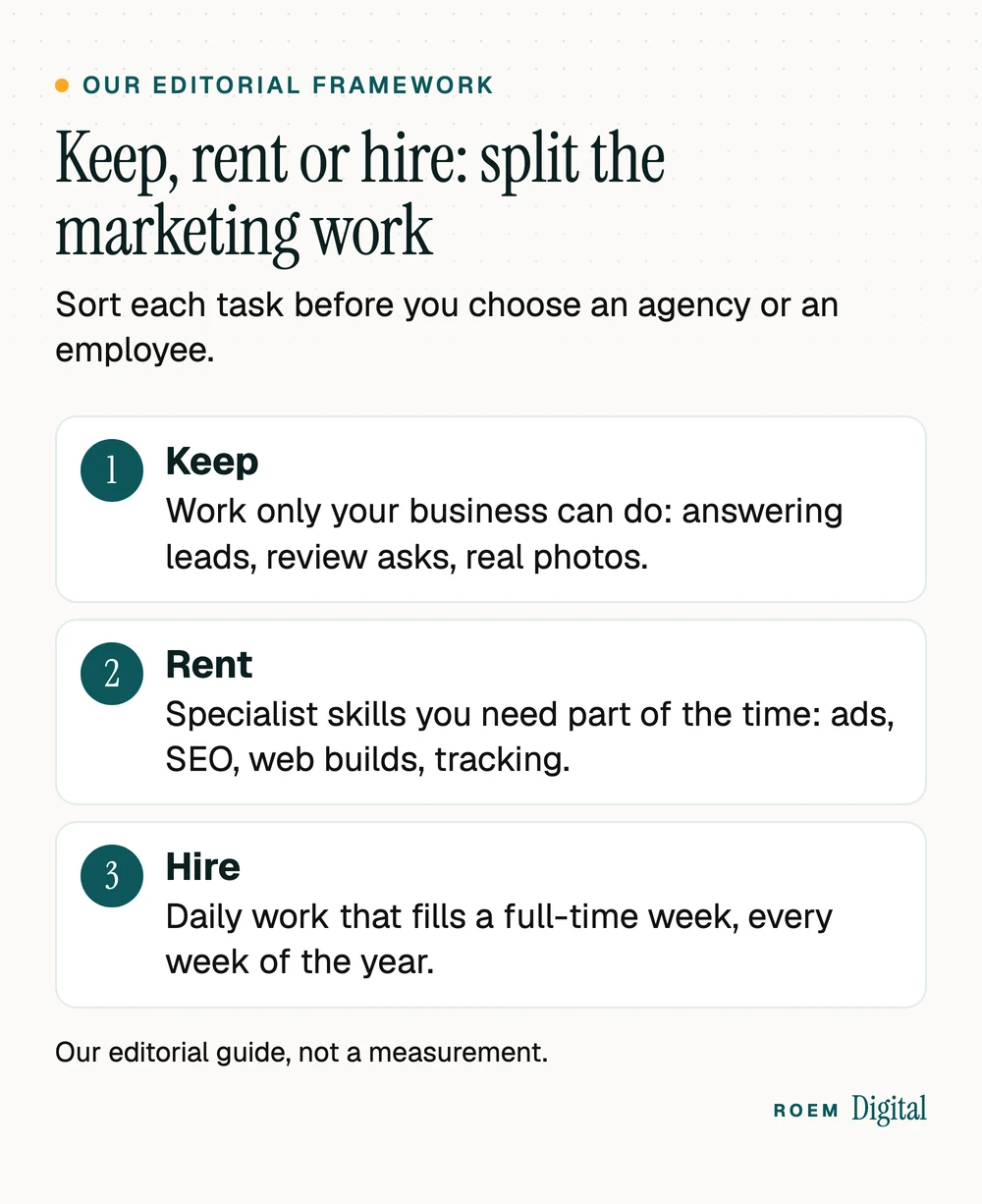
- Keep what only your business can do well: answering leads quickly, asking every customer for a review, taking real photos of your work, and knowing which customers matter most. No agency or new hire should own these. Our guide to speed to lead covers the first one.
- Rent the specialist skills you need part of the time: running ads, technical SEO, a website build, tracking setup, brand design. A full-time salary for a few days of specialist work a month rarely adds up.
- Hire when one kind of work fills a full-time week, every week: daily posting and replies, a steady content calendar, coordinating events, or managing several outside partners.
In our view, the usual answer is all three: the owner keeps the customer-facing work, an agency or specialist rents out the technical skills, and a first hire takes the daily work once it's steady. That split also turns the decision into a task list you can price, and tells you exactly what to put in a job description or an agency scope.
Signs you should hire an employee, and signs you should use an agency
Hire in-house when
- There's a full-time week of marketing work, and it stays steady across the year.
- Much of the work happens on site: daily photos, events, walk-in customers, product shoots.
- Every post or ad needs quick internal approval, as it often does in regulated fields.
- Someone on your team has the time and know-how to manage a marketer.

Use an agency or a specialist when
- You need several skills at once: a website, ads, SEO and tracking.
- The work comes in bursts, such as a launch, a rebuild or a busy season.
- Nobody on your team can judge whether the marketing is working.
- You want to start in weeks rather than after a hiring process.
Between the two lists sits a middle path: a part-time hire, a contractor for a few days a week, or an employee paired with an agency. Each lets you test how much daily work really exists before you commit to a full-time salary. If the open question is which channel to fund first, settle that before you hire anyone: our guide to Google Ads vs. SEO helps you choose.
Whoever does the work, your business should own the accounts
This matters most on the day an employee leaves or an agency relationship ends. Your domain, website, Google Business Profile, ad accounts and analytics should be in your business's name, with staff and partners added as users.
The platforms are built for this. Google's guide to Google Ads access levels explains that admin users can give account access and change access levels. It also warns that if an account has only one administrator, you may lose access to your tags if that user becomes unavailable, and suggests adding at least one more. That extra admin should be you.
- You're an owner or admin on every marketing account, not only the person doing the work.
- Everyone has their own login, employees and agencies alike, never a shared password.
- You keep a written list of every account and who has access to it.
- Access comes off the same day someone leaves.
Our guide to who owns your website and ad accounts walks through checking each one, including the domain registrar, which is easy to forget.
Make either choice work in the first 90 days
A new hire and a new agency fail for the same reasons: nobody agreed what success looks like, access was messy, and the owner stopped checking. Set them up the same way:
- Agree on three to five numbers you'll judge by, such as leads by source, cost per lead and customers won. Our guide to the five numbers every marketing report should show has the list.
- Give access as users on accounts your business owns, on day one.
- Hand over what you know: your plan, your best customers, past results, photos, and what you've tried before.
- Write down who does what, using your keep, rent and hire list, so no task belongs to two people or to nobody.
- Hold a monthly review with the numbers on the table.
- Decide at day 90 whether to keep, change or end the arrangement, based on those numbers rather than on how busy everyone looked.
How we work with small business owners
We're a small senior team based in Davenport, Florida, with no hand-offs to juniors. Emily leads strategy, design and content, and Robert handles builds, ads, tracking and optimization. Meetings happen by video by default, and in person across Central Florida on request.
Clients own their domain, website, ad accounts and analytics, and we work inside them as users. Calls, forms and bookings are tracked before any ad spend starts. Some owners want us to run the marketing. Others want a senior partner to think it through with them, which is what our marketing consulting is for.
“Working with ROEM Digital has been a great experience for my business. From developing our website to guiding us through a complete rebrand, they took the time to understand my vision and bring everything together in a way that truly represents the business. What I’ve appreciated most is their continued support. They’ve remained responsive, reliable, and willing to help whenever needed. That level of commitment goes a long way, especially as a business owner. I’d highly recommend ROEM Digital to anyone looking to establish or strengthen their brand. Having a great website is important, but having the right people behind it makes all the difference.”
Frequently asked questions
Is it cheaper to hire a marketing agency or an employee?
It depends on how much work there is. A hire is a fixed cost: salary, benefits, tools, training and your time managing them, every month. An agency fee can change with your needs. Until there's a full-time week of marketing work, renting specialist skills usually costs less than a salary.
When should a small business hire its first marketing employee?
When one kind of marketing work fills a full-time week, every week, and someone on your team can manage it. Daily posting, a steady content calendar and on-site photos or events are common reasons. Specialist work such as ads, SEO or a website build usually stays with an agency or freelancer.
Can I use a marketing agency and an in-house marketer together?
Yes, and for many small businesses it's the best fit. One workable split is an in-house person for daily posting, photos and replies, with an agency for ads, SEO, the website and tracking. Agree in writing who owns which task and which numbers, so nothing falls between the two.
How much does a marketing manager earn?
The Bureau of Labor Statistics reports a median annual wage of $166,790 for marketing managers in May 2025, and $78,760 for market research analysts and marketing specialists. Benefits add more: in June 2026 they were 30.0 percent of private employers' compensation costs, according to BLS. Pay in your area may differ.
What happens to my marketing accounts if my marketer or agency leaves?
Nothing, if your business owns them. Make sure you're an owner or admin on your domain, website, Google Business Profile, ad accounts and analytics, with each person or agency added as a user. Then removing access is a few clicks, and your history and data stay with you.
Should I hire a freelancer instead of an agency?
A freelancer is often a good fit for one skill, such as design, a website build or copywriting. An agency makes more sense when you need several skills working together, such as a website, ads and tracking. Either way, ask who does the work, how results are measured and who owns the accounts.