Short answer: llms.txt is a proposed Markdown file at your website's root that gives AI tools a short map of your key pages. Google Search ignores it, and we found no major AI company saying its systems use the file to rank or cite sites. Publish one if it's easy to keep accurate, but don't expect traffic from it.
What is llms.txt? A table of contents written for AI tools
llms.txt is a plain text file in Markdown, placed at the root of a website (yoursite.com/llms.txt), that summarizes what the site is and links to its most useful pages, so an AI tool can find the right information without reading every page.
It's a proposal, not a standard. Jeremy Howard published it at llmstxt.org on September 3, 2024, and the page shows a second version, last modified August 10, 2026. The proposal says the file is used on demand, when an AI agent needs information while helping someone, which is different from the two files sites already have:
- robots.txt tells automated tools which parts of a site they may access.
- sitemap.xml lists every page you want search engines to find.
- llms.txt offers a short, curated overview with links, small enough to fit in an AI tool's working memory.
Some sites also publish a longer companion, usually called llms-full.txt. It isn't part of the proposal, and sites use it differently: documentation sites often put their full text in it, while ours is a fuller index with a one-line summary of every page. If you want the bigger picture on how AI answers choose sources, start with our AI search optimization guide.
Who reads the file in 2026, according to the companies themselves
Here's what each company's own pages say, checked on November 25, 2026:
| Company or tool | What its own pages say |
|---|---|
| Google Search | Its guide to optimizing for generative AI features says you don't need these files to appear in Google Search, including its AI features, because Google Search doesn't use them. Publishing one will neither harm nor help your visibility or rankings there. |
| Chrome Lighthouse | An experimental Agentic Browsing audit checks for the file. A missing file is marked not applicable, because providing one is optional for now. |
| OpenAI | Its crawler documentation explains robots.txt controls for OAI-SearchBot and GPTBot. It doesn't mention the file as something its bots read. |
| Anthropic | Its crawler help article says its bots honor robots.txt. It doesn't mention the file either. |
So two parts of Google say different things, and both are right for their own product. Search ignores the file. A Chrome testing tool checks for it as part of experimental agent readiness, without scoring you down for skipping it. The proposal's page notes that OpenAI, Anthropic and Google's Gemini publish these files for their own developer documentation (OpenAI's crawler page itself points readers to one), and it says the files are used most heavily for software documentation read by coding agents. That's who the format serves best today.
Other measurements point the same way. Ahrefs, which studied sites that publish the file, reported that of about 38,000 domains with a valid one, 97% received zero requests for it in May 2026. Meanwhile, SEO audit tools have started checking for it: in our own data below, Semrush's site audit asked for the file 140 times. That's a tool's checklist, not Google's ranking system, and our SEO audit checklist explains how to sort audit warnings that matter from noise.
What our own data shows: SEO tools asked for the file, AI bots didn't
We wanted our own numbers, not just statements. Our AI crawler visits dataset counts every request that verified AI and search bots made to 14 small-business websites we build and host, over 30 days from October 20 to November 18, 2026. Our own site, which publishes both files, is one of them.
- No AI company's bot asked for either file. All 161 requests for them came from SEO and speed tools: 140 from Semrush's site audit, 20 from Chrome Lighthouse and 1 from Ahrefs, and some of those tool visits were our own audits.
- Over the same 30 days, OpenAI's search crawler, OAI-SearchBot, reached all 14 websites with 22,841 requests.
In other words, the AI search bots were busy on these sites. They fetched pages, not the summary file. The limits matter: the data counts only verified bots, and only on our websites. It's a small sample, and it measures requests, not whether a file shaped any AI answer. If you publish the file, ask whoever runs your hosting or analytics which visitors request it. If only audit tools show up, you know where its value lies for now.
Does a small business need llms.txt? When to publish it and when to skip it
Publishing the file costs little and, by Google's own account, can't hurt you in Search. The real cost is upkeep. A summary that disagrees with your website, listing an old phone number or a service you dropped, hands AI tools the wrong facts in the tidiest possible form. So here's how we'd decide. It's our judgment, not a measurement:
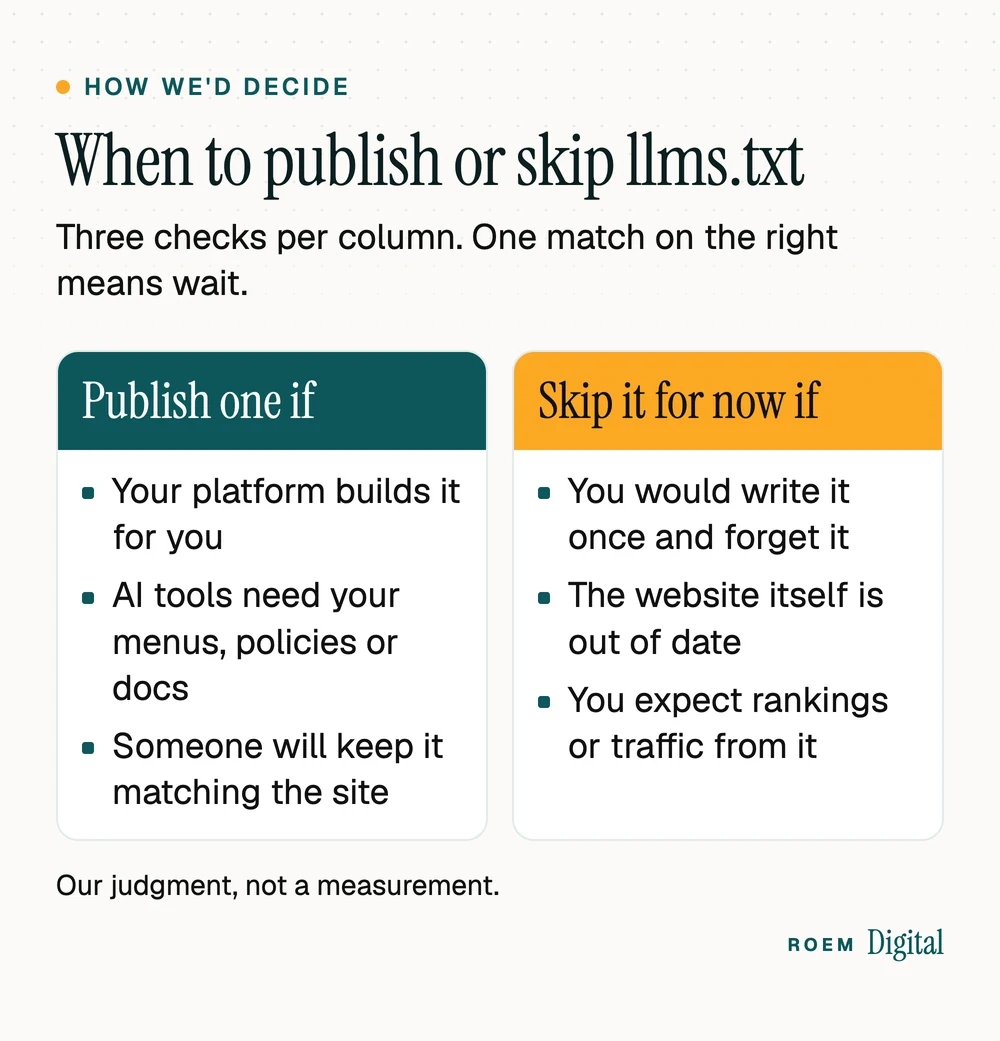
- Publish one if your platform builds it automatically, if AI tools would genuinely need your menus, policies or documentation, and if someone will keep it matching the site.
- Skip it for now if you'd write it once and forget it, if the website itself is out of date, or if you're expecting rankings or traffic from it.
For many owners the first point settles it. The proposal's own page lists Wix, which it says generates a file for every Wix site, and the WordPress plugins Yoast SEO and AIOSEO among the tools that create one. If yours is already on, leave it and check that it says what your site says.
Remember what the file can and can't do. It can only point to pages, so it's never better than the pages behind it. If your service pages are thin or vague, an AI tool that follows the links finds thin, vague pages. Fix the copy first, with help from our guide to website copywriting, and the file becomes a short, accurate index of pages worth reading.
How to write the file for a small business website
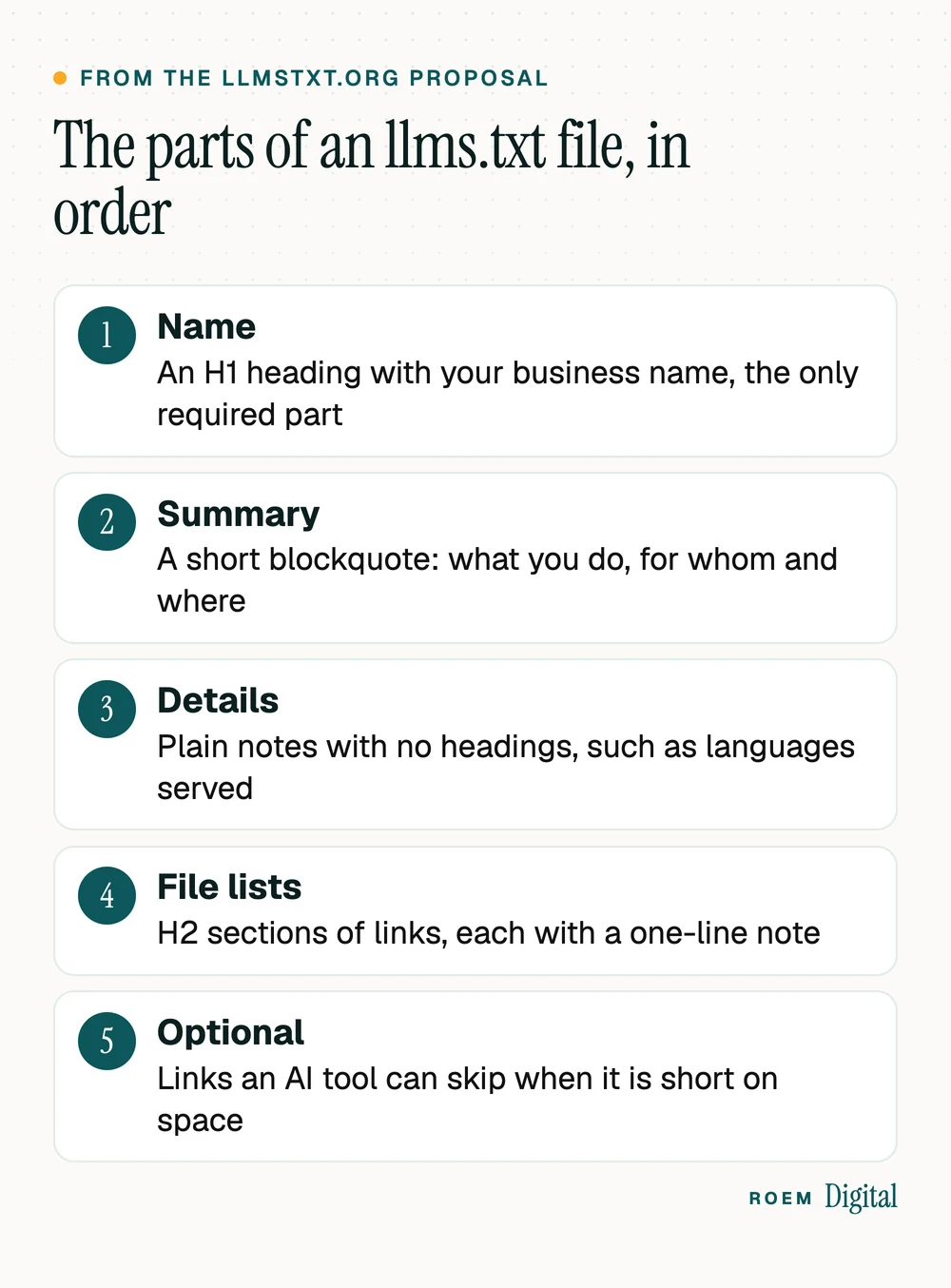
The proposal sets a fixed order. Only the first part is required:
- A heading with your business name, written as a Markdown H1.
- A one-paragraph summary in a Markdown blockquote: what you do, for whom and where.
- Short plain notes, with no headings, for facts an AI tool should keep in mind, such as the languages you serve or how to book.
- Sections of links under H2 headings (Services, About, Policies), each link followed by a one-line note on what the page covers.
- An Optional section for pages an AI tool can skip when it's short on space.
For a service business, the pages worth listing in those link sections are the ones in our must-haves for a service business website:
| Section | What to link |
|---|---|
| Services | One link per service page, each with a one-line note on what's included |
| Areas | Pages for the towns you genuinely serve, if you have them |
| About | Your team, licenses and how long you've been in business |
| Policies | Booking, cancellations, payment and warranty terms |
| Contact | The contact page and your booking link |
| Optional | Blog posts, case studies and other background reading |
Three rules we'd add. Write the same facts your Google Business Profile and website already state, word for word where you can. Leave out anything you wouldn't put on your contact page, so a service-area business never lists a home address. And test it the way the proposal suggests: give an AI assistant only the file and ask it questions about your business. If the answers are wrong, fix the file or the pages it links to. Then place it at the root, next to robots.txt, and recheck it whenever the site changes, the same way our website maintenance checklist handles other routine checks.
What actually helps AI tools find and describe your business
The next problem is the one that matters: getting AI tools to read your site and get your business right. The levers are older and plainer than a new file:
- Let the search bots in. OpenAI says sites that block OAI-SearchBot won't be shown in ChatGPT search answers, though they can still appear as navigational links. Anthropic says blocking Claude-SearchBot may reduce your visibility in its search results. Check your robots.txt before anything else.
- Keep training and search separate. Blocking a training crawler, such as GPTBot or ClaudeBot, is a separate choice from blocking search. On October 30, 2026, Google said it plans to support a shared AI training control in robots.txt, along with other AI providers, in 2027. Anthropic's crawler page says it began recognizing a signal based on the same IETF draft on October 30, 2026, and is rolling it out over time.
- Keep your Google Business Profile complete. Google's generative AI guide says Business Profiles can help your products and services show in both AI responses and other Search results.
- Write pages that answer real questions, with your services, areas, prices you're happy to publish and policies stated plainly.
- Measure it. Search Console's new Generative AI report shows when your pages appear in Google's AI features, as our Google Search Console guide explains.
Google's October 30, 2026 post on the shared training control describes it as a draft proposal built on work at the Internet Engineering Task Force, so watch for Google's support and the final details in 2027. For a wider plan, our guide to AI for small business marketing covers where AI tools fit day to day.
Where ROEM fits
We publish an llms.txt and an llms-full.txt on roemdigital.com, a short table of contents and a fuller index with a one-line summary of every page, and we measure who reads them. The dataset behind this post is free to reuse with credit under a Creative Commons license. Advice on AI search, crawler access and the content AI tools quote is part of our SEO and content service. We're a small senior team based in Davenport, Florida, working with businesses across Central Florida and nationwide, and you keep ownership of your website and every account.
Frequently asked questions
What is an llms.txt file?
It's a proposed plain text file in Markdown, placed at a website's root, that gives AI tools a short summary of the site and links to its most useful pages. Jeremy Howard proposed it in September 2024. It isn't an official web standard, and we found no major AI company saying it relies on the file to rank sites.
Does llms.txt help SEO or Google rankings?
No. Google's guide to generative AI features says Google Search doesn't use these files, and that creating one will neither harm nor help your visibility or rankings in Google Search, including AI Overviews and AI Mode. It's fine to publish one for other tools, but don't expect search traffic from it.
Do ChatGPT and Claude read llms.txt files?
Their companies' crawler pages don't say so. OpenAI and Anthropic both describe robots.txt as the way to control their bots, and neither says its bots read site owners' llms.txt files. In our own 30-day data from 14 small-business websites, no AI company's bot requested it, while OpenAI's search crawler visited all 14 sites.
What is the difference between llms.txt and robots.txt?
robots.txt tells crawlers which parts of your site they may access. Anthropic says its bots honor it, and OpenAI says its crawlers do, though rules may not apply to visits a ChatGPT user triggers. llms.txt is an optional guide to your best pages for tools that choose to read it. With time for only one, get robots.txt right first.
Should a small business website have an llms.txt file?
Only if it stays accurate. If your platform creates one automatically, keep it and check it matches your site. If you'd have to write and update it by hand, your time is usually better spent on clear service pages, a complete Google Business Profile and a robots.txt that lets AI search bots in.
What is llms-full.txt?
It's a common companion to the main file: a longer version for tools that want everything in one place, such as the full text of a documentation site or, on ours, a summary of every page. It follows the same idea and carries the same limits. Keep it in step with the shorter file and with your website.