
Short answer: Book launch marketing works backward from your publication date: build your author website and email list first, send advance copies with clear disclosure, open pre-orders, then plan the months after launch week as carefully as the week itself. The launch is the middle of your book's marketing, not the start or the end.
Book launch marketing in one plan: what to do and when
Book launch marketing is the plan that gets your book in front of the readers most likely to buy it, from the months before publication through the months after. A good plan works backward from your publication date, so each step is ready before the next one needs it.
For a first-time author, the plan has five parts: a home base you own (an author website and an email list), advance copies and honest early reviews, a pre-order window, launch week itself, and a long tail of talks, articles and group sales. Most first launches go wrong in the first and last parts. The website and list come too late to collect readers, and marketing stops when launch week ends.
We cover the website side in depth on our book launch and author marketing page: the landing page, retailer links, the launch team page and the media kit. This post is the calendar around them, plus the 2026 platform rules and the legal basics a first launch tends to miss.
A book launch plan that works backward from pub day
The plan has five stages, each with a job and a rough place on the calendar. The timings are a guide, not a rule: a traditionally published book may set some of them for you, and a self-published book lets you set all of them.
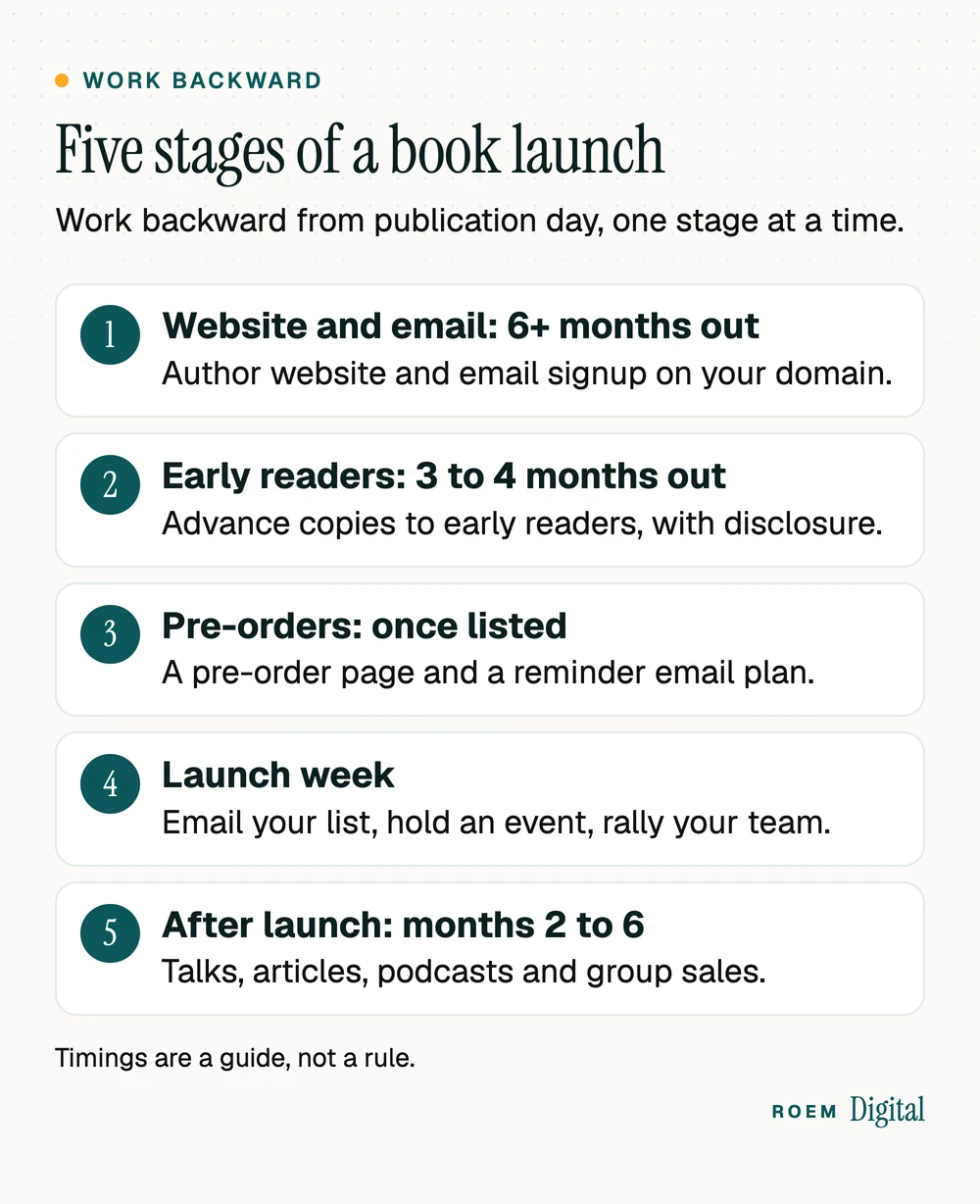
- Register your name as a domain, build an author website, and add an email signup with a reason to join, such as a free chapter. Our guide on how to choose a domain name covers the name question.
- Send advance copies to early readers who fit the book, with a short brief that includes the disclosure rules below.
- Once retailers list the book, put a pre-order page on your site and plan a few reminder emails.
- In launch week, email your list on release day, hold one event, and give your launch team the links and dates they need.
- Keep a steady schedule of talks, podcast interviews, articles and group sales for months after release.
If you have a publisher, ask early which of these stages its team handles and which are yours. Publishers often run advance copies, retailer listings and some publicity, while the author's website, email list and speaking calendar stay with the author. Either way, write down who owns each stage and its date, so nothing falls between you and your publicist in the final month.
The email list carries more weight than anything else in the plan, because it's the one audience you can reach on release day without paying a platform. Our guide to email marketing for small businesses covers building a list without buying one.
Pre-orders in 2026: what Kindle's longer window changes
If you self-publish through Amazon's Kindle Direct Publishing, the pre-order rules changed in 2026. KDP's help page on eBook pre-orders says you can set a release date up to 18 months in the future for pre-orders created on or after September 2, 2026, up from 12 months for pre-orders created before that date.
- Pre-orders are for new eBooks only. KDP says paperbacks and hardcovers can't be set up as pre-orders, but you can schedule a print release date.
- Deadlines are firm. KDP says you must submit your final manuscript at least 72 hours before release day. On your first KDP title, you must upload a manuscript when you create the pre-order and submit the final version at least 5 days before release.
- Missing the deadline costs you. KDP says your pre-order is canceled, customers who pre-ordered are notified and their orders are canceled, and your pre-order privileges may be removed.
A longer window isn't automatically better. A pre-order page that sits for a year with nobody telling readers about it does very little, and a date you can't hit puts your pre-order privileges at risk. Open pre-orders when your list is big enough to notice (and, on a first KDP title, when a manuscript is ready to upload), and set the date with room for edits. Tag every retailer link on your site with UTM parameters so you can see which emails and posts sent readers to buy.
Advance copies and reviews: the FTC rules a launch team has to follow
Free advance copies are the heart of your early reviews, and they come with disclosure rules. In the FTC's Endorsement Guides FAQ, the agency answers "yes" when asked whether a reviewer who gets a free product needs a disclosure, no matter how they got it. The test is whether readers would weigh the review differently if they knew the reviewer got the item free or at a substantial discount.
The same FAQ covers authors directly. Asked about a group of authors who agree to review each other's books, the FTC says those reviewers need to disclose the connection, and it notes that the need to disclose isn't limited to situations in which money changes hands. It also warns that asking for reviews only from customers you expect to be happy can mislead readers if it substantially skews how favorable the reviews look.
Put this in your launch team brief so nobody has to guess:
- Ask for honest reviews, not positive ones, and send copies to everyone on the team, not just your biggest fans.
- Give reviewers a disclosure line to use, such as "I received a free advance copy from the author."
- Skip review swaps, and have friends disclose. The FTC says authors who trade reviews must disclose the connection, and disclosure doesn't make a swap acceptable to retailers: KDP's customer reviews help lists reviews posted in exchange for compensation among the common reasons a review goes missing.
- Check each retailer's own review rules before launch week, because they can be stricter than the FTC's.
Not every review will be kind, and that's normal. Our guide on how to respond to negative reviews covers businesses, but for reader reviews of a book we'd usually let them stand rather than reply. This is general marketing information, not legal advice.
Copyright, permissions and when to call a publishing attorney
Your book is protected before you promote it. The U.S. Copyright Office's general FAQ says a work is under copyright the moment it's created and fixed in a tangible form, and that registration is generally voluntary. It adds that you'll have to register if you want to sue for infringement of a U.S. work, that registered works may be eligible for statutory damages and attorney's fees in successful litigation, and that registration within five years of publication counts as prima facie evidence in court.
Permissions are the other half. Launch graphics, trailers and social posts often borrow things the author doesn't own: song lyrics, long quotes from other books, photos found online, or a cover image licensed only for print. Use your own words and images, or get written permission before the campaign starts.
Talk to a publishing attorney before launch if you're signing a publishing or audiobook contract, quoting song lyrics or other copyrighted text, writing about real people in ways they might dispute, or planning a series name or imprint you want to protect. Ownership questions reach your marketing too: your domain, website and ad accounts should be in your name, as our guide to who owns your marketing accounts explains. This is general information, not legal advice.
How to market a book after launch week, when the first spike fades
Launch week gets the attention, but it's also when your warmest readers have already bought. The next problem is the quiet that follows, and in our view the books that keep selling are the ones whose authors keep showing up. Plan the long tail before launch, so it isn't improvised in week two.
| Idea | Best for | What to prepare before launch |
|---|---|---|
| Talks at churches, schools, clubs and conferences | Nonfiction with a clear audience | A speaking page with topics and a booking form |
| Podcast and radio interviews | Authors with a strong story or expertise | A media kit with bios, headshot and cover |
| Articles that answer readers' questions | Nonfiction readers searching for help | A list of the questions your book answers |
| Group and bulk sales | Small groups, book clubs and teams | A study guide and a way to order in bulk |
| Bookstore and library events | Local and regional authors | A short pitch and event-ready copies |
| A second format | Readers who prefer audio or print | Rights and files for the next edition |
Articles do double duty. A page on your site that answers a question your book answers can bring readers in for years, and the same clear answers can help your book show up in AI search tools. Our guide to AI search and generative engine optimization explains how. For live appearances, our event marketing ideas cover filling a room in the right order.
How ROEM helps authors plan and launch a book
We built the companion website for Practical Love, the relationships book by author Katonya BienAime. It's bright and inviting, it captures the book's voice, and it sends readers straight to purchase.

We're a small senior team based in Davenport, Florida, working with authors in Central Florida and nationwide by video. For a launch, that means a hand-built author site and book page through our brand and web service, an email signup with a real reason to join, a launch team page, a media kit, tracked retailer links and, when it makes sense, small ad tests. You own the domain, the site and the list. We don't promise sales or bestseller lists. See more of our work.
Frequently asked questions
When should a first-time author start marketing a book?
Start with your author website and email list as early as you can, ideally six months or more before publication, so you have readers to tell when pre-orders open. That timing is flexible, but an author who starts the list at launch has nobody to tell on release day.
How far ahead can I set up a Kindle pre-order?
Kindle Direct Publishing says you can set a release date up to 18 months in the future for eBook pre-orders created on or after September 2, 2026, and up to 12 months for pre-orders created before that date. You must submit the final manuscript at least 72 hours before release, or 5 days for a first title.
Can I put a paperback on pre-order through KDP?
No. Kindle Direct Publishing says pre-orders are available for new eBook titles only, and that paperbacks and hardcovers can't be set up as pre-orders. You can schedule a print release date instead. Point your pre-order page at the eBook and any retailers that do take print pre-orders.
Do reviewers who get a free advance copy have to disclose it?
Yes, according to the FTC's Endorsement Guides FAQ. A reviewer who receives a free product needs a disclosure no matter how they got it, and authors who swap reviews must disclose that too. Disclosure doesn't make swaps safe: KDP says reviews posted in exchange for compensation can be removed. Skip swaps and give your team a disclosure line.
Do I need to register my book's copyright?
Not to be protected. The U.S. Copyright Office says copyright exists from the moment a work is created and registration is generally voluntary. You must register before suing for infringement of a U.S. work, and registration within five years of publication counts as prima facie evidence. This is general information, not legal advice.
What should an author do after launch week?
Keep showing up for months. Book talks at churches, schools and clubs, pitch podcasts with a media kit, write articles that answer the questions your book answers, offer group copies with a study guide, and keep emailing your list. Plan these before launch so week two doesn't start from zero.