
Short answer: Musician marketing works when you own the way you reach fans: a website and an email list, then official artist profiles on every platform. Promote each song for weeks instead of one day, skip any service that sells streams or playlist spots, and know the two copyrights in every song before you promote covers or borrowed audio.
Musician marketing in plain terms: own the fans, rent the reach
Musician marketing is everything that turns a listener into a fan you can reach again: the person who joins your email list, comes to the next show, or invites you to their church or event. Streaming apps and social feeds bring people in. Your website and email list keep them.
If you want the short version of how to promote your music, it's this: claim your official profiles on the platforms you use, build a simple website with an email signup, promote each song for weeks instead of one day, play live whenever you can, and never pay anyone for streams. Everything below expands on that order.
| Channel | Who controls it | Its main job |
|---|---|---|
| Email list | You | Reaching fans on release day and before every show |
| Your website | You | One link with your music, story, dates and booking path |
| Spotify, Apple Music and YouTube profiles | The platform, with tools for you | Where people listen, and where editors and algorithms find you |
| Instagram, TikTok and Facebook | The platform | Discovery, clips and conversation, with reach that changes often |
| Live shows and services | You and the organizer | Turning listeners into fans who sign up |
| Local radio, press and podcasts | The outlet | Credibility and new audiences, usually around a release or event |
Our musician and artist marketing page covers the build side in depth: the artist website, the electronic press kit, booking forms, platform profiles and release pitching. This post covers the rhythm of promotion, the traps that can cost you royalties, and the copyright basics most music marketing guides skip.
Promote each song for a month, not a day
Most independent artists announce a release once, post about it twice, and move on. We'd argue that's backward. A song that's new to you after months of work is still new to almost everyone else on release day. So give each song a month, and give each week one job.
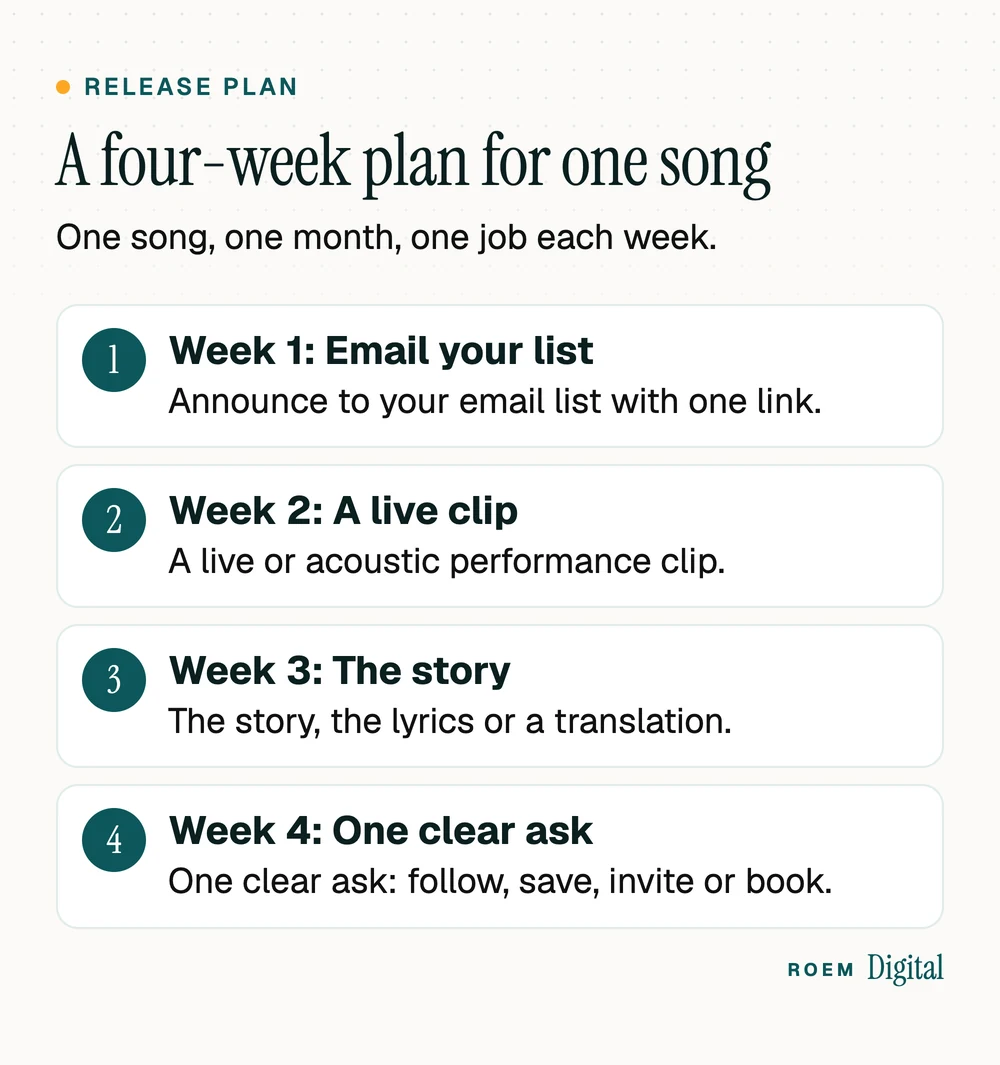
- Week 1. Email your list first, then post everywhere with one link to a page on your own site that lists every platform.
- Week 2. Post a live, acoustic or rehearsal performance. People who skipped the studio version often stop for a person playing it.
- Week 3. Share the story behind the song, the lyrics, or a translation if you sing in more than one language.
- Week 4. Make one clear ask: follow, save, share, invite you to an event, or book you. One ask, not five.
Then pick an older song and run the plan again. Your catalog is promotion you already paid for, and a fan who finds you today hears last year's single for the first time. Keep an eye on what each week does to follows, email signups and booking inquiries, not just plays. Our guide to the marketing numbers worth watching explains how to keep that report short, and our explainer on the Instagram algorithm covers how Instagram decides who sees your posts.
How to promote your music without paying for fake streams
Sooner or later, an email or a direct message will offer guaranteed streams or playlist placements for a fee. Spotify's own artificial streaming guide calls these offers scams that should be avoided, and says many of these services use bots to stream a song on repeat to inflate the count. It also says some services charge money to be "considered" for user playlists without guaranteeing placements, and tells artists to be highly skeptical of them too.
The penalties land on the artist. Spotify says it strictly prohibits using any third-party service that promises streams or playlist placement in exchange for money. When it identifies confirmed artificial streaming, it says it may withhold associated royalties, correct public streaming numbers and, depending on severity, remove tracks from Spotify playlists. It also charges labels and distributors per track when flagrant artificial streaming is detected on their content.
- Don't ask fans to stream on loop. Spotify says you should actively discourage inorganic looping and coordinated efforts to stream your music inauthentically.
- Vet any promoter. Spotify suggests asking about their methods and checking reviews from artists who worked with them.
- Spend the money where you can see the result instead: a small ad that sends people to your own page, where you can count signups.
Paid ads aren't the problem, as long as real people choose to listen. An ad that shows your performance clip to people who like similar artists, and sends them to a page you own, is ordinary marketing. If you test them, track them like any other campaign. Our guide to UTM parameters shows how to tag the link so you know which ad sent real fans.
Music marketing and copyright: two copyrights in every song
Every recorded song carries two copyrights. The U.S. Copyright Office's Circular 56A says sound recordings and musical compositions are two separate works: the composition is the music and lyrics, and the sound recording is a recorded performance of it. A registration for one doesn't cover the other.
That matters the moment you promote anything you didn't write and record yourself:
- Cover songs. The Copyright Office's Circular 73 explains the compulsory license, also called the mechanical license, for making and distributing recordings of songs already released in the US. You serve a Notice of Intention and pay royalties. You can't change the basic melody or character, or claim copyright in your arrangement, without the owner's permission. The license covers audio releases only: Circular 73 says a phonorecord doesn't include sounds accompanying an audiovisual work, so a cover posted as a video needs permission from the song's copyright owner.
- Someone else's recording in your video. Circular 73 says licenses generally have to be obtained separately from the owners of the sound recording and the underlying composition. A clip of a hit song behind your rehearsal video needs both.
- Co-writes. Agree in writing who wrote what before the song is released, so splits and registrations match.
When to talk to a music attorney
Get advice before you sign a distribution, publishing or management deal, release a cover or a sample-based track, settle co-writing splits, or receive a takedown or claim on your music. If your platforms and accounts are tied up with a former manager or label, our guide to who owns your marketing accounts shows what to check first. This is general information, not legal advice.
Your musician website: the one link that outlasts every platform
Profiles come and go, and so do the rules for who sees your posts. A musician website on your own domain is the link you can put on every profile, poster and merch tag for years. It doesn't need to be large. It needs to answer three visitors fast: a new fan who wants to listen, an organizer who wants to invite you, and someone who wants to hear from you again.

A link-in-bio page from a third-party tool is better than nothing, but it's rented the same way your profiles are. A page on your own site can carry your email signup, your booking form and your tracking, and it keeps working if the tool changes its prices or its rules. Start with four pages: listen, story, invite or book, and join the list. Add a press kit and a shop when you need them.
If your audience lives in two languages, your site should too. Elizabet Maria, a Central Florida worship artist, ministers in Spanish and English, and her site lets visitors switch languages from the header. That's a different job from adding a translate button. Our guide to bilingual websites covers how to do it well, and our bilingual marketing service covers the rest of the plan in both languages.
Local music marketing: turn every show into email signups
Live shows are still where strangers become fans, and most of those fans leave without a way to hear from you again. Close that gap at every show, service or event:
- Say it from the stage. One sentence near the end: where to sign up and what they'll get, such as early listens or show dates.
- Put a QR code on the merch table that opens your email signup, tagged so you know which show it came from.
- Ask organizers for photos and permission to use them. Event photos, credited to the photographer, make your gallery, your press kit and your next invitation stronger.
- Send a thank-you email within a few days with the song you closed with and the next date.
- Follow up with whoever booked you. A short thank-you to the pastor, worship leader or promoter, with a photo from the night, is often how the second invitation starts.
Our event marketing ideas cover how to fill the room in the first place, from the people who already know you outward.
How ROEM helps musicians and worship artists
We're a small senior team based in Davenport, Florida, working with artists across Central Florida and nationwide by video. For a musician, that usually means a hand-built site with your music, story and booking path, an email signup with a reason to join, pages in English and Spanish when your audience needs both, and tracking that shows which songs, posts and shows bring in fans and invitations. You own the domain, the site and the list. See more of our client work.
Frequently asked questions
How can independent musicians promote their music for free?
Start with what you own: a simple website, an email list and official artist profiles. Promote each song for several weeks with a performance clip, the story behind it and one clear ask. Collect email signups at every show, and reuse older songs, because new fans hear your catalog for the first time.
Are paid Spotify playlist promotion services worth it?
Not the ones that sell streams or placements. Spotify says it strictly prohibits third-party services that promise streams or playlist placement in exchange for money, and that confirmed artificial streaming can lead to withheld royalties and tracks removed from playlists. Spend that money on ads that send real people to your own page.
Can I ask fans to stream my song on repeat?
Ask them to listen, not to loop. Spotify says artists should encourage fans to listen but actively discourage inorganic looping and coordinated efforts to stream music inauthentically, such as tips for avoiding detection or using extra accounts on a family plan. A save, a share or a show ticket is worth more.
Do I need permission to release a cover song?
You need a license for the song. The Copyright Office's Circular 73 explains the compulsory mechanical license for audio releases of songs already released in the US: you serve a Notice of Intention and pay royalties. It doesn't cover video versions, which need the owner's permission. This is general information, not legal advice.
Is a recording copyrighted separately from the song itself?
Yes. The U.S. Copyright Office says musical compositions and sound recordings are two separate works. The composition is the music and lyrics, and the sound recording is a recorded performance of it. Registering one doesn't cover the other, and using someone else's recording usually needs licenses from both owners.
Should a bilingual artist have a website in both languages?
If your fans and the people who book you speak both languages, yes. Write each page for its own audience rather than leaning on an automatic translate button, and let visitors switch languages from any page. Keep song titles, release dates and booking details identical in both versions.