
Short answer: IT company marketing works best when a small MSP picks one kind of client, offers a low-risk first step such as a scoped assessment, and publishes plain answers to the security questions buyers are told to ask. Referral partners and a clear website carry the rest, and every security claim has to be one you can prove.
IT company marketing starts with one kind of customer
IT company marketing is how a managed service provider or IT shop gets in front of the businesses that need it, earns enough trust for a first project, and turns that project into a monthly plan. For a small MSP, the hardest part isn't getting noticed. It's being trusted with a stranger's network.
The short answer for managed service provider marketing: pick the kind of business you serve best, offer a scoped first step instead of asking for a contract, publish your security practices before buyers ask, and build referral relationships with the people your clients already trust. Then measure business inquiries separately from repair calls, so you know which side is growing.
Our IT services marketing page covers the website and search side: service pages, honest pricing, local search, call tracking and Google Ads for repair shops and MSPs. This post covers the business-to-business sale that sits on top of it.
MSP marketing in small steps: from a single fix to a monthly plan
Most MSP marketing asks a stranger to sign a monthly contract on the first visit. That's a big jump for an office manager who has never seen your work. A better approach breaks the sale into smaller steps and markets only the next one.
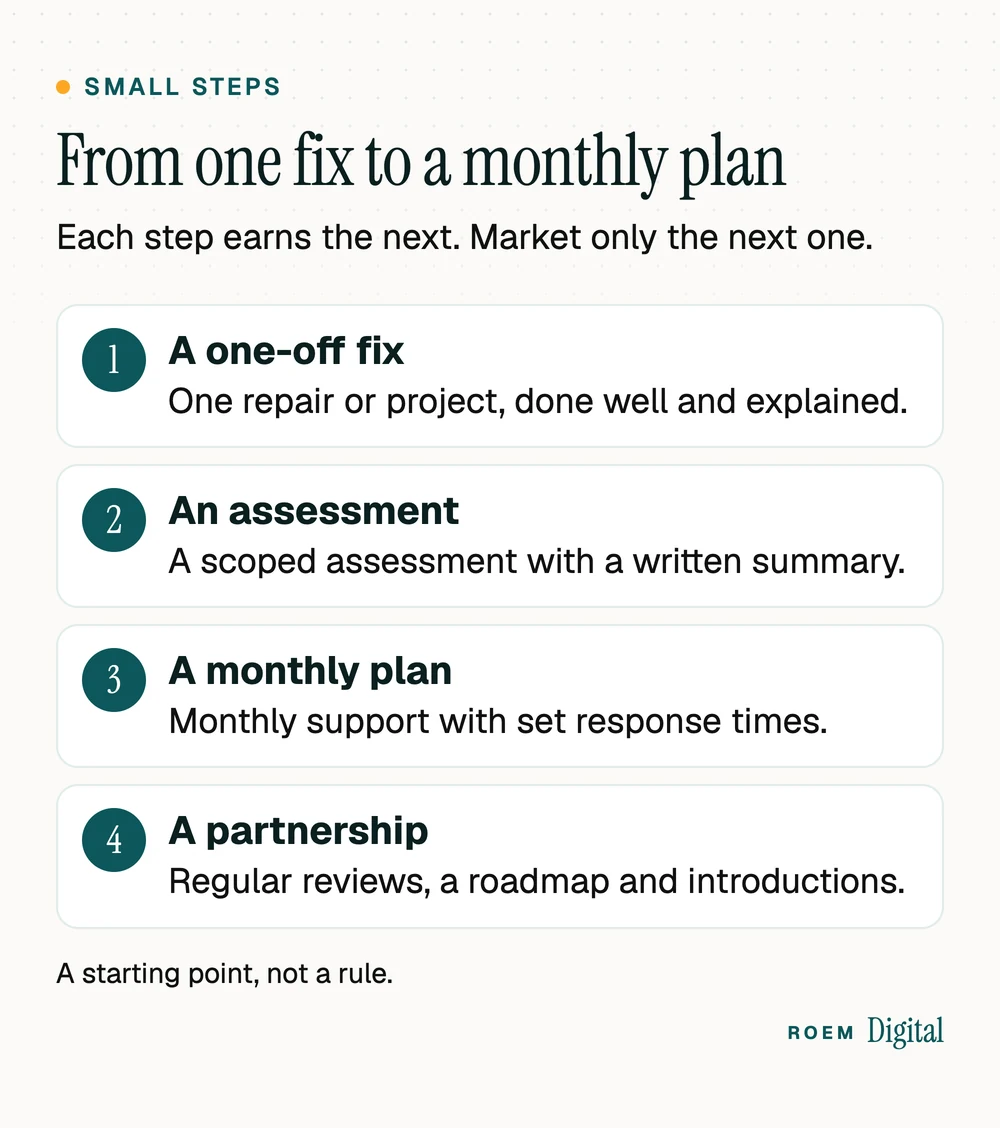
| Step | What you offer | What moves them up |
|---|---|---|
| A one-off fix | A repair, a move, a new laptop setup, a Wi-Fi problem solved | A plain-English summary of what you found and what else you noticed |
| An assessment | A scoped assessment: what you'll check, how long it takes and what they get | A written report with priorities, not a sales pitch |
| A monthly plan | Monthly support with stated response times and who answers | Onboarding that's described step by step before they sign |
| An ongoing partnership | Regular reviews, budgets and a roadmap | Results they can explain to their own boss, and introductions you ask for |
If you already run a repair counter or take one-off projects, the first step is full of people who have seen your work. Ask every business customer you've done a fix for whether they'd like an assessment, and say what it checks. A business owner whose laptop you rescued last month is a warmer lead than any ad click.
The assessment does the most work. A defined assessment gives a cautious buyer something small to say yes to, and it gives you a look at their environment before you price a plan. Make its scope specific on your site, and track assessment requests as their own conversion. Our guide to the marketing funnel shows how to measure each step, and our guide to the marketing numbers worth reporting keeps the monthly report to the few that matter: assessment requests, assessments completed, plans signed and where each one came from.
MSP marketing works better when you pick a vertical
"Managed IT for small businesses" describes thousands of companies. "IT for dental offices in our county" or "IT for accounting firms" describes a few, and the buyer can tell in one line that you understand their world. The SBA's market research and competitive analysis guide puts it simply: market research helps you find customers, and competitive analysis helps you make your business unique. It also says your competitive analysis should identify the competition by product line or service and by market segment.
Choosing a vertical isn't turning everyone else away. It's deciding who your website, examples and referral partners speak to first. Good signs that a vertical fits you:
- You already have two or three happy clients in it
- You know the software they run every day, not just the hardware
- There are enough of them within your service area
- Their advisers, such as accountants or industry associations, could refer you
Then write for that buyer. A page about IT for law offices should talk about their case software, their remote staff and the days they can't afford downtime, in their words. Our guide to keyword research for small businesses shows how to find the terms that buyer actually searches.
A strong vertical page answers four things in order: the problems that kind of office runs into, the software and devices you already support for them, what your first step (the assessment) checks for their setup, and an example from a client like them, described with permission. If you can't write the last part yet, that vertical can wait until you can.
Security marketing for IT companies: answer the checklist, skip the scare tactics
Government security agencies have told MSP customers what to check in their provider. A joint cybersecurity advisory from CISA, the NSA, the FBI and cybersecurity agencies in the UK, Australia, Canada and New Zealand (May 11, 2022) tells MSP customers to verify that their contracts include cybersecurity measures that fit their requirements. Its list of actions to take today includes disabling accounts no longer in use, enforcing multifactor authentication on MSP accounts that access the customer's environment, and making sure contracts clearly say who owns which security roles.
Turn that into marketing. Publish a plain security practices page that answers those questions about your own shop before a prospect asks. A buyer comparing three providers will notice the one that answered in writing. Cover at least these:
- Remote access: that multifactor authentication is required whenever your technicians sign in to client systems, without naming the tools or settings you use
- Accounts: how you remove access when a client's employee or one of your own technicians leaves
- Backups: how often you test a restore, and that backups are kept separate from the client's network
- Incidents: who calls whom, how fast, and what the client should do first
- Responsibilities: which security tasks are yours and which stay with the client, matching your agreement
Describe controls, not configurations. The page should reassure a buyer without handing an attacker your tool list. Link it from your plan pages and your assessment page. It belongs on the short list of pages every service business website needs, and for an IT company it may be the one a careful buyer reads twice.
What you can't do is promise more than you can prove. The FTC's advertising FAQ for small businesses says advertising must be truthful and non-deceptive, and that the law requires advertisers to have proof before the ad runs, for implied claims as well as express ones. Leave out lines like "hack-proof", "100% secure" or "guaranteed compliance". Describe what you do and how you check it. This is general marketing information, not legal advice.
Where small MSPs find business clients: referral partners and relationships
Business owners rarely search for a new IT provider out of curiosity. They ask someone they trust. Your marketing should make it easy for those people to send you work:
- Accountants and bookkeepers, who see every client's software headaches
- Office equipment and phone vendors, whose installs often uncover network problems
- Insurance brokers who sell cyber coverage and want clients who can meet its requirements
- Commercial landlords and coworking managers, who field tenants' first questions
- Other IT providers, who pass on jobs too small or too far from them
Give each partner type a short page on your site that explains what you do for their clients and how a referral is handled, then track referrals by partner. Reply to a referred lead the same day, because a slow answer reflects on the partner who sent them too, as our speed to lead guide explains. Referrals sit in the "earn" column of our lead generation guide, next to reviews. Show up where those partners meet, too: a local chamber of commerce, a business networking group or the association for the vertical you chose. A short talk on one practical topic, such as spotting invoice scams, does more than a booth. On LinkedIn, we'd start with the owner's own profile rather than the company page: post what you fixed this month in plain English, and connect with the partners above.
When to bring in an attorney or compliance professional
Marketing and contracts meet in IT more than in most trades. Talk to an attorney before you publish service-level promises, response-time guarantees or contract terms on your site, and have your standard agreement reviewed so the security responsibilities it assigns match what your marketing says. If you plan to market compliance help for a regulated industry, such as healthcare, finance or schools, work with a compliance professional who knows that industry's rules, and describe your role accurately: you support a client's compliance program, you don't certify it.
If you're unsure how to scope the offer itself, our consulting and startup strategy service helps owners shape what they sell before we market it.
How ROEM helps IT companies and MSPs market themselves
We built the website for Witter Tech, an independent tech repair and IT support business in Central Florida. The site leads with transparent pricing and plain-English service breakdowns, so a visitor knows how the job will be quoted before they call.

We're a small senior team based in Davenport, Florida, working with clients across Central Florida and nationwide by video. For an IT company, that means a hand-built site with separate paths for repair customers and business buyers, a scoped assessment page, a security practices page in plain English, and calls and forms tracked by source before any ad spend, as our guide to call tracking explains. You own the domain, the site and every account. See more of our client work.
“Working with ROEM Digital has been a great experience for my business. From developing our website to guiding us through a complete rebrand, they took the time to understand my vision and bring everything together in a way that truly represents the business. What I’ve appreciated most is their continued support. They’ve remained responsive, reliable, and willing to help whenever needed. That level of commitment goes a long way, especially as a business owner. I’d highly recommend ROEM Digital to anyone looking to establish or strengthen their brand. Having a great website is important, but having the right people behind it makes all the difference.”
Frequently asked questions
What is MSP marketing?
MSP marketing is how a managed service provider attracts business clients and turns them into monthly support customers. For a small MSP it usually means a clear website, a defined first offer such as an assessment, referral partners, a security practices page and tracking that separates business inquiries from one-off repair calls.
How do small MSPs get new clients?
Mostly through trust. Ask happy clients for introductions, build relationships with accountants, insurance brokers and office equipment vendors, and give cautious buyers a small first step such as a scoped assessment. Support that with a website that explains your plans and onboarding, and a Google profile with reviews from business clients.
Should an MSP specialize in one industry?
It often helps. A vertical lets you speak the buyer's language, show examples from businesses like theirs and build referral partners in that industry. Pick one where you already have happy clients and know the software they use. You can still serve others while your marketing speaks to that group first.
Can an IT company advertise that it makes a business secure?
Be careful. The FTC says advertising must be truthful and non-deceptive and that advertisers need proof before an ad runs, including for implied claims. Avoid absolute promises like hack-proof or guaranteed compliance. Describe the specific practices you follow and how you check them. This is general information, not legal advice.
What security questions should an MSP be ready to answer?
A 2022 joint advisory from CISA and allied agencies tells MSP customers to check that contracts include cybersecurity measures, and lists actions such as disabling unused accounts, enforcing multifactor authentication on MSP accounts and spelling out security roles. Answer those on your website before a prospect asks.
What should a free IT assessment include?
A defined scope stated in advance: which systems you'll review, how long it takes, what access you need and what the client receives. End with a short written report that ranks the risks in plain English. Keep it useful even if they never buy, because that's what earns the next conversation.